

Law Firms Use Tech to Cut Administrative Work
Law firms use tech like case management tools, automation, and AI to minimize administrative work, simplifying billing, documents, and client data.
Lawyers focus on spending their time advising clients, practicing law, preparing cases, and solving tricky issues. However, a surprising portion of their day can disappear into tasks that have very little to do with legal strategy.
They deal with piles of documents which they have to organize, emails which they have to answers, appointments left to schedule, deadlines that need tracking, forms that are pending, unprepared invoices, and most importantly, they have to fill client data into distinct platforms. Lawyers cannot simply ignore these tasks. They are part of running a law firm. However, when administrative work starts taking over the day, it becomes quite difficult for the attorneys and their teams to concentrate on the actual work that clients pay for.
That is one key reason law firms use tech more.
The objective is not only to automate all tasks or decrease the number of people in the process. In the majority of cases, it is, in fact, much simpler. Firms looking for methods to minimize routine tasks, more effectively organize data, and make routine processes simpler to manage.
For busy legal practice, such small enhancements can make a lot of difference.
The Administrative Burden Behind Legal Work
Legal work generates a tremendous amount of information.
A single cause might have hundreds of emails, court documents, contracts, billing records, notes, deadlines, correspondence, and dozens of other pieces of data. As the number of cases increases, tracking everything manually becomes impractical.
Many law firms still depend on a mixture of spreadsheets, emails, paper files, shared folders, and individual applications to ensure that things keep moving.
There is nothing wrong with such tools fundamentally. The issue is that they generally work separately.
An employee may get data through emails, update a spreadsheet, save it to a shared folder, and then enter the same data into another platform. Someone else may have to check whether the data was correctly entered or not.
This creates what could be called administrative friction.
The work is completed. However, it takes a lot more time as well as effort than it should.
Also Read: Where Law Firms Lose Time and Legal Practice Management Software Fixes It
Automation Can Manage the Routine
One of the most obvious ways technologies can reduce administrative work is through automation.
Consider what really happens when a new client comes in contact with a firm.
Someone may want to collect contact data, ask initial questions, ask preliminary questions, create a case, assign tasks, notify relevant team members, and schedule follow-ups.
When every step is manually managed, you cannot always stop something to be overlooked or delayed.
Automated workflows can handle predictable aspects of that process.
For example, data submitted through digital intake form can be utilized to start the next steps automatically. A new matter can trigger tasks for specific employees. Reminders can be created without someone having to enter them manually.
The lawyer still makes the important decisions. The technology simply handles some of the administrative steps surrounding those decisions.
That distinction is important.
Good automation is not about removing human judgment. It is about making sure human attention is reserved for the things that actually require it.
Better Case Management Means Less Searching

Few things are more frustrating than knowing a document exists but not being able to find it.
Law firms can accumulate enormous amounts of information over the life of a matter. If files are stored in different locations, employees can spend considerable time searching through folders, email threads, and old documents.
Case management technology can bring important information together.
Instead of finding in different places case notes, contact details, communication, and documents of the client, employees can access such details through simplified matter records.
This saves you more time than spending a few minutes here and there.
Imagine you have a team of ten people spending 20 minutes/day searching for a data. During the week, this adds up to more than 16 hours of staff time. Over the year, this lost productivity becomes much more difficult to ignore.
Technology can minimize that waste by making data simpler to locate.
Documents Are Another Major Time Sink
Legal professionals constantly work with documents.
Drafting, editing, reviewing, sending, signing, and organizing documents can consume a considerable amount of time during workdays. A lot of this work is extremely repetitive.
Document automation can help.
Instead of developing common documents from the beginning, firms can make use of templates that populate standard data automatically. Dates, names, matter details, addresses, and other fields can be inserted into relevant places.
This does not imply that each legal document must be created without any review. Lawyers still have to assess the substance and ensure that the document aligns with particular circumstances.
The main difference is that they no longer need to spend as much time performing routine data-entry and formatting work.
That can be specifically crucial for firms that manage huge volumes of similar cases.
Also Read: Data Labeling Vs OCR: What Legal Tech Companies Need Most?
Billing Does Not Have to Be a Manual Chore
Administrative work also affects the financial side of a law firm.
Time needs to be recorded. Expenses need to be associated with matters. Invoices need to be prepared and sent. Payments must be tracked.
When these processes depend heavily on manual entry, mistakes can happen.
A lawyer may forget to record a short client call. An employee might enter information incorrectly. An invoice can be delayed since someone is waiting for another piece of data.
Technology can simplify many of these steps.
Time tracking platforms can make it simpler to record billable work as it happens. Billing systems can use matter information to create invoices more efficiently. Automated reminders can help teams follow up on outstanding payments.
The result is not just less administrative work. It can also mean better visibility into the firm’s finances.
Client Communication Can Become Easier
Related walkthrough
Robots Are Learning to Work Like Humans


Clients often do not care what kind of tool a law firm utilizes.
They are concerned about the response of their lawyer, whether they know what is going on, and whether they are sure that their matter is being managed properly.
Technology can align with such expectations.
Secure messaging, client portals, digital document sharing, and automated notifications can minimize a few of the back-and-forth that conventionally happens through phone and email calls.
A client can directly upload a document to a secure portal instead of sending an attachment that someone later needs to rename, download, and save.
Repetitive updates can also be automated wherever appropriate.
That does not replace personal communication. In fact, it can make personal communication more valuable because lawyers and staff have fewer routine administrative requests competing for their attention.
AI Is Adding New Possibilities
AI is further taking this trend.
AI tools can aid in organizing data, summarizing documents, recognize relevant details, create specific types of content, and help with other routine knowledge work.
For legal teams, this can be specifically valuable since the bulk of the professional revolves around working and reading large volumes of text.
Imagine getting detailed document collection and have to understand important points before a meeting. An AI platform must be able to ensure a preliminary summary, allowing the lawyer to be more quickly oriented.
That does not imply that the lawyer has to blindly accept the outcome.
Legal work needs context, accuracy, and professional judgement. AI-driven data must be carefully reviewed, specifically when it impacts the client’s case.
When it is utilized responsibility, however, AI can reduce the amount of time spent on some of the more tedious parts of legal work.
Integration Matters More as Firms Grow
Adding more technology is not automatically the answer.
In fact, a new administrative hurdle can begin to take shape when a firm adopts too many disconnected tools.
If a single application manages intake, another one manages documents, another one handles billing, and another keeps track of cases; employees might end up spending their time and effort moving data between such systems.
That is why integration matters.
An enterprise legal platform can tether distinct facets of the operations of the firm, enabling data to naturally move between matters, intake, workflows, documents, billing, and reporting.
The objective is to generate lesser gaps between processes.
A lawyer should not have to ask three different people where a document is stored. A staff member should not have to enter the same client information five times. A manager should not have to build a complicated spreadsheet simply to understand the firm’s workload.
Connected systems can make those situations less common.
Technology Can Help Firms Grow Without Adding Equal Administrative Costs
One of the biggest reasons firms are paying attention to technology is growth.
Taking on more clients is obviously good for business. But growth also creates more administrative work.
If every additional matter requires the same amount of manual effort, staffing needs can increase rapidly.
Technology can help break that relationship.
A firm may be able to manage a huge workload with its present team if routine activities become more efficient. Employees can spend significantly less time entering information and more time dealing with different exceptions, providing support to attorneys, and communicating with clients.
This does not imply that technology completely replaces the manpower.
Sometimes recruiting more people is the best decision. However, firms now have another question they need to ask before instantly including headcount: can the current process be improved?
That question can lead to meaningful savings.
The Human Element Still Matters
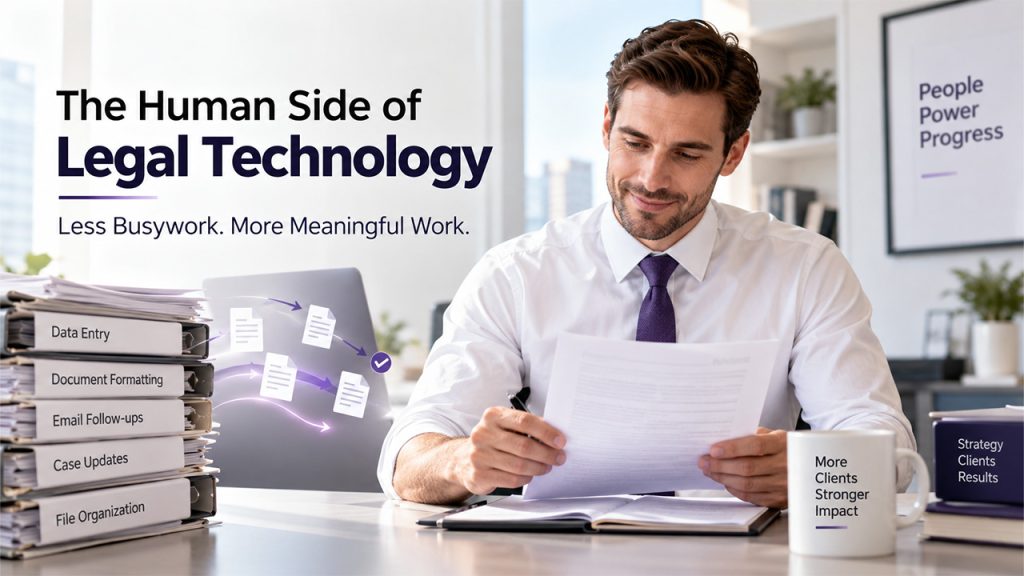
There is a tendency to describe legal technology in terms of speed and productivity, but there is another benefit worth considering.
Less administrative work can make the job more manageable.
Law is already demanding. Switching between tasks constantly, responding to repetitive requests, and tracking dozens of small responsibilities can add fatigue and frustration.
Technology can take some of that burden away and enable employees to spend more time on strategic and quality work.
Attorneys can emphasize legal strategy and clients. Paralegals can spend more time supporting cases. Administrative staff can concentrate on issues that require actual attention rather than repetitive data entry.
In that sense, technology is not just about doing more.
It is also about creating a better way to work.
A Practical Approach to Legal Technology
Law firms do not need to transform everything at once.
A better approach is to identify the areas where administrative work causes the most problems.
Maybe employees spend hours searching for documents. Maybe intake is slow. Maybe billing takes too long. Maybe attorneys repeatedly perform the same administrative tasks.
Start there.
Find the process that wastes the most time, then look for a tool that addresses the problem without creating unnecessary complexity.
Training is important too. Even top technology will not be able to deliver much value if employees do not have knowledge of how to use it.
The right systems must eventually feel as if they are part of the normal workflow of the firm instead of another chore.
The Bottom Line
Administrative work always becomes a part of operating a law firm. There will always be documents to handle, clients they can communicate with, deadlines they can keep track of, and bills they can send.
The core difference is that firms no longer need to manually manage all such tasks.
Technology can automate repetitive processes, sort data, enhance communication, simplify billing, and assist employees to find what they require much more quickly. AI can further take that ahead by helping data-heavy tasks that once needed substantial volume of human time.
The firms that benefit most will not necessarily be the ones with the most technology. Firms that mindfully use this technology will benefit the most from it.
The goal is quite straightforward: remove redundant friction so lawyers as well as their teams can spend a lot of time doing the work that needs judgment, experience, and a human touch.
For a modern-day law firm, that might be one of the intelligent investments it can ensure.