
Data Labeling vs OCR: What Legal Tech Companies Need Most
Discover how legal tech companies use Data Labeling vs OCR to improve document processing, automate workflows, enhance accuracy, and manage legal data efficiently.
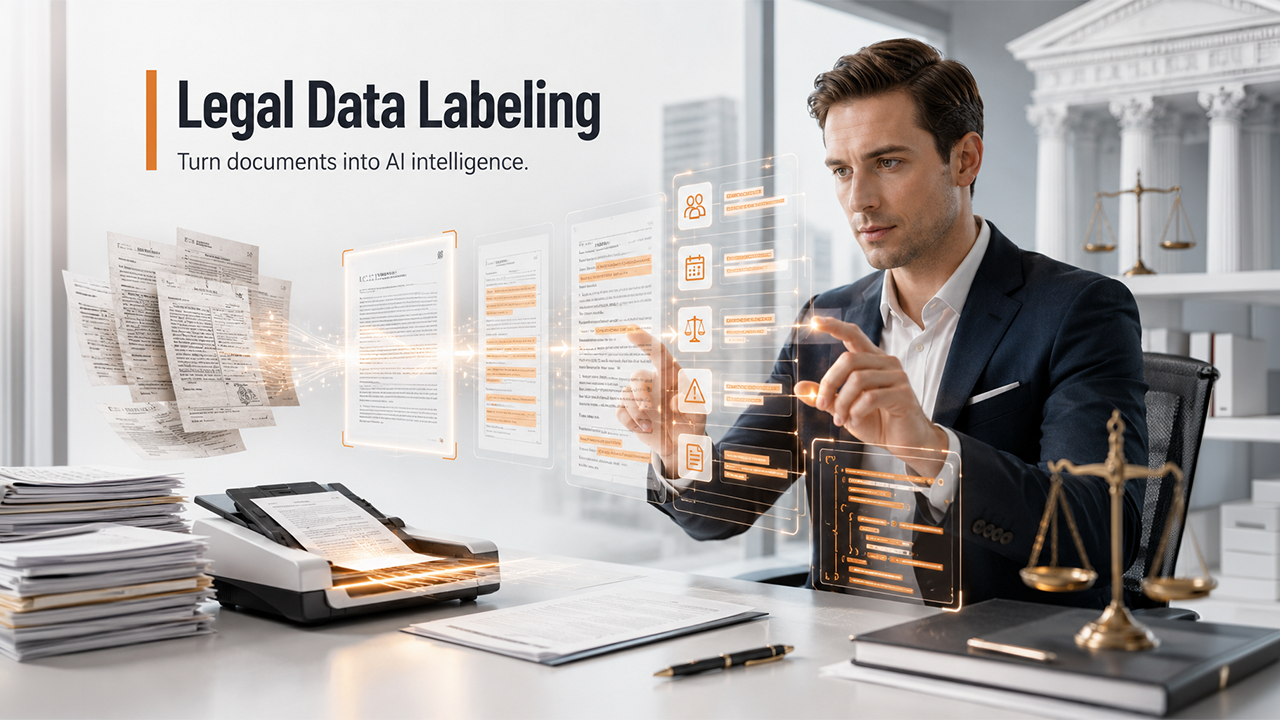
OCR (Optical Character Recognition) converts scanned legal documents into machine-readable text. Data labeling structures and annotates that text so AI models can understand it. Legal tech companies building intelligent document review, contract analysis, or predictive coding tools need both — but data labeling is the critical differentiator that separates a functional AI system from a genuinely intelligent one.
Introduction: The Document Problem Sitting at the Heart of Legal AI
The global legal AI market was valued at $1.9 billion in 2024 and is projected to reach $7.4 billion by 2035, growing at a compound annual rate of 13.1% (GM Insights, 2025). Yet beneath that headline figure lies a bottleneck that most legal tech companies encounter within the first few months of building: the raw document problem.
Law firms generate and process an extraordinary volume of unstructured documents — contracts, court filings, depositions, briefs, NDAs, regulatory submissions, and correspondence — and the majority of this content still exists in formats that AI systems cannot inherently understand. Scanned PDFs. Handwritten annotations. Tabular clauses embedded in dense paragraphs. Documents whose meaning depends entirely on their legal context, not just their words.
As of 2026, 79% of legal professionals report using AI tools, and NLP is expected to contribute 35.7% of total legal AI market revenue in 2025. But here is the gap most vendors miss: none of those AI tools perform intelligently without high-quality training data behind them. That training data requires two distinct processes — OCR and data labeling — and conflating them is one of the most common and costly mistakes in legal tech development.
This article cuts through the confusion. We compare OCR and data labeling head-to-head, explain what each does (and cannot do) for legal applications, and give legal tech companies a clear decision framework for knowing when to prioritize which.
What Is OCR and What Does It Actually Do for Legal Documents?
Optical Character Recognition (OCR) is a technology that converts images of text — whether scanned documents, photographs, or PDF renders — into machine-readable characters. It has been the foundational technology for document digitization in legal workflows for over two decades.
How OCR Works in a Legal Context
When a law firm scans a 200-page commercial agreement, OCR is the layer that transforms that image into text a computer can read. Modern OCR engines use deep learning and transformer-based architectures to recognize characters, words, and basic layout structures like columns, headers, and paragraphs.
OCR accuracy for printed text has reached 98–99% in 2025, driven by advances in AI model architectures including transformers and multimodal systems like LayoutLM. For clean, printed legal documents, OCR is reliably accurate and fast.
What OCR Cannot Do
Here is where the limitations become critical for legal tech:
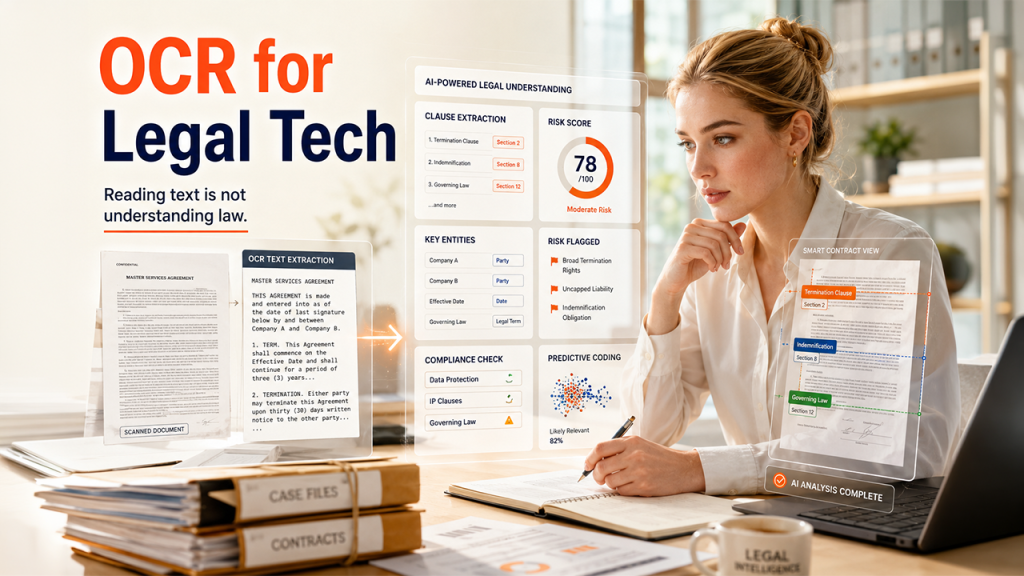
- OCR reads text. It does not understand it. It will extract the words in a liability clause but cannot identify that it is a liability clause, what party it binds, or how it interacts with an indemnification clause on page 47.
- OCR struggles with legal document structure. Courts filings, contracts, and regulatory documents contain nested hierarchies — sections within schedules within exhibits — that standard OCR cannot semantically parse.
- OCR fails on handwritten annotations. A 2024 study found that top LLMs significantly outperformed state-of-the-art OCR models on difficult handwriting, producing far fewer errors. This is critical for legal documents where handwritten margin notes and signature blocks carry legal weight.
- OCR produces no labels. The output is raw text — a wall of characters with approximate positional coordinates. That output must be structured and annotated before any AI model can learn from it.
What Is Data Labeling and Why Does Legal AI Depend on It?

Data labeling (also called data annotation) is the process of tagging, classifying, and structuring raw document content so that machine learning models can recognize patterns, learn from examples, and make accurate predictions.
If OCR gives you text, data labeling gives you meaning.
What Data Labeling Produces for Legal Documents
A properly labeled legal document does not just contain the text of a clause — it contains structured metadata identifying:
- Document type (NDA, MSA, employment agreement, court filing)
- Section hierarchy (section header → clause → sub-clause → defined term)
- Entity labels (Party A, Party B, effective date, governing law jurisdiction, payment amount)
- Clause classification (liability, indemnification, termination, confidentiality, dispute resolution)
- Semantic relationships (this indemnification clause references the definitions in section 1.3)
This structured, labeled output is what AI models are trained on. Without it, there is no contract review AI, no predictive coding system, no clause extraction tool. Platforms designed specifically for data labeling for law firm workflows have emerged to solve this exact bottleneck, bringing auto-annotation capabilities that cut weeks of manual effort down to minutes.
For legal tech companies looking to build or fine-tune their AI pipelines, data labeling for law firms has become the most time-sensitive investment in the entire development stack.
The Labeling Bottleneck Is Real
Data preparation traditionally consumes 60–80% of total ML project time. For legal documents, the burden is heavier because legal language is domain-specific, jurisdiction-sensitive, and context-dependent. A “default” label that means one thing in a consumer contract means something entirely different in a cross-border M&A agreement.
This is why legal-domain-specific labeling platforms — rather than general annotation tools — have become a prerequisite for serious legal AI development.
OCR vs Data Labeling: Head-to-Head Comparison
The table below maps OCR and data labeling across the dimensions that matter most to legal tech developers, product managers, and law firm CTOs evaluating their AI pipeline investments.
Feature Comparison Table
| Dimension | OCR | Data Labeling |
| Primary Function | Text extraction from images/scans | Structuring and tagging extracted content |
| Output Format | Raw text + approximate coordinates | Structured JSON with labels, entities, relationships |
| AI Training Value | Low (raw input only) | High (training-ready ground truth) |
| Legal Domain Understanding | None — language-agnostic | Domain-specific (legal models available) |
| Printed Text Accuracy (2025) | 98–99% | Depends on annotation quality and domain model |
| Handwritten Content | Poor to moderate | Strong with domain-expert annotation |
| Table & Structure Handling | Moderate (layout models improving) | Strong with structured labeling |
| Semantic Understanding | None | Core capability |
| Clause Classification | ❌ Not possible | ✅ Core use case |
| Named Entity Recognition (NER) | ❌ Not possible | ✅ Direct application |
| ML Framework Compatibility | Varies | PyTorch, TensorFlow, HuggingFace (direct) |
| Time to Deploy (Basic) | Hours | Days–Weeks (first dataset) |
| Cost Profile | Per-page API pricing | Per-document annotation or tool subscription |
| Scales Independently? | ✅ Yes | ✅ Yes (auto-labeling accelerates scale) |
Performance Comparison: What the Data Says
The following data points reflect 2024–2025 benchmarks across legal document processing tasks. They are drawn from industry research, academic benchmarks, and reported platform performance.
Accuracy Across Legal Document Tasks
TASK | OCR ALONE | OCR + DATA LABELING
——————————-|———–|———————
Text Extraction (printed) | 98–99% | 98–99%
Text Extraction (handwritten) | 55–72% | 78–91%*
Clause Identification | N/A | 88–95%
Named Entity Recognition | N/A | 85–93%
Document Type Classification | N/A | 91–97%
Table Extraction (structured) | 70–82% | 88–96%
Contract Risk Flagging | N/A | 82–90%
*With LLM-assisted post-correction and domain annotation
Sources: Benchmark data from Pragmile OCR Rankings 2025, SparkCo OCR Accuracy Analysis, Vellum LLM vs OCR Research (2026), and reported auto-labeling accuracy from legal AI platforms. Key insight: OCR maxes out at text extraction. Every capability above the first row — clause identification, NER, risk flagging — requires labeled training data. This is not an incremental improvement. It is a categorical difference in what the system can do.
When OCR Alone Is Sufficient (and When It Is Not)
Use Cases Where OCR Delivers What Legal Tech Needs
OCR on its own is the right tool when the goal is straightforward text digitization:
- Legacy document digitization — Converting decades of scanned case files into searchable text
- Full-text search indexing — Making existing document repositories keyword-searchable
- Basic redaction workflows — Identifying and obscuring text strings before disclosure
- Document-to-Word conversion — Preparing scanned agreements for manual editing
In these scenarios, modern OCR — especially cloud-based engines from AWS Textract, Google Document AI, or Azure Form Recognizer — performs reliably and cost-effectively.
Use Cases Where OCR Alone Falls Short
The moment a legal tech company needs the system to understand a document rather than just read it, OCR hits a hard ceiling:
- Contract review and clause extraction — The system must know what a termination clause is, not just that text appears on page 12.
- Predictive coding in e-discovery — Relevance, privilege, and responsiveness classifications require labeled examples to train on.
- Automated risk scoring — Flagging non-standard indemnification language requires a model that has seen thousands of labeled examples of standard vs. non-standard clauses.
- NLP pipeline development — Any NLP model for legal applications requires annotated training data, period.
- Regulatory compliance checking — Matching clause language against regulatory requirements needs semantic understanding, not pattern matching.
With 37% of law firm employees saying they experience challenges integrating GenAI with existing legal systems, the root cause is almost always the same: the AI was trained on generic data, not domain-labeled legal data. That gap is a data labeling problem, not an OCR problem.
The Workflow That Actually Works: OCR + Data Labeling in Sequence
Related walkthrough
Alaya AI | Data Collection And Labeling Platform

For legal tech companies building production AI systems, the question is not OCR or data labeling — it is how to structure the pipeline that uses both effectively.
The Legal AI Document Pipeline
┌─────────────────────────────────────────────────────────────────┐
│ LEGAL DOCUMENT INPUT │
│ (Scanned PDF / Digital PDF / Image) │
└─────────────────────────┬───────────────────────────────────────┘
│
▼
┌─────────────────────────────────────────────────────────────────┐
│ STEP 1: OCR │
│ • Character recognition │
│ • Basic layout detection (columns, headers, paragraphs) │
│ • Coordinate mapping of text regions │
│ OUTPUT: Raw text + bounding box coordinates │
└─────────────────────────┬───────────────────────────────────────┘
│
▼
┌─────────────────────────────────────────────────────────────────┐
│ STEP 2: AUTO-LABELING │
│ • Domain model selection (legal, contract, filing) │
│ • AI-assisted section segmentation │
│ • Auto-assignment of structural labels │
│ OUTPUT: Labeled segments with 90%+ initial accuracy │
└─────────────────────────┬───────────────────────────────────────┘
│
▼
┌─────────────────────────────────────────────────────────────────┐
│ STEP 3: HUMAN REVIEW & REFINEMENT │
│ • Legal expert review of flagged segments │
│ • Edge case correction │
│ • Custom label application for jurisdiction-specific terms │
│ OUTPUT: High-quality ground truth dataset │
└─────────────────────────┬───────────────────────────────────────┘
│
▼
┌─────────────────────────────────────────────────────────────────┐
│ STEP 4: MODEL TRAINING │
│ • Export as JSON / Markdown │
│ • Train on PyTorch / TensorFlow / HuggingFace │
│ • Iterative retraining as new documents are labeled │
│ OUTPUT: Domain-specific legal AI model │
└─────────────────────────────────────────────────────────────────┘
The AI Asset Management platform addresses this pipeline directly, offering auto-annotation that converts raw PDFs into ML-ready labeled datasets within minutes — a capability specifically designed for the legal domain model that structures contracts, agreements, and legal documents for machine learning training.
Auto-labeling accuracy on standard legal templates typically exceeds 90% out of the box, which means human review is reduced to correcting edge cases rather than annotating from scratch. That shifts the human effort from brute-force annotation to expert validation — dramatically reducing time to first functional dataset.
Decision Framework: Which Does Your Legal Tech Company Need Right Now?
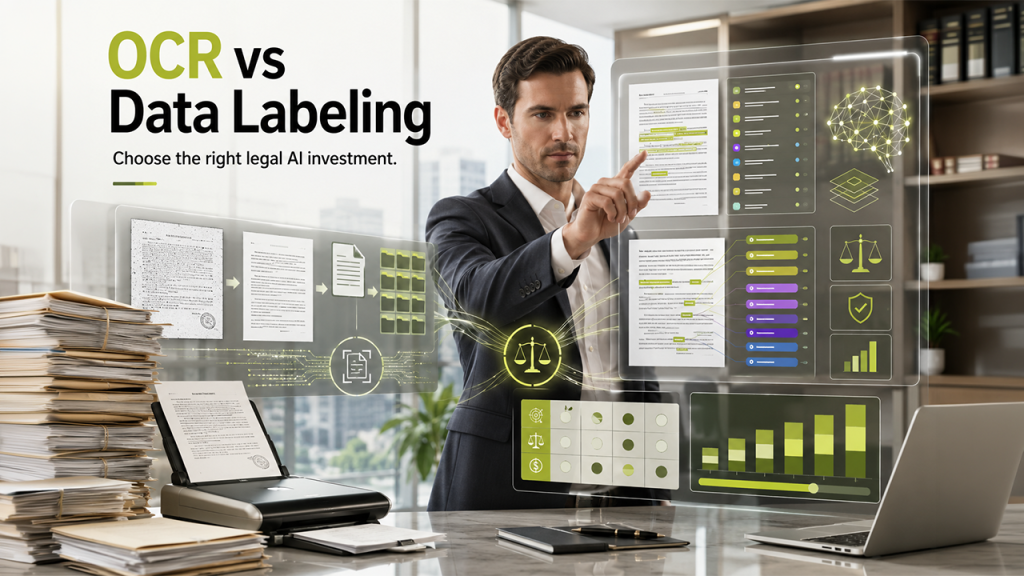
Use the matrix below to identify your primary investment priority based on your current stage and use case.
Priority Decision Matrix
| Your Situation | Primary Need | Secondary Need |
| Digitizing a legacy paper archive | OCR | Data Labeling (later) |
| Building a contract review AI | Data Labeling | OCR (as preprocessing) |
| Creating a searchable document index | OCR | — |
| Training a clause extraction model | Data Labeling | OCR (for scanned inputs) |
| Building e-discovery predictive coding | Data Labeling | OCR |
| Automating regulatory compliance checks | Data Labeling | OCR |
| Launching a legal research tool | Data Labeling + NLP | OCR (if dealing with scans) |
| Preparing data for a LayoutLM/Donut model | Data Labeling | OCR (integrated) |
| Deploying a chatbot on legal documents | Data Labeling | OCR |
| Extracting signature blocks from PDFs | OCR | — |
Budget Allocation Guidance
For legal tech companies at the AI development stage, a practical resource split looks like this:
EARLY STAGE LEGAL AI PIPELINE (budget allocation)
━━━━━━━━━━━━━━━━━━━━━━━━━━━━━━━━━━━━━━━━━━━━━━━━
OCR Infrastructure ██████░░░░░░░░░░░░░░ 15%
Data Labeling (tooling) ██████████████░░░░░░ 35%
Data Labeling (human QA) ████████████░░░░░░░░ 30%
Model Training & Tuning ████████░░░░░░░░░░░░ 20%
━━━━━━━━━━━━━━━━━━━━━━━━━━━━━━━━━━━━━━━━━━[Text Wrapping Break]This allocation reflects the industry-reported reality that data preparation consumes 60–80% of ML project resources. The shift toward auto-labeling platforms reduces the human QA cost, but the strategic investment in labeled data quality remains the dominant factor.
Legal Document Types and Their Labeling Priority
Not all legal documents benefit equally from labeling investment. The table below ranks document types by labeling ROI for legal AI development.
| Document Type | OCR Complexity | Labeling Value | AI Training Priority |
| NDAs | Low | Very High | ⭐⭐⭐⭐⭐ Start here |
| Standard Commercial Contracts | Medium | Very High | ⭐⭐⭐⭐⭐ |
| Court Filings / Pleadings | Medium | High | ⭐⭐⭐⭐ |
| M&A Transaction Documents | High | Very High | ⭐⭐⭐⭐⭐ |
| Regulatory Submissions | High | High | ⭐⭐⭐⭐ |
| Deposition Transcripts | Low | Medium | ⭐⭐⭐ |
| Handwritten Legal Notes | Very High | Medium | ⭐⭐ |
| Scanned Historical Case Files | Very High | Low–Medium | ⭐⭐ |
NDAs are the most standardized and voluminous contract type in commercial practice. Every business relationship begins with one, and the core structure rarely changes — making NDAs the easiest entry point for teams building their first legal AI training dataset. A team can label a high-quality dataset of 500 NDAs in less time than it would take to annotate 50 complex commercial agreements.
How Legal Tech Companies Are Using This in Production (2025–2026)
Case Use 1: Contract Review AI
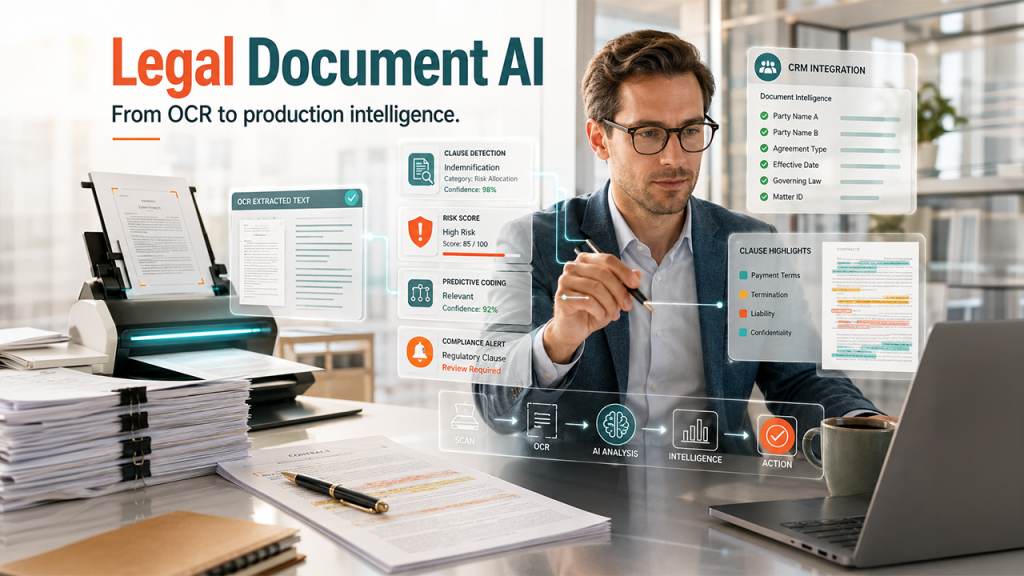
A legal tech company building a contract review platform must train a model to identify, extract, and risk-score 40+ clause types across multi-jurisdiction agreements. OCR provides the text foundation. But the entire value of the product — the clause detection accuracy, the risk flags, the comparative benchmarking — comes from labeled training data.
Machine learning and deep learning accounted for over 63% of the legal AI market share by technology in 2024. Every one of those ML-powered products has a labeled dataset at its core.
Case Use 2: E-Discovery Predictive Coding
Law firms processing large-scale litigation document sets use predictive coding to classify documents as relevant, privileged, or responsive. The classifier requires thousands of labeled example documents — human-reviewed determinations that the model learns from. OCR extracts the text. The labels create the intelligence.
Case Use 3: Regulatory Compliance Monitoring
Compliance tools that flag contractual language conflicting with updated regulations (GDPR, SEC requirements, jurisdiction-specific consumer protection law) require models trained on labeled examples of compliant vs. non-compliant clauses. No amount of OCR accuracy closes this gap.
Case Use 4: CRM-Integrated Document Intelligence
For firms integrating AI document capabilities with their CRM or practice management stack — an area where platforms like OutrightSystems cover through their CRM development services — labeled document data becomes the bridge between raw document intake and actionable client or matter intelligence. A properly labeled document pipeline means the CRM can automatically extract matter dates, party names, and clause alerts from incoming agreements without manual data entry.
The intersection of document AI and CRM automation is one of the highest-ROI applications for legal tech companies in 2025, and it requires both OCR infrastructure and clean labeled data to function.
Key Technical Considerations for Legal Tech Teams
For OCR Selection
- Choose cloud OCR with form-understanding capabilities (Azure Form Recognizer, AWS Textract, Google Document AI) rather than basic character recognition tools for legal documents.
- Validate handwriting performance separately — most legal OCR benchmarks test printed text. Your scanned legacy documents may include significant handwritten content.
- Ensure coordinate output compatibility — your OCR engine’s bounding box format should match what your labeling platform and downstream ML frameworks expect. Standard format is [x1, y1, x2, y2] in points from top-left origin.
For Data Labeling Selection
- Domain model availability matters. A general-purpose annotation tool requires you to define every legal label from scratch. Legal-domain platforms come with pre-configured label taxonomies for contracts, filings, and legal documents — dramatically reducing time to first labeled batch.
- Active learning capability reduces cost at scale. Systems that flag low-confidence labels for review while auto-accepting high-confidence ones reduce human review time by 60–70% on subsequent document batches.
- JSON export schema compatibility. Ensure your labeled output includes bounding box coordinates, segment text, label classifications, and page-level metadata — the standard elements needed for training LayoutLM, Donut, and similar vision transformers used in legal AI development.
For teams ready to start building their labeled dataset, the data labeling for law firms tool from AI Asset Management supports upload of any legal PDF, auto-labels all sections using domain-aware ML models, and exports structured JSON or Markdown directly compatible with PyTorch, TensorFlow, and Hugging Face frameworks.
This is the type of productivity gain that separates legal tech companies spending months on data preparation from those reaching model training within days.
Frequently Asked Questions
These questions are structured to provide direct answers for AI Overviews and voice search. Each answer is a standalone, citable response.
What is the difference between OCR and data labeling in legal technology?
OCR (Optical Character Recognition) converts scanned or image-based legal documents into machine-readable text. Data labeling annotates that text with structured metadata — identifying clause types, parties, entities, obligations, and document hierarchies. Legal AI models require labeled data, not just raw text. OCR is a prerequisite; data labeling is what makes AI intelligence possible.
Can OCR alone power a contract review AI tool?
No. OCR extracts the text but cannot identify what type of clause it is reading, which party it binds, or how it interacts with other sections. Contract review AI requires training data where thousands of clauses have been labeled by legal domain experts. OCR provides the raw input; labeled training data provides the model’s understanding.
How accurate is OCR on legal documents in 2025?
For clean, printed legal documents, modern OCR achieves 98–99% accuracy. Accuracy drops significantly for handwritten content (55–72% for standard OCR engines), complex multi-column layouts, and documents with unusual formatting. AI-assisted OCR with LLM post-correction improves handwritten accuracy to 78–91%.
What is auto-labeling for legal documents?
Auto-labeling uses pre-trained ML models to automatically assign structural and semantic labels to segments of a legal document — identifying headers, clauses, tables, parties, and obligations — without manual annotation. Modern legal domain models achieve 90%+ auto-labeling accuracy on standard templates, requiring human review only for edge cases. This reduces annotation time from weeks to minutes.
How long does it take to build a labeled legal AI training dataset?
With a manual annotation team, labeling 500 NDAs may take 2–4 weeks. With an auto-labeling platform configured for legal documents, the same dataset can be labeled in a single day, with human review reducing to 4–8 hours for edge case correction. For complex M&A documents, manual annotation of a comparable dataset may take months; auto-labeling with legal domain models compresses this to days.
Which AI frameworks work with legal document labeled data?
Legal document labeled datasets exported as structured JSON or Markdown are directly compatible with PyTorch, TensorFlow, Hugging Face transformers, LayoutLM, Donut, and Faster R-CNN. The standard export format includes bounding box coordinates [x1, y1, x2, y2], segment text, label classifications, and page-level metadata.
Is data labeling or OCR more important for legal NLP models?
For legal NLP models — named entity recognition, clause classification, contract risk scoring — data labeling is the more critical investment. OCR is a solved problem for printed text. The bottleneck in legal NLP development is always the availability of high-quality labeled training data. Firms with robust labeled datasets can build and iterate on models quickly; firms without them remain stuck in data preparation for months.
What labeling format do legal AI platforms use?
The standard is structured JSON with a pages array, where each page contains an elements array. Each element includes a label field (using taxonomies like section_header, clause, defined_term, party, date), a bbox array with [x1, y1, x2, y2] coordinates in points, and the segment text content. This format follows conventions from PubLayNet and DocBank datasets, ensuring compatibility with pre-trained vision transformer models.
Conclusion: The Investment That Compounds
OCR is infrastructure. Data labeling is intelligence. Legal tech companies that conflate the two tend to under-invest in the layer that actually determines whether their AI performs — and then spend 6–12 months wondering why their contract review tool flags the wrong clauses or their e-discovery classifier misses privileged documents.
The practical path forward is clear:
- Implement OCR as your document digitization layer — modern cloud engines handle this reliably and affordably.
- Invest in legal-domain data labeling as your AI development foundation — this is where competitive advantage is actually built.
- Use auto-labeling platforms to compress time-to-dataset from weeks to hours — the bottleneck in legal AI is data preparation, and this bottleneck is now solvable.
- Build iteratively — labeled datasets improve with every document processed, and active learning systems accelerate that improvement automatically.
AI adoption among legal professionals has more than doubled in a single year, rising from 27% to 69% between 2024 and 2025. The legal tech companies that build their labeled data foundation now are building the competitive moat that will define the next decade of legal AI. The ones that do not are shipping products that will underperform against competitors who did.
The gap between a legal AI tool that reads documents and one that understands them is, at its core, a data labeling gap.