





The global freelance market has outgrown traditional banking. SWIFT delays, 8–12% conversion losses, geographic restrictions – all of this pushes platforms toward blockchain-based payment infrastructure. This article breaks down why
The global freelance market has outgrown traditional banking. SWIFT delays, 8–12% conversion losses, geographic restrictions – all of this pushes platforms toward blockchain-based payment infrastructure. This article breaks down why on-chain remittances are becoming an operational priority, what's actually driving adoption, and where the real friction still lives.
Where the Banking Chain Breaks
A standard payment between a client in Canada and a contractor in Nigeria – routed through Upwork or Toptal – touches at least four financial institutions before landing. Acquiring bank, platform partner bank, correspondent bank, local recipient bank. Each hop adds a delay and a fee.
In the best case, the contractor sees the money in three days. In the worst – after a week and with 8–12% lost to conversion and charges. This is precisely why many contractors have started exploring crypto conversions for cross-border payments as a way to sidestep intermediary fees entirely. The World Bank's 2022 data put the average cost of sending $200 to Sub-Saharan Africa at 7.8%. For someone earning $500 a month, that's not a rounding error.
The core bottlenecks in traditional cross-border payouts:
- Correspondent banking chains add 3–7 business day delays
- Currency conversion fees stack across multiple intermediaries
- Certain countries remain practically unreachable through standard SWIFT rails
- Compliance holds can freeze payouts with little transparency or recourse
Why On-Chain, Not Just "Better Payment Apps"
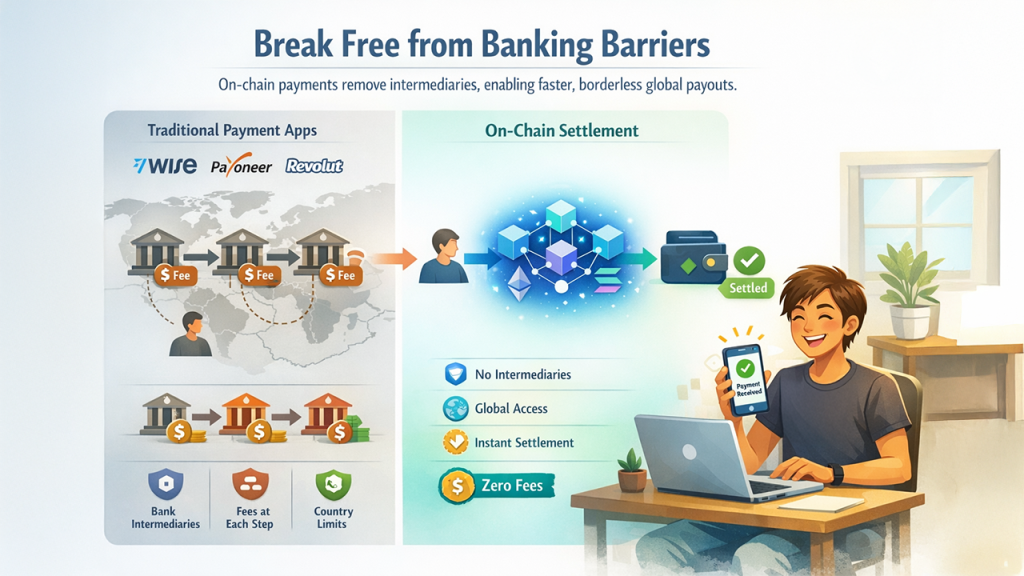
Wise, Payoneer, Revolut – each took a swing at this problem by building cleaner interfaces on top of the same underlying banking infrastructure. Wise meaningfully cut fees on select corridors. Payoneer became the de facto payout standard for Upwork and Fiverr. But all of them still operate within the same regulated, geographically constrained banking system.
On-chain settlements work differently at the architectural level. A transaction on Ethereum or Solana doesn't route through correspondent banks. Network nodes verify it, it settles into a public ledger, and no intermediary takes a cut between sender and recipient. Platforms that allow contractors to receive payments in crypto (including providers like Inqud, BitPay, and NOWPayments) gain a structural edge in regions where banking coverage is thin or unreliable.
Gitcoin, the open-source development platform, has been paying contributors in ETH since 2017. The reasoning was never ideological. Developers in Pakistan and Kenya simply had no reliable way to receive money otherwise.
Stablecoins: The Practical Layer Nobody Talks About
Most public discourse about crypto focuses on Bitcoin and price volatility. In the freelance payout space, a completely different set of instruments dominates: USDC (issued by Circle), USDT (Tether), and until its 2023 delisting, BUSD (Binance).
Stablecoins are pegged to the dollar or another fiat currency. A contractor in Brazil who receives $1,000 in USDC has exactly $1,000 the next morning – no surprise devaluation. That predictability is what made them a working tool rather than a speculative bet.
In 2023, Remote.com (one of the global payroll market leaders) officially launched stablecoin payouts for contractors across 50+ countries. Deel had moved earlier, integrating Coinbase Pay in 2021. These aren't startup experiments. These are decisions made by public companies with hundreds of thousands of clients on their books.
Smart Contracts and the New Escrow Logic
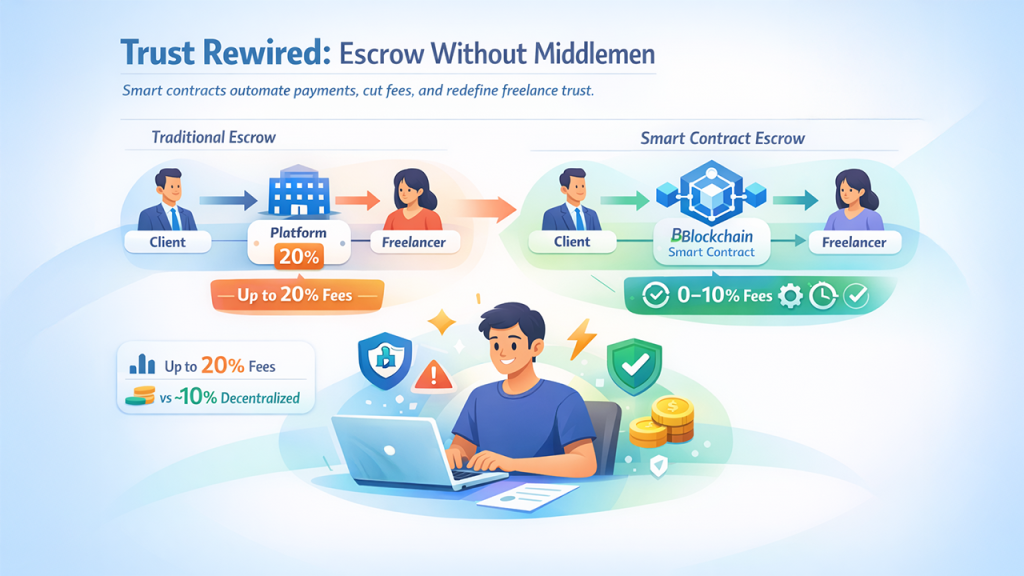
Escrow has always been the quiet backbone of freelance platforms – and one of their most profitable features. The setup is straightforward: a client deposits funds, the platform sits on them until the work is done, then releases the money. It works. It also happens to be the reason platforms feel entitled to take anywhere from 5% to 20% of every transaction. They're the trusted middle party, and trust, apparently, doesn't come cheap.
Smart contracts cut out that role entirely. The terms get written into code: if a client confirms the delivery, or a set number of days pass without a dispute, the payment moves automatically to the contractor. No one presses a button. No one takes a percentage for doing so. The ledger is public, the outcome is irreversible, and neither side needs to trust the other (or a platform) to make it work.
Braintrust has turned this into a business model. The decentralized talent marketplace charges a 10% fee, with most of it cycling back into the protocol rather than sitting in a corporate account. Upwork's 20% on a contractor's first $500 with any given client starts to look very different next to that number.
None of this means smart contracts are foolproof. The 2016 hack of The DAO, where a code flaw allowed an attacker to drain roughly $60 million in ETH, showed exactly what's at stake when the logic is wrong and the outcome is irreversible. Auditing contracts properly is non-negotiable, and it's not cheap. Still, the tooling around contract security has come a long way in the years since, and the platforms building on this infrastructure today are working with a much more battle-tested foundation.
The Regulatory Landscape
The EU's MiCA regulation (Markets in Crypto-Assets), passed in 2023, created a unified licensing framework for crypto-asset issuers and service providers across all 27 member states. It's the first systematic regulatory approach at the scale of a major economic bloc. For platforms looking to run stablecoin payouts legally in European markets, MiCA is the reference point.
In the US, the picture is messier. The SEC and CFTC haven't reached consensus on asset classification, and the 2023 lawsuits against Ripple, Binance, and Coinbase deepened planning uncertainty for any business operating in that space. Some platforms have deliberately excluded the US market from their crypto payout offerings for exactly that reason.
For contractors in countries with unstable currencies, the regulatory debate is secondary to lived experience. The Turkish lira lost more than 80% of its value against the dollar between 2018 and 2023. A payout in USDC isn't exotic in that context – it's pragmatic.
Where the Market Is Heading
The infrastructure is catching up to the ambition. Layer 2 solutions – Arbitrum, Optimism, Base (built by Coinbase) – have brought transaction costs down to cents rather than dollars. API providers like MoonPay and services such as Inqud are making fiat-to-crypto and crypto-to-fiat flows easier to integrate without building custom infrastructure from scratch.
Larger platforms (Deel, Remote, Fiverr, and various payment aggregators) no longer treat on-chain payouts as a marketing feature. It's an operational decision that cuts costs and opens access to contractor pools in underbanked markets. Allied Market Research projects the blockchain payments market could reach $7.7 trillion by 2030, with a significant share coming from gig economy B2B and B2C flows.
The question isn't whether on-chain settlements will replace traditional banking rails wholesale – that's not happening in any near-term window. The question is how much market share shifts before banks adapt their own infrastructure to close the gap.
Respond to this article with emojis