
Most e-commerce stores spend thousands attracting visitors — and then watch them leave without buying anything. Not because the products are wrong, but because shoppers can't find the right one.
Most e-commerce stores spend thousands attracting visitors — and then watch them leave without buying anything. Not because the products are wrong, but because shoppers can't find the right one. They browse, get overwhelmed, and abandon their carts. What if your store could act like a personal shopper the moment someone lands on your page?
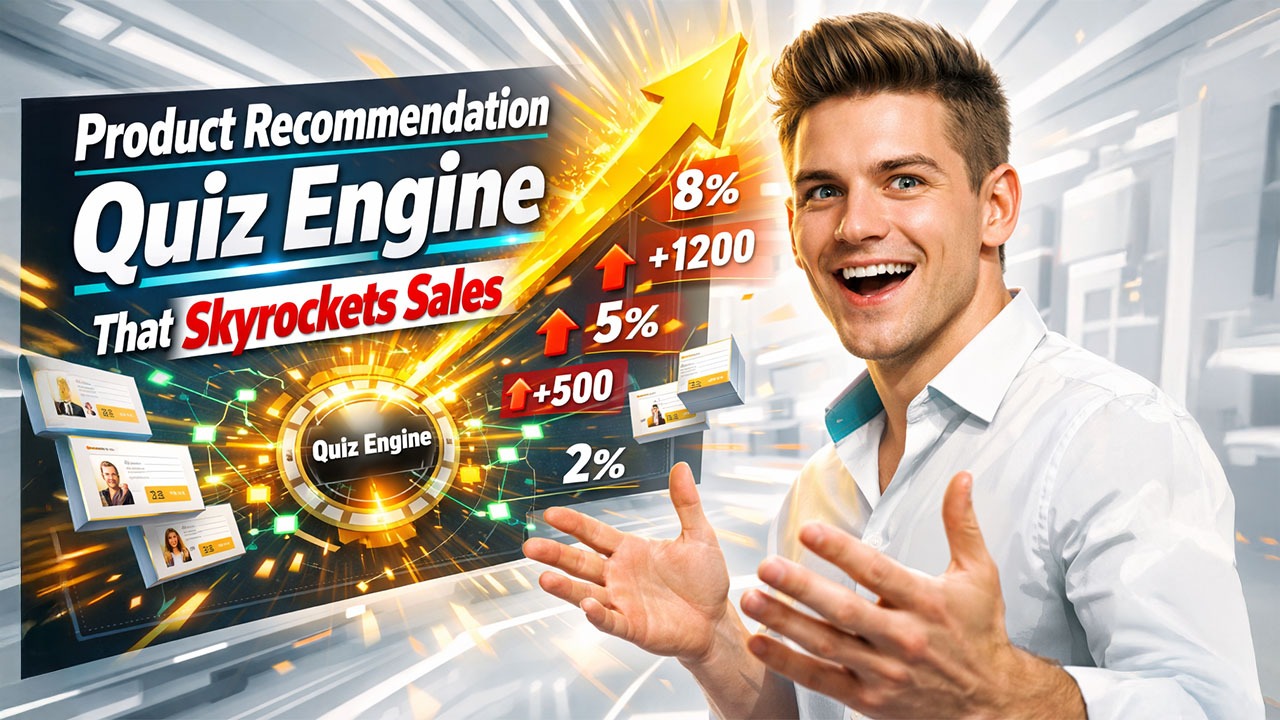
That's exactly what a well-built product recommendation quiz does. It cuts through the noise, asks the right questions, and points each customer toward exactly what they need. The result? Higher conversions, better customer satisfaction, and data that actually helps you market smarter.
What Is a Product Recommendation Quiz (and Why Should You Care)?
A product recommendation quiz is an interactive tool embedded on your store that asks visitors a series of targeted questions — about their needs, preferences, concerns, or goals — and then recommends the most suitable products based on their answers. Think of it as the digital equivalent of a knowledgeable store associate.
Unlike static product pages or filter menus, quizzes create a two-way experience. They feel personal. And that feeling matters more than most brands realize.
According to a 2022 Adobe Commerce study cited by Splitbase, [no follow] 72% of consumers say receiving personalized recommendations led them to purchase more products than they originally planned. A separate McKinsey finding noted that 71% of consumers expect some form of personalization when interacting with brands online. These aren't small numbers — they represent the majority of your potential customers.
Real Results: What the Data Says
The skeptic's question is always: Does it actually work?
The answer is yes — and the numbers are specific.
According to Interact's Quiz Conversion Rate Report, the overall conversion rate for quizzes sits at 40.1%, with service-based businesses seeing rates close to 50%. For e-commerce specifically, Interact found that product quizzes saw a 37.6% average conversion rate when users reached a lead generation form — jumping to 55.5% for those who completed it.
RevenueHunt, a product recommendation quiz platform trusted by over 20,000 brands, reports that stores using their quiz tool can expect conversion rates to rise from the typical 2% to as high as 5%, along with a 20% increase in average order value post-quiz completion.
See It in Action: Face Club's Skin Quiz
One of the clearest examples of a product recommendation quiz done right is Face Club's Skin Quiz — a personalized skincare recommendation tool that goes far beyond the typical "what's your skin type?" format.
Face Club is a results-driven skincare brand based in Richmond, BC, that has built its entire client experience around the idea that no two skins are the same. Their Skin Quiz generates a complete personalized skincare routine using professional-grade products tailored to treat concerns like acne, hyperpigmentation, wrinkles, and rosacea.
What makes this quiz stand out is its depth. Instead of offering generic results, it maps answers to specific product combinations that treat real skin concerns — the same way an in-person esthetician consultation would. Customers who've taken the quiz report noticeably improved results, with many crediting the quiz recommendations for visible changes in skin balance, clarity, and radiance.
The quiz has become a primary driver of both online engagement and in-store bookings at Face Club. Visitors who complete the Skin Quiz are significantly more likely to proceed to purchase or book an appointment — because they arrive at the results page already confident in their choices. This kind of guided experience shortens the customer decision journey and removes the most common barrier to conversion: uncertainty.
If you're in the beauty, wellness, or personal care space, this is the benchmark. A quiz that truly treats each visitor as an individual, not a demographic.
How a Product Recommendation Quiz Builder Makes This Possible
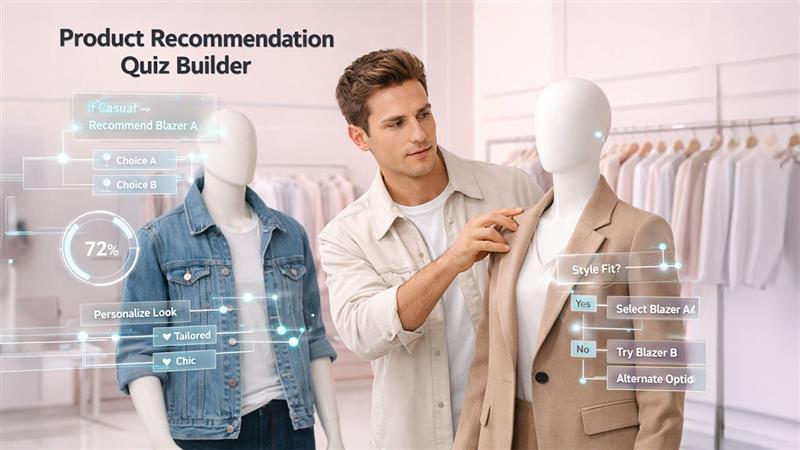
The good news is that building one of these experiences doesn't require a developer or a massive budget. A solid product recommendation quiz builder handles the logic, design, and integrations — so you can focus on the questions and the products.
Here's what to look for when choosing a product recommendation quiz builder:
- Conditional logic — the quiz should be able to skip or show questions based on previous answers, making the experience feel tailored rather than scripted.
- Native e-commerce integrations — your builder should connect directly to Shopify, WooCommerce, or whatever platform you're on, and automatically pull in your product catalog. This is what makes the recommendations dynamic rather than static.
- Email and CRM sync — quiz responses are zero-party data gold. Connecting results to Klaviyo, HubSpot, or Mailchimp lets you follow up with segmented, highly relevant emails. This is where the long-term revenue really compounds.
- Analytics and drop-off tracking — knowing where users exit your quiz tells you which questions are creating friction. Good builders show you this data clearly.
Can You Get Started Without Spending a Lot?
Yes. Access to a product recommendation quiz, free tier, or trial is standard across most platforms today. RevenueHunt, for instance, offers a free plan for new brands alongside a 15-day free trial with full feature access. WordPress/WooCommerce users can access a product recommendation quiz free plugin that includes a quiz builder, mobile-friendly design, lead capture, and cart integration at no cost. Quizell also provides a product recommendation quiz free starting option for stores just beginning to test the format.
Starting free and optimizing based on real response data is actually the smarter approach — it helps you refine your questions before scaling.
Three Ways Quizzes Directly Impact Your Bottom Line
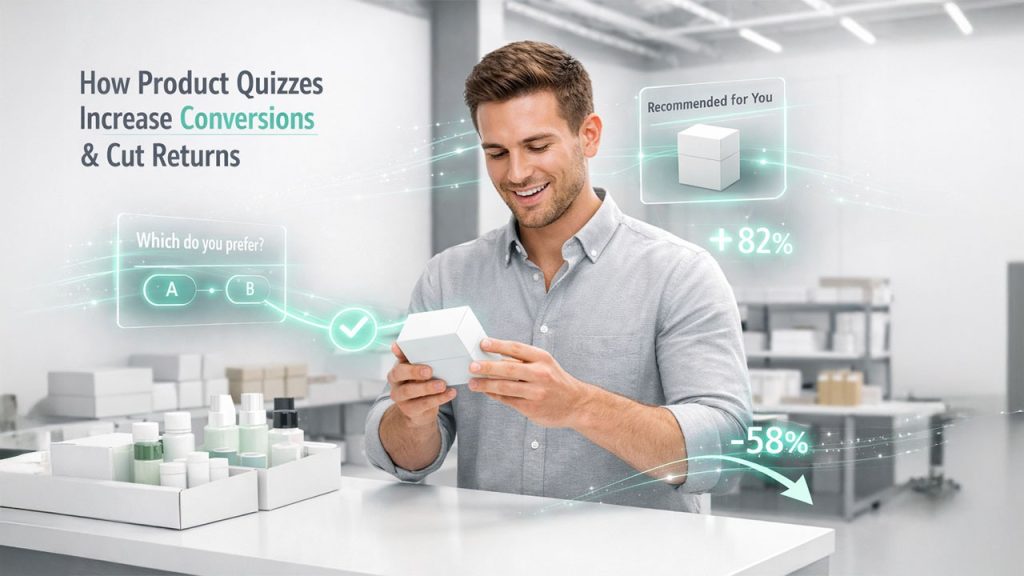
Beyond the experience factor, a product recommendation quiz delivers measurable business outcomes across three key areas:
- Higher conversion rates. Shoppers who complete a quiz arrive at the results page with intent. They've invested time, answered questions, and received a recommendation tailored to them. That confidence converts at a much higher rate than passive browsing. A strong ecommerce SEO strategy compounds this further, driving high-intent organic traffic that your quiz can then convert at an even greater rate.
- Lower return rates. When customers buy the right product on the first purchase, returns drop. This is especially valuable in categories like skincare, supplements, footwear, and apparel — where fit and compatibility matter as much as preference.
- Richer customer data. Every quiz response is a data point. You learn what problems your customers are trying to solve, what features matter to them, and what language resonates. That data improves your email segmentation, your ad targeting, and your product development.
Getting Your Quiz Strategy Right
Building a quiz isn't complicated, but making it effective requires intention. A few principles that matter:
The quiz should be short enough to complete (5–8 questions is a sweet spot for most categories) but specific enough to produce genuinely useful recommendations. Vague questions produce vague results — and vague results don't convert.
Every question should feel relevant to the shopper, not to your internal categorization logic. Frame questions around the customer's situation: "What's your biggest skin concern?" rather than "Which product category are you browsing?"
The results page is where the conversion happens. To make it work as hard as possible, it should include:
- Product images and names — shoppers need to see what they're being recommended, not just read a label
- A brief explanation of why each product fits their specific answers — this is what separates a quiz result from a random product page
- A clear, single CTA that takes them directly to checkout or the product page, with no extra steps
- A secondary option, like "email me my results,s" to capture leads from shoppers who aren't ready to buy immediately
And finally, use the data. The quiz is a lead intelligence tool as much as it is a sales tool. Segment your email list based on quiz outcomes, trigger personalized flows, and create ad audiences using quiz response patterns.
Frequently Asked Questions
Q1. What is a product recommendation quiz?
A1. An interactive tool that asks shoppers a few targeted questions and recommends the most suitable products based on their answers — like a digital personal shopper built into your store.
Q2. How does a product recommendation quiz increase conversions?
A2. It reduces uncertainty. Shoppers who receive a personalized recommendation feel confident enough to buy. Interact's data puts quiz conversion rates between 37.6% and 55.5% — far above the e-commerce average of 2–4%.
Q3. Do I need coding skills to build a product recommendation quiz?
A3. No. Tools like RevenueHunt, Quizell, and Digioh use drag-and-drop builders that require zero coding, and most offer free plans to get started.
Q4. Can a product recommendation quiz work for any e-commerce niche?
A4. It works best where personalization matters — skincare, haircare, nutrition, footwear, apparel, electronics, and pet products. It's less effective for commodity items with little variation between options.
Q5. How long should a product recommendation quiz be?
A5. 5–8 questions is the sweet spot. Short enough to complete, specific enough to produce useful results. If completion rates are low, your quiz builder's drop-off data will show exactly where people exit.
Respond to this article with emojis