


The landscape of digital payments has evolved dramatically, and nowhere is this more evident than in high-risk industries. From online gaming to cryptocurrency trading, businesses operating in volatile sectors face
The landscape of digital payments has evolved dramatically, and nowhere is this more evident than in high-risk industries. From online gaming to cryptocurrency trading, businesses operating in volatile sectors face unique challenges when processing transactions. The stakes are particularly high in 2026, as regulatory scrutiny intensifies and customer expectations for seamless, secure payments reach new heights. Companies in these sectors must navigate complex compliance requirements while maintaining robust high risk payment processing infrastructure that can handle elevated chargeback rates and sophisticated fraud attempts.
Building a secure payment gateway for high-risk businesses isn't simply about finding a processor willing to work with your industry – it's about creating a comprehensive ecosystem that balances security, compliance, and user experience. Traditional payment providers often shy away from high-risk merchants, leaving these businesses with limited options and potentially unstable processing relationships.
Understanding the High-Risk Classification
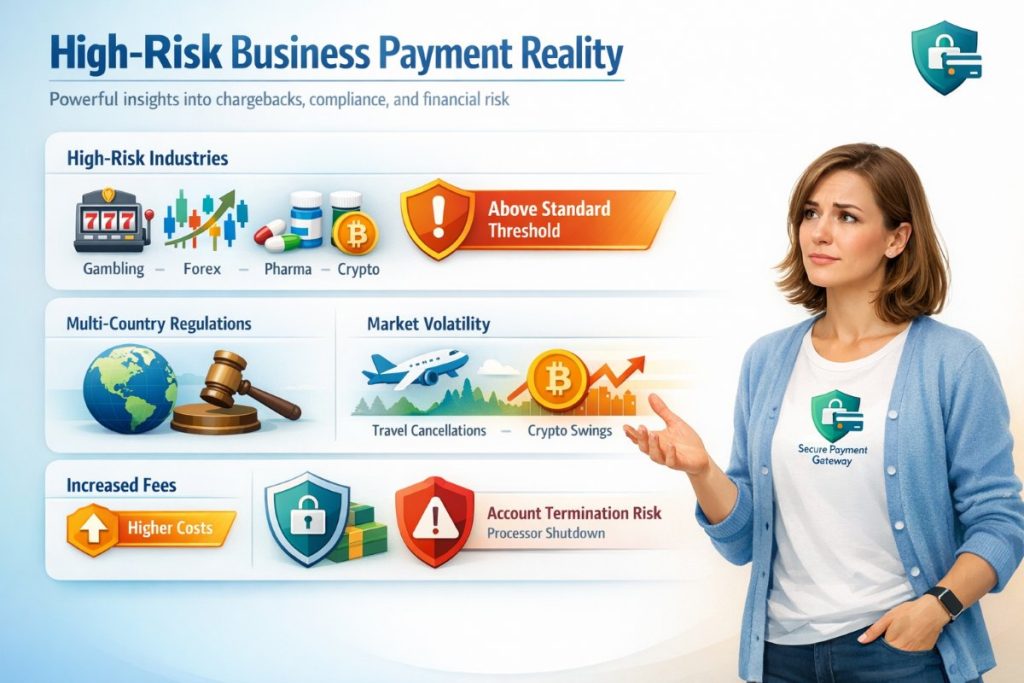
Before diving into gateway construction, it's crucial to understand why certain businesses are classified as high-risk. Industries like online gambling, adult entertainment, pharmaceuticals, and forex trading typically see chargeback rates exceeding the standard 1% threshold that traditional processors find acceptable. Additionally, these sectors often operate across multiple jurisdictions, each with distinct regulatory frameworks that complicate compliance efforts.
Market volatility plays another significant role in risk assessment. Travel and tourism businesses face frequent cancellations that result in refund requests and disputes. Nutraceutical companies deal with stringent FDA regulations and the possibility of product-related claims. Cryptocurrency exchanges must contend with price fluctuations and the evolving regulatory landscape surrounding digital assets.
The consequences of high-risk classification are substantial. Businesses often face higher processing fees – sometimes 2-3 times what standard merchants pay. They may be required to maintain reserve accounts, where the processor holds a percentage of revenue to cover potential chargebacks. Most significantly, high-risk merchants risk sudden account terminations if they exceed chargeback thresholds, potentially devastating their revenue streams.
The Architecture of Modern Secure Payment Gateways
Building a secure payment gateway in 2026 requires a multi-layered approach that addresses both technical and operational challenges. At the foundation lies the payment gateway itself – the technology that captures, encrypts, and transmits transaction data between the customer, merchant, and acquiring bank.
The first critical component is PCI DSS compliance. The Payment Card Industry Data Security Standard outlines twelve requirements that any entity handling cardholder data must meet. This involves implementing firewalls, encrypting transmitted data, maintaining vulnerability management programs, and regularly testing security systems. Many businesses choose to minimize their PCI scope by utilizing tokenization, where sensitive card data is replaced with non-sensitive equivalents called tokens.
Beyond basic compliance, high-risk gateways must incorporate advanced fraud detection mechanisms. Machine learning algorithms now analyze hundreds of data points per transaction, identifying patterns that human analysts would miss. These systems examine device fingerprints, behavioral biometrics, velocity checks, and geolocation data to assess transaction legitimacy in real-time.
Payment Orchestration: The Strategic Advantage
One of the most significant developments in high-risk payment processing is the rise of payment orchestration platforms. Rather than relying on a single payment service provider, orchestration allows businesses to connect with multiple processors, acquirers, and payment methods through a unified integration. Companies like Akurateco have pioneered this approach, offering platforms that enable merchants to route transactions intelligently across different providers based on predefined parameters.
The strategic value of orchestration becomes clear when considering the instability inherent in high-risk processing. If a business relies solely on one provider and that relationship terminates unexpectedly, revenue stops immediately. With orchestration, transactions can be instantly rerouted to alternative processors, maintaining business continuity even during provider transitions.
Smart routing algorithms form the core of orchestration platforms. These systems evaluate each transaction against multiple factors: the payment method being used, the customer's geographic location, the transaction amount, historical approval rates by provider, and current processor performance. Based on this analysis, the platform routes the transaction to the provider most likely to approve it.
Cascading functionality takes optimization further. When a transaction receives a soft decline – a temporary rejection that might succeed if re-attempted – the orchestration platform automatically sends it to an alternative processor. This happens seamlessly, without customer intervention, turning potential lost sales into completed transactions.
Building or Buying: Strategic Considerations
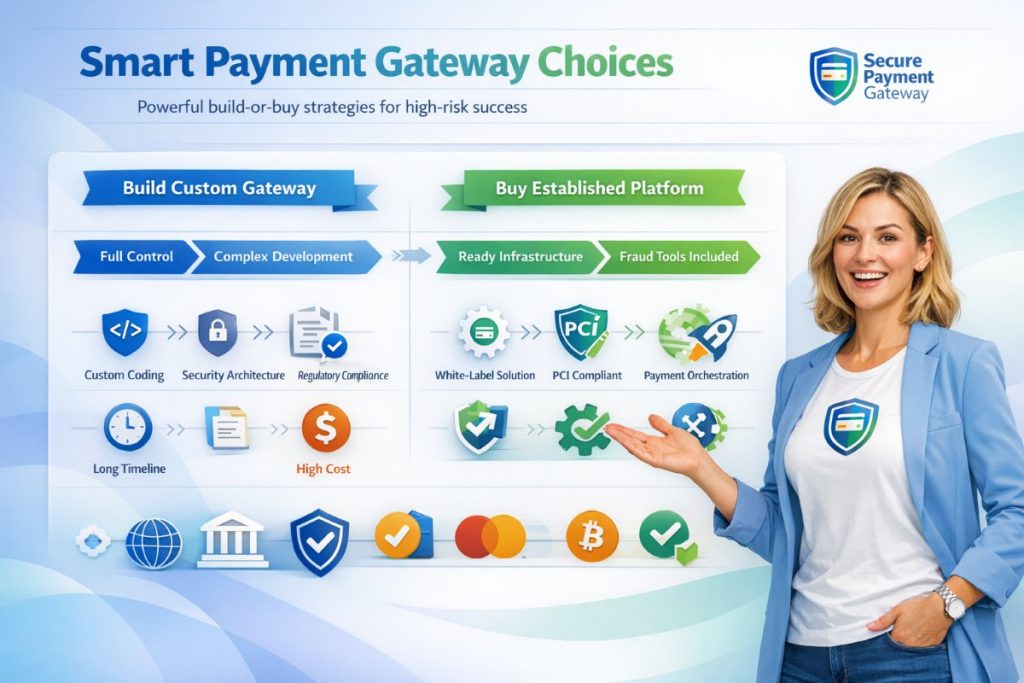
High-risk businesses face a fundamental choice: build a custom payment gateway or implement an existing platform. Each approach has distinct advantages and challenges that must be weighed against the business's specific needs, resources, and timeline.
Custom development offers maximum control and customization. A built-from-scratch gateway can be tailored precisely to the business's workflow, integrated deeply with existing systems, and modified as requirements evolve. However, payment gateway development is extraordinarily complex and resource-intensive. Development requires expertise in payment protocols, security architecture, compliance frameworks, and multiple programming languages. The typical timeline spans 12-18 months from conception to production deployment, with costs often exceeding several hundred thousand dollars.
For most high-risk businesses, implementing an established platform proves more practical. White-label solutions and payment orchestration platforms offer pre-built infrastructure that's already PCI-compliant, battle-tested, and maintained by specialized teams. These platforms provide immediate access to multiple payment providers, fraud prevention tools, and industry best practices. The time-to-market advantage is substantial – businesses can launch payment processing in weeks rather than months or years.
High-risk businesses often rely on the right mix of technology tools to manage payments, compliance, and daily workflows efficiently — here are more tools that simplify daily business operations.
Security Layers Beyond Basic Compliance
In 2026, meeting minimum security standards isn't sufficient for high-risk businesses. The threat landscape has evolved to include increasingly sophisticated attack vectors, from credential stuffing to synthetic identity fraud. Building truly secure payment gateways requires implementing multiple defensive layers.
Advanced encryption protocols form the first line of defense. While TLS 1.3 is now standard for data in transit, leading gateways also implement end-to-end encryption where payment data remains encrypted even while passing through the gateway infrastructure. Behavioral analytics have become crucial for distinguishing legitimate customers from fraudsters. Modern systems build behavioral profiles for each user, tracking patterns like typing rhythm, mouse movement, and navigation patterns.
3D Secure 2.0 has matured into an effective balance between security and user experience. Unlike its predecessor, 3DS2 enables frictionless authentication for low-risk transactions while requiring step-up verification only when necessary. For high-risk merchants, this technology shifts liability for fraudulent transactions to the card issuer, providing crucial protection against chargebacks.
Managing Chargebacks and Disputes
For high-risk merchants, chargeback management isn't peripheral – it's central to survival. Excessive chargebacks can lead to placement in monitoring programs like VISA's Fraud Monitoring Program or Mastercard's Excessive Chargeback Program. Merchants who remain in these programs risk losing processing privileges entirely.
Proactive prevention starts with clear communication. Many chargebacks result from customer confusion rather than fraud – charges appearing under unfamiliar business names, unclear billing descriptors, or forgotten subscription renewals. Modern gateways implement clear transaction descriptors, send pre-transaction notifications for recurring charges, and provide easily accessible customer service information.
Alert systems like Verifi and Ethoca have become standard features in high-risk payment infrastructures. These services notify merchants of disputes before they become official chargebacks, providing a window to resolve issues directly with customers. When implemented effectively, these systems can prevent 20-30% of potential chargebacks.
The Role of Artificial Intelligence
AI has transformed from buzzword to essential component in payment gateway architecture. In 2026, machine learning algorithms handle tasks that previously required extensive manual intervention, while identifying patterns that human analysts couldn't detect.
Fraud detection models now train on billions of transactions, identifying subtle correlations between hundreds of variables. These models continuously learn, adapting to new fraud tactics as they emerge. Approval rate optimization uses ML to predict which transactions might succeed if re-attempted or routed differently, making split-second decisions that maximize revenue.
Looking Forward
The payment infrastructure requirements for high-risk businesses in 2026 are demanding but achievable. Success requires combining robust security, intelligent routing, comprehensive compliance, and continuous optimization. Whether building custom solutions or implementing platforms like those offered by established providers, the key is creating resilient systems that can adapt to evolving threats, regulatory changes, and market opportunities.
For high-risk merchants, the payment gateway isn't merely operational infrastructure – it's a strategic asset that directly impacts revenue, customer experience, and long-term viability. Investing in sophisticated, secure payment processing capabilities pays dividends through higher approval rates, reduced fraud losses, lower chargeback rates, and the operational flexibility to scale confidently.
Respond to this article with emojis