




Running a small business has always required careful budgeting, but today’s economic pressures make cost control more important than ever. Fortunately, technology has become one of the most reliable ways to streamline
Running a small business has always required careful budgeting, but today’s economic pressures make cost control more important than ever. Fortunately, technology has become one of the most reliable ways to streamline operations, reduce overhead, and eliminate inefficiencies that quietly drain cash. Smart tech upgrades for small businesses make it possible to save time and money while building a more resilient setup for long-term growth. Below are smart tech investments that offer measurable returns without requiring enterprise-level budgets.
1. Cloud-Based Productivity Tools That Replace Inefficient Legacy Systems
The traditional software licensing model, server hosting, and other manual processes imposed a significant financial burden on businesses. This is being overcome by cloud software solutions providing substitutes to these methods at a much lower financial output.
Rather than having to handle the hardware or keep things up-to-date, teams are now treated to automatic updates, security, and the ability to work from anywhere. Email, document management, video meetings, and collaborative work spaces can now be done for a fraction of what was spent before. Businesses that switch typically see reduced IT expenses, boosted productivity, and fewer hours lost to troubleshooting outdated equipment.
2. Automation Platforms and Software That Save Money on Repetitive Tasks
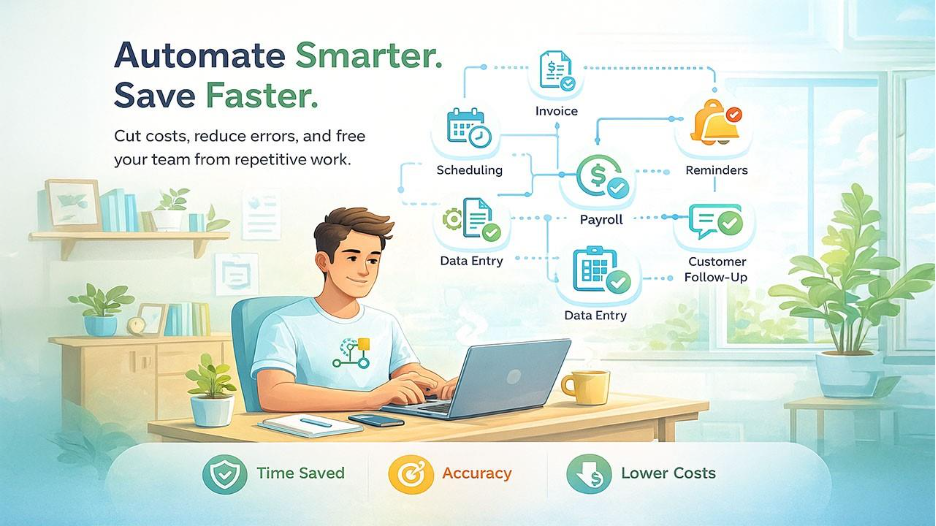
With automation tools, a lot of the workload is taken off their hands, minimizing manual work and increasing precision. Automating business operations through these platforms provides teams with the opportunity to automate tasks related to invoicing, scheduling, payroll, reminders, data entry, or customer follow-up. This kind of software that saves money does so by freeing staff from low-value work and reducing the chances of costly human error.
This kind of software that saves money does so by freeing staff from low-value work and reducing the chances of costly human error.
For example, automated billing systems cut down on delayed payments and administrative time. Automated appointment reminders reduce no-shows. Workflow automation tools help teams hand off work seamlessly without long email threads or missed steps.
The return on investment is usually quick because automation solves everyday inefficiencies that silently inflate labor costs. Over time, these tools help small businesses operate with fewer bottlenecks and a higher level of consistency.
3. Unified Communication Systems That Reduce Phone and Support Costs
Many businesses still rely on outdated phone lines or scattered communication tools that create unnecessary expenses. VoIP systems have changed this. They offer call routing, voicemail transcription, video meetings, and team messaging in one platform, usually at a much lower monthly cost than traditional phone providers.
Beyond cost savings, unified communication platforms improve customer service by reducing missed calls and shortening response times. Teams can be managed using mobile applications, computers, or shared dashboards that maintain communication regardless of the locations of all employees. This improvement in managing teams will greatly benefit small businesses that have remote or flexible teams.
4. Smart Energy Management Tools That Lower Utility Bills
Energy is a major but often overlooked business expense. Smart thermostats, occupancy sensors, LED lighting systems, and real-time energy monitors allow small businesses to control usage more efficiently.
Smart thermostats adjust temperatures based on business hours or foot traffic. LED lighting lasts longer and uses far less electricity than older bulbs. Automated power strips and timers prevent devices from running unnecessarily.
For businesses with brick and mortar locations such as retail shops, small offices, fitness studios, and cafés, these improvements can reduce utility costs by hundreds or even thousands of dollars annually. Because energy-saving devices are now inexpensive and easy to install, the payback period tends to be fast.
5. Point of Sale and Inventory Systems That Reduce Waste and Shrinkage
Small businesses that rely on physical inventory often struggle with issues like overordering, lost stock, delayed reorders, and inefficient sales tracking. Modern point of sale systems and cloud-based inventory tools solve these problems by offering real-time visibility into what is selling, what is running low, and what should be phased out.
Automated inventory alerts help prevent overstocking, which ties up cash, and stockouts, which lose sales. The system also decreases inaccuracies in money and the mistakes of employees by recording all transactions correctly.
In product-oriented businesses like retail, food services, and online retailers with commercial merchandise, there could be substantial waste reduction and profit margin improvement using such tools.
6. AI-Powered Customer Support Tools That Reduce Service Costs
Customer support services may prove to be the biggest employment expense for a small business. Customer service software powered by artificial intelligence algorithms, including chatbots and ticketing systems, proves to bring about a notable reduction in these costs. They address frequently asked questions, collect consumer information, and handle support inquiries in the absence of employees.
However, this does not mean that human service is no longer needed; instead, it lessens the amount of repetitive queries, which enables teams to work on complex queries. AI support tools increase customer satisfaction and response times, which are the two factors that influence revenue.
These systems will also improve over time, making them more affordable, even for smaller teams that do not possess any level of technical skills.
7. Cybersecurity Tools That Prevent Expensive Downtime
Cybersecurity could be something that happens in the future, but for small businesses, cybersecurity threats are very much a reality— and costly. A cyberattack could mean lost revenue and financial hardships.
Inexpensive cybersecurity solutions like password managers, multi-factor authentication software, anti-endpoint software, encrypted backup software, and real-time threat protection solutions can eliminate these threats altogether. Many small businesses today utilize managed security services where they pay a predictable fee per month to utilize enterprise-level solutions for their organization's security. Additionally, investing in comprehensive cloud security tools helps protect data stored in cloud-based systems from unauthorized access and breaches.
Investing in prevention always costs less than investing in response to a breach.
8. Remote work technologies cutting office costs
The trend of remote and hybrid working is now a reality, and small businesses are reaping benefits of cost reductions made possible due to this shift. A team of professionals, provided with secure collaboration tools, project management, video conferences, and access to cloud, can continue to be completely productive even without occupying a full office.
This is because there are no or reduced costs associated with rent, utilities, cleaning, parking, or equipment if the business has no physical location or a reduced need for space because of the changes made to accommodate remote work. Businesses that currently use a physical location may discover that they can reduce their space by implementing remote-friendly systems.
The cost savings achieved could be significant in the longer term, particularly for businesses operating in high rent areas.
Conclusion
The needs of small businesses have changed. They no longer require big budgets to gain from new technology. Upgrades that involve automation, cloud technology, smart energy solutions, communication solutions, AI helpers, and effective cybersecurity can significantly cut down costs and make things easier.
Such investments are usually able to pay for themselves within a pretty short period of time and ensure that the business is competitive in the ever-changing digital world.
Respond to this article with emojis