Telematics Data Integration in Modern Insurance Systems
Explore how telematics data integration in insurance systems utilizes IoT sensors, APIs, Edge computing, and analytics to improve risk assessment.
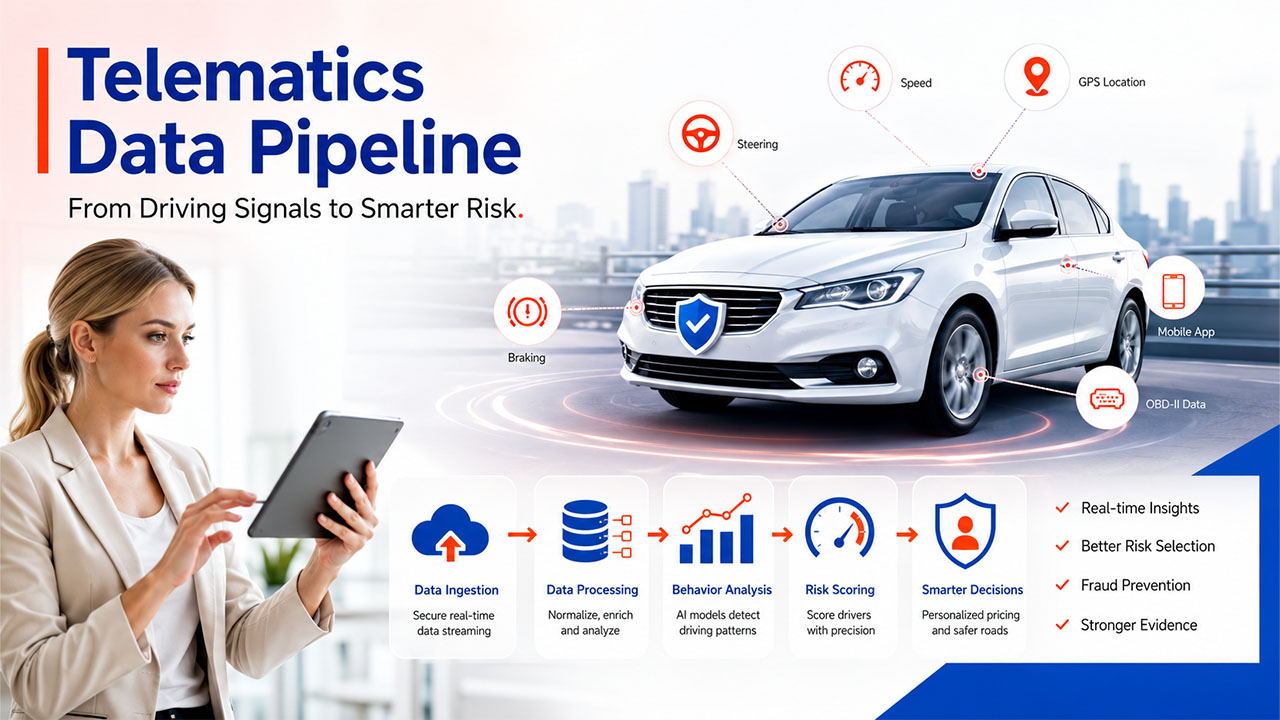
Pop the hood on almost any new car and you’ll find a small fleet of sensors quietly doing their job — accelerometers, GPS chips, an OBD-II port, sometimes LiDAR. All of it logging how the car actually gets driven. That stream of data is quietly rewriting how insurers price risk. Telematics data integration in insurance enables carriers to combine vehicle sensors, GPS information, and driver behavior insights into real-time underwriting and claims decisions. What the driver actually does behind the wheel. Here’s a look at the plumbing behind that shift — pipelines, APIs, edge computing, and the legal weight this data carries once something actually goes wrong.
Where Telematics Data Integration in Insurance Begins
Telematics isn’t new, exactly. Progressive’s Snapshot and State Farm’s Drive Safe & Save have been around for years. Today, telematics data integration in insurance depends on combining multiple data streams from OEM-installed systems, aftermarket devices, and smartphone-based applications into a unified platform that insurers can analyze.
But the hardware behind them has changed a lot since those clunky plug-in dongles first showed up. Now you’ve got OEM-embedded telematics units, aftermarket OBD-II devices, and phone-based apps running on nothing more than an accelerometer and a gyroscope. Different sources, different latency, different accuracy — and, for anyone building the backend, wildly different data schemas to wrangle into something usable.
That normalization headache is where a lot of insurtech teams lose weeks they didn’t budget for. A Tesla’s telemetry output looks nothing like what comes off a Verizon Hum dongle, and neither one resembles the JSON a smartphone SDK like Cambridge Mobile Telematics or Zendrive spits out. Before any of that raw signal turns into something an underwriter can use, it has to survive ingestion — and, increasingly, it has to survive someone disputing what it actually shows. This is exactly the terrain where legal expertise starts mattering as much as the pipeline itself. When a claim gets contested, having representation among the Best law firms for car accident cases in Beverly Hills can be the difference between telematics evidence holding up in front of a judge and it just sitting unused in a database somewhere.
Architecture Behind Telematics Data Integration in Insurance Systems
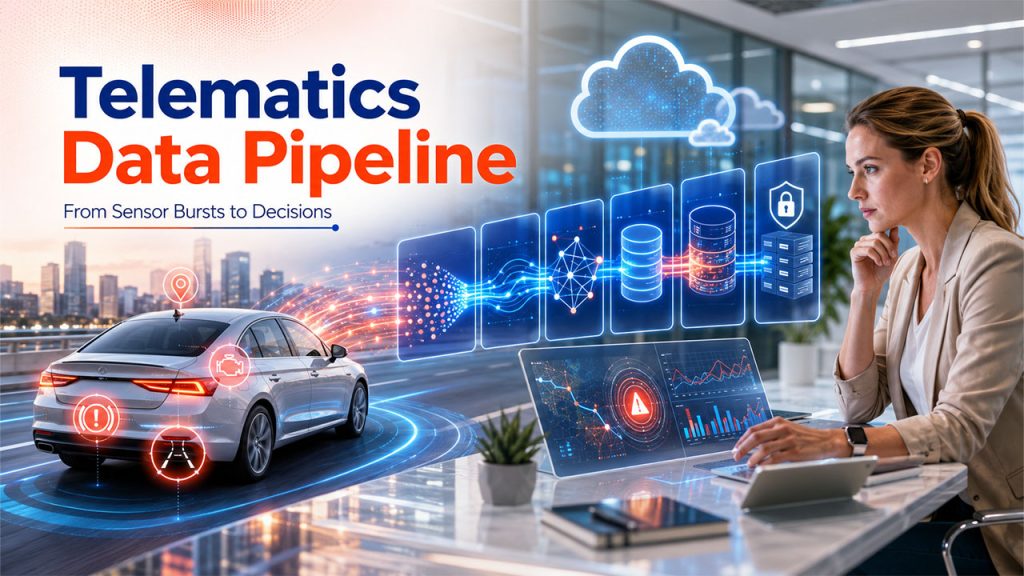
Building scalable telematics data integration in insurance systems requires a combination of streaming infrastructure, cloud storage, APIs, and analytics platforms capable of processing millions of vehicle events in real time.
As these platforms grow more complex, insurers also need structured processes for monitoring, updating, and optimizing their cloud environments. Effective cloud application lifecycle management helps ensure telematics platforms remain secure, scalable, and reliable throughout their operational lifecycle.
So what does this actually look like once a team moves past a proof-of-concept dashboard and into something running in production?
Ingestion and Streaming
Cars don’t generate data at a steady drip — they burst. A hard-braking event, a lane departure, an RPM spike — these show up in clusters, not evenly spaced intervals. Batch processing simply doesn’t cut it here, not when an insurer wants a risk flag within seconds, not hours.
The usual toolkit:
- Apache Kafka or AWS Kinesis for ingesting high-frequency sensor streams from thousands of vehicles at once
- MQTT as the lightweight protocol between the vehicle’s telematics unit and the cloud gateway — a necessity given how patchy cellular bandwidth still is on rural highways
- Azure IoT Hub or AWS IoT Core for device management, authentication, and routing at fleet scale
- Apache Flink or Kinesis Data Analytics for scoring events as they arrive, not after the fact
The Cold-Hot Storage Split
Related walkthrough
Figma Liquid Loader Animation Tutorial | Smooth Loading Animation in Figma

Not every piece of telematics data deserves the same treatment. Nobody’s querying GPS pings from six months ago on a Tuesday afternoon. But a claims adjuster looking into last week’s collision needs millisecond access to granular trip data, right now. So most architectures split things up:
- Hot storage (DynamoDB, Cosmos DB) for recent trips still feeding active pricing models
- Warm storage (Redshift, BigQuery, Snowflake) for aggregated behavior analytics
- Cold storage (S3 Glacier, Azure Blob Archive) for long-term retention — which matters more than most teams expect once litigation enters the picture
Why bother with archival tiers nobody touches for years? Because when a lawsuit surfaces eighteen months after an accident, “we deleted it to save on storage costs” is not a sentence any general counsel wants to say out loud in a deposition.
Where Edge Computing Actually Earns Its Keep
Sending every raw data point straight to the cloud sounds fine in theory, until someone calculates the bandwidth bill for a fleet of 50,000 vehicles pinging GPS coordinates every second. That’s where edge computing comes in — pushing computation closer to the source, right into the onboard unit or a nearby gateway.
Some of the more practical edge use cases:
- Running lightweight driver-behavior models directly on the onboard unit, using something like TensorFlow Lite, scoring harsh cornering or phone distraction without a round trip to the cloud
- Filtering and compressing data before transmission, so bandwidth isn’t wasted on idle GPS noise nobody needs
- Buffering locally during connectivity dead zones, then syncing once the vehicle finds a signal again
Here’s the part that gets overlooked: edge processing isn’t just about saving money on data transfer. It’s about speed. If a fraud-detection model needs to catch a suspicious deceleration pattern within seconds of a collision — before anyone has a chance to reshape the story around it — that scoring has to happen locally. A five-second round trip to the cloud is already too slow.
Driver Behavior Analytics in Telematics Data Integration for Insurance
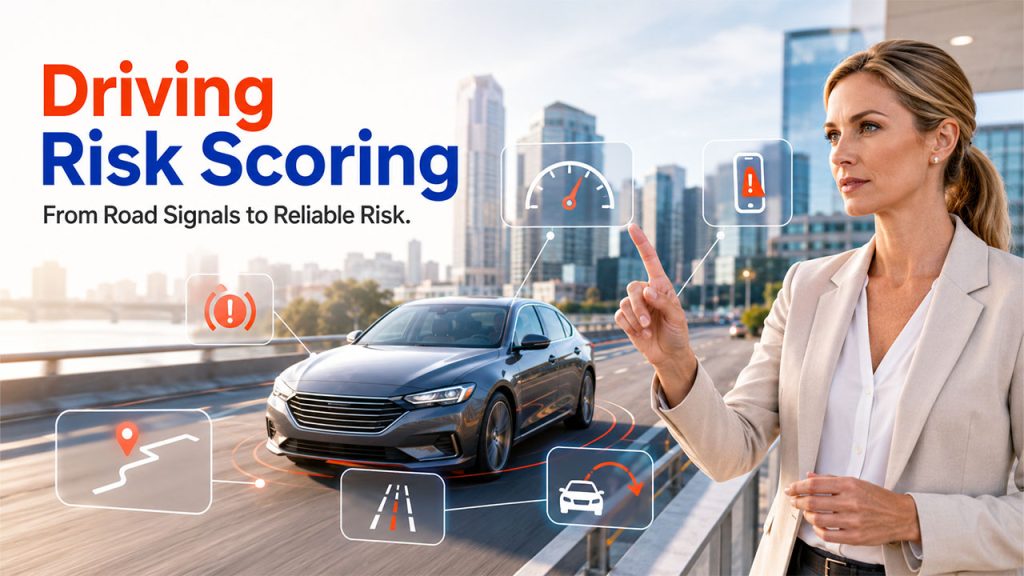
The effectiveness of telematics data integration in insurance depends on converting raw vehicle signals into meaningful driver behavior insights that insurers can use for pricing, risk modeling, and claims decisions.
Once the data lands somewhere queryable, the real engineering work begins: turning raw sensor noise into a score an underwriter can actually act on.
What Goes Into the Score
Most models weigh some combination of:
- Harsh braking and acceleration frequency, normalized against trip distance
- Cornering g-force thresholds
- Speed relative to posted limits, cross-referenced against map data — usually pulled from HERE or Google Maps APIs
- Time-of-day and road-type exposure, since a 2 a.m. highway drive scores nothing like a school-zone commute
- Phone-handling detection, inferred from accelerometer patterns that suggest distracted driving
Gradient-boosted models dominate here — XGBoost and LightGBM show up constantly, trained on historical claims data to correlate specific driving patterns with actual loss frequency. Neural approaches exist too, sure, but the industry still leans toward models that can actually explain themselves. Regulators tend to ask why a premium changed, not just that it did, and “the neural net said so” doesn’t satisfy anyone.
As insurers begin incorporating generative AI into claims analysis, customer support, and underwriting workflows, choosing the right AI approach becomes critical. Techniques such as retrieval-augmented generation and model fine-tuning can help organizations build AI systems that balance accuracy, domain knowledge, and transparency.
The Standards Problem Nobody’s Solved
Interoperability is still a mess, honestly. SAE J1979 covers OBD-II parameter IDs, ISO 15765 handles the CAN bus transport layer — but there’s no single universal schema for telematics risk scoring, nothing like what HL7 does for healthcare data. That gap is exactly why API design between telematics vendors and insurance carriers matters so much. RESTful APIs with clean, well-documented JSON schemas — or GraphQL, for teams that need flexible querying across inconsistent data sources — end up functioning as the de facto standard the industry never officially agreed on.
When Telematics Becomes Legal Evidence
And here’s where the conversation shifts from engineering to something a lot of engineers don’t spend much time thinking about: what happens to this data after a crash.
Telematics records — speed at impact, the braking timeline, steering angle in the final seconds — increasingly show up as evidence in collision investigations. Event Data Recorders, mandatory in most U.S. vehicles since 2012 under NHTSA rules, already play this role. Connected-car telematics stretches that capability far beyond the fifteen-second pre-crash window an EDR typically captures.
Sounds simple enough. It isn’t. Who actually owns this data — the driver, the manufacturer, the insurer? Can it be subpoenaed? Was it collected and stored in a way that preserves chain of custody, or did someone cut a corner three steps back in the pipeline? None of these questions get answered by the pipeline itself. That’s exactly the point where solid engineering hands off to legal counsel — where an attorney has to argue admissibility, poke holes in how a score got calculated, or explain to a jury what a compressed, edge-processed data point actually proves.
The future of telematics data integration in insurance will depend on building systems that are not only fast and accurate but also explainable and defensible. Insurers that combine connected vehicle data, real-time analytics, and transparent AI models will be better positioned to improve customer experience while meeting regulatory and legal expectations.
For IT teams building these systems, the practical lesson is simple: architect for auditability from day one. Immutable logs, cryptographic timestamps, versioned model outputs — all of it needs to survive scrutiny not just from a data scientist running a sanity check, but from a lawyer in a deposition asking pointed questions. Because sooner or later, someone’s attorney is going to ask exactly how that risk score got calculated. And “the algorithm said so” has never once satisfied a courtroom.