


Remember, the authority and credibility of any website can only be measured by determining how well it performs online and what value it delivers to its readers. It must be
Remember, the authority and credibility of any website can only be measured by determining how well it performs online and what value it delivers to its readers.
It must be clear what exactly the readers are looking for and what they should do next.
Honestly, these objectives might sound quite easy to achieve, but in reality, most sites still fail to deliver this level of clarity.
Readers land on pages, scan a few lines, and leave because nothing guides them, answers their questions, or builds confidence.
So, if you actually want to format website content where every element on a page has a purpose and communicates information users can trust, just keep on reading this guide.
Want to improve your content quality? Whether you're just starting out or refining your approach, following a content writing guide for beginners can help establish strong foundational practices. Here are some professional tips you can follow.
What Website Content Really Means in 2026
1. Content as a Functional System, Not Decoration
The website content is more like its functional tool that helps you effectively grab the reader’s attention and clearly guide them from a question to an action.
You can think of it like a system where every line, label, heading, and visual holds a specific purpose in molding the reader’s views. That’s why, when each element in your content supports a clear task, it can easily lead the reader to take action.
2. Content as the Primary Source of Truth
Remember, readers always appreciate the content that actually provides them with real, accurate information and updated facts.
In other words, we can say that in 2026, readers judge a content’s credibility based on how well it reflects real data, current rules, and honest explanations.
This is especially important when leveraging AI writing tools, you must humanize AI content to ensure it reflects authentic expertise and maintains the trust readers expect from authoritative sources.
Why High-Quality Content Matters in 2026

Here are some key reasons that will surely prove to you why content quality matters and why search engines are emphasizing more on improving the content quality and clarity by 2026.
1. It Builds Strong and Lasting Authority
The quality of your content basically demonstrates your knowledge and your grip on the topic.
How?
Because you can only explain something clearly when you understand it deeply.
That’s why not only the readers but also the search engines today rely more on expertise and factual accuracy rather than empty claims or exaggerated statements.
When your website consistently delivers simple, complete, and useful information, you create strong topical authority. This authority becomes the backbone of your entire site, which ultimately helps you rank well and earn long-term trust.
2. It Helps Users Make Better Decisions Quickly
Confusion kills conversions.
Remember, the purpose of content writing is to inform the readers about the things they are confused about. Thus, if your content is unclear or just presents vague details rather than actual facts, the readers will ultimately lose their interest and move on to finding a clearer and reliable source.
Clear examples reduce hesitation and save their time. This creates a smoother experience, increases conversions, and lowers the number of abandoned sessions.
Not only this, but good content also reduces the need for extra support because users can solve problems on their own without external help.
3. It Increases the Impact of All Marketing Efforts
Every marketing campaign leads users back to a landing page.
That’s why, if that page lacks clarity, all your paid ads, emails, and social content lose their purpose.
Therefore, opting for high-quality and clear content is indeed really important to ensure your content marketing is always on point and is capable enough to clearly guide the readers.
In website content Strong explanations support the offer, reduce doubts, and highlight benefits clearly. This improves conversions and helps you get more value from every marketing dollar.
How to Create Content That Performs in 2026
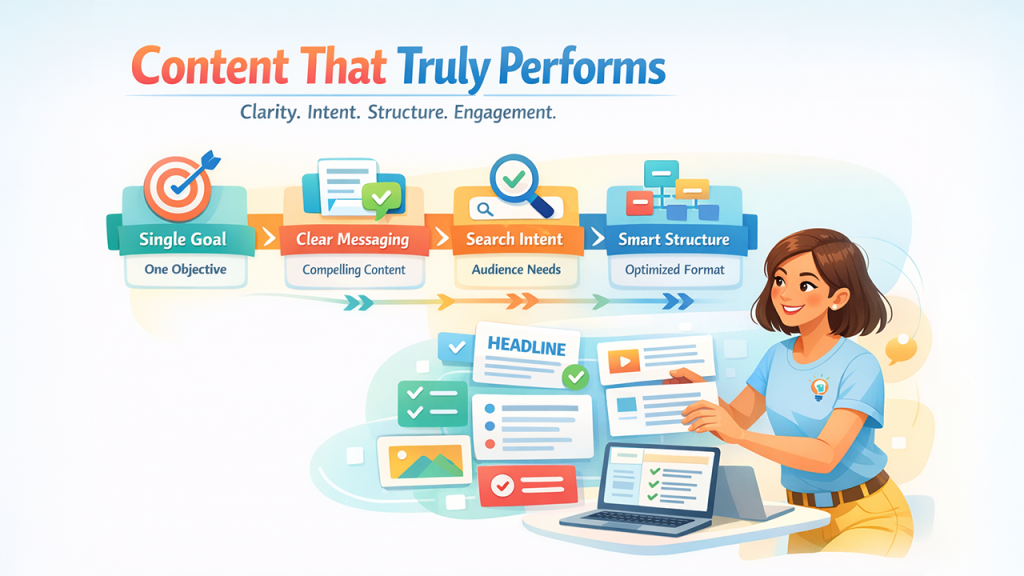
Want to improve your content quality? Here are some professional tips you can follow.
1. Start With a Single Goal per Page
You must have a clear purpose while writing content in order to actually outperform competitors in 2026 and make readers love it.
Remember, readers nowadays don’t want to waste their time scanning through tons of relevant but scattered information. Instead, they only seek clear answers to their queries.
Therefore, before you start writing, make sure to define the single job the page must complete.
This approach doesn’t just earn you the reader’s favor; however, it also helps search engines understand the purpose of your page. Thus, this clarity ultimately increases ranking accuracy.
2. Ensure Clarity and Engagement
If the info you have jotted down feels confusing, repetitive, or difficult to follow, it will lose its impact despite accuracy.
Hence, your write-ups must sound clear, natural, and engaging from start to finish.
Hence, make sure to:
- Use simple language.
- Avoid unnecessary jargon.
- Refine sentences to deliver value.
In case some parts of your text feel ambiguous, an AI paraphraser can help restructure ideas without changing their meaning, ensuring your message stays sharp and reader-friendly.
When your content flows smoothly and communicates ideas effortlessly, readers stay longer, absorb more, and are far more likely to trust your expertise.
3. Align Content With Real Search Tasks
Along with understanding your topic, it’s important that you also understand the reader’s search intent.
Identify what exactly they want; whether they are seeking a comparison, definition, step-by-step process, or expert explanation, and then format your website content according to that exact need.
For this, you can review the top-ranking competitors’ sites to better analyze how they have covered a specific search term and then apply the same pattern in your writing.
4. Structure Content for Instant Understanding
Readers nowadays prioritize content quality over quantity. Therefore, writing massive blocks of text with no pauses, highlights, or edges is of no use, no matter how valuable the information is.
So, along with what you present, you also have to pay attention to how you format that information.
Thus:
- Split your text into small blocks such as definitions, steps, examples, and FAQs.
- Add headings and subheadings for each block to guide the readers.
- Break the large bulks of content into smaller paragraphs.
- Cover one idea per paragraph.
- Leave white spaces between the paragraphs.
Wrap Up
In the last analysis, a lot has changed in the past few years and website content isn’t the same as it used to be. Therefore, you must adapt to these changes and work on write-ups that won’t leave you behind others and your position in the eyes of readers stay secure.
Respond to this article with emojis