

How Digital Agencies Can Scale SEO Services Without Expanding Their Teams
Explore how scalable SEO services help digital agencies grow using automation, white-label solutions, outsourcing, and smart technology.
In modern and digital landscape, digital agencies often face a familiar challenge, that is winning more clients becomes easier than building the internal capacity required to serve them well. The task of a SEO agency can be particularly demanding, especially because an effective campaign requires continuous research, along with technical work, content production, link building, reporting, and performance analysis.
For a SEO agency, expanding the service capacity does not always mean hiring a larger in-house team. But a right scalable SEO agency uses automation, specialized partners, standardized workflows, and carefully selected technology to handle any additional workload, while also maintaining service quality. The main element is to create a scalable system that streamlines repetitive work and specialist tasks that can be handled efficiently.
Why Scalable SEO Services Becomes Difficult
SEO is not just one-time service, but it is a contract in which the agency may need to manage keyword research, competitor analysis, technical audits, content strategies, on-page optimization, backlink campaigns, reporting, and ongoing improvements. As the client base of an agency grows, their responsibilities also multiply.
An agency serving multiple clients might be able to manage these activities comfortably with a smaller team, but the agency grows to a larger number of clients; the same processes can become difficult to manage manually. Without a scalable system, employees may spend too much time on repetitive tasks and too little time on strategy, quality, and client relationships.
Standardizing Repetitive SEO Processes
One of the easiest ways to scale up the capacity is to standardize recurring processes. A scalable SEO service agency can create documented workflows for activities such as:
- Keyword research
- Technical SEO audits
- Content briefs
- On-page optimization
- Link-building outreach
- Monthly reporting
- Competitor analysis
- Client onboarding
For SEO agencies, standardization generally means that employees do not have to recreate the same process for every account. Templates can also provide an ideal starting point for the agencies, while the checklists help ensure important steps are not missed. This exact workflow can also be customized according to the objective of each client.
The main goal is not to make every campaign identical, but standardized processes can create a reliable foundation that allows specialists to spend more time on decisions that are actually required to be expert.
Using Automation for Time-Consuming Tasks
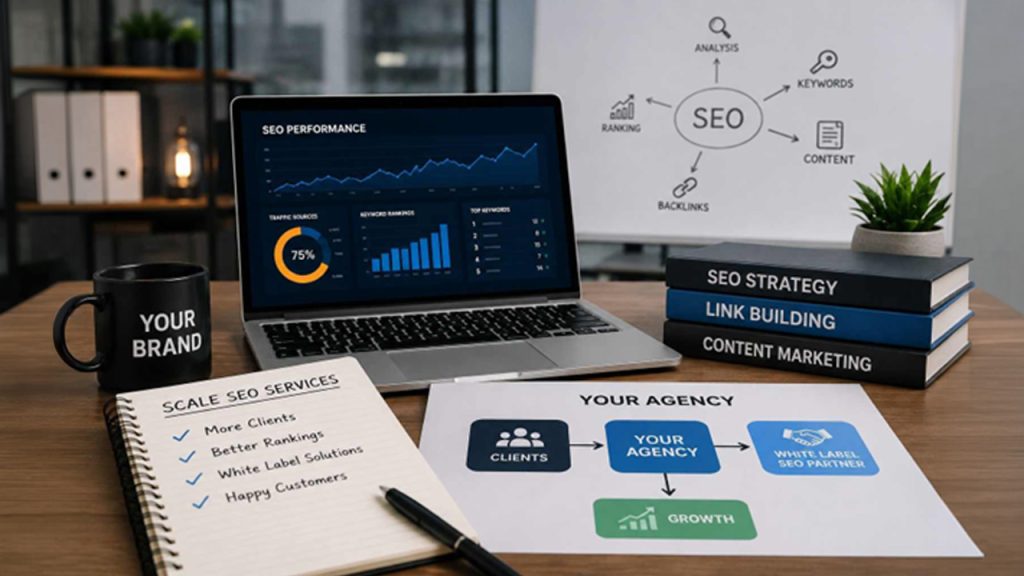
Automation can remove many repetitive activities from an SEO workflow.
Reporting is a common example. Instead of manually collecting data from multiple platforms every month, agencies can connect reporting systems and automatically organize important metrics.
Other potential applications include scheduled website crawls, rank monitoring, task notifications, lead management, data collection, and routine quality checks.
AI automation can expand these capabilities further. Agencies exploring this approach may consider White Label AI Automation Services as part of a broader strategy for handling repetitive workflows while keeping their internal team focused on higher-value work.
Automation should be implemented selectively. A process should be evaluated based on whether automation actually saves time and maintains the required level of accuracy.
Outsourcing Specialized SEO Work
Not every agency needs to maintain specialists for every SEO discipline internally. Some campaigns generally require technical SEO expertise, advanced content production, digital PR, link building, local SEO, or specialized development knowledge. Maintaining a full-time specialist for every possible requirement can also become expensive, especially for a smaller agency.
Working with external specialists can provide additional capacity when needed.
This model allows an agency to efficiently maintain strategic control while assigning specific production tasks to be experienced professionals. The agencies generally remain responsible for the client relationships and overall campaign direction.
The most effective outsourcing relationships are built around clear processes, quality standards, deadlines, and communication.
White-Label Services Can Expand an Agency’s
White-label services take outsourcing a step further by allowing an agency to provide additional services under its own brand.
For example, an agency that specializes in web design may want to offer SEO without building an entire SEO department. A white-label partner can handle agreed-upon fulfillment while the agency manages the client relationship.
This model can allow agencies to expand their service menu without immediately taking on the cost of additional employees.
WhiteLabelRank provides white-label SEO solutions designed to help agencies manage SEO fulfillment while presenting services under their own brand.
For agencies considering this model, it is important to evaluate fulfillment quality, communication processes, reporting capabilities, turnaround times, and how much customization is available.
Protecting the Client Relationship

Scaling fulfillment should not mean losing control of the client experience.
Clients generally care about results, communication, transparency, and responsiveness. They do not necessarily need to know which team member completed every individual task, but the agency should understand what is being delivered on their behalf.
A scalable agency should maintain clear ownership of:
- Strategy
- Client communication
- Goals and KPIs
- Quality control
- Campaign direction
- Final approvals
External partners and automation systems can support these areas, but they should operate within a framework controlled by the agency.
Building Reusable Content Systems
Content production can become another major bottleneck as SEO clients increase.
Instead of creating every article from scratch, agencies can develop repeatable systems for content research, briefing, editing, optimization, and publication.
A standardized content workflow might include keyword analysis, search-intent evaluation, competitor review, outline development, first-draft production, editorial review, SEO optimization, fact-checking, and final approval.
Templates can speed up the process without requiring every article to follow exactly the same structure.
Human editorial oversight remains important. Content should reflect the client’s industry, audience, expertise, and brand voice rather than becoming generic material produced from a template.
Improving Client Onboarding
Related walkthrough
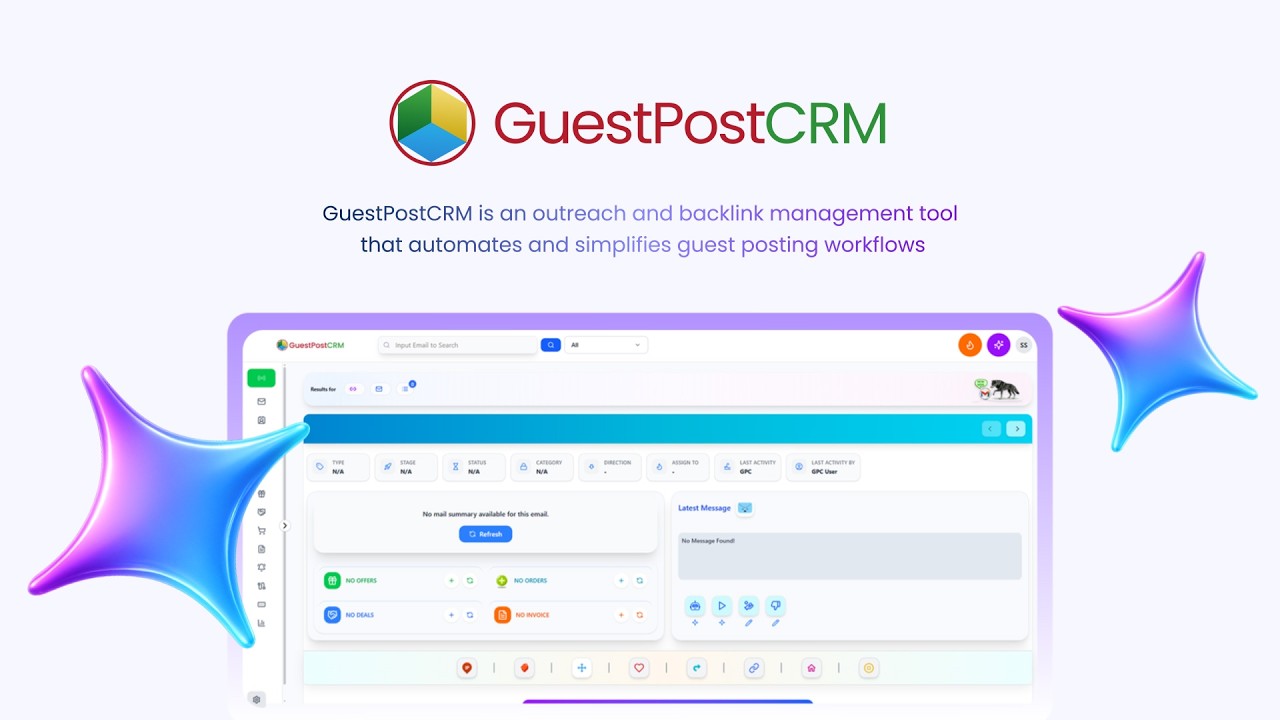
GuestPostCRM: Streamline & Scale Your Outreach Workflow Effortlessly
Scaling problems often begin before SEO work even starts.
If onboarding is inconsistent, account managers may spend excessive time collecting information that should have been gathered during the initial process.
A structured onboarding system can collect important information such as:
- Business objectives
- Target markets
- Primary services
- Existing website access
- Analytics access
- Search Console access
- Competitors
- Previous SEO activity
- Target keywords
- Brand guidelines
Once this information is organized, the SEO team can begin work faster and with fewer clarification requests.
A well-designed onboarding process also creates a consistent experience for clients regardless of the size of the agency.
Using Data to Prioritize Work
More clients do not necessarily require every task to receive the same amount of attention.
Agencies should prioritize activities based on potential impact.
For example, a technical issue preventing search engines from properly accessing important pages may deserve immediate attention, while a minor metadata improvement may be scheduled later.
Data can help account managers and SEO specialists determine where their time is most valuable.
Prioritization becomes increasingly important as an agency grows because there are only so many hours available across the team.
Creating Quality-Control Checkpoints
One risk of scaling through automation or outsourcing is inconsistent quality.
Agencies can reduce this risk by introducing checkpoints throughout the workflow.
A content piece might require editorial review before publication. A technical recommendation might need specialist approval. A backlink campaign could require prospect-quality checks before outreach begins.
Quality control does not need to involve reviewing every minor task manually. Agencies can identify the stages where errors would have the greatest impact and focus human oversight there.
This creates a balance between efficiency and reliability.
Choosing Technology That Works Together
Adding more software does not automatically make an agency more efficient.
A technology stack should reduce complexity rather than create additional administrative work.
Before adopting a new platform, agencies should consider whether it integrates with existing tools, whether employees can learn it quickly, and whether it eliminates a meaningful amount of manual work.
Connected systems can help information move between different stages of a campaign. For example, project-management software can receive tasks from reporting systems, while CRM platforms can maintain client information used by account managers.
The objective should be a connected workflow rather than a collection of unrelated tools.
Managing Communication as the Client Base Grows
Communication becomes more challenging when an agency manages dozens or hundreds of clients.
Account managers can reduce this pressure through structured communication schedules and reusable reporting frameworks.
Monthly reports should focus on the metrics that matter to each client rather than overwhelming them with every available data point.
Agencies can also establish standard response procedures for common questions and requests.
Automation can help with reminders, scheduled reports, meeting preparation, and internal notifications, allowing account managers to spend more time on strategic conversations.
Knowing When to Hire

Scaling SEO services without expanding the team of the agency does not always mean an agency should never hire new employees. But at some point, the most important question is whether the additional employee can solve a genuine capacity problem.
Agencies can examine workloads, margines, client growth, employee utilization, and the type of work being delayed. If a specialist is continuously spending time of administrative tasks, automation can become the first solution. If the agency lacks strategic expertise that directly affects results, hiring may be more appropriate.
The right approach can also be a combination of internal employees, automation, and external specialists.
Creating a Scalable SEO Services Business Model
A successful scalable SEO service is all about building systems, that can handle increased demand without allowing the quality to decline. An agency can easily combine standardized workflows, automation, specialized outsourcing, white-label fulfillment, technology integrations, and strong quality control.
The internal team of the agency can also remain focused on strategy, client relationships, campaign direction, and final decision-making, while specialized partners and technology can handle appropriate production tasks.
This structure can make it possible to add clients without immediately increasing every internal resource at the same rate.
The Future of Scalable SEO Services
SEO agencies generally operate in an environment where technologies and client expectations continue to evolve. Automation and AI are also changing how research, content, reporting, and operations tasks are performed. Businesses expect agencies to deliver a broader service efficiently.
Agencies that build scalable SEO service systems have the capacity to respond to this environment more effectively, rather than just relying entirely on manual processes. The goal of a scalable SEO service agency is not to handle more clients, but to increase capacity, while also maintaining campaign quality, client communication, and strategic oversights.
By combining key elements, such as people, processes, technology, and reliable fulfillment partners, a digital agency can expand their SEO services without automatically expanding their internal teams at the same pace.