
Understanding AI Chatbots: Benefits, How They Work, and Their Development Process
Learn how AI chatbots work, explore their benefits and challenges, and discover the development process to choose the right chatbot solution for your business.
The article explores what AI chatbots are, how they work, their key benefits, the development process, and how businesses can choose the right AI chatbot that match their needs.
In the current, continuously evolving technological landscape, artificial intelligence is transforming how businesses communicate with customers, manage operations, and deliver personalized experiences. Among all the latest developments and impactful innovations, AI chatbots are considered the most transformative. These intelligent AI-powered chatbots have the capability to understand user queries, generate relevant responses, automate repetitive tasks, and offer support across multiple digital channels.
AI chatbot offers key benefits to organizations, from answering frequently asked questions to assisting customers with purchases. Organizations are continuously adopting chatbot technology to improve customer engagement, reduce operational costs, and deliver faster and more convenient services. Organizations looking to implement these capabilities can explore professional AI chatbot development services to build customized solutions that align with their business goals and customer requirements.
What are AI Chatbots?
AI chatbots generally refer to software applications that utilize artificial intelligence to simulate human-like conversations using text or voice. AI chatbot use various software applications, such as artificial intelligence, natural language processing (NLP), and large language models (LLMs), to understand, process, and generate human-like text or voice responses in real time.
The AI chatbot solutions can be integrated into websites, mobile applications, messaging platforms, customer support portals, and enterprise systems. These chatbots can handle various types of tasks, such as handling simple questions, recommending products, retrieving information from business databases, or assisting users with complex workflows.
Key Features of AI Chatbots
Some of the key features of AI chatbots are as follows:
- Context and Conversation Memory: The chatbot can track multi-turn dialogue history, making the interactions feel continuous and meaningful.
- Personalized Responses: AI chatbots can tailor responses using relevant customer preferences, previous interactions, and authorized data.
- 24/7 Availability: The AI chatbot can help around the clock. They can answer common questions, share product information, and guide users through routing processes.
- Multilingual Support: AI Chatbots can support conversations in multiple languages, helping businesses communicate with customers from different regions.
Benefits of AI Chatbots
AI chatbots offer various advantages to organizations, especially when they are designed around real business requirements and implemented responsibly.
Some of the key benefits of AI chatbots are as follows:
- Reduced Operational Cost: AI chatbots help automate routine interactions, allowing customer support teams to focus on more complex challenges and high-value activities.
- Faster Responses: AI chatbots have the capability to respond to common queries almost immediately, reducing waiting times and helping users find required information without navigating multiple pages. Businesses can further improve customer support efficiency by evaluating AI customer support platforms that offer chatbot automation, knowledge base integration, workflow management, and human-agent handoff.
- Scalability and Consistency: These chatbots can handle multiple conversations simultaneously, making them useful for organizations experiencing growing customer demand.
- Valuable Business Insights: Chatbot interactions can reveal recurring customer questions, common service problems, product interests, and gaps in existing documentation.
How Do AI Chatbots Work?
The working process of an AI chatbot includes the following steps:
- Step 1: Understanding User Input
The process begins when a user submits a message or speaks a request. - Step 2: Interpreting Context
The chatbot needs to understand conversational context, previous messages, and relevant details. - Step 3: Retrieving Relevant Information
Various enterprise chatbots use retrieval-augmented generation (RAG) to retrieve relevant information from a knowledge base and offer it to a generative AI model as context.
Choosing the right approach depends on the chatbot’s requirements. Understanding the differences between retrieval-augmented generation (RAG) and fine-tuning can help businesses determine how to connect AI models with business knowledge and customize their behavior.
- Step 4: Generating Responses
Once the chatbot understands the request and has access to relevant information, it prepares a response.
- Step 5: Learning and Improvements
Chatbots continuously evaluate conversation quality, analyze user feedback, review failed interactions, and update their knowledge sources.
AI Chatbots vs Traditional Chatbots
Related walkthrough
Claude Opus 5.5 Is More Than an AI Chatbot

In the past few years, chatbots have become a crucial part of modern customer service and business automation. However, not all chatbots work in the same way. Traditional chatbots rely primarily on predefined rules, scripts, and decision trees, whereas an AI chatbot uses artificial intelligence to understand, interpret, and generate relevant responses.
Traditional Chatbots
Traditional chatbots operate using predefined rules and conversation flows. These chatbots are relatively straightforward and easier to develop and maintain, making them suitable for repetitive tasks and predictable customer interactions.
AI Chatbots
AI chatbots use technologies such as natural language processing (NLP), machine learning, and, in many modern systems, large language models (LLMs) to understand and respond to user queries. They interpret different ways of expressing the same request, use conversational context, and provide more flexible responses.
Quick Comparison
A quick comparison of traditional chatbots and AI chatbots are as follows:
| Features | Traditional Chatbots | AI Chatbots |
| Technology | Predefined rules and scripts. | AI, NLP, and LLMs. |
| Understanding Language | Primarily keywords and fixed inputs. | Can interpret natural language and variation in phrasing. |
| Response Generation | Predetermined responses. | Responses are selected or generated based on context. |
| Context Awareness | Usually limited | Can maintain conversational context. |
| Personalization | Limited and rule based. | Uses relevant customer data and conversation history. |
| Integration | Often supports predefined workflows. | Can connect to multiple business systems and tools. |
How Do Organizations Build AI Chatbots?
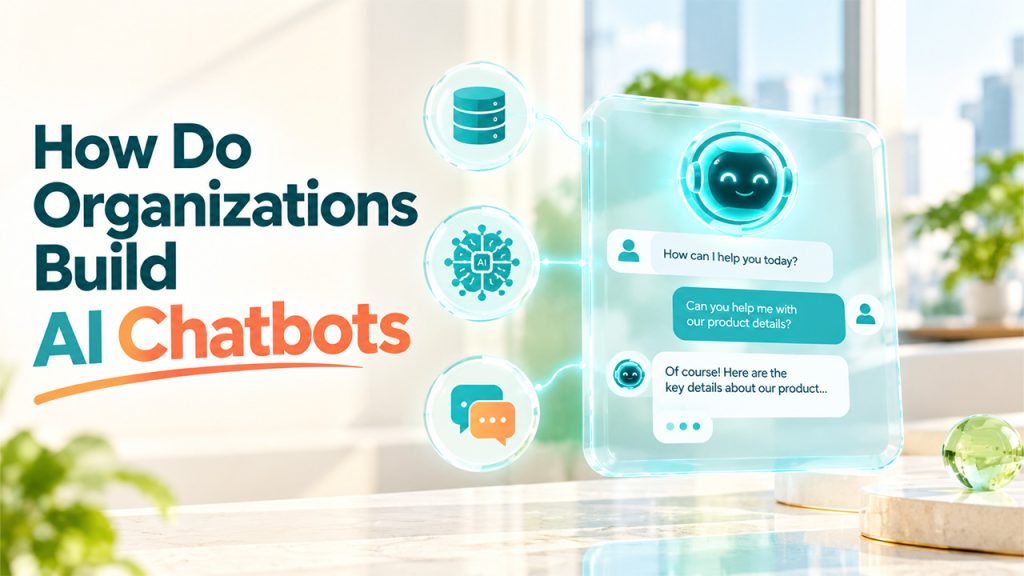
The development process of AI chatbots includes the following steps:
- Step 1: Define Business Goals and Requirements
The first step of AI chatbot development is to identify the problem that the chatbot should solve. Clear objectives offer a foundation for technical decisions and help establish realistic expectations. - Step 2: Choosing the Right Chatbot Technology
Selecting the right technology and appropriate technical approach is essential. The best choice balances functionality, cost, reliability, data control, and maintenance requirements. - Step 3: Prepare Data and Knowledge Sources
The quality of the chatbot depends heavily on the information available to it. For RAG-based systems, documents may be divided into searchable sections and indexed for retrieval. Access controls should ensure that users receive only information they are authorized to view. - Step 4: Design the Conversation Experience
A useful chatbot should be easy to interact with, even for users unfamiliar with AI technology. The chatbot should be able to communicate clearly and make it easy for users to contact a human when needed. - Step 5: Develop and Integrate the Chatbot
During implementation, developers connect the selected AI model with the user interface, knowledge sources, business applications, and any required APIs. Effective CRM API integration helps connect the chatbot with existing business systems and synchronize relevant data. The chatbot can then be deployed on relevant channels, such as websites, mobile applications, or messaging platforms. - Step 6: Test and Evaluate Performance
Testing helps identify weaknesses before the chatbot reaches its intended audience. Useful evaluation metrics include response accuracy, task completion rate, escalation rate, response latency, customer satisfaction, and cost per resolved interaction. - Step 7: Deploy, Monitor, and Optimize
After testing, the chatbot is deployed in a controlled environment or released to intended users.
Challenges of AI Chatbots
Although AI chatbots are transforming customer service and business automation, they also have certain limitations. Some of the key limitations of AI chatbots are as follows:
- Risk of Inaccurate Information
One of the major limitations of AI chatbots is their ability to generate incorrect or misleading information. Generative AI chatbots might produce responses that sound convincing but contain factual errors. - Data Privacy and Security Concerns
AI chatbots may process sensitive information, which includes personal details, customer records, and business documents. If these systems are not designed and managed properly, they can create privacy and security risks. - High Development and Maintenance Costs
Although AI chatbot services can reduce some operational expenses, they also require significant investment. Costs can include AI model usage, software development, data preparation, system integrations, testing, infrastructure, monitoring, and ongoing maintenance.
Conclusion
AI chatbots are continuously transforming how businesses interact with customers by offering faster support, personalized experiences, and efficient task automation. By combining the capabilities of natural language processing, machine learning, generative AI, and business-system integrations, AI chatbots can offer faster and more personalized experiences to users. The right ai chatbot solution can create a meaningful operational improvement and offer key benefits to organizations, like customer support automation, an internal knowledge assistant, or an intelligent sales tool, when implemented responsibly.
Frequently Asked Questions
AI chatbots offer several benefits, including 24/7 customer support, faster responses, reduced repetitive workloads, improved scalability, personalized interactions, and valuable customer insights.
AI Chatbot Development may involve natural language processing, machine learning, large language models, APIs, databases, cloud infrastructure, and conversational interfaces.
Yes. AI chatbots can integrate with CRM platforms, help desk software, e-commerce systems, databases, and enterprise applications through APIs and other integration methods.
Yes. Many AI chatbots can understand and generate responses in multiple languages.