
7 Custom Software Development Companies for Fintech and Asset Management Platforms in 2026
Compare seven custom software development companies for fintech and asset management platforms in 2026.
Choosing the right custom software development partner is essential for fintech and asset management businesses that need secure, scalable, and adaptable financial platforms. These products often require bespoke data models, third-party integrations, audit trails, real-time processing, and tools for both clients and internal teams.
Financial platforms need to be able to work with complex processes secured at scale, but also remain pragmatic in operations and easy to evolve. Fintech and asset management products may require bespoke data models, third-party connectivity, audit trails, real-time processing, and tools for both clients and internal teams. The seven companies below take different technical and product approaches to those requirements.
What Are the Top Companies to Consider?
1. Freshcode
For financial businesses that need engineering closely aligned with operating needs, Freshcode is a custom software development company with experience across fintech, financial services, and investment research. Its published work includes a procurement and contract management platform for a large European bank. Freshcode rebuilt the architecture, moved business logic to the backend, and introduced an AWS Lambda ETL parser. Application load time fell below two seconds, while developer onboarding dropped from several days to a few hours.
The company has also developed an ESG and SDG analytics platform for an investment research firm that processes terabytes of data on a daily basis. Freshcode is involved in cases where data processing and specific business flows are of importance. However, a far-reaching transformation might require even broader expertise or consultancy.
Netguru
Netguru combines software engineering with product design and has a broad finance portfolio. Its work includes backend and frontend development for private equity platform Moonfare and a digital wealth management solution for financial advisers. Netguru has also worked on banking products for FairMoney and Solaris.
This range makes it useful when a financial platform must balance complex workflows with a polished customer experience. Companies seeking only one narrowly defined backend specialist may find its wider product model more than they need.
3. STX Next
STX Next is particularly relevant when Python, data, and backend architecture sit at the centre of the product. For Volkswagen Financial Services, its team developed a financing system that compares hundreds of offer variants and automates decisioning and compliance reporting. STX Next reports that the solution reduced the time needed for initial offers by 50 percent and shortened time to payout by 30 percent.
Its work with fintech company Vyze also involved four Scrum teams and Python-based backend development. The public portfolio is strongest in engineering-intensive financial systems rather than design-led consumer applications.
4. Miquido
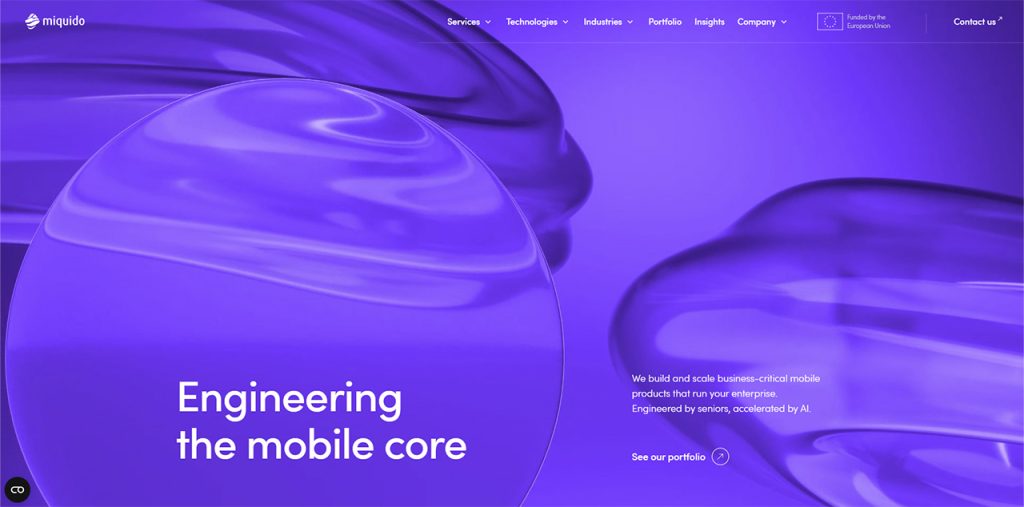
Miquido suits mobile banking products that rely on a number of external financial services. For Nextbank, it rebuilt a native banking application in Flutter and facilitated integrations with payments, KYC, remittance, and insurance providers.
The company reports that Nextbank white-label products are used by 10 banks and that its mobile application has had two million downloads. Miquido also covers AI and financial compliance consulting. Its public work makes it most convincing for digital banking and customer-facing finance products rather than highly specialized institutional investment systems.
5. DashDevs
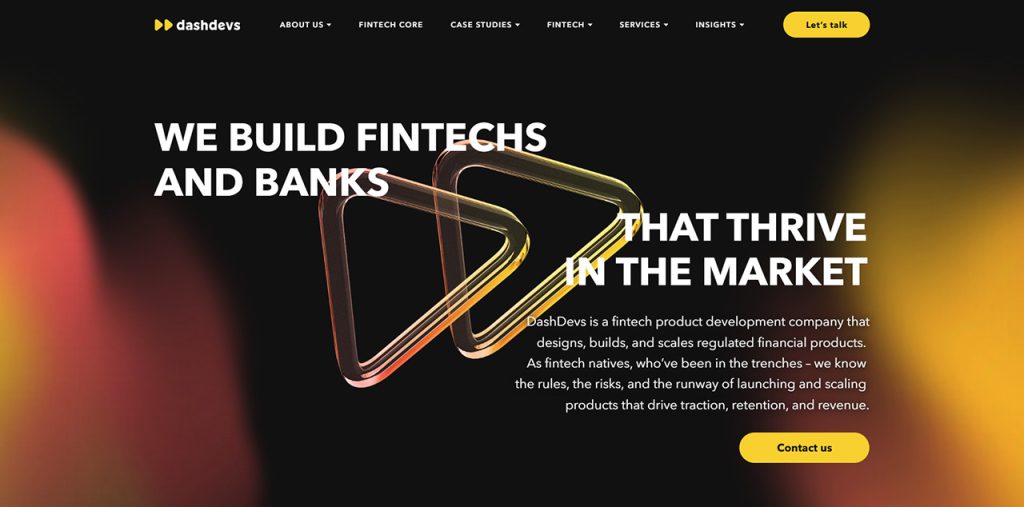
DashDevs’ area of expertise is more specific — it focuses primarily on the banking and fintech spheres. The company’s flagship product, Dozens, needed a custom core banking orchestration platform, more than 20 external APIs, and offered features such as current accounts, savings, and investments. The product was launched in just nine months. DashDevs also develops products in the realms of automated savings, wealth management, KYC, payments, and alternative asset servicing.
That depth can help with regulated products containing many connected services. However, businesses with substantial development needs outside financial services may prefer a partner with broader industry coverage.
6. 10Clouds
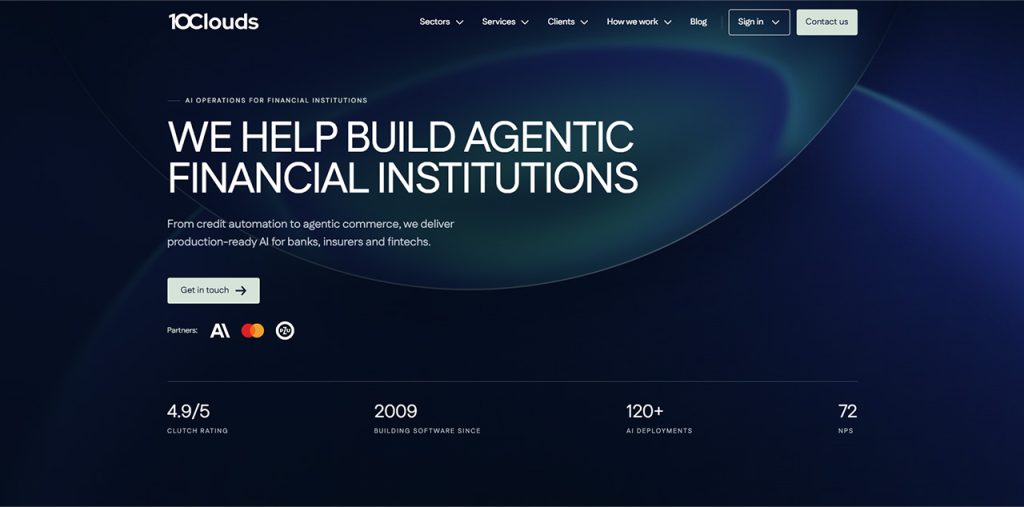
For all your financial needs, including payments, loans, identification, open banking, and AI-powered processes, 10Clouds is the way to go. It offers a range of fintech services, including discovery, cloud work, product modernization, API first architecture, compliance-aware engineering, and more.
Published projects include ongoing work with identity technology provider Trust Stamp and development for digital asset company Qenta. The provider supports both managed delivery and team extension, which gives growing fintech companies some flexibility. Buyers should still define which regulatory duties belong to the engineering vendor and which stay with internal compliance teams.
7. Softjourn

Softjourn has extensive published experience in payments and financial software. Its portfolio includes the expense management platform PEX, payment systems, open banking modernization, and a database migration for the accounts receivable company Versapay. Microservices architecture and accounting connections have been part of its collaboration with PEX for over ten years.
Softjourn is therefore worth taking into account when the project is driven by modernization, account infrastructure, or payments. Teams building highly design-focused investment applications may also want to compare its UX capabilities with more product design-centred firms.
Summary Table
| Company | Strongest fit | Published project evidence |
| Freshcode | Custom fintech and investment data platforms | European bank platform and ESG analytics |
| Netguru | Wealth management and digital banking | Moonfare and Digital Wealth Solutions |
| STX Next | Python-based financial systems | Volkswagen financing and Vyze |
| Miquido | Mobile banking and integrations | Nextbank |
| DashDevs | Core banking and regulated fintech | Dozens |
| 10Clouds | Cloud and AI fintech products | Trust Stamp and Qenta |
| Softjourn | Payments and modernization | PEX and Versapay |
How to Choose a Custom Software Development Company for Fintech
Related walkthrough
Export Custom Module In SuiteCRM

Before considering the architecture selection process costly to retrofit later, it is critical to establish security requirements. Specifically, rather than depending on end-stage testing techniques, the NIST Secure Software Development Framework suggests incorporating features and processes throughout the software development life cycle. Applications that handle financial, identity, and investment-related data in particular need to follow this procedure[.
Before hiring an organization, it may be necessary to ask a series of questions regarding access controls, code reviews, testing procedures, dependency management, audit trails, incident response, and technical documentation practices. In addition, one should clarify the organization’s role in architectural decision-making processes and its approach to the testing of third-party API services. In the case of asset management systems, particular attention must be paid to data lineage, access control, reporting logic, and the ability to provide justification for calculations to internal stakeholders.
There is no universal architecture that can be applied to all financial products and services; thus, working with a provider that will take responsibility for future modifications and updates is essential.
Conclusion
Selecting the right custom software development company requires more than comparing technical capabilities or published case studies. Fintech and asset management businesses should evaluate each provider’s domain expertise, integration experience, security practices, and understanding of FinTech Software Architecture. The right architecture ensures that financial applications are secure, scalable, and capable of handling complex operations. The best partner will understand the organization’s requirements and build a solution that can evolve alongside its business. By assessing these factors carefully, financial companies can make a more informed decision about their long-term software development investment.