

Search Engine Positioning Example: How to Rank Higher on Google
Search engine positioning example explains how your website can appear on Google. The blog also explains ranking factors, real examples, and steps to push your pages higher in search results.
In SEO, the main goal is to appear at the top of SEO, but not everyone can achieve that. While some can show up at the top of page 1, others remain buried on page 10. You might ask what really defines this ranking. The answer is the search engine positioning. This blog explores search engine positioning examples, explaining the concept from scratch so that even beginners can understand. Irrespective of whether you run a small business, a blog website, or want to study digital marketing, you will learn all key concepts that help a website achieve higher rankings in search engines.
Understanding Search Engine Positioning
Search engine positioning can be defined as the process of enhancing the position of your website in search engines such as Bing, Google, or Yahoo. You can think of it like a race; the higher the rank of your website, the more people will be able to see and click on it.
Simple Example: When you type “best CRM developer in New Jersey,” the websites that take the top position have the best search engine positioning. They have earned that spot because they have ticked all the boxes, including having fast pages, the right keywords, and getting other websites to link to their pages.
Search engine positioning is generally used in combination with SEO (Search Engine Optimization). In fact, the two terms are closely associated with one another:
- SEO is the group of actions you can take to improve the rankability of your website.
- Search Engine Positioning is the main outcome you get, i.e., your website appears in the search results.
The better your SEO strategies, the higher position you will achieve in search engines. Better positioning means attracting more visitors. And, naturally, more visitors mean getting more readers or sales. The concept is very straightforward.
Read More: Go through our dedicated blog on “What Are Search Engine Basics?” to understand the fundamentals of search engines.
Why Is Search Engine Positioning Important?
Let us learn some core truths about why your position in search engines is so significant:
| Google Position | Average Click Rate | What It Means? |
|---|---|---|
| Page 2 and Beyond | Below 1% | You become almost invisible to the audience |
| #4-#10 position | 1-5% | Traffic goes down substantially |
| #3 Position | 11% | Decent visibility |
| #2 Position | 15% | Not bad but attracts slightly less traffic |
| #1 Position | 28% | At least 1 in every 3 people click on your link |
As you can see, appearing on page 1, especially among the top 3 spots on the first page can make a lot of difference. This is why businesses spend so much time enhancing their search engine positioning.
Real Search Engine Positioning Example
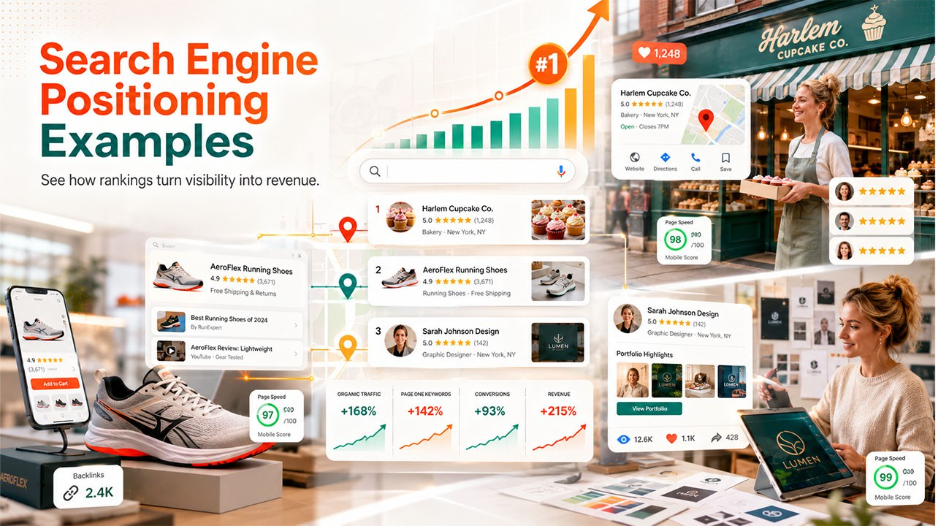
Let us see some real-world search engine examples, so you can exactly see how this works in practice-
Example 1: Local Bakery in New York-
Imagine you own a bakery in Harlem, New York. You want to rank for the keyword “Local Bakery in Harlem.” Let us see the example of two different bakeries holding different positions on search engines:
- Bakery A (Position #1): Has a fast website, utilizes the keyword “best cupcakes in Harlem” on their page. Moreover, it is listed on Google Maps and has 50 positive Google reviews.
- Bakery B (Position #2): It has a slow website, does not utilize any specific keywords, only has 2 reviews, and does not appear in Google Maps.
Which bakery do you think has a higher possibility of attracting customers? Bakery A, of course. This is a great search engine positioning example that signifies how small factors can give you great results in revenue.
Example 2: Online Shoe Store-
An online shoe store wants to rank for “Affordable running shoes” or “economical running shoes.” They utilize specific strategies such as:
- Write an in-depth blog post about “Top 10 economical running shoes in 2026.”
- It utilizes the keyword “economical running shoes” in the meta title, meta description, headings, and content.
- Collaborate with fitness bloggers to get reviews and place backlinks on their YouTube channels and blogs.
- Ensure that the website loads in less than 2 seconds.
Example 3: Freelance Graphic Designer:
A team of freelance graphic designers wants to target clients online. They can target the keyword “logo designer for small businesses.” Let us look at their search engine positioning example:
- Generate a portfolio page with that exact keyword in the title.
- Create a blog post- “How to Select the Right Logo Designer for Your Small Business?”
- Connect with previous clients to ask them to leave Google reviews mentioning their design services.
- They share their portfolio on Pinterest and LinkedIn and link back to the website.
After 6 months of consistent effort, the designer can rank on page 1 of their target keyword and begin to get 5-10 new client inquiries every month from Google alone.
What Factors Define Search Engine Positioning?

Google utilizes hundreds of signals to assign various positions. Factors that ensure that most impact are listed as follows:
Content Relevance and Quality:
- Does the page answer the search query directly?
- Is the content accurate, comprehensive, and well-structured?
- Does it align with the intent of the user? (navigational, information, and transactional)
Backlink Authority:
- How many quality websites link to your page?
- Are those links connecting your website to topically relevant domains?
- Irrelevant or spammy links can negatively impact your SEO instead of improving it.
Technical SEO Signals:
You can take care of a few factors in technical SEO to improve the search engine positioning of your website:
- Mobile friendliness
- Page load speed
- Crawlability and indexation
- HTTPS Security
User Experience Signals:
- Click-through rates from the search engine results pages.
- Dwell time (how long are the visitors staying on your pages)
- Bounce rate (how many visitors land on the page and leave immediately).
A Detailed Search Engine Positioning Example of a Small Business
Related walkthrough
How to change default search Engine

Let us understand this with the help of a real-world example of a fictional HVAC company in Delaware, United States, looking to enhance its positioning:
Step 1: Recognize Target Keywords:
Utilize Google Search Console or a professional tool such as Ahrefs to look for keywords where the website already appears between positions 8-20. You should target these pages more because they are on the verge of delivering you the expected results.
Step 2: Audit the Existing Page:
Check whether the page thoroughly covers the topic. Does it provide answers to the follow-up questions? Is the title tag SEO optimized? Is your meta description compelling?
Step 3: Enhance Depth of Content:
Include a comparison table, an FAQ section, or a local case study. For the HVAC company, including a section on “average AC repair costs in Delaware” with real data from local sources can enhance relevance.
Step 4: Develop Relevant Backlinks:
Reach out to local blogs on home improvement, chamber of commerce directories, and industry associations. Even 3-5 quality links to a particular page can meaningfully shift the position. Learn key outreach strategies to earn backlinks from credible sources.
Step 5: Resolve Technical Problems:
Run the check “Core Web Vitals.” If a page takes more than 4 seconds to load, then this becomes a ranking disadvantage. Remove render-blocking scripts and compare images.
Step 6: Monitor Position Weekly:
Utilize the performance report of Google Search Console to track the average position of every target keyword. You can expect good results for competitive keywords between 6-12 weeks. For low-difficult keywords, you can expect results even sooner.
Small businesses see good returns quickly when they combine local SEO with content enhancements.
How Can You Monitor and Measure Search Engine Positioning?

Tracking positioning means monitoring the average position of your page for specific keywords over time. The best free tool you can use for this is Google Search Console. Paid platforms such as SEMrush, Ahrefs, and Moz provide micro-tracking across hundreds of keywords with daily updates:
What Can You Measure?
- Average position per keyword (not just overall).
- Position changes week after week and month after month.
- CTR at every position (a low CTR, even with higher rankings, can be an indication of a weak meta description or title).
- Impressions (how frequently your page shows up, even if it is not being clicked).
What Are the Most Prevalent Search Engine Positioning Mistakes?
Even experienced SEO professionals can make a few errors:
- Targeting Keywords That Are Too Broad: “Software” is quite a broad term. Achieving a ranking for this keyword is next to impossible. You can instead target long-tail keywords such as “CRM developers in Indianapolis.”
- Ignoring Search Intent: If you are optimizing content for the keyword “Best CRM Software” that lists only product features (transactional) can struggle if searchers are looking for a comparison guide.
- Publishing and Forgetting: Positions can decay over time if content is not regularly updated. If you had written a blog in 2023 on the best SEO tools and have not updated it since then. The content will most likely not rank.
- Placing Links to Homepage Online: Links to specific pages, especially the ones that are targeting informational or commercial keywords, have a direct impact on positioning.
- Only Focusing on Search Engine Rankings: There is more than one way to gain visibility in search engines. You can also target featured snippets, local packs for your target keyword, “People Also Ask” box, etc.
How Long Does It Take to Enhance Search Engine Positioning?
There is no timeline that is universally true for all websites and industries. However, you can target a few realistic benchmarks that are set based on common industry experience:
- Low-competition and long-tail keywords: 4-8 weeks to see meaningful improvement in search engine position.
- Medium-competition keywords: This can take some time, ideally takes between 3-6 months.
- High-competition Head Terms: Ranking in highly difficult keywords often takes time. It will take at least 6-18 months and even longer based on your budget and domain authority.
Factors That Accelerate Your Positioning Gains:
- Target pages appearing in positions 8-15. Such pages are easier to push to higher rankings than pages that appear on the 5th or 6th page.
- Publishing content that is substantially better than the available top results.
- Earning backlinks through relevant or authoritative backlinks.
- Resolving vital technical SEO problems that are blocking rankings.
Edge Case: A brand-new domain with zero authority can struggle to rank on a high difficulty keyword for at least 6-12 months.
If you want to learn key strategies to monetize your website in 6 months, go through our blog.
Conclusion:
As a search engine positioning example reveals, getting a higher rank on Google is not a one-time task. Search engine positioning is not just a one-time task. It is a consistent process that rewards relevance, consistency, and technical accuracy. From targeting the right keywords to getting quality backlinks and resolving page speed issues, each action compounds over time. Irrespective of whether you are an SEO professional or a small business owner, applying the steps given above gives you a real competitive advantage. Track your weekly progress, fine-tune your content consistently, and your rankings will showcase your effort.