
What Is Salting in Security? A Beginner’s Guide
Learn what is salting in security, how password salting works, and how unique salts protect stored passwords from rainbow table attacks & common cyber threats.
In the current digital landscape, passwords play a critical role in protecting personal information, business data, and online accounts. However, having a strong password alone is not enough to keep sensitive information secure. Cybercriminals usually utilize various techniques to steal passwords and gain unauthorized access to systems. This is where organizations use enhanced security methods, such as hashing and salting, to strengthen password protection.
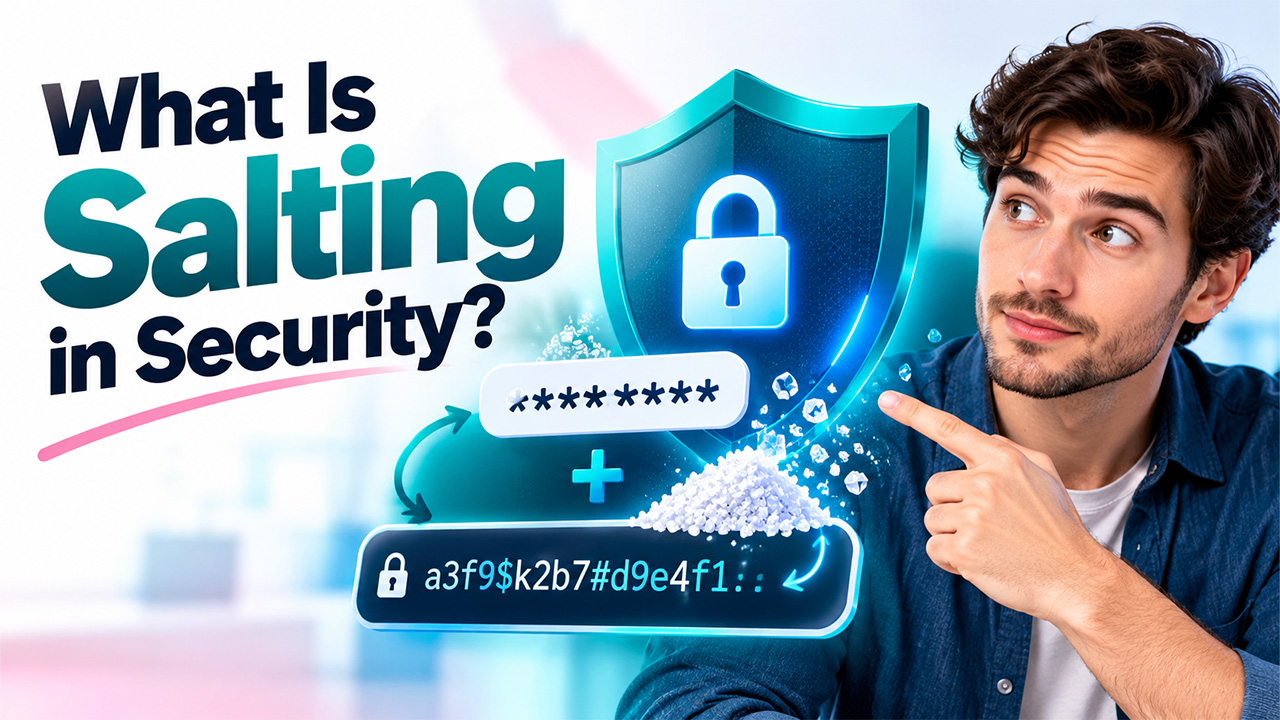
Users generally wonder what is salting in security. In cybersecurity, salting is a technique that is used to improve password security by adding unique and random data to a password before hashing it. This technique makes it more difficult for attackers to use stolen password databases to discover the original passwords of the user.
TL: DR
In cybersecurity, users wonder what is salting in security. Salting in security adds a unique and random value to a password before hashing it. Password salting helps protect stored passwords, along with reducing the effectiveness of rainbow table attacks and strengthening password security when it is combined with secure hashing algorithms. Organizations can further strengthen account protection by implementing advanced authentication methods, such as multi-factor authentication and biometric verification.
- Improves Password Security: Makes identical passwords produce different hashes.
- Prevents Rainbow Table Attacks: Reduces the effectiveness of precomputed hash tables.
- Uses Unique Salts: Assigns a different salt to each password.
What is Salting in Security?
Salting in security is a technique that is used to protect passwords by combining each password with a unique and randomly generated value, called a salt, which is applied before a cryptographic hashing algorithm. A salt is typically a random sequence of bytes that is generated for an individual password. It is stored alongside the resulting password hash so that the system can verify the password when the user logs in.
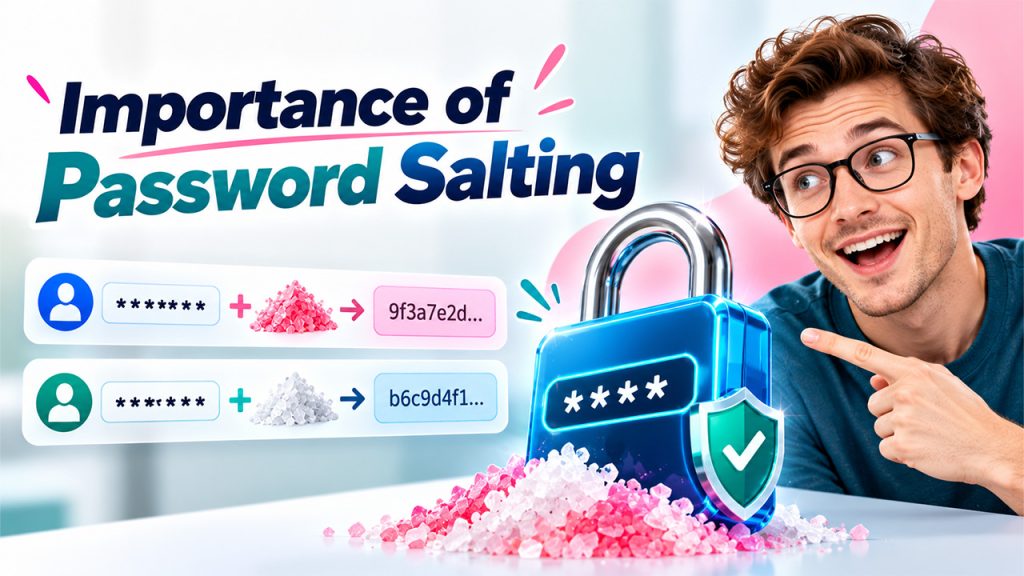
With salting, each password receives a different salt, even if two users have identical passwords, their resulting password hashes will generally be different. The main aim of salting in security is to make large-scale password-cracking attempts more difficult and expensive.
What Is Password Salting
Password salting is a type of security practice that helps protect stored passwords from being easily recovered if a database is compromised. The process adds a unique and random value called a salt to a password before processing it with a password-hashing algorithm. Password salting helps protect all the stored passwords from cyberattacks by making it harder for attackers to identify passwords using precomputed hash tables.
Websites and applications generally store password hashes that are produced by specialized password-hashing functions, instead of storing passwords as plain text. However, attackers can use previously calculated hash databases, which are known as rainbow tables, or can also perform repeated password guesses to identify weak passwords. Businesses can strengthen their CRM security by following CRM security best practices, including strong password policies, two-factor authentication, and regular access reviews.
In this scenario, password salting helps address the risk by ensuring that the same password does not consistently produce the same stored hash across different accounts when unique salts are used.
Importance of Password Salting
Related walkthrough
Google Sheets Pivot Tables for Beginners (With the New Compact Layout)

Some of the key benefits of password salting in cybersecurity are as follows:
Reduces Rainbow Table Effectiveness
Unique salts make precomputed hash tables less useful against salted password hashes.
Makes Identical Passwords Look Different
Users with the same password will have different hashes when their salts differ.
Increases the Cost of Large-scale Attacks
Attackers generally need to perform password guesses separately for each salt rather than reuse one precomputed result across many accounts.
Improves Password Storage Security
Salting adds an important layer of protection when combined with a suitable password-hashing algorithm.
In addition to secure password storage, following password security best practices can help users reduce the risk of account compromise.
How Does Salting Work?
The process of password salting works by adding a unique and randomly generated value, which is called a salt, to a password before processing it with a password-hashing algorithm. The step-by-step process of how salting works is as follows:
Step 1: User Creates a Password
When a user registers on a website or application, they choose a password. The application stores the information that allows it to verify the password during future login attempts, without the original password in plain text.
Step 2: The System Generates a Unique Salt
The system generates random salt using a cryptographically secure random number generator. This value is the additional data used by the password-hashing process.
Step 3: The Password and Salt are Hashed
The application passes the password and salt to a suitable password-hashing algorithm.
Step 4: The System Stores the Result
The application stores the salt and the resulting password-hash information in its databases. After the process, the original password does not need to be stored; the salt is generally not secret and can be stored with the hash.
Step 5: The User Logs In
When the user attempts to log in, the system retrieves the stored salt and hashing parameters. The system then processes the submitted password using the same verification procedure.
Difference Between Hashing and Salting
Although hashing and salting are closely related, they serve different purposes.
Hashing helps transform data into a fixed-format output using a mathematical function. A suitable password-hashing algorithm is designed for password storage to make guessing attacks computationally expensive.
Salting adds a unique and random value to the password-hashing process, helping prevent attackers from reusing precomputed results and making identical passwords produce different stored hashes. Businesses can strengthen their overall security strategy by following data protection best practices to safeguard sensitive information and reduce the risk of unauthorized access.
A quick comparison between hashing and salting is as follows:
| Features | Hashing | Salting |
| Purpose | Transforms a password into a hash | Adds unique random data to password processing |
| Uses random data | Not necessarily | Yes, a unique salt should be generated for each password |
| Protects against precomputed attacks | Depends on the algorithm and implementation | Makes precomputed rainbow tables less effective |
| Makes identical passwords produce different results | Not necessarily | Yes, when different salts are used |
| Used independently for password storage | A suitable password-hashing algorithm is required | Salting is used together with password hashing |
Best Practices to Implement Password Salting

Some of the best practices that organizations should follow while implementing salting in security systems are listed below:
Generate a Unique Salt for Every Password
Organizations should ensure that every password should receive its own independently generated salt. Reusing salts across different accounts reduces the protection provided by salting.
Use a Cryptographically Secure Random Number Generator
Businesses should ensure that salts are unpredictable and generated using a reliable cryptographically secure random number generator. Any guessable or predictable salts weaken the implementation.
Choosing a Suitable Password-Hashing Algorithm
Organizations should use a password-hashing function that is designed to resist guessing attacks. They should also avoid using fast general-purpose hash functions.
Configure the Work Factor Correctly
The password-hashing algorithm should be configured to use appropriate computational resources. The correct settings usually depend on the infrastructure and performance requirements of the application.
Organizations can further protect user accounts by adopting additional authentication methods such as MFA alongside secure password storage.
Conclusion
Salting in security is an important technique for protecting stored passwords from common cyberattacks. The technique adds a unique and random value to each password before hashing. Password salting reduces the effectiveness of rainbow table attacks, making password cracking more difficult. By implementing password salting correctly, developers and organizations can make password databases more resistant to common attacks and strengthen the protection of users’ sensitive information.
Frequently Asked Questions
Yes. Unique salts are a standard part of secure password storage practices. They should be used with an appropriate password-hashing algorithm.
Encryption transforms data into a form that can be reversed using the appropriate decryption key. Password hashing is designed to be one-way, allowing verification without recovering the original password. Salting adds unique random data to the password-hashing process.
Yes. Salts are generally stored alongside password hashes and do not need to be secret. Their purpose is to increase the cost of password-cracking attacks.
Salting makes precomputed attacks less useful and prevents attackers from easily reusing the same calculations across accounts. It does not stop brute-force attacks entirely.