
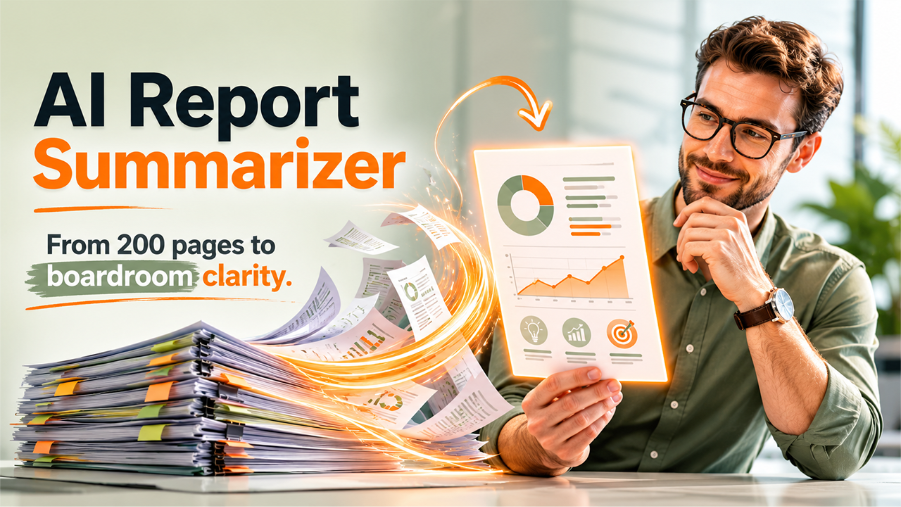
Manual vs AI Report Summarizer: What to Choose in 2026
Learn how to use manual and AI report summarization. Discover how by reading our guide about the relevant document summarizer tools and strategies.
It is 4 PM on a Friday, and your boss has requested you to summarize a 200-page report to present it at the executive meeting on Monday morning. You have to digest technical material, extract valuable insights, and present them in a way that keeps leadership interested. Sound familiar? You’re not alone.
Being able to summarize long documents into actionable summaries has become a critical skill in the modern, fast-paced work environment. In the process of preparing a board presentation, briefing stakeholders, or even just keeping up with industry reports, good summarization can help you avoid getting lost in information.
The difficulty lies in determining what’s really important, the intricate connections between concepts, and in transmitting knowledge with accuracy and certainty. In this guide, we’ll provide you with some practical tips on how to reduce even the most overwhelming reports into concise, effective summaries that your boss will be willing to listen to. You’ll learn how to make the most of both manual techniques and an AI report summarizer.
Understanding the Main Elements of the Report
You must know what you’re dealing with before you can make a good summary. Let’s see what the main elements of a report should be.
Identifying the Principal Objectives and Findings
Determining the key elements early on will save you hours of work. Find the goals of the report in the executive summary or introduction. Next, jump to the conclusion.
Highlighting Important Data and Statistics
Particularly note comparative data that indicates year-over-year growth, performance against benchmarks, or deviations from projections. Make sure you know what these numbers mean, how they were computed, and why they’re essential to your organization.
Recognizing Implications and Recommendations
Your boss doesn’t simply want to know that sales have decreased by 12%. They would like to know whether this is an indicator of a market change, a competitive risk, or a seasonal change. Understanding these implications will enable you to structure your summary and make your recommendations.
Manual Summarization Strategies
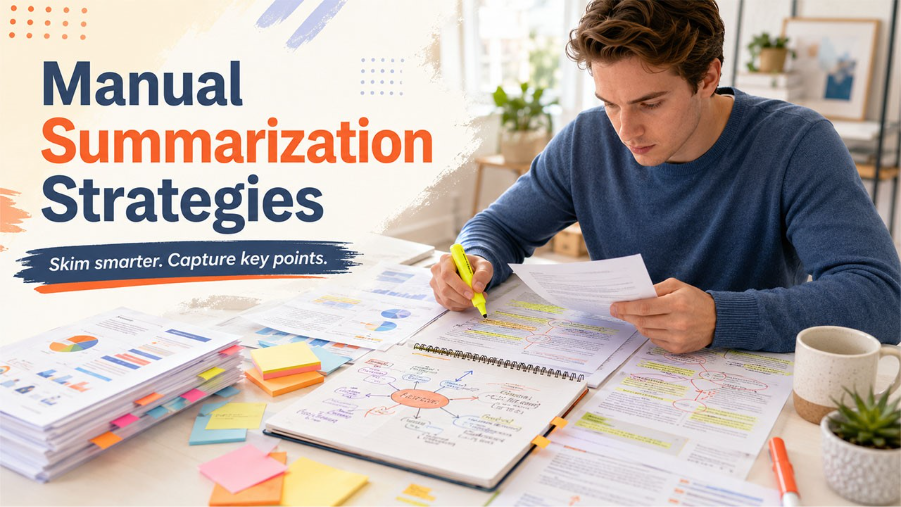
Even when we can rely on powerful AI PDF summarizer free tools, manual summarization remains valuable for building deep comprehension and critical thinking skills. By actively engaging with the material, you’ll remember it better and gain a nuanced insight that automated tools may overlook.
Skimming and Scanning for Essential Information
Effective skimming is an art. Look for bolded words, section headings, topic sentences (typically the first sentence of each paragraph), and transition words such as “most importantly,” “in conclusion,” or “the key finding”.
Numerous reports have standard structures. Pay attention to the results, analysis, and recommendations sections, where most of the content lies.
Note-Taking for Key Points
As you read the report, develop a systematic way to track key information. Some professionals prefer mind mapping, which may be especially helpful when the report presents several interrelated themes.
Whichever approach you go for, take notes in your own words to force the thinking process and really understand the content you’re dealing with.
Summarization with AI Technology
Related walkthrough
How to Choose the Right AI Tool (Stop Guessing)

Although manual approaches build knowledge, AI-based tools are necessary in time-sensitive scenarios. Many professionals now combine AI report summarizers with other productivity platforms to speed up research, documentation, and decision-making workflows. Exploring modern AI productivity tools can help teams manage information more efficiently across departments.
Overview of AI Report Summarizers
AI report summarizers use natural language processing and machine learning to analyze text. These tools can scan hundreds of pages in just a few seconds.
The effectiveness of these tools lies in their training on millions of documents across various topics. This exposure makes them see patterns in all things, including financial reports and scientific papers.
Free AI PDF Summarizers
Among the various AI report summarization tools available, you can opt for a free PDF reader for the analysis of long, complex reports. AI PDF Reader is a great free-to-use solution to try.
AI PDF summarizer allows you to upload PDFs and receive structured summaries that preserve the original document’s logical flow. You’ll be able to change the level of detail, and you can use the AI chat to pose questions on specific points.
Crafting the Summary
With the necessary information at hand, your next step is to arrange it into a compelling story for maximum impact.
Arranging Main Ideas Logically
Your summary doesn’t necessarily need to reflect the original structure of the report. When your boss is more interested in financial implications, present those findings first.
Concluding with Actionable Insights
The most powerful summaries lead the audience to make a decision. What are the decisions to be made based on this report? What should the organization do? Put these insights into words that highlight urgency and opportunity.
Delivering the Summary
The most brilliant summary is useless without confident and engaging delivery.
In remote and hybrid workplaces, summaries are often presented during virtual collaboration sessions. Understanding how to join and manage Microsoft Teams meetings effectively can improve communication and ensure your insights are delivered clearly to stakeholders.
Choose the Approach That Suits Your Specific Needs
Our workplaces continue to generate large volumes of information. Individuals who can effectively summarize complex data and convey it to others are valuable assets to their organizations.
The methods we have discussed provide you with a complete arsenal for handling even the most daunting documents. The turning point is understanding when to use which method.
Choose manual summarization in high-stakes reports that need a nuanced understanding. On the other hand, let your preferred text summarizer AI handle the heavy lifting for you when dealing with preliminary reviews or when facing severe time constraints.
It’s important to remember that summarization is a skill that can get better over time. Every report you tackle improves your skills to find patterns in documents fast and present results with clarity and confidence.
Summarize with Confidence
Be it manual or AI report summarizer, the objective is to pass from information overload to informed decisions. The next time your boss throws a massive report on your desk with an impossible deadline, breathe: you possess all the strategies and tools to deal with it.