
How to Improve Brand Visibility in AI Search Engines?
Find effective strategies to enhance brand visibility in AI search engines such as Perplexity, ChatGPT, and Gemini through AEO, GEO, and technical SEO.
The growth of AI-driven search engines has drastically changed how consumers find brands and make buying decisions. With Perplexity, ChatGPT, and Google AI Overviews managing an increasingly large volume of search queries, businesses face a vital question: how to enhance search visibility in AI search engines and remain discoverable in this landscape?
In this complete guide, let us explore effective strategies for enhancing brand visibility in AI search engines, covering everything from generative engine optimization (GEO) basics to advanced AI optimization techniques that leading brands are using in 2026.
What Strategies Enhance Brand Visibility in AI Search Engines?
Before delving into specific tactics, it is vital to comprehend what actually makes AI search distinct from conventional search. AI platforms such as Perplexity and ChatGPT do not just provide results aligned with keywords; they process information collected from distinct sources to provide contextually relevant and conversational responses.
The most efficient strategies to improve brand visibility in AI search engines are as follows:
- Generative Engine Optimization (GEO): Specifically optimizing content for AI retrieval and citation.
- Answer Engine Optimization (AEO): Content structuring to answer conversational queries directly.
- Authority Building: Establishing topical expertise that AI models can identify and cite.
- Technical AI SEO: Implementing structured data analytics and schema markup for AI comprehension.
- Multi-platform Optimization: Personalizing strategies for Perplexity, Gemini, ChatGPT, and Google AI Overviews.
Businesses that secure services with specialized AI search optimization agencies greatly report enhancements in AI visibility, and some observe 3-5 times improvements in brand mentions across AI platforms within 6-12 months. For companies aiming to establish a commanding presence in European markets, partnering with an expert GEO agentur in Deutschland ensures that your localized content is perfectly structured for high visibility and reliable citations within top generative AI engines.
Comprehending How AI Search Engines Work
To effectively enhance brand visibility in AI search engines, you need to first be familiar with how these solutions process and present data.
Large Language Models and Data Retrieval:
AI search engines are driven by LLMs, i.e., Large Language Models that have been trained on large volumes of internet data. Whenever a user asks a query, such models:
- Understand the Query: Understand context and user intent.
- Fetch Relevant Data: Get insights from real-time web searches and training data.
- Process Responses: Integrate sources to create helpful and coherent answers.
- Cite Sources: Attributing data to specific websites (in a few cases).
What Are the Important Differences Between Conventional Search?
| Factor | Traditional Search (Google) | Synthesized answers in a conversational tone |
|---|---|---|
| Results Format | List of links | Synthesized answers in conversational tone |
| Ranking Factor | Keywords, Backlinks, Page rank | Citation-worthiness, authority, clarity |
| User Behavior | Clicks-through to website | Often gets answers directly |
| Optimization Approach | SEO | GEO/AEO |
| Visibility Measurement | Clicks, rankings, impressions | Citations, mentions, recommendations |
Strategy 1: Execute Generative Engine Optimization
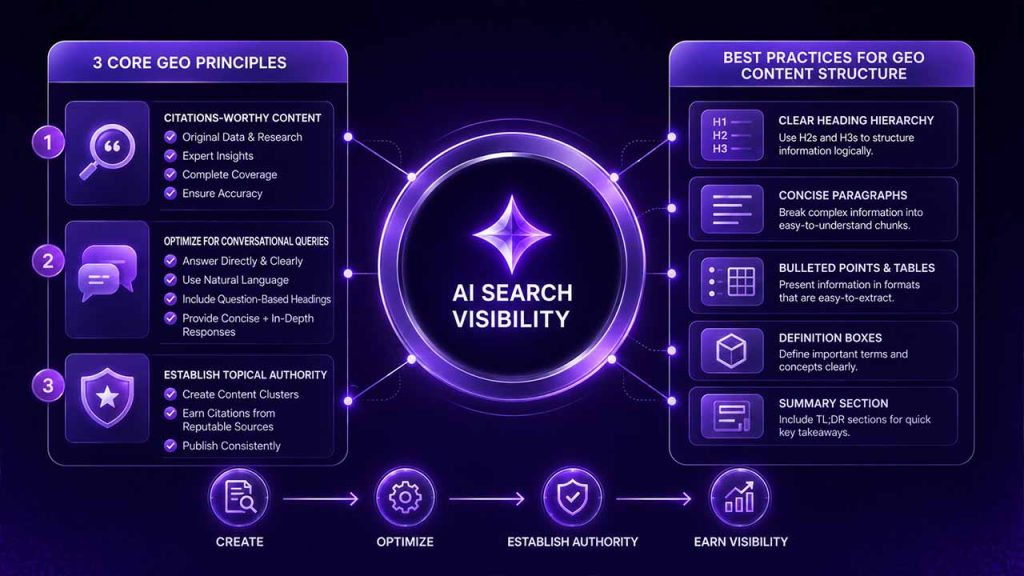
Generative engine optimization can be defined as the process of streamlining your digital presence and content to be understood, discovered, and cited by AI-driven search engines.
Core GEO Principles
1. Create Citations-worthy Content:
AI engines cite sources that render unique and authoritative information. To become more worthy of citations:
- Include Original Data and Research: Proprietary surveys, statistics, and case studies to get more frequently cited.
- Offer Expert Insights: Commentary from experts who are recognized by the industry.
- Provide Complete Coverage: In-depth guides that comprehensively cover topics.
- Ensure Accuracy: Rigorously check all the facts and data.
2. Optimize for Conversational Queries:
The difference between traditional search and AI search queries is that AI search queries are more conversational than traditional search queries. You can optimize by:
- Directly and clearly answering questions.
- Utilizing natural language that aligns with how people ask questions.
- Involve question-based headings (what, who, when, where, why, how)
- Provide scannable and concise responses followed by in-depth explanations.
3. Establish Topical Authority:
AI models prioritize topical expertise. You can set authority through:
- Creating complete content clusters centered around core topics.
- Getting citations and mentions from reputed sources.
- Consistently publishing content on expertise areas
What Are the Best Practices for GEO Content Structure?
Organize your content for streamlined AI comprehension:
- Clear Headings of Hierarchy: Utilize H2s and H3s to logically streamline information.
- Concise Paragraphs: Break complex data into easy-to-understand chunks.
- Bulleted Points and Tables: Present information in formats that are easy to extract.
- Definition Boxes: Define important terms and concepts in a clear way.
- Summary Section: To address users who do not read completely, you can utilize TL; DR sections.
Strategy 2: Master Answer Engine Optimization (AEO)
Answer Engine Optimization emphasizes organizing content to render direct answers to user questions. This is significant for getting featured in voice search results, featured snippets, and AI-driven answers.
AEO Best Practices
1. Target Question-driven Keywords:
Target and research questions that your audience is asking:
- Utilize platforms such as AlsoAsked, AnswerthePublic, and Semrush to find queries.
- Also look at the section “People Also Ask” on Google.
- Review common questions regarding customer support.
- Track social media discussions and industry forms.
2. Provide Concise or Direct Answers:
- Directly answer the question in 40-60 words.
- Follow with supporting context and details.
- Keep the question as H2 or H3 heading wherever appropriate.
- Include relevant data and examples.
3. Optimize for Featured Snippets:
Featured snippets directly feed into AI Overviews. To optimize:
- Paragraph Snippets: Give 40- 60-word responses or definitions.
- List Snippets: Utilize bulleted or numbered lists for step-by-step guides.
- Table Snippets: Display comparative information in HTML tables.
4. Execute FAQ Schema:
Utilize FAQ structured data to enable AI engines to comprehend your Q&A content:
{

  "@context": "https://schema.org",

  "@type": "FAQPage",

  "mainEntity": [

    {

      "@type": "Question",

      "name": "How does AI search differ from traditional search?",

      "acceptedAnswer": {

        "@type": "Answer",

        "text": "AI search delivers conversational, context-aware answers by evaluating authority and clarity, not just keywords."

      }

    },

    {

      "@type": "Question",

      "name": "What content gets cited most by AI engines?",

      "acceptedAnswer": {

        "@type": "Answer",

        "text": "Original research, expert commentary, and well-structured content that directly answers conversational queries."

      }

    },

    {

      "@type": "Question",

      "name": "How do I measure AI brand visibility?",

      "acceptedAnswer": {

        "@type": "Answer",

        "text": "Use AI monitoring tools to track mention frequency, citation context, and competitive share of voice across ChatGPT, Perplexity, and Gemini."

      }

    }

  ]

}
Strategy 4: Develop AI-friendly Technical SEO
Technical optimization enables AI crawlers to effectively understand and index your content.
Vital Technical Optimizations
1. Execute Complete Structure Data:
Schema markup enables AI to understand the context of your content:
- Organization Schema: Determine the data of your company
- Article/Blog Posting Schema: Mark up blog topics with data, authors, and categories.
- Product Schema: Ensure in-depth product details for e-Commerce.
- FAQ Schema: Markup Q&A content for AI extraction and featured snippets.
- HowTo Schema: Structure content procedurally.
- Review Schema: Include testimonials and ratings.
2. Optimize the Architecture of the Website:
Create a logical and clear website:
- Ensure content organization in topical clusters
- Utilize keyword-rich and descriptive URLs
- Execute breadcrumb navigation
- Ensure a shallow click depth (3-4 clicks to any page)
3. Improve Crawlability:
Make sure AI crawlers can easily access your content:
- Submit as well as maintain XML sitemaps
- Appropriately utilize robots.txt (do not block important content)
- Execute canonical tags to avoid duplicate content issues
- Ascertain higher page load speeds
4. Semantic HTML Structure:
Utilize semantic HTML to enable AI to understand hierarchy in content:
- Single H1 per page that aligns with the main topic
- Logical hierarchy for H2-H6 headings
- Proper utilization of lists (ul, ol) and tables
- Semantic elements (header, main, section, article, aside, footer)
Strategy 5: Utilize AI Visibility Tools for Tracking
Related walkthrough
The Ultimate Brand Booster Plan for Startups, SaaS & AI Companies

You will not be able to make improvements to something that you cannot measure. AI visibility tools are vital for monitoring the presence of your brand across AI search engines.
Important Metrics You Can Monitor:
- Frequency of Brand Mention at the Top: How frequently AI engines mention your brand.
- Quality of Citation: Context and sentiment of mentions.
- Competitive Positioning: Compare your visibility with that of your competitors.
- Query Triggers: Which queries are likely to encourage AI to mention your brand?
- Platform Coverage: Visibility across ChatGPT, Perplexity, Gemini, etc.
Strategically Utilize AI Visibility Data:
Leverage tracking data:
- Recognize top-opportunity queries when you are not currently visible.
- Establish competitor benchmarks and monitor progress.
- Fine-tune content strategy as per what is working.
- Quickly detect and address visibility issues.
For businesses that do not have expertise in in-house AI, collaborating with professional AI search engine optimization agencies gives you access to enterprise-based tracking systems that can effectively interpret the data.
Strategy 6: Establish Brand Authority for AI Recognition
AI models focus on authoritative sources. Establishing brand authority enhances your possibilities of being recommended and cited.
Tactics for Building Authority:
Publish Original Research
Including original research and data is worthy of citation:
- Conduct surveys on the industry and publish industry findings.
- Link sources that publish reports on the state of the industry annually.
- Collaborate with research institutions.
- Make use of internal data that gives you unique insights.
Secure Mentions and Media Coverage
Brand mentions across a variety of authoritative sources is strong signal of credibility:
- Foster relationships with industry experts.
- Provide guest articles to relevant institutions.
- Become a part of conferences and industry events.
- Ensure thought leadership engagement on social platforms.
Foster Expert Positioning
Promote your team members as industry experts:
- Ensure podcast appearances and speaking engagements.
- Publish expert commentary and bylined articles.
- Join appropriate online communities.
- Maintain up-to-date expert credentials and bios.
Get Quality Backlinks
Getting links from authoritative sources ensures credibility:
- Generate linkable assets (templates, tools, original research)
- Invest in strategic digital PR.
- Establish relationships with complementary brands.
- Join relevant listings and directories.
Strategy 7: Platform-specific Organization
Distinct AI platforms have different features. Accordingly, personalize your approach:
ChatGPT Optimization (SEO for ChatGPT):
ChatGPT depends on training data and web browsing (in a few versions):
- Make sure that your brand shows up on high-authority sources that improve training data.
- Make sure that your Wikipedia entries are accurate and complete whenever applicable.
- Create content that addresses common questions users ask on ChatGPT.
- Get backlinks from credible sources that signal authority.
Perplexity AI Optimization:
Perplexity AI focuses on real-time web search with source citations:
- Optimize your content to show up in the source citations of Perplexity.
- Emphasize well-structured and complete content.
- Maintain optimal crawlability and quick page speeds.
- Optimize featured snippet opportunities.
Google Gemini Optimization:
Gemini integrates with the search infrastructure of Google:
- If your Google search ranking is high, you have a higher chance of appearing in Google AI Overviews.
- Incorporate Generative Engine Optimization techniques and optimize for the AI overviews.
- Optimize Google Business Profiles to appear in local queries.
- Utilize YouTube to gain visibility in video content.
Microsoft Copilot Optimization:
Copilot integrates with Microsoft or Bing products:
- Ascertain optimization of Bing Webmaster.
- Maintain a strong presence on LinkedIn, which is also Microsoft-owned.
- Incorporate ranking factors specific to Bing.
What Are the Prevalent Mistakes That Can Hurt Your AI Search Visibility?
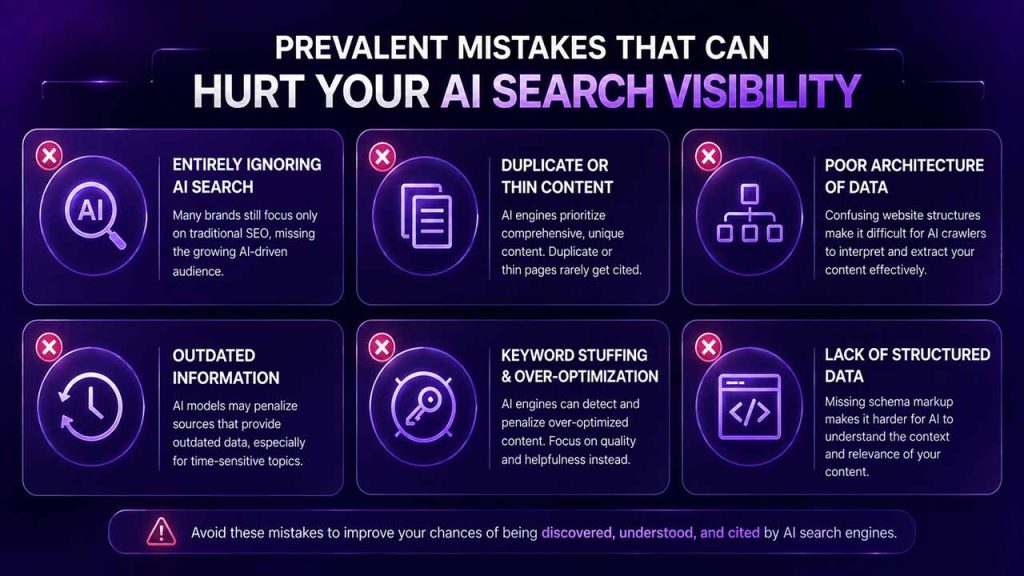
Avoid the pitfalls that can negatively impact the AI visibility of your brand:
1. Entirely Ignoring AI Search:
A lot of brands still exclusively focus on conventional SEO, failing to tap into the growing audience that utilize AI. Gartner has forecasted a 25% decline in the conventional search traffic 2026.
2. Duplicate or Thin Content:
AI engine focuses on complete or unique content. Duplicate content or thin pages often do not get cited.
3. Poor Architecture of Data:
Confusing structures of website make it tough for AI crawlers to effectively interpret and extract your content.
4. Outdated Information:
AI models can penalize sources who are keeping outdated data, specifically when it comes to topics that are time sensitive.
5. Keyword Stuffing and Over-optimization:
AI engines are advanced enough to identify and possibly penalize content that is over-optimized (contains keyword stuffing). You need to pay attention to quality as well as the helpfulness of the content.
6. Lack of Structured Data:
If your schema markup is missing, AI can find it tougher to understand the context and relevance of the content.
Measuring Success in AI Search Visibility
Monitor these key performance indicators to assess improvements in your AI search visibility efforts:
Primary Efforts:
- Frequency of Brand Mentions: Monitor mentions across Perplexity, ChatGPT, and Gemini.
- Citation Rate: How frequently does your content get cited as a source.
- AI Overview Appearances: How many times have you been featured in Google AI Overviews?
- Competitive Voice Share: Comparing your visibility against your competitors.
Secondary Metrics:
- Referral Traffic from AI Tools: Clicks from other citing platforms and Perplexity
- Visibility in Featured Snippets: Your appearance in Google’s featured snippets.
- Topical Authority Scores: Third-party authority metrics.
- Structured Validation of Data: Quality of schema implementation.
- Site Clusters: Site clusters are a group of websites that show up on the right side of a search result.
How Much Time Does It Take to Ensure AI Visibility Improvement?
AI visibility improvement is not a one-day process. A general timeline is as follows:
- Technical Optimization: Generally, it takes 1-3 months to implement; effects can be observed between 2-6 months.
- Content Optimization: It takes around 3-6 months to see meaningful improvements in visibility.
- Authority Building: It takes between 6 and 12 months to see substantial gains in authority.
- Overall Strategy: Most brands see great improvements within 6-12 months of continuous effort.
You can partner with a professional GEO specialist who can help you expedite the results by preventing common mistakes and executing strategies from the very beginning.
Conclusion
Enhancing brand visibility in AI search engines needs a multi-level approach that integrates GEO, AEO, technical SEO, authority building, and platform-centric strategies. As AI-based search continues to transform how consumers find brands, businesses that adjust early can get a phenomenal competitive advantage. Emphasize well-structured, authoritative, and citation-worthy content while continuously tracking your performance across platforms. Irrespective of whether you execute strategies in-house or secure services from an AI search optimization agency, the time to act is now.