

Best Free Keyword Research Tools to Sharpen Your SEO in 2025
The right free keyword research tools can make your SEO strategy sharper without any financial investment. Compare the best picks by simplicity, search volume insights, and PPC data.
Obtaining good rankings in SERP results requires a detailed strategy that starts long before you write even a single word. It begins with understanding precisely what your audience wants to know or purchase. This is exactly where keyword research turns out to be a vital step. For bloggers, marketers, and small business owners working with tight budgets, the good news is that a lot of free keyword research tools are available that can enhance your SEO and content strategy.
In this guide, let us see what these tools are, how they operate, how they are unique, and how you can select the right one for your requirements.
What Are Free Keyword Research Tools?
Keyword research is the core part of what SEOs do. Free keyword research tools are software applications or platforms that can enable you to recognize the search terms people generally type in search engines such as Bing or Google. They give you data points like:
- Search volume: how frequently a keyword is searched each month.
- Keyword difficulty: What is the level of competition for a particular keyword?
- CPC (cost-per-click): valuable for both paid advertising and search engine optimization.
- Long-tail keyword suggestions: more particular phrases with less competition.
- Search intent signal: define the purpose of users, i.e., whether they want to learn, buy, or compare.
Contrary to premium tools that need paid subscriptions, free keyword research tools provide a usable subset of such features at no cost. They are specifically valuable for freelancers, startups, bloggers, and small businesses that require data-based insights without a substantial upfront investment.
Top Free Keyword Research Tools Worth Using in 2026
Related walkthrough
TubeOptimize Pro Review: Boost YouTube SEO with AI Tools for Higher Rankings & Views

1. Google Keyword Planner
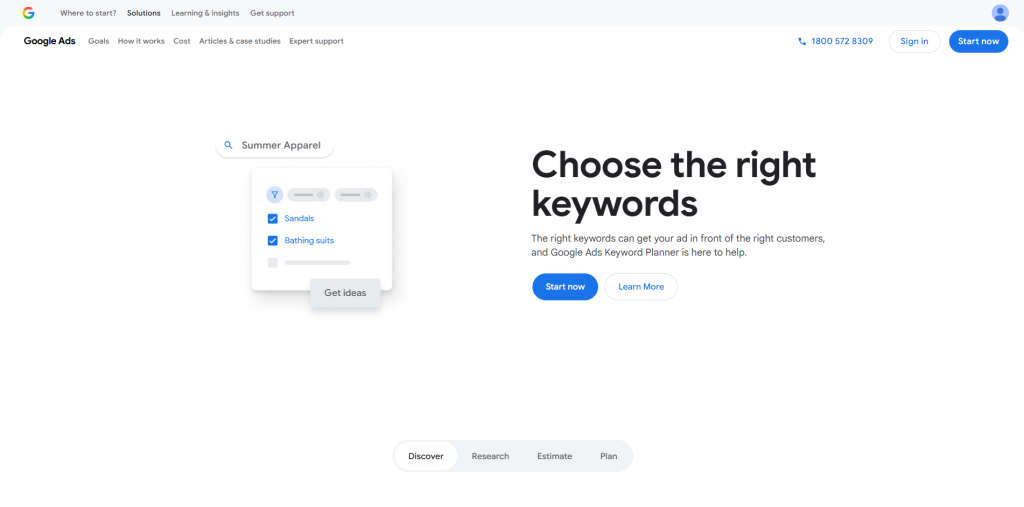
Google Keyword Planner emerges as one of the most trustworthy free keyword research tools available. Built originally for Google Ads users, it extracts data from Google directly, ensuring that you get the most accurate search volume for a particular keyword.
Key Characteristics:
- Search volume changes and historical information get directly sourced from Google.
- Suggested variations in keywords and associated phrases.
- Ad-driven insights that also prove to be advantageous for organic SEO keyword research.
- Free accessibility with a Google Ads account (no ad spend is needed).
The only caveat is that it factors in PPC campaigns more than organic results, so search volume data appears in wider ranges rather than accurate figures. Yet, it turns out to be a great starting point for finding keywords.
2. SEMrush Keyword Magic Tool
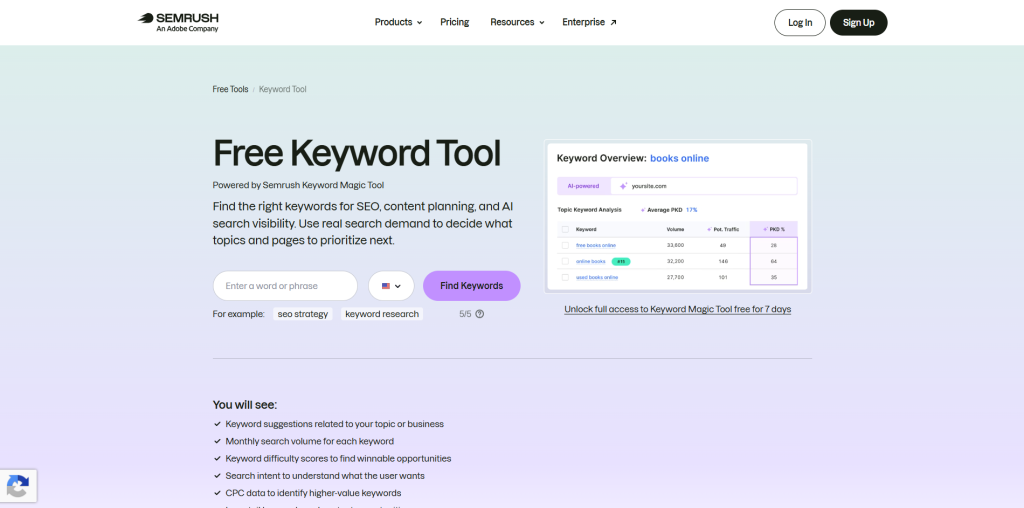
SEMrush’s Keyword Magic Tool enables you to search a database with more than 25 billion keywords across 142+ countries, with filters for search intent, search volume, and keyword difficulty score.
Main Features:
- Accessibility to the quality metrics, including competition level, search volume, CPC, intent, and trends across national, local, and global scales.
- Keyword difficulty analysis that takes into account 10+ parameters, including authority scores, referring domains, search intent signals, and SERP features.
- Capability to review average CPC for ads associated with target keywords, valuable for planning PPC campaigns along with organic content.
The free tier comes with a few usage limits applicable daily. However, even within those limits, SEMrush ensures wide enterprise-level keyword research depth that competes with numerous premium tools.
3. Moz Keyword Explorer:
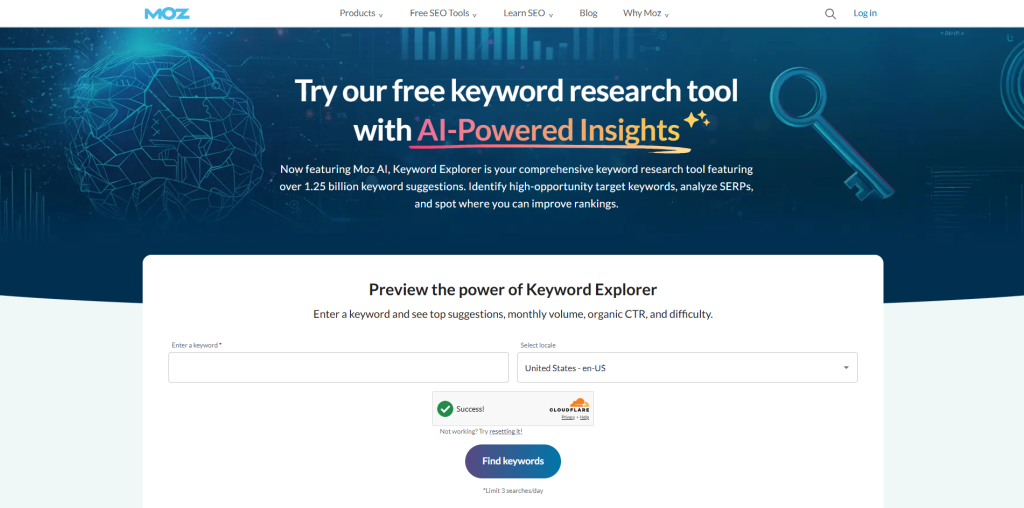
Moz Keyword Explorer features more than 1.25 billion keyword suggestions and utilizes Moz to examine ranking difficulty, keyword demand, and search intent. Users can also assess domain authority, organic click-through rates, and the competitive landscape.
Main features:
- The free account involves 10 keyword queries/month, with every query returning around 1,000 keyword suggestions along with complete metrics such as organic CTR, volume, difficulty, and priority scores.
- Free-tier users also get access to SERP analysis for each keyword, showcasing which pages are presently ranking and what SERP characteristics they currently trigger.
- A Priority score metric that gives insights on difficulty, volume, and click-through potential, enabling you to focus your efforts on winnable terms.
Moz is specifically well-suited for starters, courtesy of its user-friendly and clean design and detailed educational resources.
4. Ahrefs Free Keyword Generator:
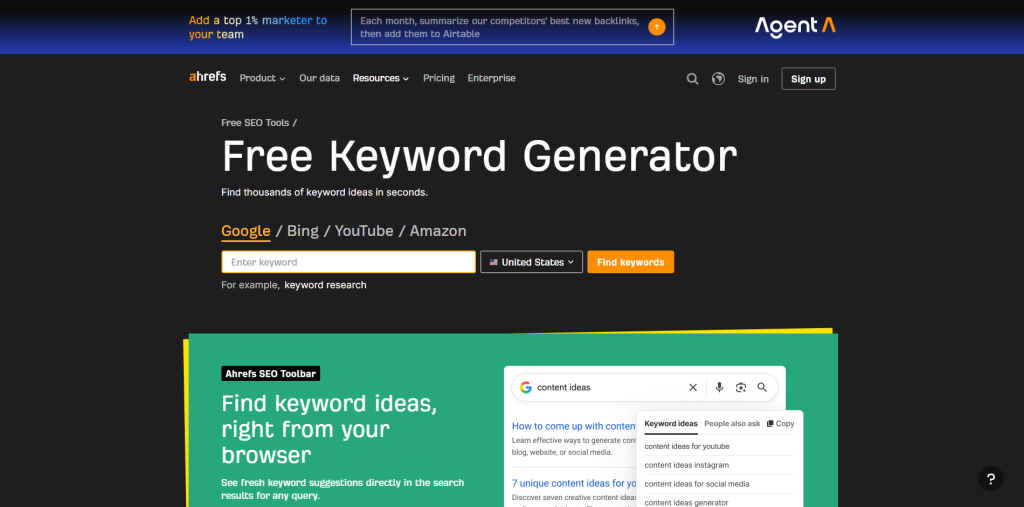
Ahrefs provides a free keyword generator available at their public-facing tool place, which returns close to 100 keyword ideas for each search without needing a sign-in.
Main features:
- Returns hundreds of basic metrics and keyword ideas, including difficulty scores and search volume for your seed term.
- Free tools also involve a YouTube keyword tool, a keyword difficulty checker, and an Amazon keyword tool, encompassing numerous platforms apart from Google.
- Ahrefs also gives you a separate free SERP check tool for checking search result pages along with the keyword information.
The free keyword research tools of Ahrefs are beneficial for creating quick ideas without requiring a complete subscription.
5. WordStream’s Free Keyword Tool
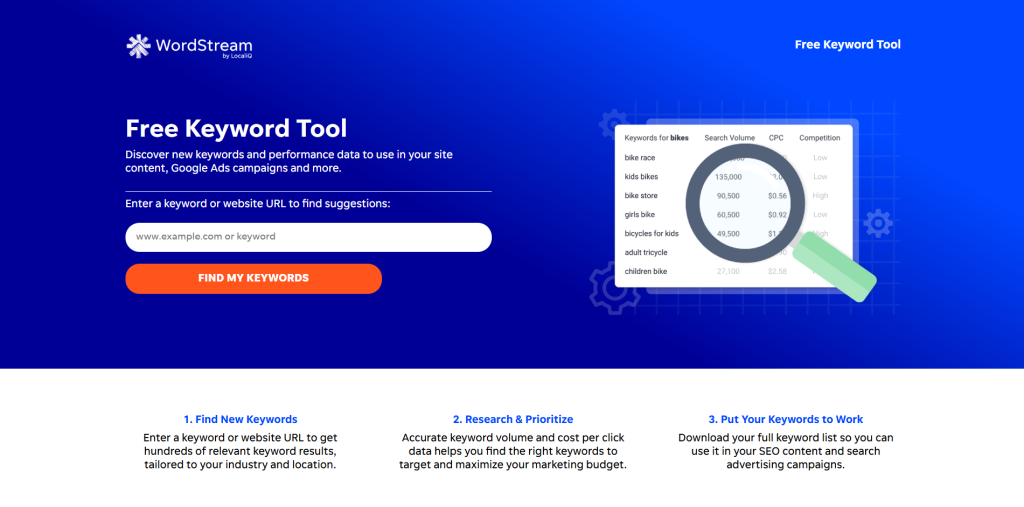
WordStream’s Free Keyword Tool is specialized to be quick and simple. It provides you with hundreds of related key terms personalized to your location and industry.
Main features:
- Gives you actionable data which includes competition level and accurate CPC along with keyword suggestions.
- Enables filtering by 24 business verticals from Finance and Retail to Health and Travel.
- Provides support to the location-driven filtering across 23+ countries, making it valuable for both international and local campaigns.
- The tool sources keyword data through Bing and Google keyword research API.
The free version showcases all the best 25 results instantly; the complete list is available through email. It is specifically well-suited for marketers who run PPC campaigns and also wish to gain insights for their organic keyword strategy.
6. Wordtracker
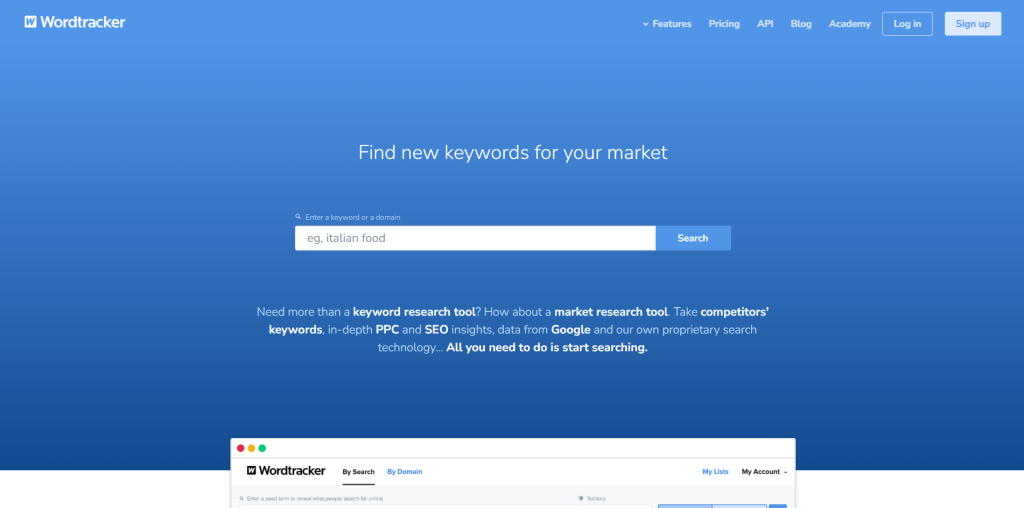
Wordtracker positions itself as an effective free alternative to Google Keyword Planner, providing the capability to surface thousands of profitable long-tail keywords around 10,000 results per each search.
It is specifically valuable for recognizing low-competition and niche-specific terms that premium tools can overlook. The free version provides a limited number of searches per day, making it a great option for targeted research sessions instead of high-volume keyword mining.
7. Ubersuggest
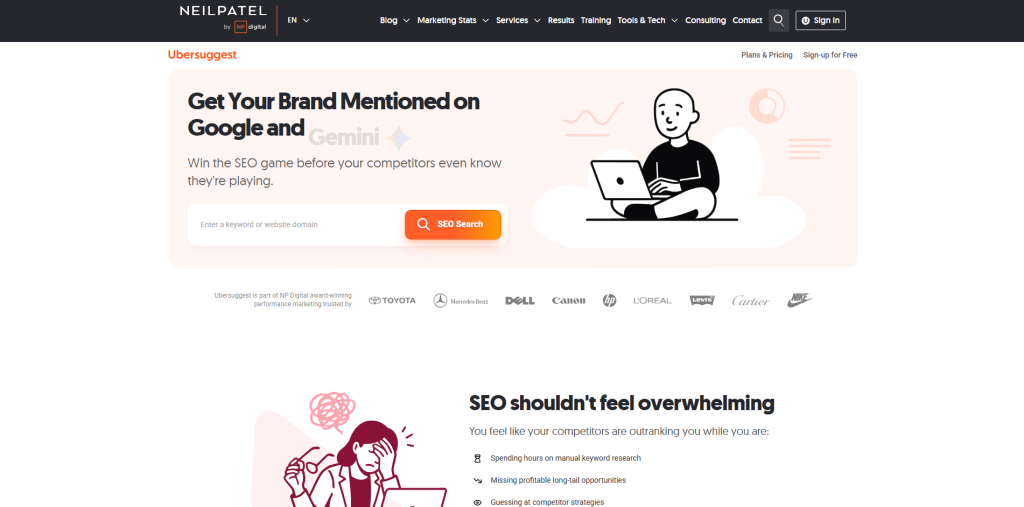
Built by Neil Patel, Ubersuggest has emerged as one of the most prominent free keyword research tools, providing a generous set of SEO insights without needing a premium subscription upfront.
Main features:
- Involves SEO difficulty scores, search volume, paid difficulty, and content ideas.
- A tab of keyword finer analysis that compares your domain against key competitors, valuable for identifying content gaps.
- It strikes a good balance between rich data and usability, making it best for bloggers, freelancers, and small agencies.
There is a daily search limit on the free plan. However, the data available within such limits is among the most complete of any free keyword tool.
8. AnswerThePublic
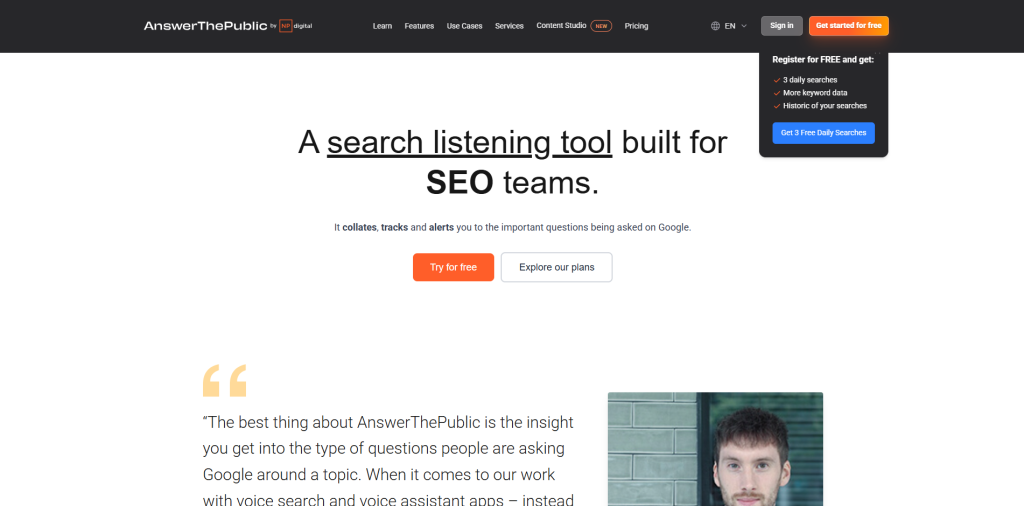
AnswerThePublic creates comparisons, questions, and prepositions around a main term, ensuring queries in natural language that align with precise user searches. This makes it the best option for blog post ideas and brainstorming content.
It is specifically beneficial for:
- Creating topic clusters around a keyword
- Optimizing content for featured snippets and the People Also Ask section.
- Mapping out opportunities for long-tail keywords as per real user questions.
The free version poses daily limitations on searches. However, even a single session can help you recognize dozens of useful content angles.
How to Choose the Right Free Keyword Research Tool?
No single tool encompasses all aspects. The right choice depends on your specific workflow:
| Goal | Recommended Tool |
|---|---|
| PPC + organic combined | Google Keyword Planner and WordStream |
| Large keyword database | SEMrush Keyword Magic Tool |
| User-friendly interface | Ubersuggest, Moz |
| Multi-platform research | Ahrefs Free Keyword Generator |
| Searching long-tail keywords | Wordtracker |
| Content conceptualization | AnswerThePublic |
For the right results, utilize a mix of tools: Google Keyword Planner to find out competition and search volumes, AnswerThePublic for question-driven keywords, and Google Trends for recognizing rising topics and seasonal patterns. People who launch and monetize their website in 6 months utilize numerous free keyword research tools instead of depending on a single platform.
Conclusion
The landscape of free keyword research tools is capable and wide. Google Keyword Planner provides unmatched search volume and competition accuracy. SEMrush ensures a broad keyword database with intent-level filtering. Moz introduces a user-friendly interface with trustworthy priority scoring. Ahrefs gives you trusted difficulty data with no sign in needed. WordStream adds locations and industry-based filtering. Wordtracker specializes in long-tail discovery. Ubersuggest balances simplicity and depth. And AnswerThePublic is a preferable solution for content ideation based on actual search behavior.
An intelligent keyword research strategy generally involves a combination of these two or three tools. You can verify volume in one, explore intent in another, and analyze competition in a third. Begin with the tool that aligns with your objectives and begin from there.