
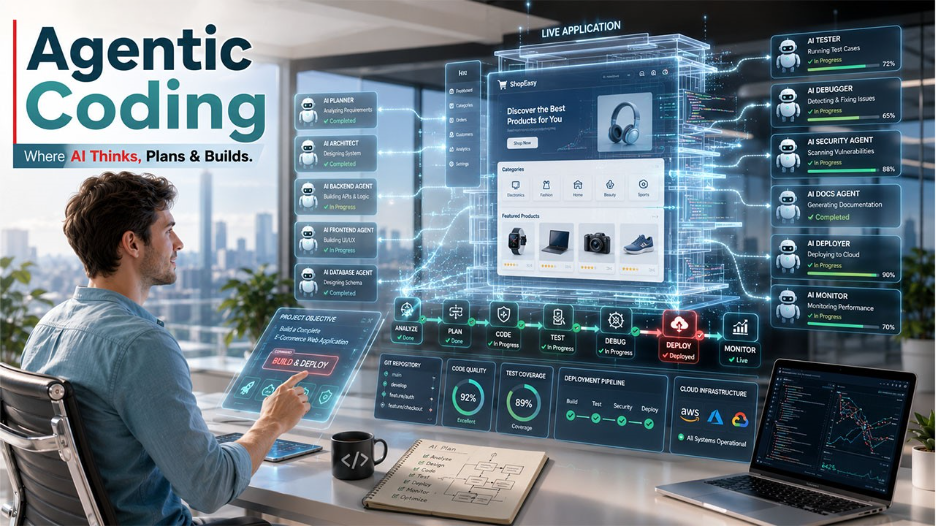
Understanding Agentic Coding: From AI Assistants to AI Agents
Understand what agentic coding is, and discover how AI agents work, their benefits, and how it is transforming software development in 2026.
The article offers a complete understanding of what agentic coding is, how it works, and what its applications are in the real world, along with its benefits and limitations.
In the recent few years, the software development sector has witnessed massive transformations. From coding manually in low-level programming languages to modern integrated development environments (IDEs), cloud-based platforms, and AI-powered code assistants. In this continuous shift, Agentic Coding is considered the next major shift in the sector.
Unlike traditional AI coding assistants, which only respond to prompts, the intelligent AI agents in agentic coding can plan, reasoning, executing, testing, debugging, and iterating on software development tasks, with minimal human intervention. With the increasing adoption of AI-first development practices across various organizations, agentic coding is emerging as one of the most significant trends in the sector.
Understanding Agentic Coding
Agentic coding is considered the modern approach to software development, in which an AI agent offers an active role in the coding process. The agentic AI system can independently operate with a degree of autonomy, which allows the developers to delegate complex workflows. The agent can plan, execute, test, and refine software development tasks, unlike a traditional AI coding assistant, which only responds to prompts or suggested code snippets.
The agentic coding combines key capabilities, such as large language models, reasoning capabilities, and core programming principles explained in Basic Coding Concepts, access to development tools, and the ability to maintain context across the entire project. The agent can efficiently analyze a codebase, along with understanding project requirements, generating new features, modifying existing code, running tests, and identifying and fixing bugs.
Features of Agentic Coding
Agentic coding efficiently introduces new and more enhanced intelligence and autonomy into software development. Some of the key features of agentic coding are as follows:
- Autonomous Task Execution: One of the key features of agentic coding is its ability to perform various tasks independently. After receiving an objective, the agent plans the required steps, writes code, executes commands, runs tests, and iterates the solution, with minimal human intervention.
- Context Awareness: Unlike traditional coding assistants, the agentic AI can understand the broader context of a project. It can also analyze the entire codebase, project structure, coding standards, dependencies, and documentation to generate code.
- Tool Integration: The agentic coding system can seamlessly interact with multiple development tools and environments. They can also work with version control systems, integrated development environments (IDEs), testing frameworks, package managers, databases, cloud platforms, and deployment pipelines.
- Automated Testing and Debugging: Agentic coding has the ability to validate its own work. The agent can generate unit tests, integration tests, and functional tests, and can also execute them automatically to identify failures, analyze error messages, and modify code.
Benefits of Agentic Coding
Agentic coding offers key benefits to organizations, which include:
- Increased Developer Productivity: The AI agents can efficiently automate various repetitive and time-consuming tasks, such as boilerplate code, creating APIs, generating documentation, and configuring project files, increasing the productivity of the developers.
- Faster Software Development: Agents can significantly reduce the time required to develop software applications. The AI agents can analyze requirements, generate code, perform testing, and fix errors independently.
- Improved Code Quality: The agent follows established coding standards, along with design patterns and best practices, while generating code. This results in enhanced overall quality, readability, and maintainability.
- Reduced Development Costs: Agentic coding helps organizations optimize resource utilization and reduce operational costs.
Traditional AI Coding vs Agentic Coding
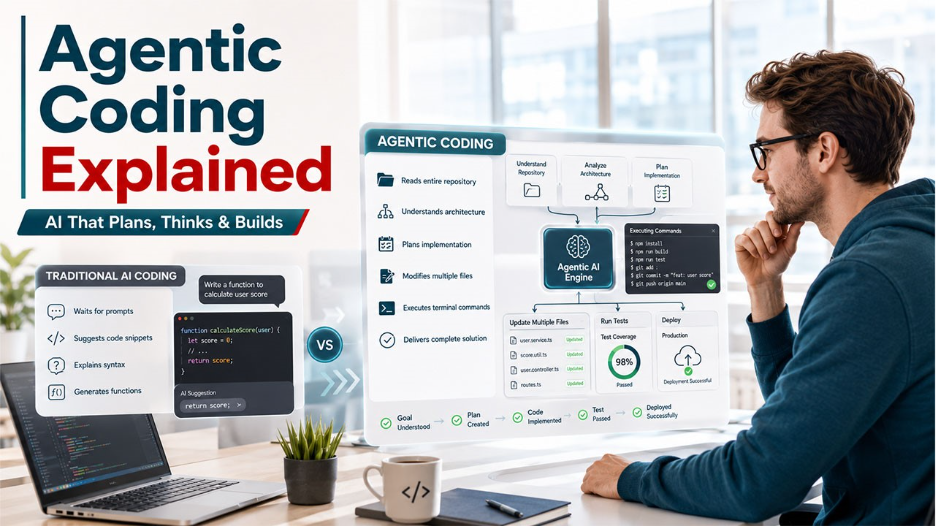
Traditional AI Coding
Traditional AI coding is an AI-powered coding assistant that offers suggestions based on the user’s prompt. The traditional AI coding tools can generate functions, explain code, complete syntax, write documentation, and answer programming questions.
A traditional AI coding assistant can:
- Waits for prompts
- Suggests code snippets
- Explains syntax
- Generates functions
Agentic Coding
Agentic coding takes traditional AI assistance a step further. It enables the AI agent to act autonomously, understand high-level objectives, and determine the sequence of actions needed to complete them.
Agentic coding assistant can:
- Read the entire repository
- Understand architecture
- Plan implementation
- Modify multiple files
- Execute terminal commands
Quick Comparison Table
| Features | Traditional AI Coding | Agentic Coding |
| Role of AI | Act as a coding assistant | Act as an autonomous AI software agent |
| Working Style | Reactive | Proactive |
| Planning | No independent planning | Creates and follows execution plans |
| Context Awareness | Basic | Broader |
| Code Generation | Can generate individual code snippets or functions | Can generate complete features across multiple files and modules. |
How Agentic Coding Works
Related walkthrough
Agentic AI Explained Simply | The Future of Autonomous AI Agents
Agentic coding combines key features of several AI technologies in one intelligent workflow, ensuring optimum results.
The working process of agentic coding is as follows:
- Understand Requirement
The AI interprets the request of the developer and applies foundational logic from Programming Fundamentals to identify frontend requirements, backend APIs, database schema, authentication, payment gateway, and testing strategies.
- Task Planning
The AI agent creates a structured execution plan instead of writing random code. It designs databases, creates APIs, builds the frontend, adds authentication, integrates payments, writes tests, and generates documentation.
- Repository Analysis
The agent scans the project for folder structure, existing libraries, dependencies, coding standards, APIs, and previous implementations.
- Generates Codes Autonomously
The AI creates multiple files, which include controllers, services, database models, API routes, UI components, and configuration files.
- Testing
The platform automatically runs unit tests and may execute multiple tasks in parallel using concepts, similar to What is Asynchronous Programming, executes integration tests, checks edge cases, and validates API responses.
- Debugging
The agentic system also inspects code for any stack traces, error logs, failed assertions, and runtime exceptions.
- Improves Continuously
The agent evaluates codes for performance, security, readability, and maintainability.
Real-World Application of Agentic Coding

Agentic coding is significantly transforming the process of software development, testing, and maintenance across industries. The solution combines key capabilities, such as autonomous decision-making, intelligent planning, and workflow automation. Agentic coding helps organizations in accelerating software delivery, reducing development costs, and improving code quality.
Some of the key real-world applications of agentic coding are as follows:
Enterprise Software
Enterprises generally manage complex software systems that consist of thousands of files, multiple development teams, and legacy applications. For enterprises, agentic coding helps in automating key aspects of software development and maintenance.
Benefits
- Faster software delivery
- Improved code consistency
- Reduced technical debt
- Lower maintenance costs
Startups
In startups, agentic coding helps in developing and launching applications faster, mainly by automating repetitive development tasks. AI agents can write boilerplate code, configure projects, and create documentation independently.
Benefits
- Faster time-to-market
- Reduced development costs
- Improved product quality
- Greater focus on innovation
DevOps Automation
DevOps mainly focuses on automating software development, deployment, and operations. Agentic coding helps DevOps by enabling AI agents to automate key aspects, such as infrastructure management, deployment pipelines, testing, and system monitoring.
Benefits
- Faster deployments
- Reduced manual configuration
- Improved system reliability
- Continuous monitoring
Cybersecurity
Agentic coding can also assist security teams by detecting vulnerabilities, scanning code for security risks, and recommending fixes automatically. It continuously monitors applications, identifies insecure coding practices, analyzes dependencies, and helps developers build more secure software.
Benefits
- Early detection of security vulnerabilities
- Improved software security
- Faster remediation of issues
- Reduced risk of cyberattacks
Challenges of Agentic Coding
Despite key advancements, agentic coding can still present organizations with key challenges, which are as follows:
- Trust and Verification: The AI-generated code can contain several logical errors, security vulnerabilities, and inefficient algorithms.
- Data Privacy: It increases organizational efforts in protecting sensitive code, complying with regulations, and preventing unauthorized data sharing.
- Complex Business Logic: The AI agents, although they excel at repetitive and structured tasks, can struggle with domain-specific rules, ambiguous requirements, and strategic architectural decisions.
Conclusion
Agentic coding is considered a significant move forward in software development, which combines key features, such as reasoning, planning, autonomous execution, testing, and continuous improvement. The tool also transforms how software is designed, developed, and maintained. Agentic coding enables the development teams to automate repetitive tasks, improve code quality, accelerate software delivery, and focus on solving key business problems.
With the increasing adoption of AI technologies across the globe, agentic coding is expected to become a core component in modern software engineering. The organizations which implement collaborative human-AI development models are sure to be better equipped to build secure, scalable, and innovative software, while also remaining competitive in the modern landscape.
FAQs About Agentic coding
Can agentic coding replace human developers?
No, agentic coding supports developers by automating repetitive tasks, while human developers can handle key aspects, like handling architecture, strategy, and final decision-making.
What are the key technologies combined in agentic coding?
Agentic coding combines key AI technologies, such as large language models (LLMs), reasoning systems, tool integrations, and memory-based context handling.
Is agentic coding safe to use?
Yes, agentic coding is generally safe to use, especially when it is combined with human oversight, testing, and security validation processes.
Can agentic coding improve code quality?
Yes, agentic coding follows pre-established rules, such as best practices, coding standards, and continuous refactoring to optimize code.