
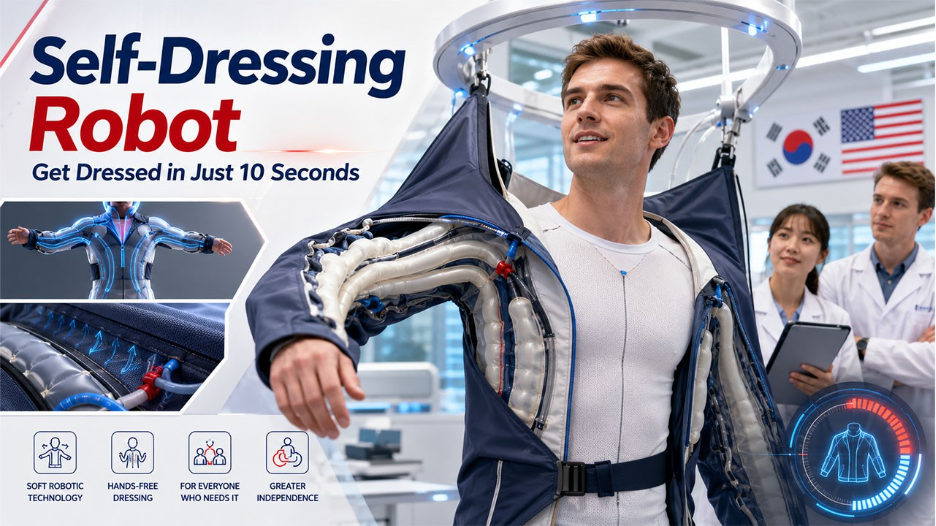
South Korea–U.S. Researchers Unveil Self-Dressing Robot That Dresses Users in Just 10 Seconds
South Korea–U.S. researchers unveil a self-dressing robot that helps users get dressed in just 10 seconds, marking a major breakthrough in assistive robotics and AI.
Imagine if you could put on your own clothes without even lifting a finger. What looked like a scene from a science fiction film once is now turning out to be a reality. Researchers from KAIST (Korea Advanced Institute of Science and Technology) in South Korea and Stanford University in the United States have created a smart self-dressing robotic system that can make users wear clothes hands-free in not more than 10 seconds.
This is a major breakthrough that can change the lives of millions of people, specifically the ones who have trouble dressing on their own.
Meet SWAG: Self-Wearing Adaptive Garments
The technology is known as SWAG, which is a short form for Self-Wearing Adaptive Garments. Contrary to conventional wearable robots or heavy robotic assistants, SWAG directly incorporates soft robotics into the clothing itself.
The system leverages flexible air-driven structures, which are commonly described as robotic “vines,” hidden in the garment. When they are activated, such robotic components increase the air pressure and move through the fabric gently, guiding the clothing over the body of the wearer.
As a result, you get a fully automated dressing process that needs little to almost no effort from the user’s side.
Understanding the Self-Dressing System
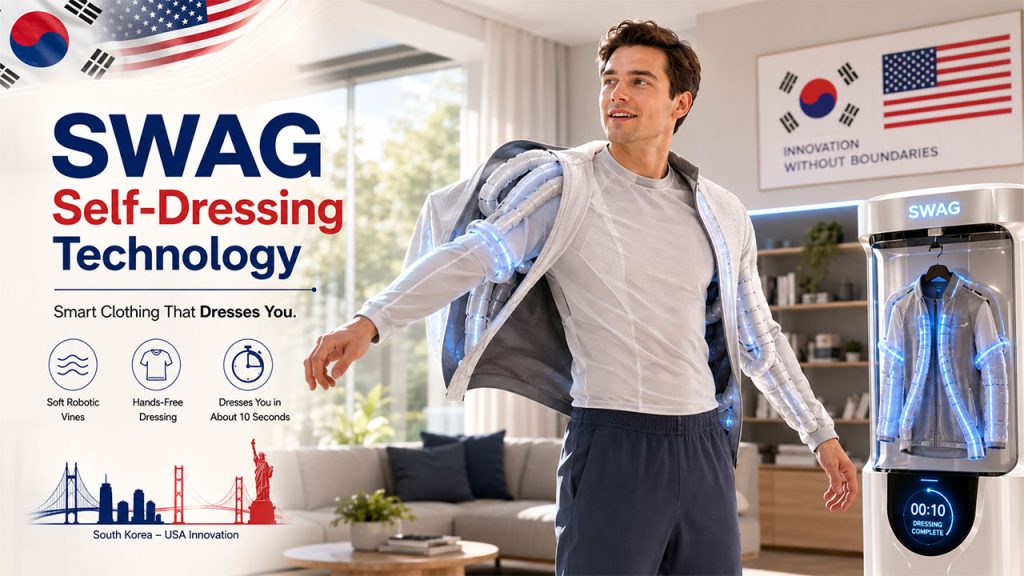
The secret that drives SWAG exists in its soft robotic design.
Instead of pushing or extracting mechanical arms, the inflatable robotic vines naturally move through the garment. As it travels, they slowly convert the clothing into the right position and slide it over to the body of the person.
Since the robotic components are flexible and soft, they can adapt safely to the distinct body shapes without causing any discomfort.
One of the most staggering characteristics is that users do not have to remain perfectly still. The system works seamlessly even while the wearer is making a few small movements or even walking, completing the entire design process in around 10 seconds.
What Is the Significant of This Technology?
Related walkthrough
Aei Robot Invests $29.5M in Humanoid Robot Mass Production Plant

Dressing is a simple task for many people. However, for others, with deformity, injury, or discomfort, it can be slightly challenging.
The robot that could self-dress can provide top-level independence for:
- People with physical disabilities.
- Elderly individuals
- Patients that are recovering from any injury or surgery.
- Individuals have limited mobility.
- Caregivers help patients or family members.
By minimizing the need for physical assistance, technology can enhance both life quality and independence.
Applications Apart from Daily Clothing

The possible use-cases for SWAG go beyond ordinary clothing.
Researchers have a theory that such a technology can be used for:
- Protective clothing for workers in the healthcare industry.
- Medical gowns in hospitals
- Rescue or firefighter uniforms.
- Hazardous suits for industrial safety.
- Cleanroom garments leveraged in manufacturing semiconductor products.
In emergency situations, the capability to quickly wear specialized protective equipment can help you save a lot of time.
The Future of Smart Clothing
Smart clothing is rapidly changing, and SWAG showcases a great step forward in wearable robotics.
Future versions can involve characteristics like:
- Automatic Adjustment of Sizes.
- AI-driven Health Tracking.
- Regulation of Temperature.
- Customizable Comfort Settings.
- Integration with Smart Healthcare and Home Systems.
As AI (Artificial Intelligence) and soft robotics advance continuously, clothing may become more than wearing something. It can actively help us in our daily lives.
Final Thoughts
The collaboration between Stanford University and KAIST showcases how soft robotics can solve real-world challenges in a straightforward, yet effective way. While technology is still in the stage of research, it points to a future where getting dressed can become as simple as pressing a button.
For elderly individuals, people with disabilities, and healthcare professionals, self-dressing garments could offer greater independence, convenience, and safety.
In the future, we can expect wearable technology to not only be restricted to fitness trackers and smartwatches. It can soon involve clothing that can enable you to get dressed, all in approximately 10 seconds.
Read Also: The Role of AI and Robotics in Enhancing Precision and Safety in Aircraft Engine MRO Operations