

How Bespoke Software Helps Businesses Build Around Their Own Rules
Learn how bespoke software helps businesses build around their own rules with custom workflows, seamless integrations, compliance, and long-term scalability.
Off the shelf software is designed for a broad market. It assumes standardized workflows and generic roles. When your business processes sit at the intersection of regulation, competitive differentiation, and operational complexity, forcing them into a mass market product creates workarounds, audit gaps, and risk. Bespoke software is custom built for specific business needs, encoding your exact workflows, roles, access rights, and decision logic into a system you own. SoftDoes works with enterprises and scale ups in finance, healthcare, education, and e-commerce where these details are not optional. This article shows how bespoke software supports unique business processes, how it integrates with existing systems, and how to choose the right development partner for a bespoke software project with custom software solutions.
Encoding Your Business Logic: Roles, Rules, and Permissions by Design
Modern bespoke software development is essentially the translation of a company’s “operating manual” into a living application. Every internal policy, approval chain, access restriction, and exception path becomes part of the source code or rule definitions. Bespoke software ensures a precise fit for specific requirements by translating unique rules into executable logic.
This process of software development through bespoke software development demands deep domain expertise. As a senior engineer at SoftDoes puts it: “You cannot encode business rules you do not fully understand. The discovery workshops are where we learn the client’s language, map every decision path, and identify the rules that actually run their business, not just the ones written in a policy document.”
Capturing these rules requires detailed discovery workshops, domain interviews, and mapping of existing procedures before any line of code is written. Here is what can be modelled:
Business Rules
- Eligibility checks (credit score thresholds combined with income and debt ratios)
- Pricing logic (volume tiers, contract terms, territory restrictions)
- Exception handling (override paths, temporary rule deviations with approval)
- Compliance gates (regulatory checks triggered at specific process steps)
Role Based Access Control
- User roles defined by function: back office staff, branch manager, compliance officer, clinician, billing clerk
- Access rights scoped by department, data domain, or patient relationship
- Multi step approval workflows where different thresholds activate different chains
- Attribute based access combining role, location, device trust, and purpose
Auditability
- Immutable logs capturing who accessed what data, when, and for what purpose
- Version history of every rule change with rollback capability
- Exportable audit reports aligned with regulatory frameworks
How Bespoke Software Integrates Into Your Existing EcosystemHow
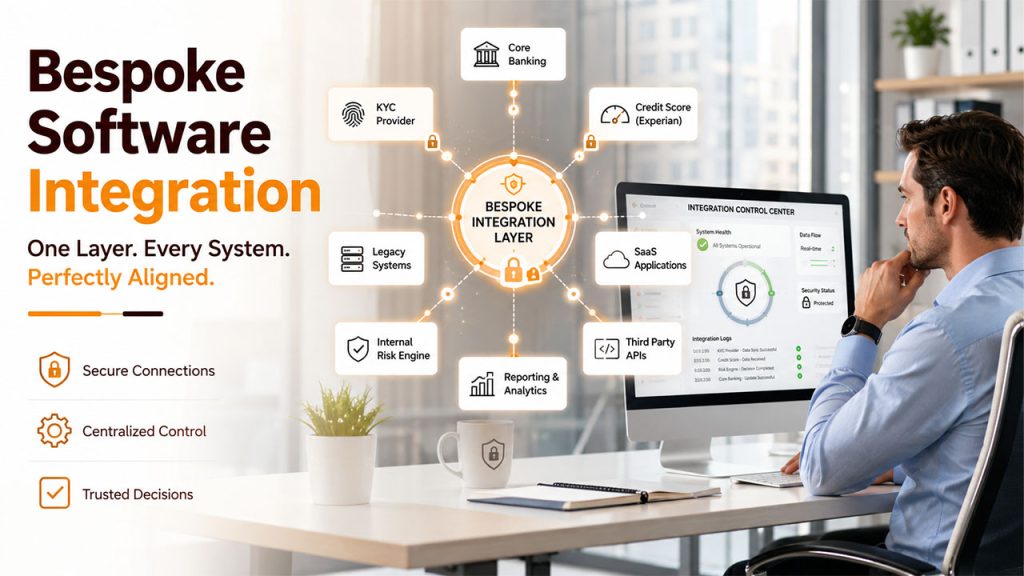
Bespoke software can seamlessly integrate with existing systems, acting as a control layer that enforces company specific rules over shared data. Custom applications can connect legacy databases to modern SaaS tools, and bespoke integration software eliminates manual data entry between systems. This tailored software approach ensures precise alignment with business needs and operational workflows.
Concrete example: A custom underwriting platform pulls KYC data from a third party provider via API, fetches credit scores from Experian, combines both with internal risk profile logic, and pushes the decision back into the core banking system. The bespoke layer is the middleware, the single source of truth for how decisions are made.
Integration can reduce error rates by up to 90 percent when bespoke software acts as the orchestration service connecting various business systems.
Bespoke Software vs Customising Off the Shelf: When to Build Around Your Rules
Related walkthrough
Chapter 9 | SuiteCRM Custom Code Architecture | Logic Hooks, Workflows u0026 Upgrade-Safe Development

There is an important distinction between building bespoke software and heavily customising an off the shelf solution. Configuring Salesforce or ServiceNow through low code workflows and plugins is customisation. Building a decision engine from raw architecture to suit your domain is bespoke. Both have a place, but they serve different needs.
Bespoke software typically has a higher upfront cost than off the shelf solutions, but bespoke software can provide a higher ROI over time compared to off the shelf software. For every dollar spent on custom software, businesses can see up to four dollars in return, and bespoke software can yield a 300 percent higher ROI than off the shelf systems. As Engadget has noted, digital transformation in healthcare increasingly depends on systems that encode clinical and regulatory logic at the software level.
When customisation of shelf software is sufficient:
- Your business processes are relatively standard (basic CRM, email marketing, document management)
- Your rules change infrequently and fit within existing platform configurations
- Your target audience and user count make per seat SaaS fees manageable
- Small businesses with limited unique features or compliance demands
When bespoke custom solutions are necessary:
- Your rules are central to your competitive advantage or compliance posture
- Off the shelf solutions force workarounds that create operational risk
- You operate in a regulated sector where generic software cannot model state specific clinical rules, insurance constraints, or financial controls
- You need to own the intellectual property and source code of the software directly
Inside a Bespoke Software Project: From Discovery to Live Operations
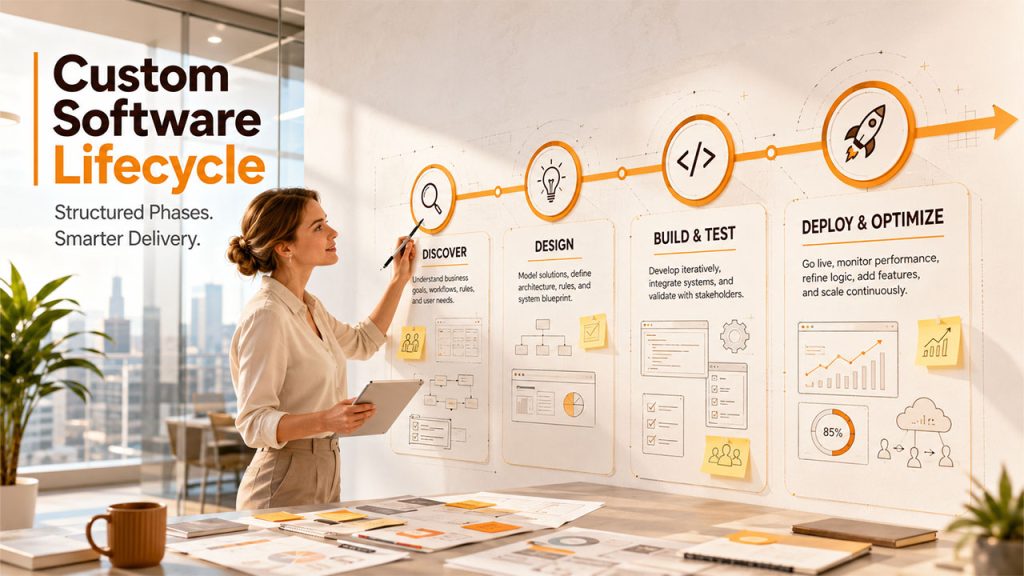
Understanding the development process helps leaders set realistic expectations. Large custom IT projects run about 45 percent over budget on average, and bespoke software development can take over a year for complex projects. The antidote to scope creep and budget overruns is a structured, phased approach with strong domain language alignment.
Here is the typical development process SoftDoes follows for custom software and app development:
- Discovery (2 to 6 weeks): Workshops with domain experts to map legacy workflows, document business rules, identify roles and exception cases, and audit existing systems. This phase uses domain driven design so that terms like “policy,” “case,” or “encounter” have precise, shared meanings between the development team and the business.
- Solution Design (2 to 4 weeks): Model entities (customers, contracts, policies, lab results), build decision tables, define rule specifications, and architect the system for scalability, security, and compliance requirements.
- Iterative Development (8 to 20 weeks): Build modules in sprints, translate the domain model into scalable architecture, integrate with existing systems, and validate rule logic with stakeholders after each iteration. Iterative development reduces project risk by surfacing issues early.
- Post Launch Optimisation: Monitor performance, measure rule accuracy, refine logic, add new features, and maintain governance. Bespoke systems can be updated and scaled to accommodate new processes as the business evolves.
Choosing a Development Partner That Can Build Around Your Rules
Choose a partner with relevant experience in similar systems. A Custom Software Development Agency with case studies in your sector, whether finance, healthcare, education, or energy, brings domain fluency that generic software developers cannot match. For example, case studies in financial services show how replacing hard coded rules systems with versioned decision engines improved compliance outcomes and processing speed. A discovery first approach indicates a good development partner who invests time in understanding your unique business model before proposing a software solution.
Clear communication is essential for project success. As Ars Technica has reported on enterprise software failures, the root cause is rarely technical. It is miscommunication between engineering teams and business stakeholders.
Select a partner with transparent pricing models for budget certainty. Ongoing costs for bespoke software are about 15 to 25 percent of the build cost annually, covering ongoing maintenance, security patches, and feature enhancements. Post launch support is crucial for ongoing success, ensuring that as compliance requirements shift or business goals evolve, the software evolves with them.