
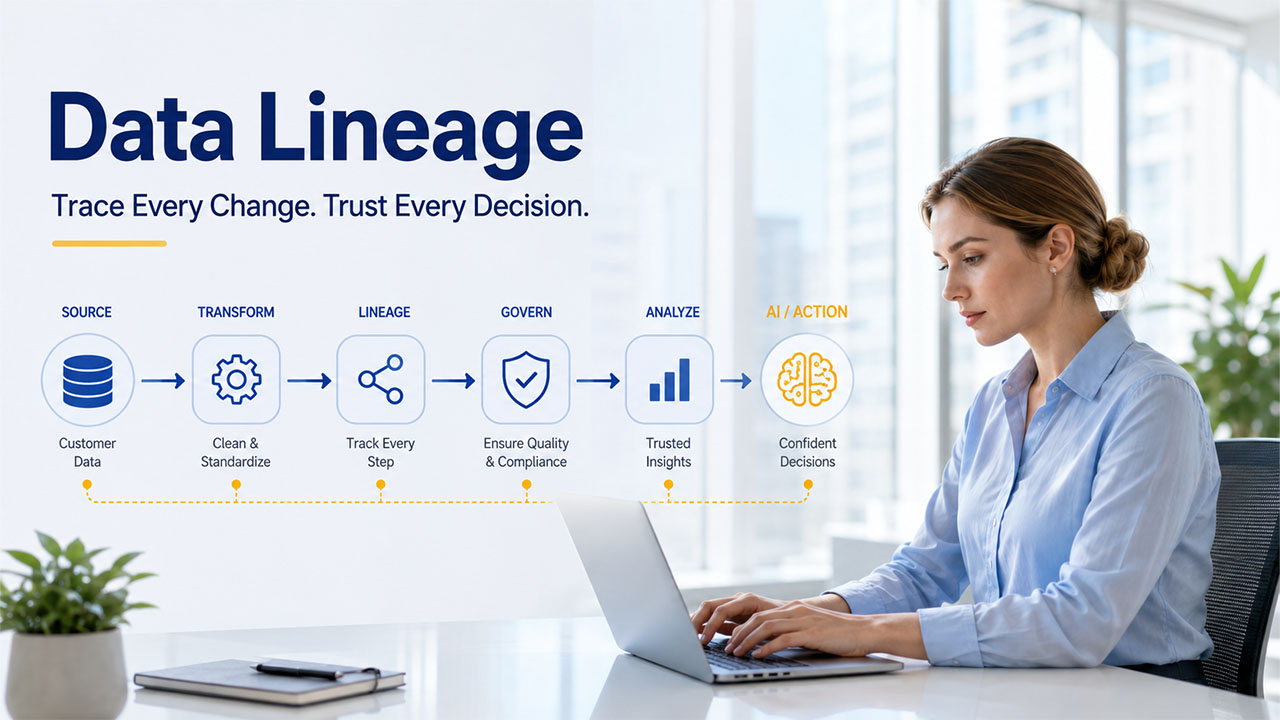
What Is Data Lineage? Why It Matters for Analytics, Governance, and AI
Explore Data Lineage and understand how it improves analytics, strengthens data governance, and builds trusted AI-ready data pipelines.
The dashboard breaks on a Monday morning, and a revenue number looks wrong. The auditor generally asks the organization where the personal data of the customer went, and who touched it. In each of these cases, the real question that arises is the same, where did this data come from, what happened to the data, and who is depending on its downstream? That is what data lineage helps answer.
For a growing business in the USA, data lineage has moved from just a nice-to-have solution to a more practical tool. Data lineage supports reliable analytics, along with a clearer compliance evidence, and safer early steps, in artificial intelligence.
The guide helps explore data lineage and offers a tool-agnostic plan, that the user can start as soon as this quarter.
What Is Data Lineage?
Data lineage is a map of how data moves and changes across your systems. A useful lineage map typically shows the data source, transformation logic, the path the data takes, the time or version involved, and the destination or downstream consumers.
Two related terms often get mixed together:
- Provenance refers to the first instance or origin of the data. Provenance answers where data started, while lineage tracks the journey across the pipeline.
- Governance is the broader set of policies, ownership, and controls. Lineage is one input that makes governance easier to apply and verify.
For one vendor’s perspective on Data Lineage across systems, use it as a comparison point rather than a rulebook.
Why Lineage Matters for Analytics
Many analytics problems are lineage problems in disguise. When someone renames a column in a source table, dashboards downstream can break or show the wrong values. Without lineage, tracing that failure often becomes manual guesswork across many systems.
Lineage helps in three practical ways:
- Impact analysis before changes. You can see what a schema change will touch before deployment.
- Faster root-cause analysis. When a metric looks off, you can follow the graph back to the source.
- Trust in KPIs. Teams are less likely to second-guess numbers when they can see where each figure comes from.
Column-level lineage is more detailed than table-level lineage and can speed up root-cause analysis when a specific field changes. Field-level views show which columns are affected, while table-level views cannot always provide that detail.
Why Lineage Matters for Governance and Audits
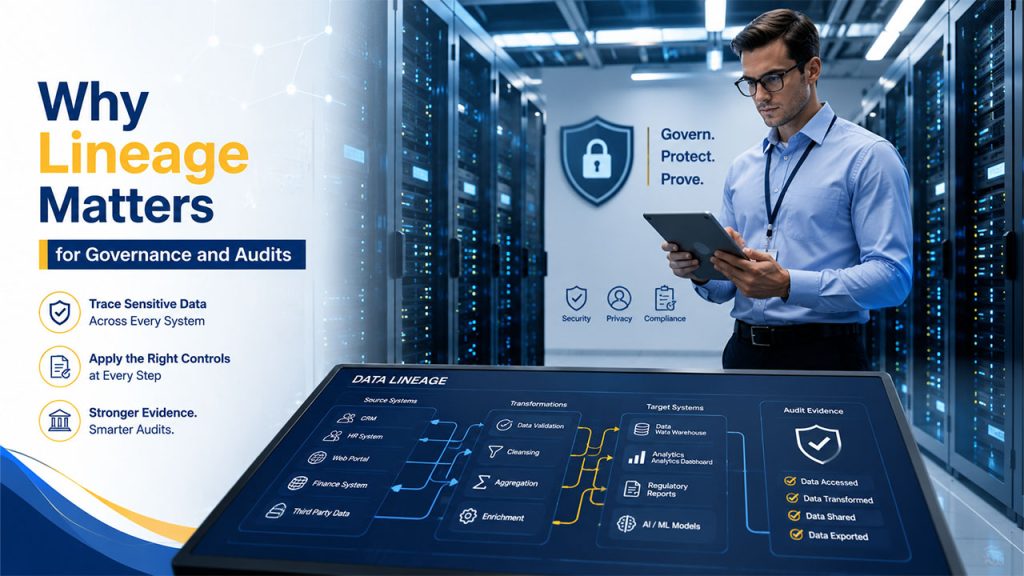
Lineage gives you an auditable path for sensitive data. If personal information enters through one system and flows into reports, a lineage graph shows where it propagates so you can apply the right controls. This complements a data catalog and access controls rather than replacing them.
A careful note on regulations: lineage can help you evidence compliance, but you should not assume any single rule strictly requires it. Lineage records operations over time, which supports auditing, quality control, and activity monitoring.
Why Lineage Matters for AI and LLMs
Related walkthrough
Claude vs ChatGPT: Which AI Is Better for You?

AI readiness depends on knowing your data. Large language models (LLMs) and other models are only as trustworthy as the datasets behind them, and that trust depends on documentation and traceability.
Regulators are pointing in the same direction. The EU AI Act entered into force on August 1, 2024. Obligations for general-purpose AI (GPAI) apply from August 2, 2025, and most rules apply from August 2, 2026, with some high-risk system obligations phasing in later. Annex IV requires technical documentation to include information about training datasets, including their provenance, scope, and how they were obtained and selected.
In the United States, the NIST AI Risk Management Framework crosswalk includes a verification item asking whether data provenance is documented and managed. None of this is legal advice, but the pattern is clear: if you plan to build or buy AI, being able to trace training and input data is becoming standard practice.
Table-Level vs. Column-Level Lineage
Not all lineage has the same resolution, and the difference matters.
- Table-level lineage shows how datasets connect. It tells you that Table A feeds Table B, which feeds a report.
- Column-level lineage goes deeper. It maps how individual fields move and transform, so you can see which column affects which downstream field.
How to Start Lineage in a Small or Mid-Size Stack
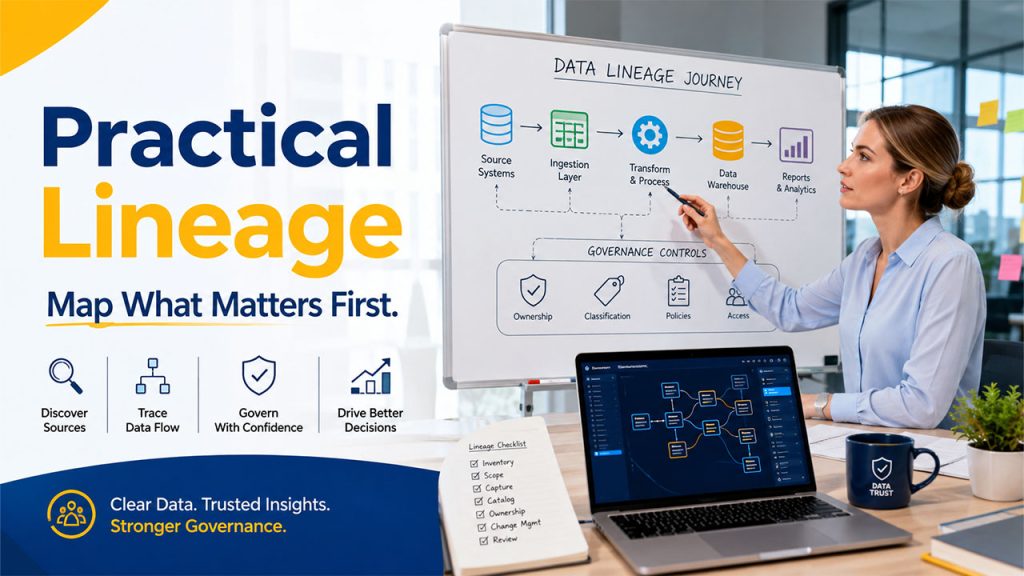
You do not need a large program to begin. A focused, step-by-step approach works well.
- Inventory what matters. List your critical reports, models, and data products first.
- Set a minimal scope. Start with one or two domains rather than the whole company.
- Capture from sources of truth. Use SQL parsing, query logs, or event-based standards like OpenLineage to record lineage automatically.
- Unify with your catalog. Connect lineage to your metadata or catalog layer so it lives in one place.
- Assign ownership. Set rules for how tags and classifications propagate, and name a person responsible for each domain.
- Add lineage to change management. Require a pre-deploy impact review for schema changes.
- Review quarterly. Check for drift, gaps, and stale sections at least every three months.
A Brief, Neutral Look at Tooling
Lineage tools fall into a few categories. Warehouses and processing engines can emit lineage directly. Apache Doris 4.x, for example, can emit table- and column-level lineage events through a lineage plugin, though it does not store those events, expose a lineage query API, or provide visualization on its own.
Catalog and metadata platforms stitch lineage across systems. DataHub is one example in this category. Its documentation says it can capture automated end-to-end lineage across databases, ETL, dbt, business intelligence, and machine learning tools into a unified graph, with automatic column-level lineage across many native connectors. These are vendor claims, so verify them against your own stack.
When you evaluate options, focus on fit, integrations, automation quality, and column-level coverage rather than brand names alone. Compare ETL tooling options against how well they capture pipeline changes and transformations.
Common Pitfalls to Avoid
- Manual spreadsheets. Hand-maintained lineage goes stale fast. Automate capture where you can.
- Single-tool blind spots. Lineage inside one tool misses cross-system flows. Stitch lineage across platforms.
- Stale graphs. A lineage map is only useful if it reflects reality. Measure freshness and coverage.
- No ownership. Without a named owner, propagation rules and classifications drift over time.
Frequently Asked Questions
Q1. Is data lineage the same as provenance?
No. Provenance describes where data first came from. Lineage tracks the full journey through systems, transformations, and consumers.
Q2. Do small teams need column-level lineage?
Not always. Table-level lineage is often enough to start and to see how datasets connect. Column-level lineage becomes worthwhile when you need precise impact analysis, compliance tracking of specific fields, or model debugging.
Q3. How does lineage help with AI compliance evidence?
Lineage documents where training and input data comes from and how it was transformed. Annex IV of the EU AI Act requires technical documentation on training-data provenance, and the NIST AI RMF crosswalk asks whether data provenance is documented and managed. Lineage helps you produce that evidence, though it is not a substitute for legal review.
Q4. Where should we begin?
Start with one or two critical domains, capture lineage automatically from your sources of truth, connect it to your catalog, assign owners, and review quarterly for drift.