
How Generative AI Is Being Used to Improve Business Workflows
Discover how generative AI improves business workflows by automating repetitive tasks, supporting employees, connecting systems, reducing bottlenecks, and improving decision-making.
In this digital-first world, businesses are increasingly incorporating generative AI to automate their everyday business tasks, process large data, assist their employees, and improve business workflows. Legacy software systems used to follow rigid predefined rules; however, generative AI is much more advanced and flexible. It can generate written content, produce summaries in an instant, carry out deep research, brainstorm ideas, and even hold a conversation with users in more flexible and efficient ways. If it is implemented carefully, it can significantly help businesses to complete tasks faster than human staff. This reduces manual tasks which frees your team to focus on tasks that actually need human oversight, judgment, creativity, and personal touch.
Why Businesses Are Turning to AI-Powered Workflows
Many business workflows revolve around everyday tedious repetitive activities such as follow-ups, raising tickets, data entry, summarizing meetings, drafting emails or scheduling appointments, which takes up too much time without even contributing to real decision making.
However, these manual tasks can be automated with the help of generative AI. It can process large amounts of information in minutes, summarize them, and pull actionable insights that can help you make faster business decisions. After that, employees only have to review, edit, and approve those outputs. They don’t have to spend hours on every task.
However, it does not mean that every process needs automation. Businesses must only automate those tasks that create unnecessary delays or put administrative pressure on the team. There are processes that still need human oversight and judgment.
Automating Repetitive Administrative Tasks
Administrative work is one of the clearest areas where generative AI can support business efficiency.
Usually in offices, employees spend hours or sometimes days drafting routine documents, taking notes, organizing and summarizing reports, setting up internal meetings, managing communications, or responding to repeated queries. However, now all these tedious, repetitive tasks can be easily handled by AI tools. They can prepare initial drafts, collect and organize data, and give employees a head starts without much manual effort.
Let’s understand this with an example: instead of transcribing lengthy meeting notes manually, an employee can use AI models that can do that within seconds and provide all major highlights of the meeting in a structured action list. Another employee can use the AI tool to draft a report by feeding it company information that is already available in the knowledge base system. This way, they can save their time and energy on tasks that can easily be automated and be done with them in a few minutes rather than dragging the whole day.
One thing worth mentioning is that human reviews still matter. AI systems are not perfect and sound confident even when they are wrong. Therefore, review your AI outputs especially if it is about financial decisions, legal matters, sensitive customer data, or other high-impact business activities. Never trust AI completely.
Improving Internal Communication

Communication is another area where AI can help streamline workflows.
Companies that employ a lot of people produce large volumes of information in the form of emails, meetings, reports, updates on projects, and documentation. Locating the necessary information can be hard when employees have to sift through all that data.
The AI tool can help in summarizing long pieces of text, identifying key information, and organizing it into something easier to read.
For instance, a project manager may need to use AI to summarize several project updates and identify all pending tasks. A leader of a department may need to prepare a short summary of a lengthy report before a meeting.
Supporting Customer Service Teams
Customer service desks have to answer a lot of inquiries which have quite similar structure. The generative AI may be used to assist representatives in generating an appropriate answer, researching necessary information, making summaries of the conversation, and offering solutions.
An AI application can also sort out previous conversations to give a representative a chance to have more information when answering a customer’s question.
AI is not necessarily going to substitute for humans. In most cases, the most effective way to use this technology is to make it an assistant.
A representative can correct an answer generated by AI, personalize it, and send it to the customer.
Helping Employees Find Information Faster
Businesses typically possess useful information in disparate forms like documentation, knowledge base, policy manual, presentation material, and their own systems.
Even if the employee is aware that the information is available somewhere, it still takes them considerable time to find it. An AI-enabled system can facilitate this process for the employee to pose queries using natural language.
Rather than searching for the exact phrase, the employee may simply state what they want to know, and in return get a brief answer in relation to the internal data.
This can be especially helpful for businesses having large volumes of documentation.
Generating First Drafts and Ideas
Generative AI can also support creative and knowledge-based work.
Marketing teams could use AI to think of ways to develop campaigns, content teams could draft outlines using AI, and sales teams could draft first drafts of marketing messages to their customers.
Product teams could also use AI in organizing customer feedback and generating improvement ideas on how to improve productivity.
It is worth noting that the role of AI in content creation is mainly in developing the content as a starting point and not as the end point of the process.
This is because employees can contextualize, validate, and infuse knowledge from their experience into the work done by AI.
AI Can Connect Different Business Processes
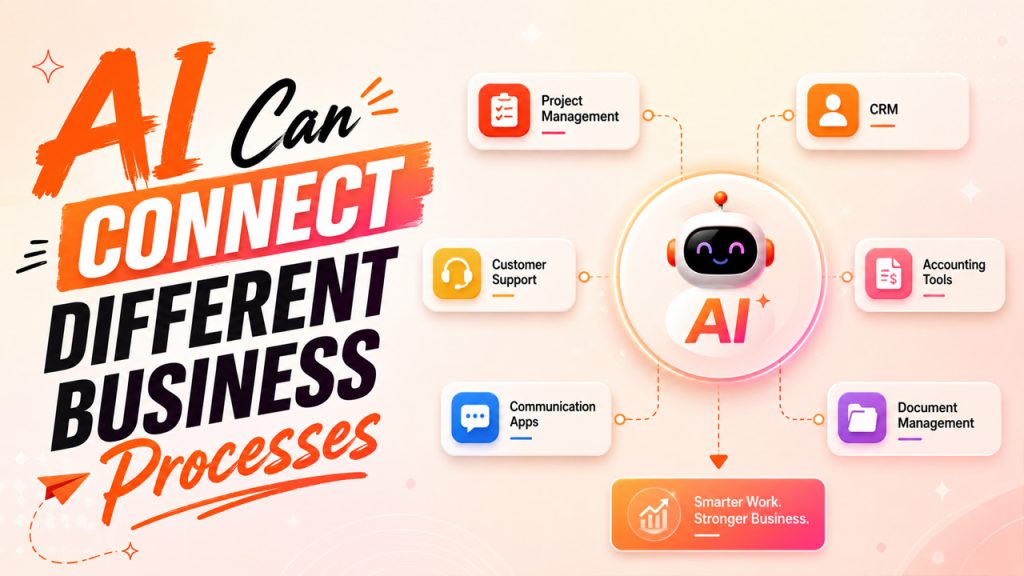
The benefits of generative AI become more significant when it is integrated with existing business systems.
A company may already use CRM software, project management platforms, customer-support systems, accounting tools, communication applications, and document management systems. AI can potentially assist employees across these systems when appropriate integrations are available.
For example, customer information from a CRM could be used to help prepare a personalized communication. Project information could be summarized into a progress update. Support conversations could be organized into recurring issues that management can review.
The goal is not simply to add another AI tool to the technology stack. Instead, businesses should consider how AI can work alongside systems employees already use.
Custom AI Solutions Can Address Specific Business Needs
Related walkthrough
Adobe Launches AI-Powered Agent Orchestrator

Off-the-shelf might come handy for performing general tasks; however, some organizations need custom solutions that are designed specifically around their specific business workflows.
A company may have unique data sources, internal processes, customer requirements, or software systems that cannot be addressed effectively through a generic tool.
This is where custom AI development can become valuable. A tailored solution can be designed around the organization’s objectives, data environment, and existing technology infrastructure.
A customized system may take more planning than simply subscribing to a general-purpose AI application, but it can provide greater control over how the technology fits into an organization’s existing processes.
Reducing Workflow Bottlenecks
Business bottlenecks appear if some part of the process requires manual labour from a few people.
For instance, there is a need to manually check incoming requests and assign the correct department for them. There is another case where the company needs to collect data from different sources to generate a weekly report that may take many hours.
AI technology can help in classification, summarization, document generation, and information processing tasks, thus decreasing the time required for the completion of these parts of the process.
Removing smaller bottlenecks can have a wider effect on the organization because employees can move through processes more quickly instead of waiting for repetitive tasks to be completed.
Improving Decision Support
Generative AI can also help employees prepare for decisions by organizing information and highlighting relevant details.
Managers may need to review customer feedback, sales reports, project updates, or operational information before deciding what to do next. AI can help summarize these materials and organize them into a more accessible format.
However, AI should support decision-making rather than replace appropriate human judgment.
AI-generated information can contain errors, omissions, or inaccurate interpretations. Employees should verify important information against reliable sources before making decisions that could significantly affect customers, finances, employees, or business operations.
Data Privacy Should Be Part of the Strategy
Introducing AI into business workflows also creates important questions about data handling.
Organizations should determine what information can be processed by AI systems and what information should remain restricted. Sensitive customer information, confidential business documents, employee records, and proprietary data may require additional safeguards.
Businesses should establish clear policies covering acceptable AI use, data access, employee responsibilities, and review procedures.
Security should be considered during the planning stage rather than after an AI system has already been introduced. This helps organizations pursue efficiency while maintaining appropriate controls around important information.
Employees Need Training and Clear Guidelines
Technology alone does not guarantee successful workflow improvement. Employees need to understand how the tools work and where they should be used.
Training can cover appropriate prompts, information verification, privacy considerations, editing AI-generated content, and recognizing potential errors.
Clear guidelines can also prevent inconsistent usage. Employees should know which AI tools are approved, what types of information they can enter, and when human review is required.
Organizations that treat AI as a workplace capability rather than simply a software purchase are more likely to achieve meaningful long-term results.
Measuring the Impact of AI Automation
Businesses should establish measurable goals before implementing AI into important workflows.
Useful measurements might include:
- Time saved on repetitive tasks
- Response times
- Processing volumes
- Employee productivity
- Customer service performance
- Error rates
- Cost per workflow
- Employee adoption
These measurements can help determine whether an AI implementation is actually improving the process.
A tool that generates impressive outputs but does not reduce meaningful workload may not provide enough value to justify its cost. Businesses should focus on measurable improvements rather than adopting AI simply because it is popular.
Starting With Small, Practical Use Cases
Companies do not need to transform their entire operation at once.
A better approach is often to identify one repetitive workflow where AI can provide measurable assistance. The business can test the technology, collect feedback, evaluate the results, and then determine whether the approach should be expanded.
For example, an organization might begin by using AI to summarize internal meetings. Once employees become comfortable with the process and appropriate safeguards are established, the company could explore additional applications such as customer-service assistance, document processing, or internal knowledge retrieval.
Small implementations make it easier to identify problems before AI becomes deeply embedded across the organization.
The Future of AI-Enabled Business Workflows
Generative AI is becoming another component of the modern business technology stack. Its ability to process information, generate content, assist employees, and interact through natural language gives organizations new ways to approach everyday work.
The strongest results are likely to come from businesses that focus on practical applications rather than trying to automate everything. AI can handle repetitive or information-heavy tasks while employees continue to provide judgment, creativity, accountability, and personal interaction.
As the technology develops, businesses will have more opportunities to connect AI with existing software and create workflows that are faster and more adaptable.
Ultimately, successful AI adoption is less about replacing people and more about helping them spend their time on work where their expertise provides the greatest value.