
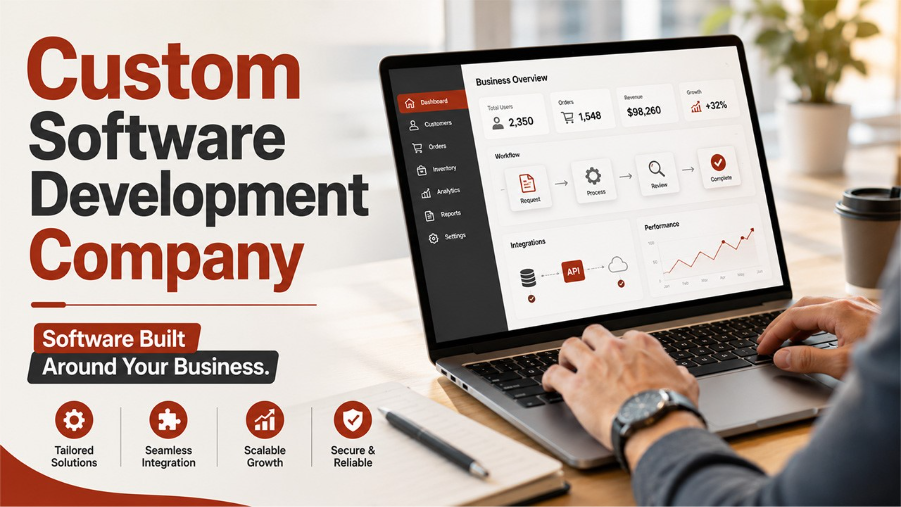
How a Custom Software Development Company Can Support Your Business
Explore what a custom software development company does, its key services, healthcare software solutions, and how to choose the right development partner.
Every business eventually hits a wall with off-the-shelf software; it does most of what you need, but never quite all of it. The gap is exactly why so many companies end up searching for a Custom Software Development Company instead of trying to force a generic tool to fit their workflow.
The appeal is straightforward. Rather than adapting your business to accommodate a product designed to serve several thousand other businesses, custom software solutions are designed to suit how you do business. Be it the automation of processes, the integration of incompatible systems, or the development of industry-specific software, custom software development caters to all such requirements.
In this blog, we’ll get into what these companies actually do, why businesses choose custom builds over ready-made tools, and how to figure out which service and partner actually fits what you need.
What Is a Custom Software Development Company?
A Custom Software Development Company is literally a company that develops software tailor-made to the particular client’s demands, as opposed to selling the same pre-made software to everyone. Instead of altering your business processes to match a generic software, the software is adapted to meet the actual business process flows.
Typically, close collaboration with a Software Developer or even an entire team is required at every stage from discovery, design, and development up to testing and maintenance. The resulting software solution would be custom-made to meet your unique business needs and integrate into your business environment.
It’s a different relationship than buying software off a shelf too. You’re not just a customer picking a plan; you’re working with a team that needs to actually understand your business before writing a single line of code.
Why Businesses Choose Custom Software Over Off-the-Shelf Tools
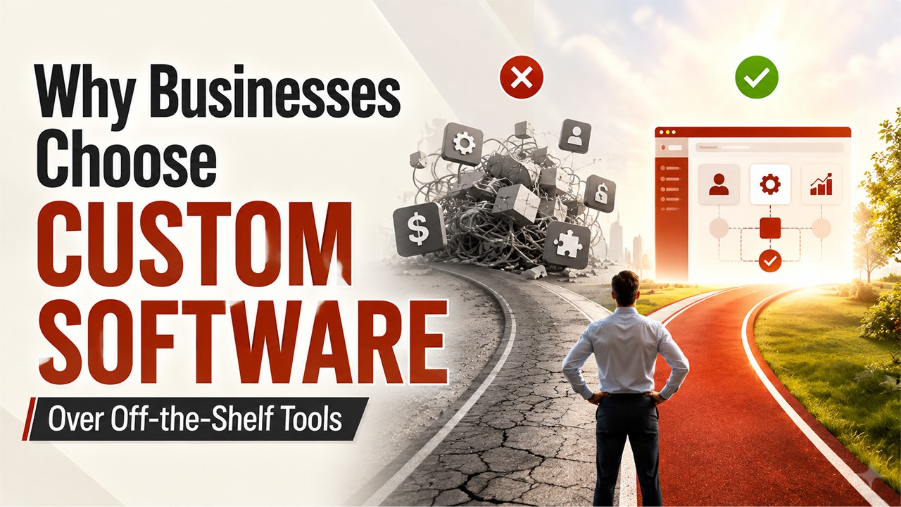
Off-the-shelf software works fine, right up until it doesn’t. Here’s where the cracks usually start showing:
Rigid workflows:
Generic tools are built for the average business, not yours specifically, so you end up bending your process to fit the software instead of the other way around.
Limited Integration:
Off-the-shelf solutions do not integrate well with all the existing systems used by businesses, which requires additional manual effort to compensate for the gaps.
Paying for features you don’t need:
Almost all of the off-the-shelf platforms provide several dozens of features at one price, while businesses tend to utilize only a fraction of them.
Scaling problems:
While some things may be good for a small team, scaling can become problematic. Generic software does not always provide necessary scalability options.
Industry-specific gaps:
Some industries (especially health care) have specific needs and requirements that cannot be fulfilled with generic software products.
None of the points mentioned above make off-the-shelf solutions poor. It is just that they are created for general cases. When the business has something specific to do, customization becomes the optimal choice.
Key Services Offered by a Custom Software Development Company
Related walkthrough
Chapter 9 | SuiteCRM Custom Code Architecture | Logic Hooks, Workflows & Upgrade-Safe Development

Most of the Custom Development Services revolve around some key types, depending on the particular situation within your business:
Custom application development:
Developing an application from scratch, which is specially designed for certain business processes, departments, or workflows.
System Integration:
Making sure that different tools and databases can share information without the need for human intervention in the form of data re-entering.
AI Software Development Services:
Integrating AI Software Development Services such as automation, predictive analytics, and AI-based decision-making into your software solutions rather than relying on third-party applications.
Legacy system modernization:
Updating older software that still works but has become slow, insecure, or difficult to maintain.
Cloud-based development:
Building your application in the cloud to make sure that it is easy to scale, remotely use, and doesn’t require significant infrastructure investment.
Ongoing maintenance and support:
It is important to note that custom software requires ongoing support and maintenance due to constant changes in business processes.
The right combination of these depends entirely on where your business currently struggles, and a good development partner will usually help you figure that out before recommending a specific approach. Whether you need custom software application development built from scratch or system integration to connect your existing tools, the key is matching the solution to your actual problem, not forcing your problem to fit a pre-built mold.
Custom Software Development for Healthcare
Healthcare happens to be one of the best examples of areas in which general software does not work. With strict compliance standards, the sensitive nature of information, and workflows that vary from clinic to clinic, Custom Healthcare Software is designed to address issues that cannot be solved by pre-fabricated software systems at all. This is why many healthcare practices partner with a healthcare software development vendor to build HIPAA-compliant, workflow-specific solutions from the ground up.
Practice management solutions available on the market are created in such a way as to be as compatible as possible with various clinics. But even such a small thing as a physical therapy clinic will differ dramatically from a diagnostics laboratory in terms of operations and procedures. The difference is taken into account in custom development software.
A few of the common requirements of a Healthcare Software Development Company include:
Patient management systems:
Solutions that take into account the process of work in a particular practice and are customized according to that process rather than making people fit in some rigid generic interface.
Healthcare providers often work with a Healthcare Software Development Company to create solutions that align with their specific operational and compliance requirements.
HIPAA-compliant data handling:
Custom-built software can easily be developed in such a way that they are in compliance with these regulations from the very beginning rather than adapting generic products later.
Integration with existing medical systems:
Integration with EHR systems, billing software, or lab software that cannot be easily integrated by generic tools.
Automation for repetitive tasks:
Automatic appointment reminders, automatic billing follow-ups, automatic insurance verification and reporting, all freeing time of the staff for more important tasks.
Telehealth and remote care features:
Custom-built video consultation tools, remote monitoring dashboards, or patient portals designed around a provider’s actual care model.
For healthcare providers in particular, the risk associated with having software go wrong isn’t just in terms of inconvenience; it can impact patient care and compliance directly. This is typically the biggest consideration for why healthcare companies choose custom-built software over general practice management software.
How to Choose the Right Software Developer or Partner
Picking the right partner matters just as much as the technology itself.
A few things worth checking before committing to anyone:
Relevant industry experience:
A Software Developer who’s built something similar before will spot problems you haven’t thought of yet, especially in regulated industries like healthcare.
Clear communication process:
You want regular updates and visibility into progress, not radio silence until the project’s “done”.
Post-launch support:
Software needs maintenance after launch, so it’s worth confirming what ongoing support actually looks like before signing anything.
Portfolio and case studies:
Past projects tell you more about actual capability than a sales pitch ever will.
Scalability planning:
A good partner asks about where your business is headed, not just where it is right now.
Taking the time to vet this properly upfront saves a lot of frustration later, since switching partners mid-project is far more disruptive than researching before you start.
Conclusion
Ultimately, using the services of a Custom Software Development Company is about one simple thing: the software customized to your needs works better than the software you must customize to yours. Whether it is a healthcare-oriented solution, automation through the use of AI, or integration of the tools that used to be incompatible with each other, there are problems that generic platforms cannot solve.
While it is not always the most budget-friendly option initially, and does require some time spent on finding the right partner, the pay-off is always worth the effort.
And the best way to know whether it is time to look into customization options is when your employees find themselves doing the same workaround over and over again, performing manual work which would be automated through the use of a proper tool, or when the software does not do something because “it was not designed to do that”.
Frequently Asked Questions
Q. How much does custom software development cost?
Costs vary widely depending on complexity, features, and integrations needed. A simple internal tool is much cheaper than a full-fledged healthcare platform that should meet certain compliance requirements; thus, prices are project-based in most cases.
Q. How long does custom software take to build?
It varies based on the scope of the project, but usually takes from several months to create a small tool up to a year or even more to develop a multi-functional system.
Q. Is custom software better than off-the-shelf tools?
Not necessarily; it all depends on your needs. An off-the-shelf solution will do for regular business processes, but custom software becomes relevant when your workflow or industry surpasses the capabilities of generic platforms.
Q. Do custom software companies offer ongoing support after launch?
Most of them do, as software requires upgrades, repairs, and modifications as the company grows. You should clarify the details of such support before signing any agreement.
Q. Is custom software development worth it for small businesses?
It is a matter of how the problem you need to solve is presented. If a small business runs into the same issue using available solutions over and over again, then it might be worth the effort.