
FinTech Software Architecture: Core Components Every Financial Platform Needs
Explore the core components of fintech software architecture, including identity management, ledgers, payments, compliance, security, data, and monitoring.
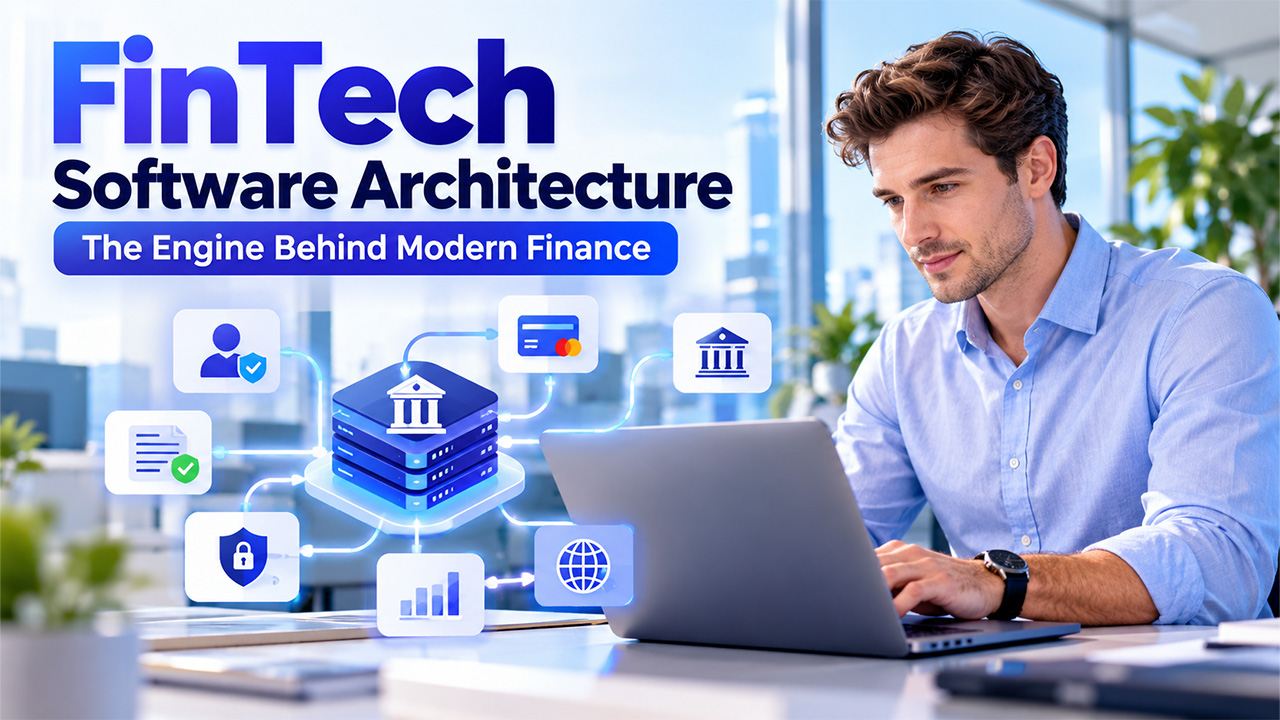
A financial platform does not only consist of a payment form, a mobile app, or a personal account. It goes beyond that. There are separate services behind every user’s actions. These services include identification, processing transactions, managing balance, integration of the bank, and access control. If these components lack clear boundaries, a change to one module can stir problems in other parts of the system. This is where fintech software architecture comes into the picture. It works as a set of interconnected parts. Each part performs a specific financial operation or technical function.
User Layer. Identity Management
You can find the client interface to be a web portal, a mobile app, or both. However, it is worth mentioning that major financial operations should not be handled by the UI. An API layer typically operates between the interface and internal services. And its job is to receive requests, validate them, and forward them to the right component.
The two things that are needed separately: identity and access management. Why? Because it is used for user authentication, roles, sessions, and verifying access rights. In the case of financial products, it becomes mandatory to draw a clear distinction between regular and privileged operations. Additionally, it is also imperative to keep access logs. This helps you to know who did what and when. It makes accountability easy and obvious.
Design the architecture for a specific product
In practice, software development for fintech often begins not with choosing a programming language, but with defining the financial scenario. Specifically, this could involve a bank account, payments, lending, an e-wallet, or investments. Access rules, necessary integrations, data structure, and audit requirements all depend on this. That is why custom fintech software may incorporate off-the-shelf third-party services for specific functions. However, the product’s internal logic and the interaction between components must be designed as a unified system. This approach also explains why fintech software development services cover not only coding but also architectural planning and integrations, as well as testing and preparation for regulatory compliance.
Accounts. Ledger. Transactions
One of the central components is the ledger. This system records financial transactions and changes in the balance. Double-entry bookkeeping comes handy in accounting transactions. Each transaction comes with matching credit and debit entries. This helps you check the integrity of the records rather than taking the current balance at its face value. The transaction service must also handle transaction statuses. That is, a transaction can be created, authorized, executed, rejected, or canceled. Idempotency is required for repeat requests. This is to ensure that the same payment command doesn’t create a duplicate transaction.
Payments. External rails
Financial software often interacts with banks, card processors, open banking APIs, payment gateways, and other providers. Therefore, financial services software development must include a separate integration layer with:
- clear contracts,
- error handling,
- wait time control.
International payments may require different currencies, FX logic, and multiple payment rails.
In a more complex system, payment orchestration allows you to:
- Work with multiple providers;
- Determine where to route a specific transaction.
These features reduce reliance on a single external service. However, they also add requirements for monitoring and data consistency.
Compliance. Risk. Data Protection
Related walkthrough
10 Must-Have WordPress Plugins: Every Site Needs These

A financial platform must have a mechanism for verifying customers and monitoring high-risk transactions.
- KYC processes may include document verification and identity checks.
- AML solutions include sanctions screening and transaction monitoring.
- Fraud detection can operate as a separate service that evaluates transactions based on defined rules or risk models.
This is where a fintech software development company must consider not only the product’s functionality but also the requirements of the jurisdiction in which it operates. The set of mandatory controls varies depending on the business model. Therefore, compliance should not be left until after development is complete.
Access and data security
It must cover data, devices, APIs, accounts, and internal services.
The following measures help minimize the risk of unauthorized access:
- Encryption during transmission and storage,
- Secret management,
- Privileged access control,
- Logging,
- Monitoring.
NIST describes zero trust as an approach in which access is not automatically granted based solely on the network location of a user or device. Authentication and authorization must be separate access control functions.
Data. Integrations. Observability
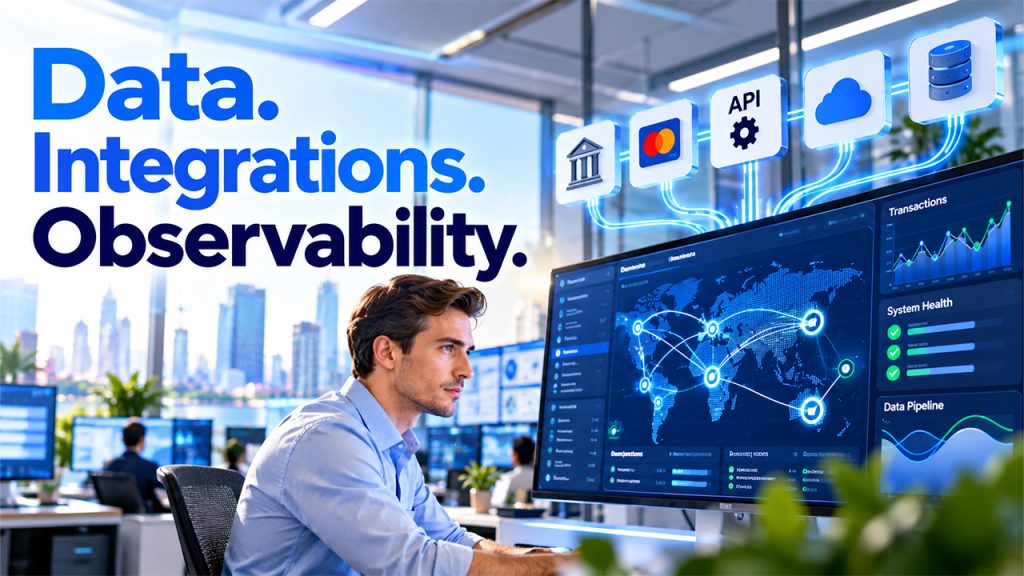
Fintech software almost always relies on data exchange with other systems. An API gateway can centralize routing, authentication, rate limiting, and access control for internal APIs. The data layer must separate financial records, operational data, and analytical needs so that complex reports don’t create an unnecessary burden on transactional processes.
The following are also important for finance software development:
- Backup,
- Disaster recovery,
- Data change control.
Financial information must remain accessible and consistent even when a specific service is temporarily unavailable.
Monitoring. Auditing
Logs, metrics, and traces help understand what is happening inside a distributed system. Auditing separately records significant user and system actions. Especially those that modify financial data or access rights.
For high-load products, where the number of transactions is increasing, fintech custom software development must also consider:
- queues,
- asynchronous processing,
- horizontal scaling.
An Architecture You Can Evolve
Every financial platform does not need dozens of microservices from its first day. Many times, it is easier to test, deploy, and manage a modular monolith. In other cases, using separate services for payments such as ledger, KYC, or notifications is justified because of security reasons and varying scaling.
That is why custom fintech app development services should be based not on a trendy architectural pattern, but on:
- Real business processes,
- Transaction volumes,
- Integrations.
A high-quality financial software development strategy also allows you to replace an external provider without rewriting the entire product.
Conclusion
A solid fintech infrastructure distributes responsibilities clearly among all its components. It strives to make things work in harmony without causing a single mix of important functions into a single, indivisible layer. Components like user access, identity management, ledger, transactions, compliance, and security along with APIs, data and monitoring must work in coordination. This is the structure that gives a financial platform foundation for a secure launch, controlled changes, and future scalability.