
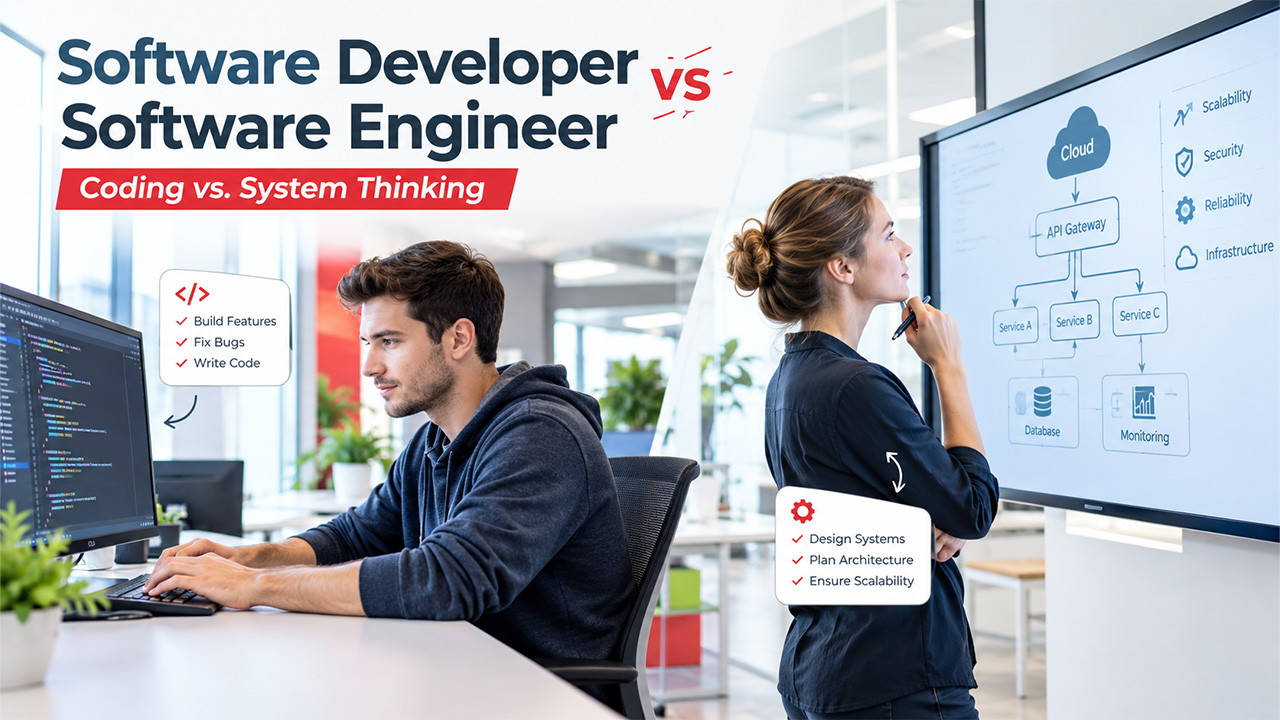
Software Developer vs Software Engineer: A Full Comparison
Compare software developers and software engineers by their responsibilities, skills, education, tools, career paths, and approach to software projects.
Suppose there are two employees, Priya and Arjun, who work in an IT company. They sit at the same desk row, join the same 10-minute morning meeting where the team shares daily progress, and ship code to the same product. Priya’s title says “Software Developer and Arjun’s says “Software Engineer.” When you ask them the difference between software developer vs software engineer, they both pause and think for a while because on most days, there isn’t much of a difference. This small pause is why this question keeps appearing in interviews, LinkedIn debates, and college placement cells. The titles sound like they should mean two very different jobs. In reality, the gap is smaller than people think, but it’s not zero either. Let’s actually see it.
What Is a Software Developer?
A software developer is someone who writes, tests, and fixes the code that makes an app or website actually work. They take an idea, break it into smaller pieces, design around it and turn each piece into working software. Developers usually focus on one part of the puzzle at a time and then move on to the next. They’re hands-on, practical, and close to the code every single day. If you think of a project as a house, then the developer is the person actually laying the bricks and wiring the switches.
Custom software development often starts exactly this way, one working piece at a time.
What Is a Software Engineer?
A software engineer does most of the things that a developer does, but with a wider lens. Unlike developers, engineers consider the whole system at once, how all the pieces come together, whether it’ll work when a thousand more users use it, and what happens if something suddenly stops working at midnight. Their focus is more on structured processes, testing frameworks, and planning for the long term. Strong software testing basics usually sit at the center of that structured process.
If we stick with the house metaphor, the engineer designs the blueprint, checks it against building codes, and makes sure that the whole structure works well without collapsing under pressure.
Software Developer vs Software Engineer: Quick Comparison
Related walkthrough
Devin: World’s First Virtual Software Engineer #devin #ai #artificialintelligence #cognition

Before looking at each role in detail, this quick comparison highlights the main differences in focus, scope, approach, and responsibilities.
| Aspect | Software Developer | Software Engineer |
| Main focus | Writing and building features | Designing systems and solving structural problems |
| Approach | Practical, hands-on coding | Process-driven, methodical |
| Scope | Often one part of a product | The full architecture and how parts connect |
| Typical mindset | “How do I build this?” | “How do I build this, so it lasts?” |
| Common background | Coding bootcamps, self-taught, degrees | Often (but not always) a formal engineering degree |
Software Developer vs Software Engineer: Key Differences Explained

The table gives you a quick picture; now let’s look at how these differences appear in real-world work.
Responsibilities
A developer usually spends his day writing code, fixing what breaks, and turning designs into something that can actually be clicked and used by people. An engineer also codes; however, it goes further than that. An engineer plans and thinks for the long term. In smaller teams, one person often does both without even noticing.
Software Developer:
- Writes and tests code for individual features, making sure each one works correctly before it goes live to users.
- Fixes bugs quickly, tracing errors back to their source and patching them without breaking other parts of the app.
- Converts designs and written requirements into actual working software that matches what the product team envisioned.
- Works closely with designers and product managers to clarify details and adjust features as feedback comes in.
Software Engineer:
- Plans how different modules and services connect, so the whole system behaves reliably even as it grows larger.
- Reviews other developers’ code for long-term stability, catching structural issues before they turn into bigger problems later.
- Thinks through scaling, security, and reliability early, anticipating what could break under heavy traffic or misuse.
- Makes architecture decisions that shape the entire product. It is the kind of call a custom healthcare software development company must get right, since a weak structure can put patient data at risk.
Education
Developers have all kinds of relevant backgrounds. Some have a computer science degree, some learned how to code through YouTube and stubbornness, and most switched careers entirely through coding bootcamps. No matter how they learned, what matters is whether they can write clean, working code.
Engineers, on the other hand, often get a formal degree in software or computer engineering. It is imperative for them to have a degree because they work around system design, data structures, and reliability testing that are harder to master. That said, this line is getting blurry every year. There are plenty of brilliant engineers who have never attended one engineering lecture in their life.
Skills, Tools, and Languages
A good developer usually has a handful of skills in programming languages and the everyday tools that go well with them. This same technical foundation is mandatory for an engineer; however, they lean harder into the tools and concepts that are used for designing and safeguarding an entire system, not just one part of it.
The right software development tools can make this gap much easier to bridge.
Software Developer:
- Programming languages like JavaScript, Python, Java, or PHP, depending on the project
- Version control tools such as Git and GitHub for tracking code changes
- Debugging tools and browser dev tools for catching errors fast
- Frameworks like React, Angular, or Django to speed up building features
Software Engineer:
- Broader command of programming languages plus system design concepts and data structures
- Tools for testing at scale, like automated testing suites and CI/CD pipelines
- Cloud platforms such as AWS or Azure for building systems that scale safely
- Security and architecture tools used to plan systems that hold up under real-world pressure
Career Paths
There are many people who start out as developers, simply because hands-on learning happens here fast. From here onwards, the paths split. Some move into engineering as they grow comfortable and familiar with bigger, messier systems, while others decide to stay as developers and just get remarkably good at it.
Both paths circle back to the same software development lifecycle at their core.
Software Developer:
- Front-end Developer: They build a part of an app or website that is visible to actual users and allows them to interact with it.
- Back-end Developer: They write the code that runs behind the scenes and handle data, logic, and servers.
- Full-stack Developer: They work with both front-end and back-end stuff, switching between the two as needed.
- Mobile App Developer: They primarily focus on building apps for phones and tablets, often for iOS or Android.
Software Engineer:
Quality Assurance Engineer:
They are responsible for testing software thoroughly before the launch to catch bugs or errors, so users never see them.
Software Integration Engineer:
They help companies connect and set up large-scale software platforms, so everything connects properly.
Cybersecurity Engineer:
They design security plans and build safeguards to protect systems and sensitive data from breaches or cyberattacks.
Site Reliability Engineer:
Their role includes keeping live systems running smoothly and stepping in when something breaks at scale.
For instance, a developer at a healthcare software development company might begin building patient-facing app screens. However, later on, they grow into a cybersecurity engineer role once patient data protection becomes a part of the job.
Conclusion
In short, developers build pieces, and engineers make sure those pieces don’t break down under pressure. Most real jobs blend both, and when you’re weighing software developer vs software engineer, the title on the offer letter often says more about company culture than actual duties. If you’re job hunting, read the responsibilities, not just the label. If you’re hunting for jobs, make sure to read the responsibilities, not just the label. And if you’re hiring, say, looking for a custom software development company to build something patients’ lives might depend on, you’ll want a team that can do both: hands-on enough to build fast and structured enough to not let anything break.
Frequently Asked Questions
No. They're different focuses, not different skill levels. A great developer can be more valuable than an average engineer, and the reverse is just as true.
Yes, easily. Many developers grow into engineering roles over time as they gain experience with larger systems and long-term planning.
Not necessarily. Many successful developers are self-taught or bootcamp graduates. Skill and portfolio often matter more than the degree itself.
Healthcare software usually needs both. Engineers handle system reliability and compliance, while developers build the actual patient-facing features quickly and accurately.
Not always. Many companies use "developer" and "engineer" interchangeably, so it's smarter to check the actual job description than the title alone.