
What Is Machine Learning? Key Concepts Explained
Learn what is machine learning, how it works, explore key algorithms and models, and discover real-world applications in healthcare, finance, retail, and AI.
Think about how you can recognize your friend’s handwriting just by looking at it. You never analyzed it closely or looked at how the letters were shaped. You just knew. Because you simply saw enough of your friend’s writing over the years, and your brain picked up the pattern on its own. Computers can learn in a similar way. They don’t follow a long list of instructions given by a person; rather, they study many examples and find the patterns themselves. This is called machine learning. So, what is machine learning and how does it work exactly?
What Is Machine Learning?
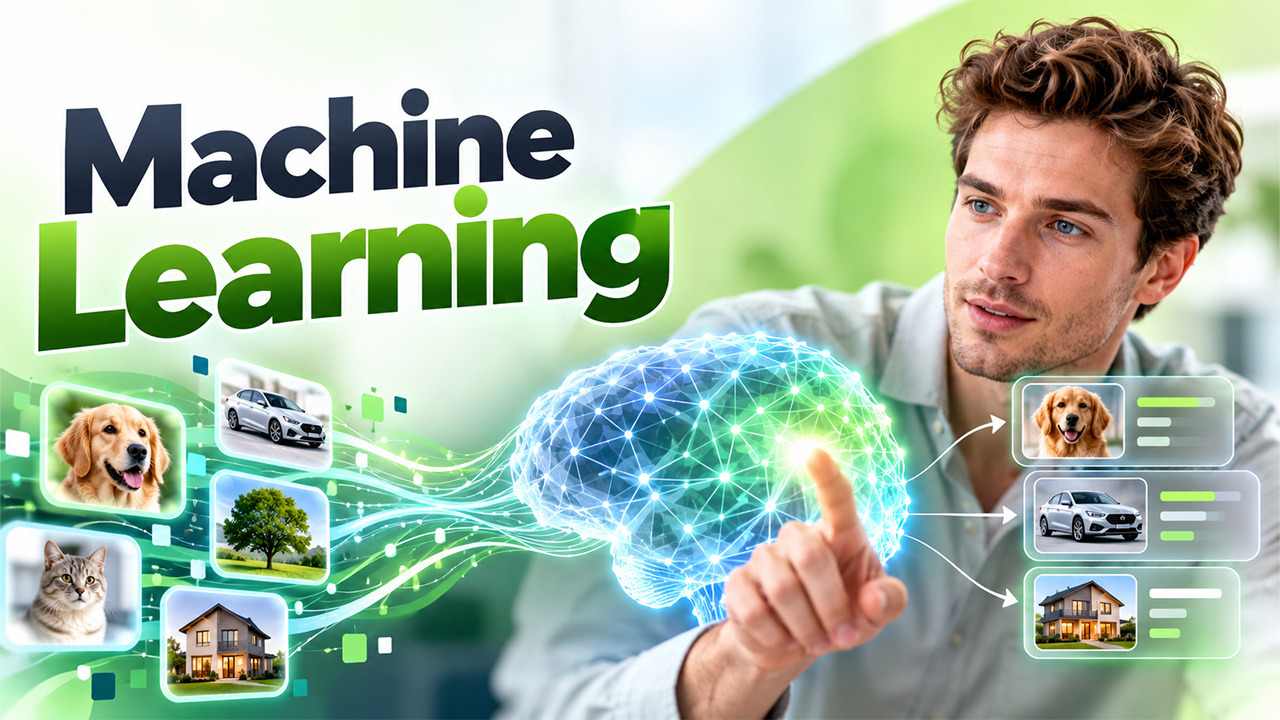
Machine learning is the way by which computers learn from data instead of receiving step-by-step instructions. When you feed computers several examples, it identifies the patterns hidden inside them. This process is central to AI model training, where models learn from data to make predictions and improve their performance. Later, when it comes across something new, it uses those patterns to make a smart guess. For instance, a bank can train its systems on all past transactions, so it can spot fraudulent payments and flag them. The better examples it sees, the better its guesses get.
How Does Machine Learning Work
The idea behind this is simple. A computer analyzes the input and the answers that match it. From those pairs, it establishes the relation between the two. Let’s understand through a small example: say you show a computer these pairs: 2 gives 10, 5 gives 19, and 9 gives 31. Now, it studies the pattern and figures out the hidden rule, which is: multiply by three, then add four. So, now if you give it a 7, it correctly gives you 25. This is how real systems work, only with millions of examples and far more complex rules.
Machine learning works in four steps:
Step 1: Prepare and Clean Data
Raw data is often messy. It has gaps, missing values, mistakes, incorrect numbers, and inconsistent formats. So, the raw data is cleaned and organized.
Step 2: Train the Machine Learning Model
The processed data is fed into computer systems to train machine learning algorithms. The systems analyze data again and again, and each time get better at guessing the right answers.
Step 3: Test the Model with New Data
Now, to test the systems, new data is given that it hasn’t seen before. If it was trained properly to recognize apples and bananas in a basket, can it still recognize them when placed on a table? This step helps you see if it truly learned or just memorized. This type of evaluation is essential for predictive model testing, helping determine whether a machine learning model can make reliable predictions when it encounters unfamiliar data.
Step 4: Improve Model Performance
If you are not satisfied with the results, make changes in the setup or provide better data, then try again.
One important thing to note is that a model is only considered good when it learns from the data and gives better outputs. Poor-quality data leads to poor guesses regardless of how clever the system is.
AI vs. Machine Learning vs. Deep Learning
People often use these terms interchangeably as if they mean the same thing. They don’t. At best, you can think of them as circles, one sitting inside the other.
| Term | What It Means | Simple Example |
| Artificial intelligence (AI) | The big idea of making machines act in smart, human-like ways | A voice assistant or a self-driving car |
| Machine learning (ML) | A part of AI where machines learn from data instead of fixed rules | A tool that sorts spam emails |
| Deep learning | A part of machine learning that uses layered, brain-inspired networks to handle complex data | Face recognition on your phone |
So, all machine learning is AI, but not all AI is machine learning. And deep learning is one special kind of machine learning.
Types of Machine Learning Algorithms
Related walkthrough
Genie 3 AI World Model Explained in 2 Minutes

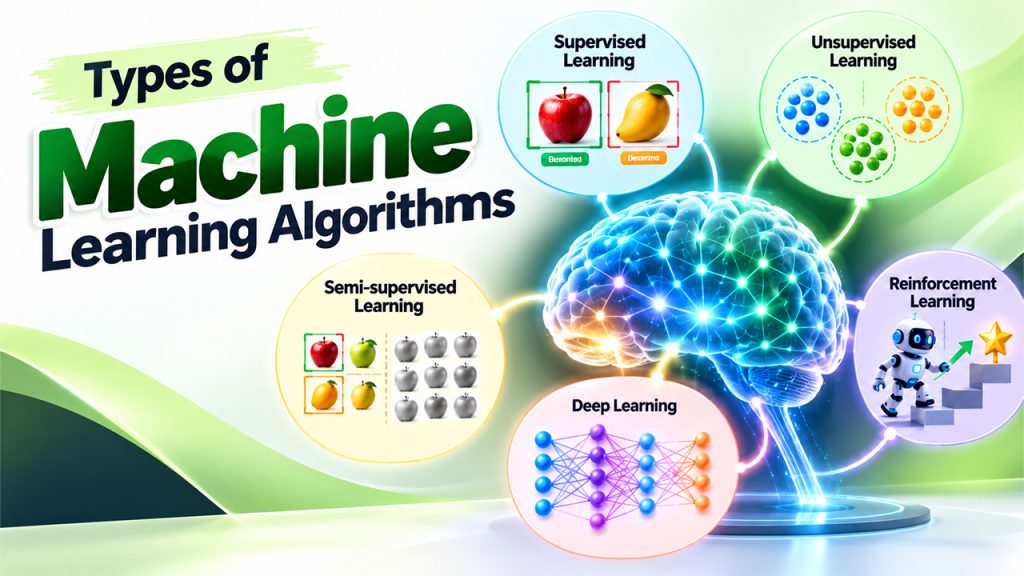
Machine learning algorithms are the methods a computer uses to learn. They differ mainly in how much help the computer gets along the way.
Here are the five main kinds:
Supervised Learning
Data that already has labels is used to train systems. Picture thousands of photos, each tagged “apple” or “mango”. After enough data and practice, a model can even identify fruit it has never seen before. This approach is called supervised learning, and its accuracy depends on the quality of the examples provided. However, someone must first label all that data, which is time-consuming, making high-quality labeled training data an important part of building reliable AI systems.
Unsupervised Learning
In this, data has no labels at all. The computer works by categorizing data into groups by finding things that look alike. A shop might use it to see which items people tend to buy together. Setting it up is easy; however, it can’t give precise outcomes.
Semi-supervised Learning
This combines both supervised and unsupervised learning. Here, the computer gets a small amount of labeled data and a large pile of unlabeled data. First, it uses labeled data to learn and then labels the rest on its own. It is useful when labeling everything manually takes too long, such as with long documents.
Reinforcement Learning
Here, the system learns by a trial-and-error method. It is similar to playing video games. If it gives good answers, it wins points and loses them for bad ones. Repeating this over time, it figures out how to collect the most points. It has beaten top human players in games, though real life changes too fast for it to work easily everywhere.
Deep Learning
This method works by using small, connected units, loosely inspired by the human brain. Data passes through many layers, and each layer extracts something more detailed than the last one. Many of today’s advanced AI models are built this way. It works well for images, speech, and language. However, to work well, it needs a lot of data and computing power.
Common Machine Learning Models and Examples
Most beginners get confused between a model and an algorithm. Let’s clear that up. An algorithm is a method, whereas a model is what you get after the method is done learning from data. Understanding how AI models learn from data makes this distinction easier to grasp. The algorithm works as a study plan, and the model is what you know once the studying is done.
There are many machine learning models available out there. These are some of the most common ones:
| Model | What It Does | Example |
| Linear Regression | Predicts a number by drawing a straight-line trend through data | Guessing a house price from its size |
| Logistic Regression | Sorts things into two groups, such as yes or no | Deciding if an email is spam |
| Decision Tree | Asks a chain of yes-or-no questions to reach an answer | Approving or rejecting a loan application |
| Random Forest | Combines many decision trees and goes with the majority vote | Spotting unusual bank activity |
| K-means Clustering | Groups similar items together without labels | Splitting customers into shopping groups |
| Neural Network | Uses layers of connected units to find complex patterns | Recognizing faces or understanding speech |
There is no single model that works well for everything. The right model depends on the problem you’re trying to solve, the type of data, and the volume of data.
Real-World Applications of Machine Learning

You probably use machine learning many times a day without noticing.
Here are some places it shows up:
Healthcare
Doctors use it to study scans and health reports. It analyzes data to recognize unusual patterns. It can help spot signs of disease early, such as certain tumors or eye problems. However, it doesn’t replace health professionals in any way; rather, it gives them another set of eyes that process data faster.
Finance
Banks use machine learning models to catch suspicious transactions and fraud. Through machine learning integration, a system learns what normal transactions look like, and when something unusual happens, it flags the activity within seconds. The same idea is used in machine learning in threat detection, where systems monitor networks and spot suspicious activity before it causes harm.
Retail and Shopping
Retail and e-commerce stores use it to recommend products, plan stock, and predict what people might be interested in buying. This is why the “you might also like” list often hits too close to home.
Entertainment
Streaming apps observe what shows you watch and suggest similar shows that you might like. Many studios also use it to sort and tag huge libraries of videos and images.
Computer Vision
Cameras and apps use it to recognize objects, faces, and scenes. A camp photo app, for instance, can spot a child in thousands of pictures and alert the parents.
Conclusion
So, what is machine learning? In short, it is a practical method for computer systems to learn from data. It already shapes how we shop, pay, travel, and use services. As data keeps growing and AI evolves, these systems will become more useful in everyday life. However, they cannot work on their own. They need careful monitoring, clean data, and human oversight in AI to remain reliable and responsible. For anyone curious about technology, learning the basics now is a smart move, and it gets easier with every example you come across.
Frequently Asked Questions
It's a way for computers to learn from examples instead of fixed instructions. They find patterns in data and use them to make predictions or decisions.
No. Machine learning is one part of AI. AI is the bigger idea, and machine learning is one way of reaching it.
An algorithm is a method used to learn. A model is the finished result after that method learns from data.
Coding, basic math, and statistics help a lot. Still, many online courses let beginners start slowly and learn at their own pace.
Poor data quality, biased results, and models that memorize instead of learning are the biggest ones. Hard-to-explain decisions and high computing costs are also common problems.