
AI Search vs Traditional Search: How Online Discovery Is Being Rewritten
Type a question into Google today and odds are you'll never leave the results page. That's not a hunch. SparkToro's analysis of Similarweb clickstream data found that 68% of U.S. Google searches in early…
Type a question into Google today and odds are you’ll never leave the results page. That’s not a hunch. SparkToro’s analysis of Similarweb clickstream data found that 68% of U.S. Google searches in early 2026 ended without a single click, up from roughly 60% in 2024.
Meanwhile, ChatGPT crossed 900 million weekly active users this year. People aren’t just searching differently. They’re asking differently.
For marketers comparing AI search vs traditional search, that raises an awkward question. If fewer people click, do backlinks still matter? Is paying for premium link building services still smart, or is that budget better spent elsewhere? The honest answer sits somewhere between the “SEO is dead” crowd, and the vendors promising page-one miracles.
AI Search vs Traditional Search: Key Differences?
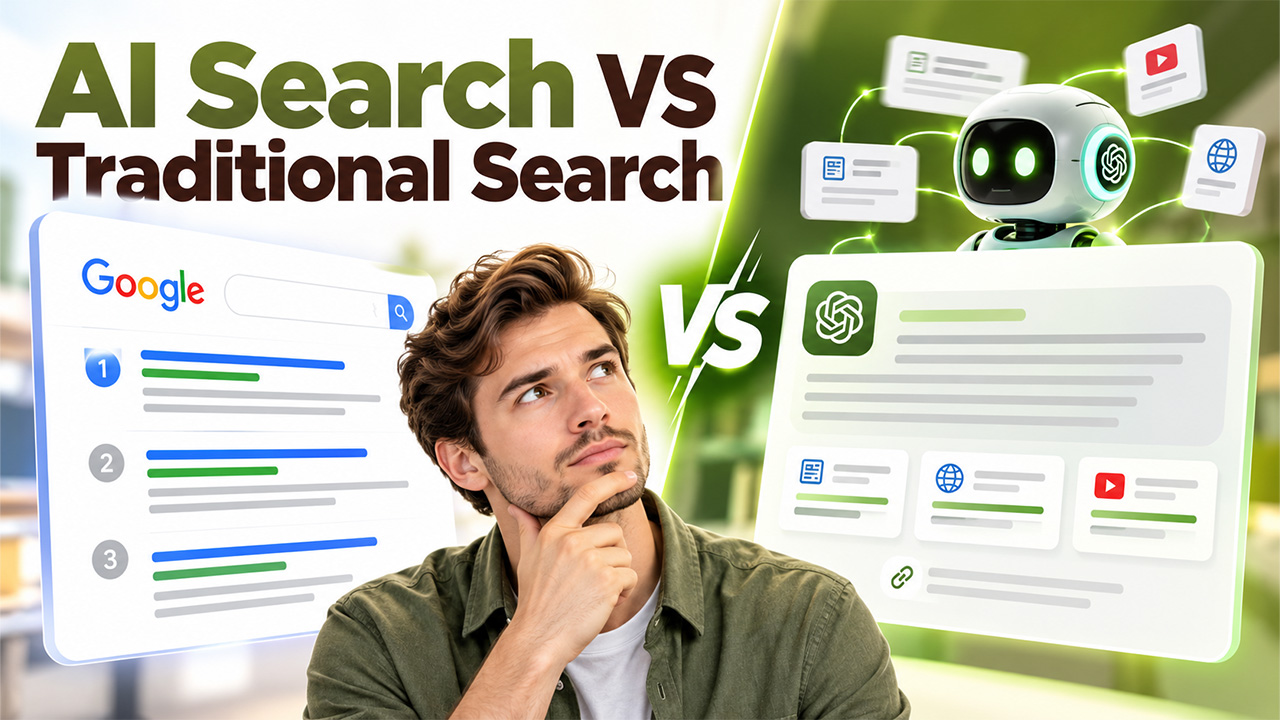
AI search vs traditional search comes down to this: traditional search ranks pages, while AI search writes answers.
A classic engine crawls the web, scores pages on relevance and authority, then hands you ten blue links. You do the reading. You decide who to trust.
AI tools such as Google’s AI Overviews, AI Mode, ChatGPT, and Perplexity pull from several sources and stitch together one response. Sources show up as small citations, often tucked behind a link icon. Plenty of users never open them.
The Short Version
• Output: a ranked list of pages vs. a written summary with citations.
• User effort: comparing tabs vs. reading one answer and asking follow-ups.
• Query style: short keywords vs. long, conversational prompts.
• Brand win: rankings and clicks vs. mentions and citations.
AI Search vs Traditional Search: Traffic Consumed by AI Overview?
Quite a bit. Ahrefs examined 300,000 keywords and found the top-ranking page’s click-through rate ran about 58% lower whenever an AI Overview appeared. Its 2025 version of the same study measured 34.5%, so the gap got wider, not narrower.
There’s a twist, though. Seer Interactive reported that organic CTR on AI Overview queries climbed from 1.3% in December 2025 to 2.4% by February 2026. Its data also showed pages cited inside the Overview pulled roughly 2.1% CTR, while uncited pages on the same results page managed about 0.9%.
Translation? Getting cited matters. Getting skipped by the AI layer stings twice.
Is Google Losing to ChatGPT?
Not yet. Not by a long shot, depending on how you count.
StatCounter still had Google near 90% of global search engine share in April 2026. AI Overviews reach around 2 billion monthly users because they live inside Search itself, and Alphabet reported Search revenue grew 19% year over year in Q1 2026.
In AI search vs traditional search, the starting point hasn’t moved much. What’s shifted is the ending. Discovery increasingly wraps up inside the answer box, before any website gets a visit.
Do Backlinks Still Matter in AI Search?
Related walkthrough
Stellar OST to PST Converter Review 2026 | Online vs Desktop – Real Test

Yes, but they no longer carry the load alone. Anyone who tells you otherwise probably has something to sell.
An Ahrefs analysis of 75,000 brands found that branded web mentions correlated with AI visibility at 0.664, compared with 0.218 for backlinks. That’s a striking gap. AI systems appear to care about brand authority and how often credible sources talk about you, not merely who links to you.
Still, don’t torch your link strategy. Seer Interactive’s 2026 correlation work found that in travel, referring domains and links from news sites tracked strongly with AI citation visibility. AI Overviews also tend to draw on pages that already rank well, so old-school authority keeps feeding the new machine.
The Skepticism Is Earned
Lots of business owners have been burned. Private blog networks. “Guest posts” on sites that exist purely to sell guest posts. Cheap high-DA links that quietly disappear within a quarter. Retainers that cost more than a junior hire and deliver a spreadsheet of irrelevant URLs.
Those tactics were risky before. In AI search, they’re close to worthless. A language model has no reason to cite a thin page on a link farm, and a paid mention nobody reads builds zero brand familiarity.
What Should Businesses Do Now?
Earn attention where real readers and real publications already gather. In practice, that looks like this:
• Favor editorial placements on relevant, trafficked sites over raw link counts.
• Answer common questions plainly near the top of each page. Clear, quotable sentences get lifted into AI summaries more often.
• Grow branded search through original data, digital PR, podcasts, and genuine community participation.
• Keep local SEO sharp. A plumber in Phoenix or a dentist in Dallas still wins through Google Business Profile, reviews, and local citations, since SparkToro notes local, branded, and transactional queries remain far less click-starved.
• Track AI citations and mentions alongside rankings, not instead of them.
How to Vet a Link-Building Provider
If you’re weighing outside help, push for straight answers:
• Can they show live placements on sites with real, verifiable traffic?
• Do they pitch editors, or pick from a menu of “available” domains?
• Do they talk about relevance and brand mentions, or only domain metrics?
• What happens if a link vanishes after a few months?
Fuzzy replies are a warning sign. Reputable providers expect these questions and answer them without flinching.
The Bottom Line
Search isn’t dying. AI search vs traditional search is splitting discovery into two paths. Classic rankings still capture branded, local, and buying-intent traffic, while AI answers increasingly decide which brands people trust before they ever click.
Links remain part of that equation. The difference is that manufactured authority fools no one anymore, least of all a language model. The brands that come out ahead will be the ones credible sources genuinely choose to talk about.