
10-Step Checklist for Moving Your Business to the Cloud
Cloud migration checklist to move your business and CRM to the cloud securely, reduce costs, and improve performance.
Cloud adoption is beneficial, both to a small business that needs to lower its infrastructure expenses and increase its infrastructure, and to a large organization that is seeking to modernize its business area. Nevertheless, unless it is planned or orchestrated with cloud-managed IT services, the transition may cause some unforeseen expenses, security threats, and discontinuities in operations.
The following 10-step checklist will show you the main stages to go through for cloud migration services.

Assess Your Current IT Infrastructure
Your current IT environment is not something that you should be blind to.
Key actions to take:
- List all the IT applications and assets.
- Determine how systems are dependent on each other.
- Assess the present performance and weaknesses.
- Identify workloads that are cloud-enabled.
It allows you to detect possible pitfalls in the process of migration and enables you to make sure that the most crucial systems are thoroughly considered. While reviewing your current IT infrastructure, it’s equally important to evaluate whether traditional servers or cloud environments are better suited for your CRM and business operations. Choosing the wrong infrastructure can impact performance, scalability, and long-term costs. To understand this better, read this detailed guide on Bare Metal vs Cloud Servers for CRM.
Define Your Business Goals and Requirements
The cloud migration services are supposed to be in line with your larger business goals. In the absence of clear goals, one could not easily measure any achievement or select appropriate solutions.
Consider the following:
- Do you want to minimize the costs or increase the scale?
- Do you require improved teamwork tools?
- Does it have any compliance or regulatory requirements?
- How would you forecast performance improvements?
There will be clearly set objectives to guide all the decisions during the process of migration.
Choose the Right Cloud Model
Various models of clouds exist, and the choice of the model to use depends on your business requirements:
- Public cloud
- Private cloud:
- Hybrid cloud
Both models have benefits, and thus one should consider the best model to suit the operation and security needs.
Evaluate Cloud Service Providers
Google and Amazon are not all alike as cloud service providers, and they often outperform many Cloud Storage Alternatives in terms of scalability and enterprise features. Selecting the appropriate partner plays a vital role in determining whether your migration will be successful or not.
In an assessment of the providers:
- Garbage collection and availability assurances.
- Security services and applications.
- Price organization and disclosure.
- Customer service and customer support level agreements.
Joining forces with more seasoned partners, including Atlantic BT, may also allow businesses to perform the process with much less difficulty.
Calculate Total Cost of Ownership (TCO)
Although a cloud solution may save on initial expenses, one should take into consideration the entire financial scenario.
Be sure to account for:
- Migration costs
- Continuous subscriptions and usage charges.
- The costs of maintenance and support.
- The expenses of training and onboarding.
This is achieved through a comprehensive cost analysis, which avoids budget overruns and makes them last.
Read Also: 15 Best Cloud Storage Alternatives in 2026 (Compare Features, Pricing & Security)
Develop a Data Security and Compliance Strategy
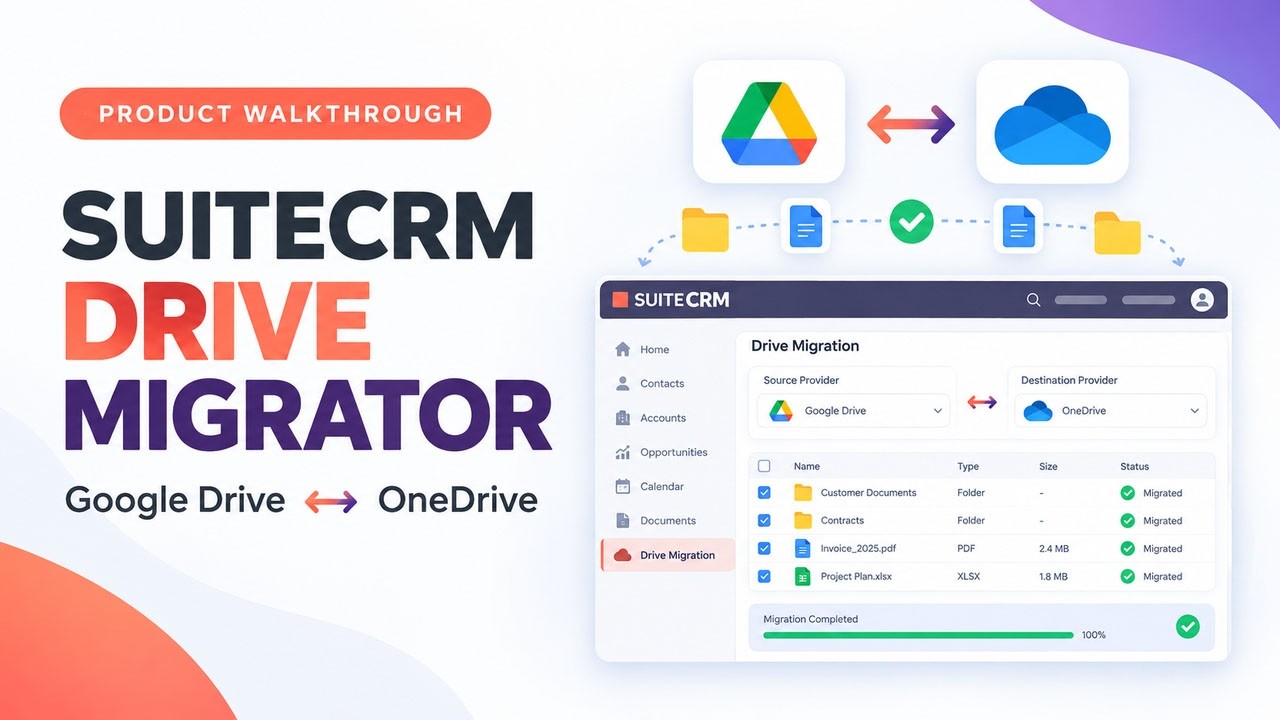
Related walkthrough
SuiteCRM Drive Migrator Tutorial | Google Drive to OneDrive | OneDrive to Google Drive Migration
One of the most topical factors of cloud migration is security. Considerations of importance include encryption of data and data permissions, adherence to the industry standards (e.g., GDPR, HIPAA), and periodic security checks and controls.
An effective security plan with trusted cloud service providers will not only secure your data, but it will also create trust among customers and other stakeholders.

Create a Migration Plan and Timeline
To make the transition efficient, a migration plan assists in creating an orderly and efficient software migration.
Your plan should include:
- A phased migration approach
- The critical systems are prioritized.
- Risk management strategies
Structured timeline fitting will help keep the project up to date and cause as few disruptions as possible to the everyday operations.
Prepare Your Team
Technology will not make everything work – your team should be prepared to go through the transition.
Steps to prepare your team:
- Conduct training on the new tools and platforms.
- Beef in the communication of change.
- Role and responsibility assignment.
- Manage the issues and opposition.
A knowledgeable team that is well prepared will go a long way in ensuring that migration to the cloud is successful.
Test Before Full Migration
One third of cloud migrations fail, and only 25% meet their migration deadlines. Testing is also an important procedure that must not be ignored.
Testing should include:
- Application performance testing.
- Vulnerability and security testing.
- Data integrity checks
- User acceptance testing
This is because, by fixing problems before they happen, you will minimize the chances of expensive ailments once the entire deployment has occurred.
Plan for Post-Migration Optimization
The optimization must be in place and be constantly optimized to give you the maximum return on your investment.
Focus on:
- Performance tracking of the monitoring systems.
- Optimizing resource usage
- Settling parameters on demand.
- Reviewing costs regularly
Continuous optimization will contribute to the efficiency and make sure that your cloud environment will keep changing with your business requirements.
In Conclusion
Relocating your business to the cloud is an involved process, but very rewarding when it is well done. The risks can be minimized by adhering to a specific checklist: beginning with evaluating your infrastructure and finishing with the optimization of the transition after migration.