
How AI Is Advancing PDF Translation?
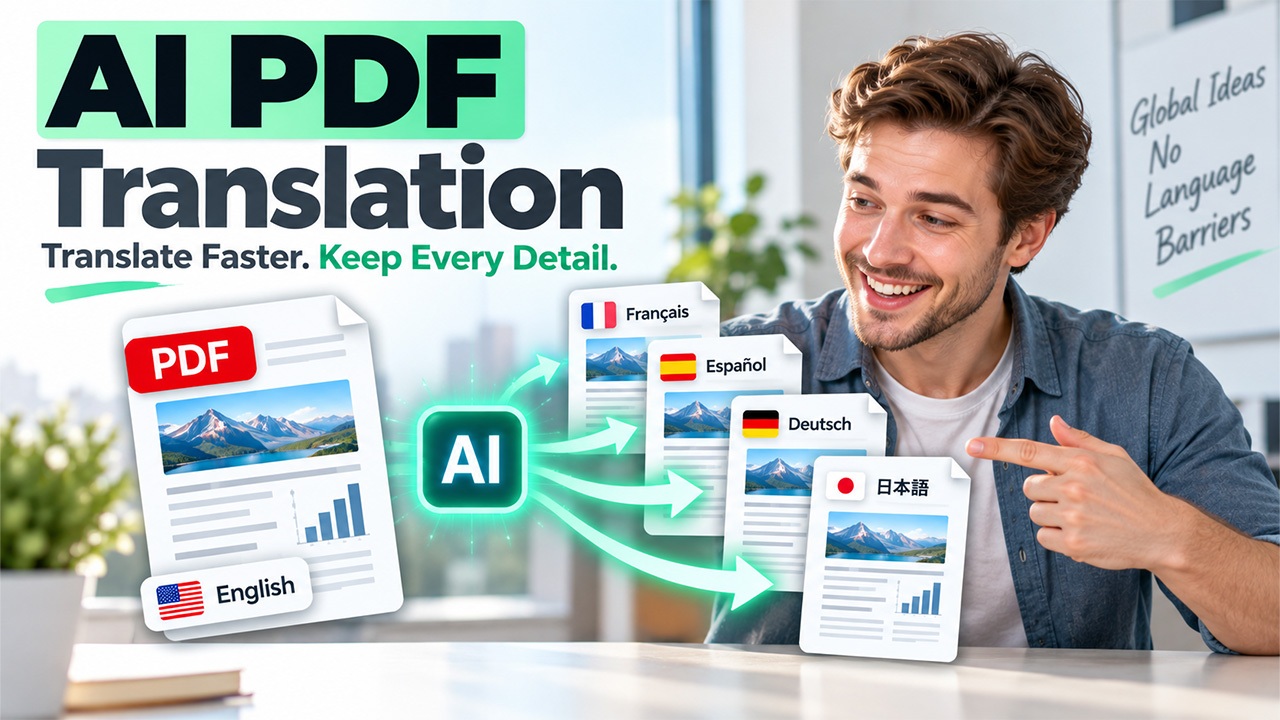
AI-powered PDF translation retains formatting while converting text at scale, minimizing manual work for businesses handling multilingual documents.
PDFs are most common formats for sharing reports, business documents, manuals, presentation, research, and education materials. However, for global businesses distributing the same PDF across different markets ensures a familiar challenge: the document must be translated without losing its formatting, structure, or meaning.
Conventional PDF translation can be difficult to scale and slow. Text may have to be sent to translators, manually extracted, reviews, and then placed back into the original design. Headings, tables, images, and page layouts can easily change during the process.
Artificial intelligence is modifying this workflow. Advanced AI-driven PDF translation tools can process complete documents, while a free PDF form filler can help users complete and edit PDF forms before sharing or distributing them. This can make production of multilingual documents quicker, much simpler to manage, and consistent.
AI-driven PDF Translation
What AI PDF translation Involves?
AI-powered PDF translation leverages natural language processing and machine learning to recognize the text inside a PDF, comprehend its context, and convert it into another language.
More sophisticated platforms do a lot more than just extract sentences and return the translated text simply. They can identify distinct elements of the document, including paragraphs, headings, lists, tables, and captions, and then recreate the translated version while ensuring the overall structure of the document.
This is specifically valuable for complex files where formatting is a core aspect of the content experience.
How AI Enhances Translation Efficiency and Speed?
Manual translation of PDF generally involves numerous separate steps. Teams may want to transform the file into an editable format, copy text into a tool of translation, send it for review, and rebuild the document later.
You can AI to ensure automation of the majority of this process.
An entire PDF can be simultaneously processed, enabling an extensive volume of content to be translated much more quickly than a complete manual workflow. This is specifically crucial for organizations handling huge document libraries or updating reports, product materials, and internal documentation regularly.
AI platforms can also use consistent terminology across a document, minimizing variation that may occur when distinct sections are separately managed.
Preserving Document Structure and Formatting
One of the greatest challenges in the translation of PDF is making sure that the original layout remains intact.
A translated sentence may be longer or shorter than the source version. Tables can change; headings may no longer fit within the same space, and text boxes can overflow.
Advanced AI PDF translation platforms are built to take these issues into account. Instead of returning plain translated text only, they can retain elements like headings, page structure, images, tables, and other formatting.
This minimizes the amount of manual redesign needed after translation and makes final document simpler to prepare for publication as well as distribution.
Benefits of AI-Powered PDF Translation
Quicker Accessibility to Documents in Multiple Languages
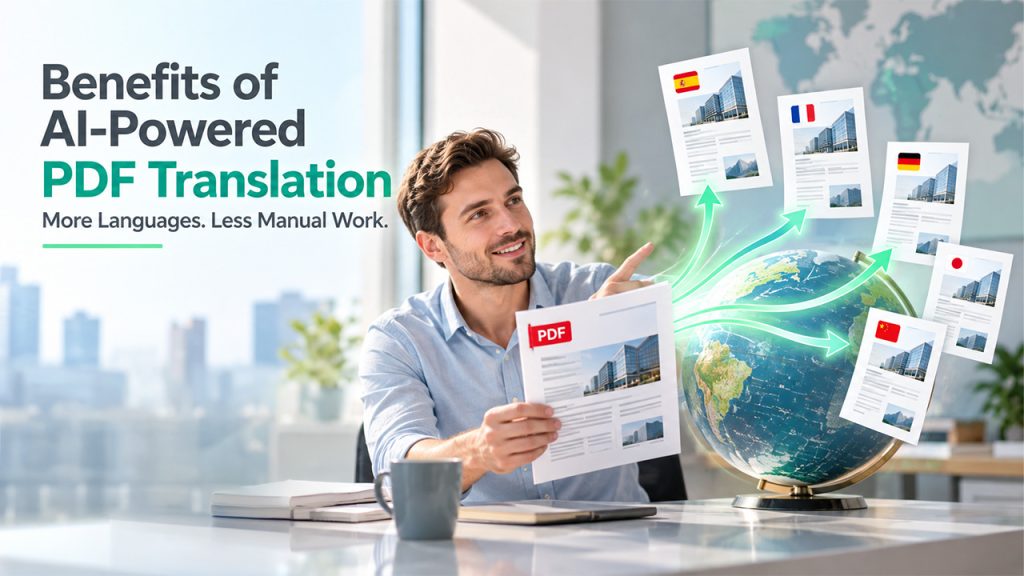
AI translation can greatly minimize the time needed to create localized PDF versions.
This is important for organizations that need to quickly distribute documents across different regions. Training materials, company reports, product data, and customer resources can be converted into different languages without repeating the overall process manually for each market.
Faster localization also helps organizations keep translated materials aligned with the latest source document.
Greater Scalability for International Teams
A small number of PDFs may be manageable through traditional translation methods. Problems show up when an organization has thousands or hundreds of files.
As the document library evolves, manual translation becomes greatly complex to coordinate.
AI-driven PDF translation provides a more scalable approach since the same system can process a great volume of documents and provide support to distinct languages. Teams can leverage workflow for existing markets and extend it when new languages are needed.
This makes AI particularly useful for organizations with frequently updated content.
Better Consistency Across Documents
Consistency is important when translating business or technical materials.
Terminology, product names, recurring instructions, and brand-specific phrases must not change from one document to another.
AI translation platforms can leverage translation memory, glossaries, and previously approved content to ensure consistent language across distinct files.
Instead of translating every repeated phrase from scratch, the system can apply established terminology automatically. Human reviewers can then focus on more complex linguistic or contextual issues.
Reduced Manual Formatting Work
- Conventional translation generally separates language work from document design.
- Even if the translation is complete, someone may want to adjust spacing, rebuild tables, or fix layouts of pages.
- AI tools that preserve PDF formatting can reduce this extra production work.
The result is not simply faster translation. It can also reduce the time between getting the source file and having a localized document, which is ready to publish.
What Are the Common Use Cases of AI PDF Translation?
Related walkthrough
Best 10 Free AI tools for 2026

AI-driven PDF translation can provide support to so many distinct types of documents.
Businesses may leverage it for manuals, product brochures, contracts, reports, sales materials, internal documentation, and training resources.
Educational businesses can convert resource documents and course materials, while global teams can make internal resources accessible to employees in different regions.
Readers may also encounter digital book and document platforms such as OceanofPDF when sourcing PDF materials for translation. However, it is important to check the source, copyright status, and safety of any file before downloading or translating it.
The same technology can also be utilized for large collections of archived PDFs that can otherwise need great manual work to localize.
Challenges and Limitations
Complex Formatting Can Still Require Review
The structure of PDFs changes widely:
- Some may have simple text, while others involve multi-column charts, layouts, scanned pages, tables, or unusual typography.
- AI platforms can manage a lot of these elements. However, highly complex files might still require manual adjustment after translation.
- The more complex the source document becomes, the more significant it is to go through the final layout before publication.
Context and Specialized Terminology Remain Difficult
AI translation has considerably enhanced. However, it can still make mistakes when the language extensively depends on the context.
- Legal wording, technical terminology, industry-specific vocabulary, and ambigious phrases may need expert review.
- A sentence can be correct grammatically while utilizing the wrong term for a particular audience or industry.
- This is why organizations converting important PDFs must combine automation with relevant quality controls.
Scanned PDFs create Additional Challenges
Not every PDF contains editable digital text.
Some files are scans of printed images or documents. In such cases, the system first has to identify the text before it can translate it.
Unusual fonts, poor scan quality, distorted pages, and handwritten notes can minimize accuracy in recognition.
For such files, reviewing both the translated version and extracted text becomes specifically significant.
The Role of Human Review
AI can manage bulk of the routine tasks pertaining to translation of PDF. However, human expertise is still important.
Reviewers can recognize awkward phrasing, terminology errors, formatting issues, and cultural issues that automated platforms can overlook.
For routine documents, AI might manage most of the process with quality check only at the end. More sensitive materials, like technical, legal, financial or, customer-facing documents, may need more in-depth review.
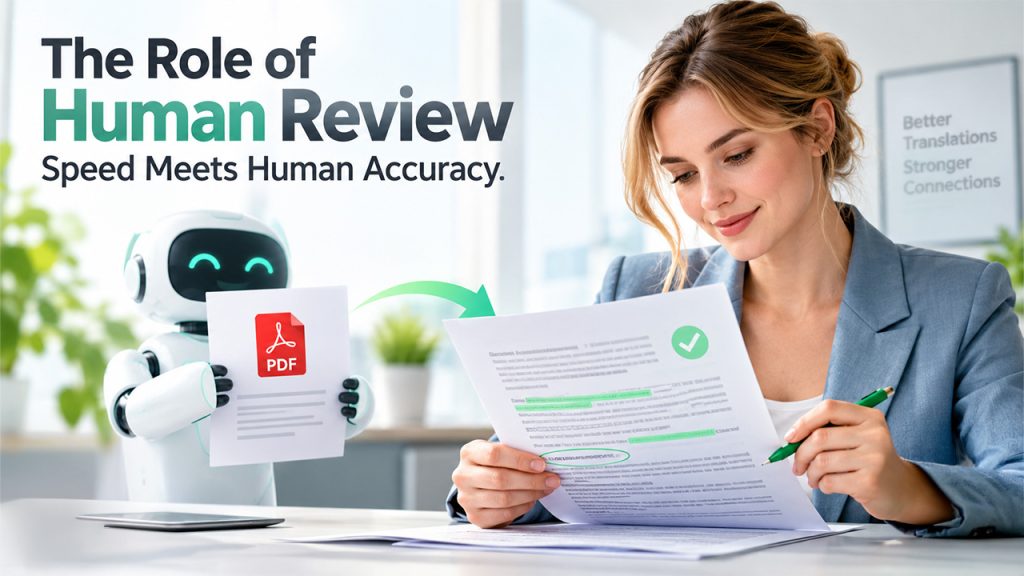
The most useful approach is generally a hybrid workflow. AI manages document processing and translation at scale, while human specialists focus on nuance and accuracy.
The Future of PDF Translation
AI PDF translation is possibly becoming more and more integrated into wider localization and content workflows.
Instead of considering PDFs isolated files, businesses can handle them along with presentations, websites, and other formats of content through centralized platforms of translation.
Glossaries and translation memory can enhance consistency, while automation can aid in updated files to pass through localization workflows more quickly.
As language models and document recognition enhance, AI platforms will also become much better at managing contextual language and layouts.
The objective is not just translate PDFs quickly. It is to make document management in multiple languages much simpler to scale.
Conclusion
AI is changing PDF translation by minimizing a lot of the manual steps conventionally needed to localize documents. Modern platforms convert large volumes of text, preserve structure of document, provide support to different languages, and ensure more consistent terminology across different files.
This provides global businesses with a more scalable and quicker way to make sure documents become available to global audiences.
Challenges are still there. Specifically, with scanned files, complex layouts, and specialized terminology. Human review is still significant when context and accuracy are important.
The most successful approach incorporates both. AI ensures automation, speed, and scalability, while human reviewers make sure that the final document is natural, accurate, and ready for its intended audience.