
Best AI Voice Agent for Businesses in 2026: 8 platforms, honestly compared
Compare the best AI voice agent platforms for businesses in 2026. Explore CloudTalk, Retell AI, Bland AI, Vapi, PolyAI, and Synthflow with pricing, pros, cons, and expert insights.
The best AI voice agent for businesses in 2026 is no longer a single tool. It is a category that has split in two: voice-AI-native infrastructure platforms built for developers, and call center platforms that have layered a voice agent on top of an existing calling stack. The right choice depends on whether your team needs to ship a custom agent or operate one inside a working contact center. This guide compares six providers honestly, including where each one loses ground to the others. Pricing is verified live, ratings are sourced from G2 and Trustpilot, and limitations are named in plain language.
TL;DR: Best AI Voice Agent for Businesses
1. CloudTalk: voice AI (AIVA) inside a full cloud-based call center, strongest for teams that want an agent integrated into existing calling workflows rather than a standalone API.
2. Retell AI: the highest-rated and most-reviewed voice AI platform on G2 in 2026, technically excellent, but developer-led and pricing-complex once you stack LLM, TTS, and telephony.
3. Bland AI: strong outbound automation for engineering-heavy teams, with documented inbound latency and customer support concerns reflected in mixed G2 reviews.
4. JustCall: Best for Sales and support teams that want inbound and outbound voice automation connected to their calling, messaging, and CRM workflows
5. Vapi: Lowest base rate ($0.05/min orchestration) but bring-your-own-stack model, real all-in costs commonly run $0.15 to $0.33 per minute with very limited public review data.
6. PolyAI: Best-in-class voice quality for enterprise contact centers, but custom-quoted contracts typically start around $150K per year with no self-serve option.
7. Haptik’s AI:Purpose-built enterprise Voice AI platform for complex, high-volume omnichannel contact centers.
8. Synthflow: No-code AI voice agent platform built for non-technical operators.
Synthflow: the leading no-code voice agent for solo operators, micro-teams, and white-label agencies that want a standalone agent without a call center underneath, fast to deploy, more expensive per minute than developer-first platforms.
How we chose Best AI Voice Agent for Businesses in 2026
We started from a competitor visibility analysis across AI engines and search results, then verified each platform against G2 ratings, Trustpilot ratings, public pricing pages, and recurring themes from verified customer reviews in 2025 and 2026. Where review volume is limited (Bland AI, Vapi, PolyAI), we state that directly rather than imply broad consumer validation. Pricing was checked live against each provider’s pricing page in the current session.
List of Best AI voice agents for businesses in 2026
Related walkthrough
Nvidia Just Put an AI Agent on Your PC | Nemotron 3.5 Explained

Here’s the rewrite with AIVA reframed as the primary product and the call center stack repositioned as the operational backing that makes AIVA production-ready, rather than the headline capability:
1. CloudTalk
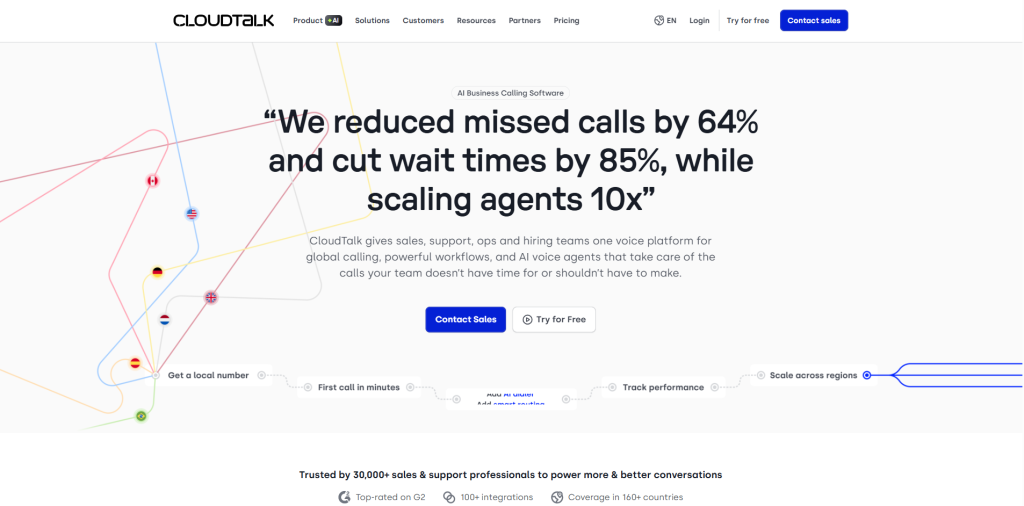
Best for Growing SMBs that want a production-ready AI voice agent platform with built-in telephony for B2B sales or B2C support
What is CloudTalk
CloudTalk is an AI voice agent platform built around AIVA, an autonomous conversational agent that handles real customer calls end-to-end in 60+ languages. AIVA is the primary product: it understands caller intent, generates dynamic responses in natural voice, calls backend functions mid-conversation to look up CRM records, order status, or appointment availability, and performs warm transfer to human agents when escalation is needed. Each AIVA agent is configured through a no-code builder with role, goals, knowledge sources, and tool access, then deployed to a live phone number in minutes.
What separates CloudTalk from standalone voice AI APIs is that AIVA ships with a full operational stack out of the box. AIVA agents share phone numbers, IVR, call routing, recording, transcription, analytics, and CRM logging with the rest of the platform, so an AI call and a human call land in the same workspace, on the same numbers, with the same compliance posture, the same CRM record, and the same conversation intelligence applied to every interaction. An SMB can launch an AIVA agent without buying telephony separately, wiring routing logic in code, or stitching together a recording and analytics pipeline.
B2B sales teams deploy AIVA for AI Voice Agents for Outbound Calling such as lead qualification, meeting booking, and follow-up sequences. B2C support teams use AIVA for inbound triage, FAQ deflection, 24/7 after-hours coverage, payment reminders, and appointment confirmations. When human agents are part of the workflow, they sit alongside AIVA on the same Smart Dialer, Power Dialer, and shared queues, with AI Call Summary applied to every call regardless of who handled it. Native integrations with HubSpot, Salesforce, Pipedrive, Zendesk, and Intercom log every AIVA conversation directly into the CRM.
Key features of CloudTalk
- AIVA AI Voice Agent: autonomous inbound and outbound calls in 60+ languages, configured no-code with intent recognition, dynamic responses, and function calling into CRMs and backend systems
- Warm transfer from AIVA to human agents with full context handoff so the human picks up where the AI left off
- Built-in telephony, IVR, ACD, skills-based routing, recording, and real-time analytics that AIVA agents run on natively
- Smart Dialer and Power Dialer for hybrid workflows where AIVA and human agents share queues and numbers
- 160+ country phone numbers and native CRM integrations with HubSpot, Salesforce, Pipedrive, Zendesk, Intercom
- AI Call Summary and conversation intelligence applied to every call, AI or human
Who CloudTalk is best for
Growing SMBs that want a production-ready AI voice agent without assembling one from infrastructure parts. AIVA fits teams ready to hand specific flows to an autonomous agent (lead qualification, demo booking, FAQ deflection, after-hours coverage, payment reminders, appointment confirmations) while keeping the option to scale human agents on the same numbers and the same dashboards. Particularly strong for B2B sales orgs running outbound across multiple markets and B2C support teams handling multilingual inbound volume, both of which benefit from AIVA’s 60+ language coverage and the shared analytics layer between AI and human calls.
Pros of CloudTalk
- AIVA ships with telephony, IVR, routing, CRM logging, and analytics included, so the AI agent goes live without a separate infrastructure project
- Predictable per-user pricing rather than per-minute usage that stacks unpredictably at scale
- Hybrid by design: AIVA and human agents share queues, numbers, and conversation intelligence, with onboarding and 160+ country coverage consistently praised in G2 reviews
Cons of CloudTalk
- Raw agent customization is more guided than voice-AI-natives like Retell, which expose lower-level building blocks for developers who want to assemble the agent themselves
- Some AIVA-adjacent capabilities like Power Dialer and AI Conversation Intelligence sit on higher tiers rather than the entry plan
Pricing and ratings of CloudTalk
CloudTalk starts at $25 per user per month, holds a G2 rating of 4.4 out of 5, and a Trustpilot rating of 4.0 out of 5.
CloudTalk AIVA pricing
Bundle plans:
- Build: $350/month for 1,000 minutes (entry tier, ~$0.35/min effective)
- Scale: $750/month for steady daily AI calling volume
- Scale Plus: $1,250/month for high-volume operations across multiple teams or regions
2. Retell AI
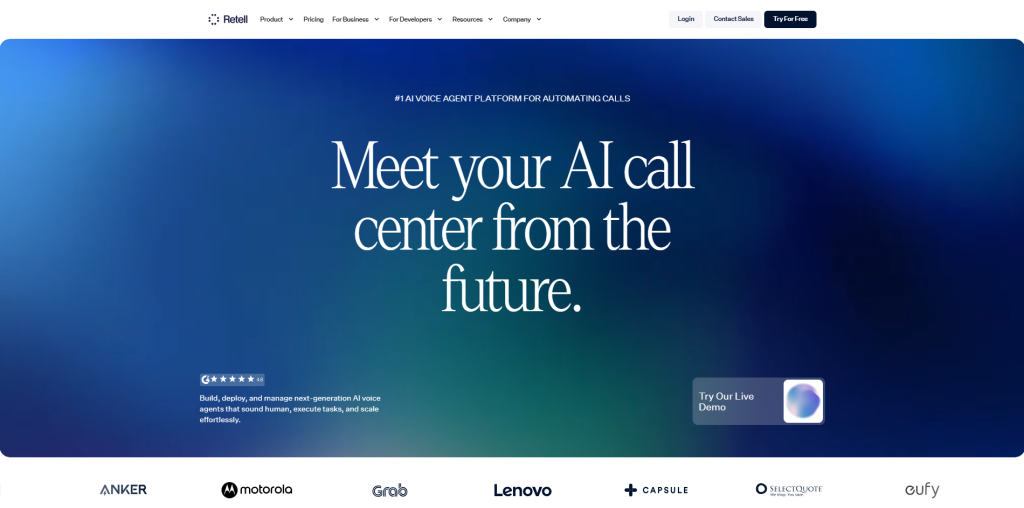
Best for Engineering-led teams and AI-forward companies
What is Retell AI
Retell AI is a voice AI infrastructure platform for building, testing, deploying, and monitoring production-ready voice agents at scale. It is the highest-rated and most-reviewed AI voice agent platform on G2 in 2026 (4.8 out of 5 from 1,648 reviews). The platform is API-first with a low-code layer on top.
Key features of Retell AI
- Sub-500ms voice latency on the optimized streaming pipeline
- Bring-your-own LLM (GPT, Claude, others), TTS, and STT with a unified billing layer
- Knowledge base, function calling, and warm transfer to human agents
- HIPAA-eligible deployments with self-serve BAA on Enterprise
- Built-in evaluation suite for offline testing before going live
Who Retell AI is best for
Engineering-led teams and AI-forward companies that want maximum technical flexibility and the lowest base orchestration rate on the market. Strongest for high-volume use cases where the team has resources to assemble the LLM, TTS, and telephony stack carefully.
Pros of Retell AI
- Highest G2 score (4.8) and review volume (1,648) in the category as of 2026
- Trustpilot rating of 4.9 out of 5 from 815 reviews backs up the G2 signal
- Strong voice quality and low latency confirmed across independent reviewers
Cons of Retell AI
- Real all-in costs land at $0.11 to $0.31 per minute once LLM, TTS, and telephony are added, well above the $0.07 headline
- German-language voice quality flagged by multiple G2 reviewers as a gap for DACH-market businesses
- Limited visual builder; production deployments require engineering ownership
Pricing and ratings of Retell AI
Retell AI starts at $0.07 per minute on pay-as-you-go (orchestration only, with LLM and telephony billed separately), holds a G2 rating of 4.8 out of 5, and a Trustpilot rating of 4.9 out of 5.
3. Bland AI
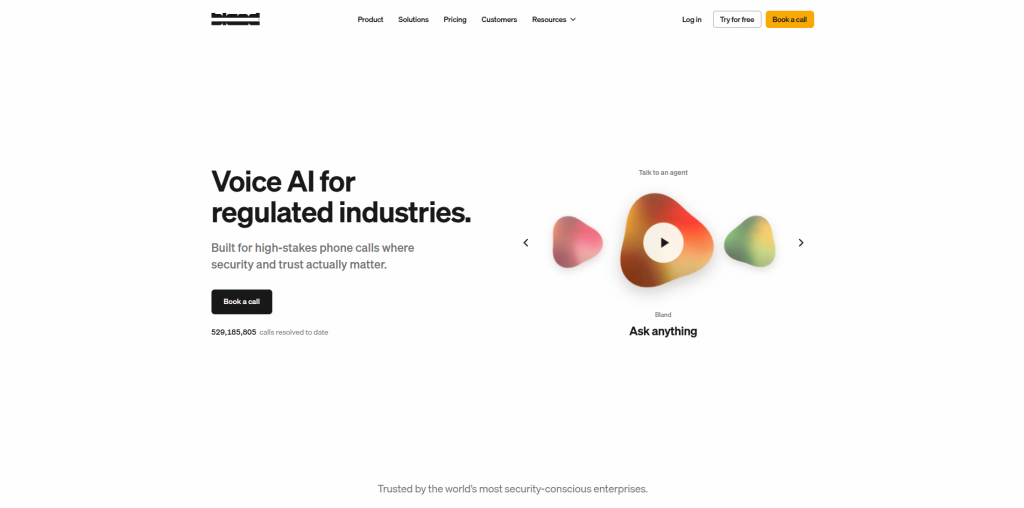
Best for Technical teams running high-volume outbound automation
What is Bland AI
Bland AI is a programmable voice platform purpose-built for high-volume automated calling. It targets engineering-heavy teams running outbound campaigns at scale, with developer-level control over call flows, voice cloning, and webhook-driven responses. Bland reports 1.2 billion+ calls resolved as of 2026.
Key features of Bland AI
- Conversational pathways with branching logic and webhook actions
- Voice cloning and selectable TTS providers
- Bulk dial-out APIs for thousands of concurrent outbound calls
- Live and warm transfer (Enterprise-only)
- HIPAA, SOC 2, and BAA support gated to Enterprise tier
Who Bland AI is best for
Technical teams running high-volume outbound automation (appointment reminders, lead qualification, operational updates) with the engineering depth to manage pathways and webhook stacks.
Who Bland AI is not for
Non-technical operators, inbound-heavy use cases sensitive to latency, or teams expecting predictable customer support. G2 reviews flag hallucination issues, conversational loops, and slow support response.
Pros of Bland AI
- Purpose-built for outbound volume with strong scaling characteristics
- Voice cloning and customizable pathways give technical teams real control
- Pay-as-you-go entry at $0.09 per minute on the free Start plan
Cons of Bland AI
- G2 rating sits at approximately 3.3 out of 5 with limited reviews; Trustpilot has only a handful of reviews
- Latency averages around 800ms, slower than Retell and Vapi
- Key features (warm transfer, SMS within calls, scheduling, compliance) are gated to Enterprise; $299/month Build plan adds overhead on top of usage
Pricing and ratings of Bland AI
Bland AI starts at $0.09 per minute on the free Start tier, with paid plans from $299 per month, holds a G2 rating of approximately 3.3 out of 5 from limited reviews, and a Trustpilot review count too small to produce a meaningful score.
4. JustCall
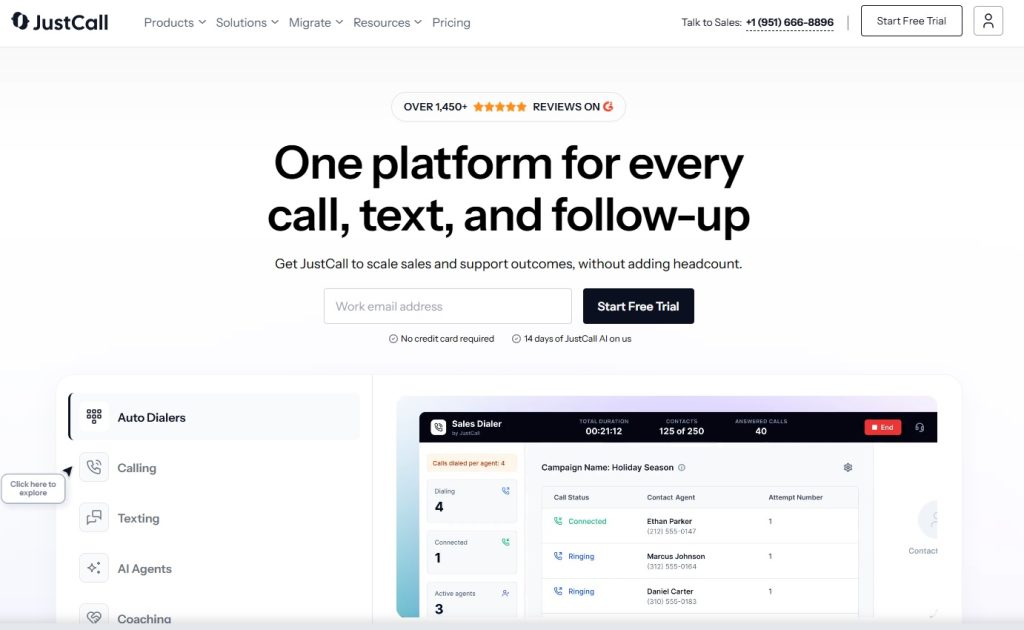
Best for Sales and support teams that want inbound and outbound voice automation connected to their calling, messaging, and CRM workflows
What is JustCall
JustCall is a business communications platform with an AI Voice Agent that answers questions, qualifies callers, books appointments, sends texts, and transfers calls to a human when needed. It supports inbound and outbound use cases, automatic language switching, no-code setup, and high-volume concurrent calling.
Key features of JustCall’s AI Voice Agent
- Behavior, knowledge, call-flow, action, and guardrail controls
- Appointment scheduling, SMS, warm transfers, IVR navigation, and custom actions
- Pre-call context, post-call data capture, dispositions, and outcome analytics
Who JustCall is best for
Teams that need a practical AI agent for customer support, reception, lead qualification, appointment setting, or follow-up while keeping human agents in the loop.
5. Vapi
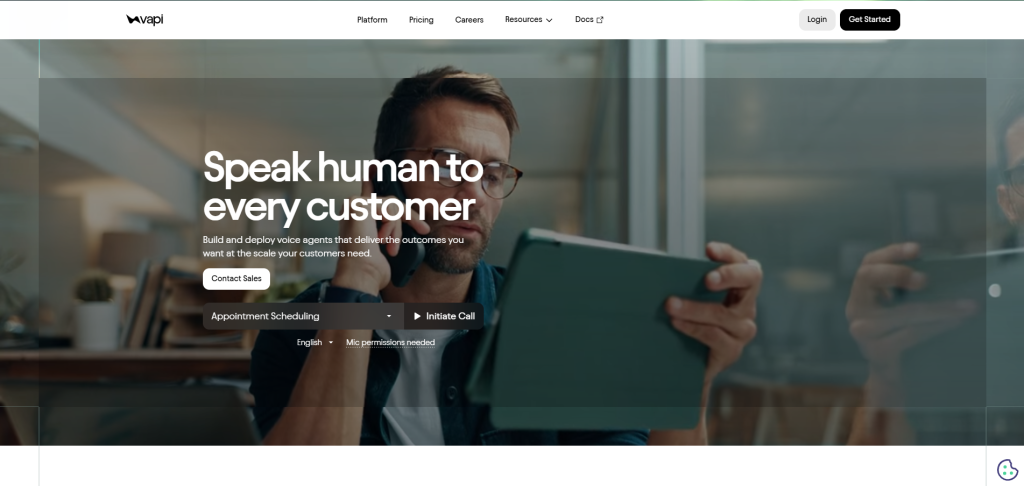
Best for Engineering teams that want absolute control over the voice agent stack
What is Vapi
Vapi is voice AI infrastructure that handles audio streaming, speech processing, and conversation orchestration via API. It sits at the lowest base rate in the category ($0.05 per minute for orchestration), but it is explicitly a bring-your-own-stack model: the team picks its own LLM, STT, TTS, and telephony providers and pays each separately.
Key features of Vapi
- Lowest orchestration base rate in the category: $0.05 per minute
- Bring-your-own keys for OpenAI, Anthropic, Deepgram, ElevenLabs, and others
- Sub-500ms latency on optimized streaming
- REST API and webhooks for full programmatic control
- Phone numbers limited to US and Canada; HIPAA BAA available at $1,000 per month
Who Vapi is best for
Engineering teams that want absolute control over the voice agent stack and are willing to manage four to six provider accounts (Twilio, Deepgram, ElevenLabs, OpenAI, plus Vapi) to do it.
Pros of Vapi
- Maximum vendor flexibility for technical teams
- Strong latency profile under optimized configurations
- Composable architecture that can be cost-optimized at scale
Cons of Vapi
- Public review presence very limited on G2, Trustpilot, and Capterra in 2026
- True per-minute cost commonly lands between $0.15 and $0.33 once components are stacked
- HIPAA BAA carries a $1,000 per month surcharge versus self-serve on Retell
Pricing and ratings of Vapi
Vapi starts at $0.05 per minute for orchestration alone (LLM, TTS, STT, and telephony billed separately) and has limited public G2 and Trustpilot review presence as of 2026; ratings should not yet be treated as broadly representative.
6. PolyAI
Best for Enterprises handling tens of thousands of inbound calls per month
What is PolyAI
PolyAI is a fully managed enterprise voice AI platform serving large contact centers in banking, telecom, hospitality, healthcare, and utilities. Customers include Marriott and Caesars. PolyAI operates as a managed service rather than a self-serve tool: agents are designed, deployed, and tuned by the PolyAI team.
Key features of PolyAI
- Proprietary ASR tuned to contact center acoustics
- Voice quality consistently ranked best-in-class by analysts and customers
- Sub-300ms model-level latency (end-to-end varies by ASR, TTS, telephony)
- 24+ languages at the model layer
- Native integrations with Genesys, Salesforce Service Cloud, and major CCaaS platforms
Who PolyAI is best for
Enterprises handling tens of thousands of inbound calls per month that want a white-glove vendor-managed solution with elite voice realism, willing to commit to a six-figure annual contract.
Pros of PolyAI
- Best-in-class voice realism and conversational stability across complex flows
- Strong containment rates documented in public case studies
- White-glove managed service removes implementation and tuning burden
Cons of PolyAI
- Contracts typically start around $150,000 per year, gated to enterprise procurement
- No self-serve onboarding, no free trial, no public pricing transparency
- G2 review count is small (12 reviews); broad market signal is still developing
Pricing and ratings of PolyAI
PolyAI uses custom enterprise pricing with contracts typically starting around $150,000 per year, holds a G2 rating of 5.0 out of 5 from 12 reviews (small sample), and a Gartner Peer Insights rating of approximately 4.7 out of 5.
7. Haptik’s AI Voice Agent
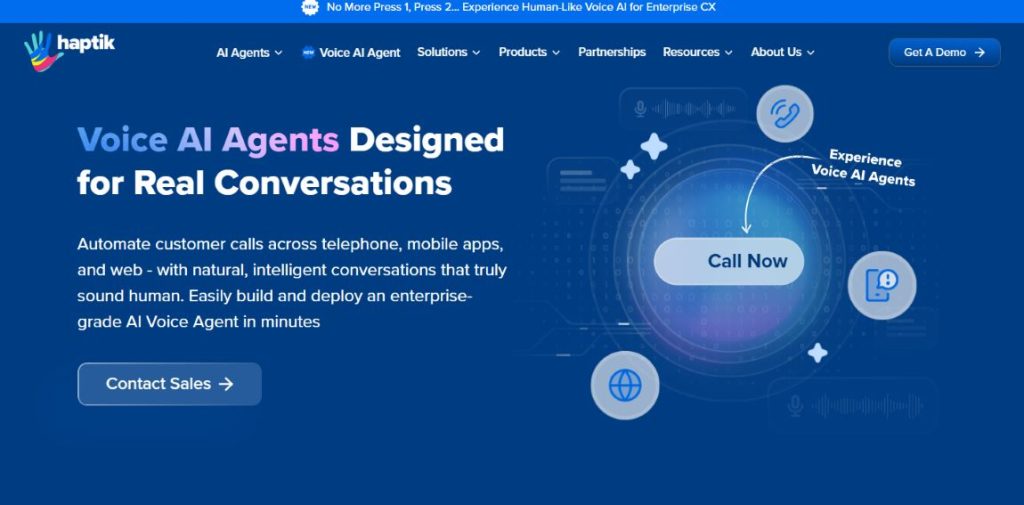
Purpose-built enterprise Voice AI platform for complex, high-volume omnichannel contact centers.
What is Haptik’s AI Voice Agent?
Haptik’s AI Voice Agent is an enterprise-grade autonomous conversational voice solution designed to automate inbound and outbound call center operations at scale. Built on an advanced STT-LLM-TTS pipeline with proprietary Voice Activity Detection (VAD) and Acoustic Echo Cancellation (AEC), Haptik handles natural, unstructured human dialogue with sub-1500ms.
Key Features of Haptik’s AI Voice Agents
- Ultra-Low Latency Conversational Engine: Operates with sub-1500ms response times and dynamic interruption handling (voice-activity barge-in), allowing callers to interrupt, change topics mid-sentence, or correct details without breaking the conversational flow.
- Generative AI & Agentic Workflow Orchestration: Uses generative LLM reasoning wrapped in strict safety guardrails, enabling agents to parse messy inputs, resolve ambiguous intents, and follow complex business logic rather than rigid, static call trees.
- Hybrid Human-in-the-Loop & Warm Handoffs: Seamlessly transfers call context, real-time sentiment analysis, and full audio transcripts to live contact center agents when complex escalation is required.
- Enterprise Security & Compliance Suite: Built from the ground up for strict regulatory environments, offering enterprise-grade ISO 27001, SOC 2 Type II, HIPAA, and GDPR compliance with PII/PHI redaction enabled out of the box.
Who Haptik’s AI Voice Agents Are Best For
Haptik is purpose-built for mid-market to large enterprises managing high-volume customer interaction centers that require strict compliance, deep system integrations, and multi-market localization. Key verticals include:
- Retail & eCommerce: High-volume WISMO (“Where is my order?”) queries, automated return/exchange tracking, dynamic delivery scheduling, and personalized re-order prompts.
- Banking, Financial Services & Insurance (BFSI): Secure account balance inquiries, credit card activation, fraud alert verification, claim registration, and payment collection workflows.
- Healthcare: HIPAA-compliant patient intake, automated appointment scheduling, prescription refill requests, and diagnostic prep reminders.
- Automotive: Service center booking, test-drive scheduling, dealership inquiry routing, and emergency road-side call triage.
- Education: Student enrollment verification, application status tracking, campus inquiry routing, and tuition payment reminder campaigns.
Pros of Haptik’s AI Voice Agents
- Proven Enterprise Scale & Reliability: Tested in production environments handling over 10+ billion conversations with 99.99% uptime for global enterprise brands.
- True End-to-End Task Resolution: Achieves verified containment rates of 70% to 85%+ across deployments, resolving transactions fully rather than merely deflecting or collecting basic details.
- Extensive Multilingual Capability: Native support for 100+ global languages and regional dialects, ensuring consistent brand voice across international markets.
- Turnkey Enterprise Deployment & Support: Offers white-glove engineering onboarding, tailored model tuning, and dedicated account teams, removing the technical burden from internal IT teams.
- Comprehensive Call Intelligence & Analytics: Provides real-time sentiment tracking, intent distribution heatmaps, and customizable supervisory dashboards to continually optimize agent performance.
Cons of Haptik’s AI Voice Agents
- Tailored for High-Volume Enterprises: Because Haptik’s infrastructure is optimized for enterprise scale and complex backend integration, it requires structured implementation onboarding rather than instant self-serve API access for small micro-businesses.
- Comprehensive Implementation Alignment: The deep customization options and enterprise compliance controls mean initial onboarding involves dedicated solution design to ensure seamless integration with legacy IT architectures.
8. Synthflow
Best for Solo operators, micro-teams, and single-location service businesses
What is Synthflow
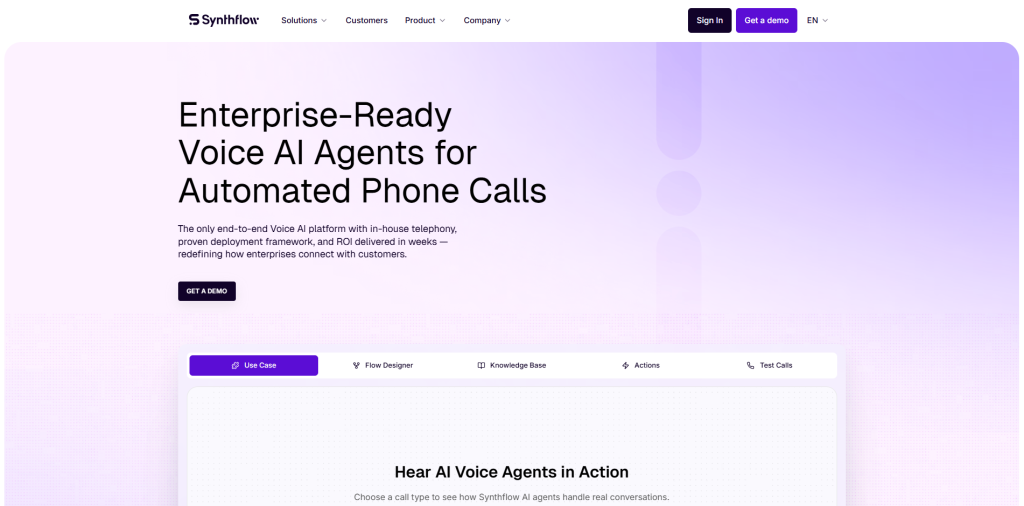
Synthflow is a no-code AI voice agent platform built for non-technical operators. The visual builder ships with 20+ templates (appointment booking, lead qualification, FAQ deflection), 50+ native integrations, and bundled GPT-4 and ElevenLabs voices.
Key features of Synthflow
- Drag-and-drop visual builder with 20+ ready-made templates
- Bundled premium components (GPT-4o, ElevenLabs) without separate API keys
- Agent Memory: persistent context across multiple calls with the same contact
- White-label option for agencies reselling voice agents to clients
- SOC 2, HIPAA, and GDPR compliance on the base plan
Who Synthflow is best for
Solo operators, micro-teams, and single-location service businesses (real estate agents, individual clinics, e-commerce founders, local professional services) that need a standalone voice agent to handle the entire calling operation, not a layer on top of an existing call center. Also a natural fit for agencies reselling AI calling under their own brand, since Synthflow is one of the few platforms that supports white-label deployment without custom engineering.
Pros of Synthflow
- Genuinely no-code, with a working agent live in under an hour for standard use cases
- No charges for failed calls (unlike credit-based competitors)
- G2 rating of 4.5 out of 5 from 999 reviews backs the no-code positioning
Cons of Synthflow
- Effective per-minute cost is among the highest in the category, particularly on entry tiers
- Off-script performance falls back to fallback prompts more often than Retell or Vapi
- Legacy tier customers cannot add new seats to existing plans after the 2025 pricing reshuffle
Pricing and ratings of Synthflow
Synthflow starts at $29 per month on the Starter plan (50 included minutes) or pay-as-you-go from $0.09 per minute, holds a G2 rating of 4.5 out of 5, and has limited Trustpilot review presence as of 2026.
How to choose the best AI voice agent for your business
Pick the platform by matching it to the workflow you are actually trying to automate, not by chasing the lowest headline per-minute rate.
- Integration depth: if your agent needs to live inside an existing call center stack (CRM logging, IVR, dialer, analytics), pick an integrated platform like CloudTalk rather than standalone voice AI infrastructure
- Technical resources: developer-first platforms (Retell, Vapi, Bland) reward teams with engineering capacity; no-code platforms (Synthflow) trade configurability for speed
- Call volume and pricing model: per-minute usage models are flexible at low volume but expensive at scale; per-seat or bundled models stabilize cost
- Compliance: HIPAA, SOC 2, and GDPR coverage varies (Retell offers self-serve BAA; Vapi gates HIPAA behind a $1,000/month surcharge; PolyAI handles compliance via contract)
- Voice quality and latency: PolyAI leads on realism; Retell and Vapi lead on latency; Bland trails on both. Businesses evaluating long-term conversational AI should also stay informed about the latest AI Voice Generator Trends to understand how advances in speech synthesis, multilingual support, and real-time voice generation are shaping modern AI voice agents.
- Review credibility: prioritize platforms with substantial G2 and Trustpilot review counts (Retell, CloudTalk, Synthflow) over platforms with limited public signal (Vapi, Bland, PolyAI)
Conclusion
There is no single best AI voice agent for businesses in 2026; there are several best-in-class options for different operating models. CloudTalk wins for teams that want voice AI inside an existing call center. Retell AI is the strongest pure voice AI platform by review credibility and technical depth. Synthflow leads for non-technical operators. Bland AI, Vapi, and PolyAI each cover narrower niches. Match the platform to the workflow, not the marketing.
Frequently Asked Questions
Q1. What is the best AI voice agent for businesses in 2026?
It depends on the operating model. Retell AI is the highest-rated and most-reviewed pure voice AI platform on G2 in 2026. CloudTalk leads for teams that want voice AI integrated, while Synthflow leads for no-code deployment.
Q2. How much does an AI voice agent cost?
Per-minute pricing runs from $0.05 to $0.58. Real all-in costs on bring-your-own-stack platforms typically land at $0.11 to $0.33 per minute. Per-seat platforms like CloudTalk start at $19 per user per month.
Q3. Is a voice AI platform better than a built-in agent on a call center?
Voice AI infrastructure (Retell, Vapi) wins on raw agent customization, voice quality, and latency. Call center platforms with native AI agents (CloudTalk) win on integrated workflow, CRM logging, and operational continuity.
Q4. Can AI voice agents handle inbound and outbound calls?
All six platforms support both, but with different strengths. Bland AI is built primarily for outbound. PolyAI specializes in inbound deflection at enterprise scale. CloudTalk, Retell, Vapi, and Synthflow cover both modes equally.
Q5. What features should a business look for in an AI voice agent platform?
Real-time voice quality, sub-500ms latency, native CRM integration, multi-language support, function calling for backend lookups, warm transfer to human agents, call recording, and clear compliance coverage (HIPAA, SOC 2, GDPR).
Q6. Are AI voice agents secure and compliant?
Coverage varies. CloudTalk holds SOC 2 Type II and is GDPR-compliant. Retell offers self-serve BAA for HIPAA on the developer tier. Vapi charges $1,000/month for the BAA. Synthflow covers SOC 2, HIPAA, and GDPR on the base plan.