

Cloud Application Development Services: Building Future-Ready Applications
Explore cloud application development services and discover their benefits, types, features, processes, and steps for choosing the right partner.
The article explores how professional cloud application development services help set the foundation for long-term growth for businesses and understand its benefits, types, essential features, and processes.
In the current fast-paced digital environment, applications need to do more than simply perform a set of functions. The applications need to be more scalable, accessible, secure, flexible, and capable of adapting to changing customer expectations.
This is where cloud application development services offer its capabilities. The cloud-based application allows businesses to operate software and access data through internet-connected infrastructure, instead of just relying on traditional on-premises systems. Organizations, from startups to large enterprises, are actively adopting cloud technology to reduce infrastructure complexity, improve collaboration, accelerate innovation, and deliver a better digital experience.
What Are Cloud Application Development Services?
Cloud application development services generally refer to the process of designing, developing, deploying, and maintaining applications that are operated on cloud-based infrastructure, rather than relying solely on traditional on-premises servers. The services help businesses build applications that are scalable, secure, flexible, and accessible using an internet connection. The cloud application development services can include a wide range of services, from custom business applications and SaaS platforms to e-commerce solutions and enterprise software.
Partnering with professional cloud application development services, businesses can design applications that can easily adapt to changing workloads and increasing volume of users without having to continually invest in physical infrastructure. The cloud infrastructure helps businesses support remote accessibility, faster deployment, centralized data management, and integration with modern technologies, such as AI and analytics.
Benefits of Cloud Application Development Services
Cloud application leverages cloud-based computing, storage, databases, and other services to deliver software efficiently. The services help businesses build flexible, scalable, and reliable digital solutions. Some of the key benefits of cloud application development are as follows:
Scalability and Flexibility
One of the major advantages of cloud application development is that it offers businesses the ability to scale according to their requirements. The services are also considered beneficial for growing businesses and applications that can experience fluctuating demand.
Cost Efficiency
The service helps reduce the costs associated with purchasing, maintaining, and upgrading the physical servers and other IT infrastructure. The service allows businesses to use cloud resources according to their requirements, instead of relying on traditional infrastructure upfront.
Faster Application Development and Deployment
The cloud platform enables developers to access ready-to-use services, development tools, databases, APIs, testing environments, and deployment capabilities.
Enhanced Security
Cloud applications help incorporate various key features such as encryption, identity management, authentication, role-based access controls, security monitoring, and automated backups.
Types of Cloud Application Development Services
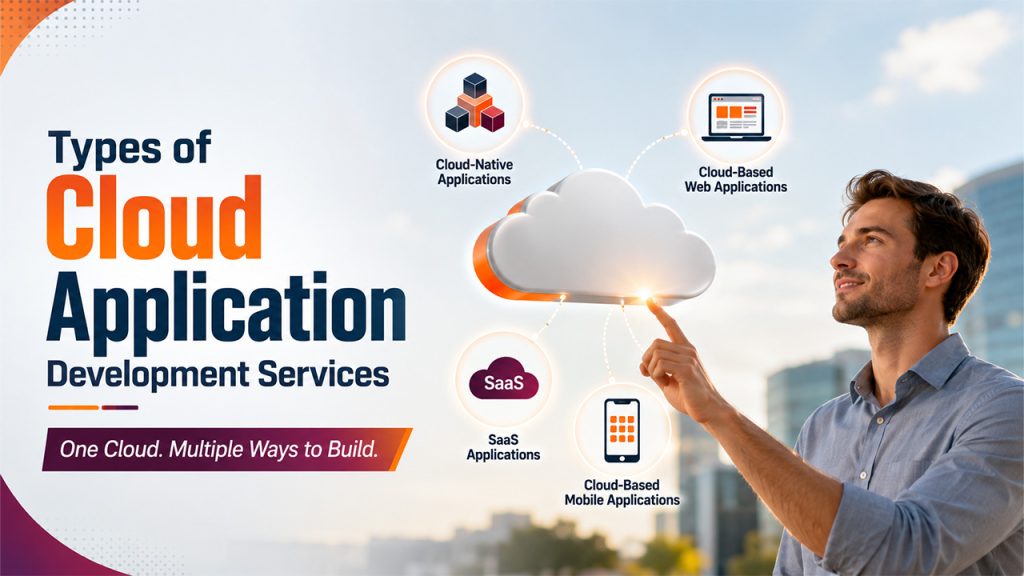
Cloud application development services support a wide range of business applications, from simple cloud-based tools to complex enterprise platforms. Partnering with professional services partners, organizations can choose a wide range of services to build, migrate, integrate, or enhance their digital solutions.
Some of the major types of cloud application development services are as follows:
Cloud-Native Application Development
Cloud-native applications are mainly built specifically to take advantage of cloud infrastructure. The development uses technologies such as containers, microservices, APIs, and automated deployment processes. It also allows applications to be designed for scalability, flexibility, resilience, and continuous development.
Cloud-Based Web Application Development
Cloud-based web applications mainly run on cloud infrastructure and can be easily accessed through web browsers. These applications can also provide users with access without requiring traditional software installation on individual devices.
SaaS Application Development
SaaS applications are hosted in the cloud and are delivered to customers over the internet. This type of service generally allows users to access the software through a browser or dedicated application.
Cloud-Based Mobile Application Development
The mobile application depends increasingly on cloud infrastructure for data storage, authentication, APIs, notifications, analytics, and business logic. Custom mobile application development services help businesses build applications that can communicate with cloud-based backends.
Cloud vs Traditional Application Development
Related walkthrough
The Future is Here: Sanctuary AI & Microsoft's Groundbreaking AI Collaboration

Traditional application development generally depends on dedicated infrastructure and is difficult to scale. Whereas cloud applications are designed around distributed infrastructure and cloud services.
A quick comparison between traditional and cloud application development are as follows:
| Factors | Traditional Applications | Cloud Applications |
| Infrastructure | On-premises | Cloud-based |
| Scalability | Requires hardware changes | Designed for scaling |
| Accessibility | Location-dependent | Accessible through the internet |
| Deployment | Infrastructure intensive | Leverage automated cloud deployment |
| Maintenance | Requires extensive internal infrastructure | Uses managed cloud services |
The Cloud Application Development Process

Developing a cloud application generally involves more than just writing code and deploying it to a cloud server. A successful application requires careful planning, architecture, development, testing, deployment, and ongoing optimization.
The complete process of cloud application development includes the following:
Step 1: Analyzing the Requirements
The first step towards cloud application development is to identify business goals, target users, application features, integration, security requirements, and expected workloads.
Step 2: Architecture Planning
The team selects an appropriate architecture and determines how the application, database, APIs, cloud services, and security components will interact with each other.
Step 3: UI/UX Design
The team creates interfaces that focus on usability, accessibility, consistency, and the need to target users.
Step 4: Development
The developers build frontend and backend components, APIs, databases, authentication, systems, integrations, and other required functionality.
Step 5: Testing
The team ensures that the application undergoes functionality, performance, security, compatibility, and usability testing before deployment.
Step 6: Deployment
The application is deployed to the selected cloud environment. Teams leverage automation to make deployments more consistent and repeatable.
Step 7: Maintenance and Optimization
After launching the application, the team offers regular updates, monitoring, security improvements, performance optimization, and feature enhancements, for long-term success.
Choosing the Right Cloud Application Development Services
Selecting the right cloud application development services is among the most crucial decisions, as the quality of the development partner affects the performance, security, scalability, and long-term success of the application.
Before selecting cloud application development services, businesses should consider the following factors:
Understanding the Business Requirements
Before selecting a development company, businesses should clearly define what they want to achieve with the application. They need to identify their target audience, essential features, expected number of users, and security requirements.
Evaluate Cloud Deployment Expertise
Businesses should look for a provider with demonstrated experience in developing and deploying and migrating cloud applications, rather than just offering general software development services. Cloud development requires specialized knowledge of cloud architecture, databases, APIs, security, scalability, deployment, and monitoring.
Review Previous Projects
The portfolio of a company can offer valuable insight into its development capabilities. Businesses should review previous applications to understand the type of projects the provider has handled.
Conclusion
In the past few years, cloud application development services have grown to become a strategic choice for businesses looking to build scalable, secure, flexible, and future-ready applications. Cloud technology can support a wide range of business requirements, from SaaS platforms to e-commerce applications. Cloud technology helps create a connected digital ecosystem tailored to an organization’s specific goals, especially when it is combined with custom application development and custom mobile application development services. In the current digital business landscape, cloud applications are no longer considered an alternative to traditional software infrastructure; it is becoming a fundamental building block for organizations.
Frequently Asked Questions
How long does it take to develop a cloud application?
The timeline to develop a cloud application generally depends on various factors, such as application complexity, number of features, integrations, technology stack, security requirements, and testing needs.
Is Cloud Application Development suitable for small businesses?
Yes, small businesses can use cloud application development to build scalable solutions without making any extensive investment in physical infrastructure.
What technologies are used in Cloud Application Development?
Cloud application development can include various technologies, such as programming languages, web and mobile frameworks, databases, APIs, containers, microservices, serverless technologies, DevOps tools, and cloud services.
How secure are cloud applications?
Cloud applications incorporate various security measures such as encryption, authentication, authorization, role-based access controls, secure APIs, monitoring, backups, and vulnerability testing.