
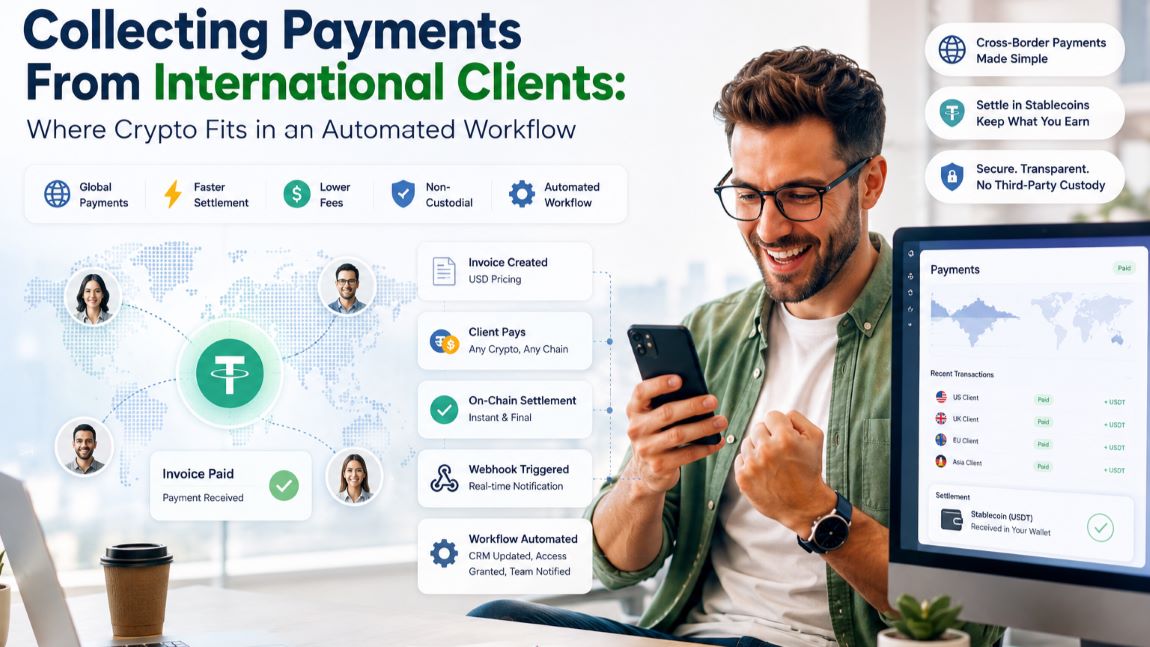
Collecting Payments From International Clients: Where Crypto Fits in an Automated Workflow
Collect payments from international clients using crypto and automate invoicing with secure payment workflows.
Most teams have the front half of their revenue process figured out. The lead is tracked, the deal moves through the pipeline, the CRM knows exactly what was agreed and when. Then the invoice goes out to a client three time zones away, and everything stalls in a part of the stack nobody optimized: getting the money in.
For businesses selling domestically, this is a solved problem. For anyone invoicing across borders, it usually is not. Wire transfers take days to clear and shed a percentage in intermediary fees. Cards get declined for reasons neither side can see. Clients in some regions simply cannot use the payment method you offer. Meanwhile the CRM record sits at “invoice sent” and someone has to chase it manually, which is exactly the kind of work automation is supposed to eliminate.
Crypto has been pitched as the answer to this for years, usually badly. The pitch is worth revisiting, though, because the tooling changed and the sensible framing is narrower than the hype suggested.
The framing that actually makes sense: an additional method, not a replacement
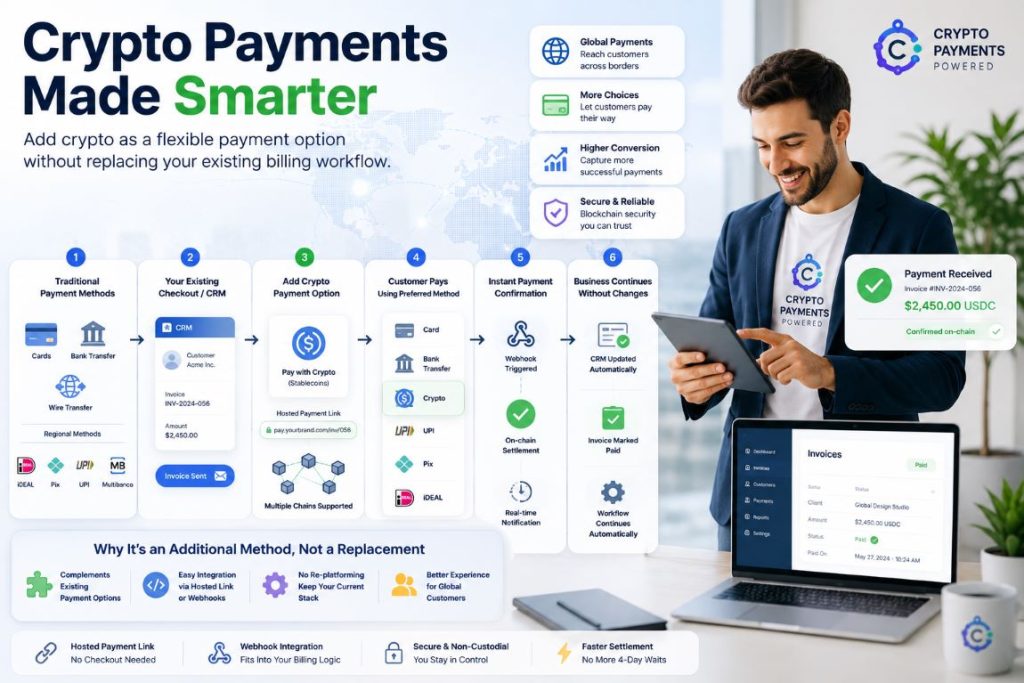
The mistake is treating crypto as a migration. It is not. It behaves like any other alternative payment method you would bolt onto a checkout: iDEAL in the Netherlands, Pix in Brazil, UPI in India, Multibanco in Portugal. None of those cover every customer. Each one wins the segment for whom it is the natural way to pay, and adding it lifts conversion for that segment without disturbing anyone else’s flow.
Crypto works the same way. You are not asking a client who has never held a token to go buy one. You are giving the clients who already transact on-chain a way to settle that feels normal to them, instead of losing that segment at the payment step or forcing them through a wire that takes four days. For agencies with international clients, SaaS with a global signup base, or anyone selling into markets where card coverage is thin, that segment is often larger than expected.
Because it is an added method rather than a migration, the integration risk stays low. A hosted payment link needs no checkout at all. A webhook drops into billing logic you already have. Nothing gets re-platformed.
Where the automation actually happens
This is the part that matters for anyone who builds workflows for a living. The interesting property of a crypto payment is not the payment. It is the settlement event.
An on-chain settlement is verifiable, final, and it fires the moment the funds arrive rather than three business days later after a batch job somewhere. That gives you a clean trigger. A signed webhook lands, and your system does what it was always supposed to do automatically: mark the invoice paid, update the CRM record, flip the account from trial to active, release the deliverable, notify the account manager. No reconciliation pass, no manual “did the wire land yet” check on Monday morning.
Compare that to the usual cross-border flow, where the confirmation arrives as a bank notification a human has to read and act on. The automation ceiling on the traditional path is set by how slow and unstructured the settlement signal is. Move the signal on-chain and the ceiling lifts.
The distinction that actually matters: who holds the money
Related walkthrough
SuiteCRM Chapter 8: GuestPostCRM Deep Dive | AI CRM Automation u0026 Email Intelligence

Here is where most coverage of this topic goes generic. Faster settlement and cheaper cross-border transfers get cited as the crypto advantage, and they are real, but every crypto processor claims them. They are table stakes, not a reason to pick one approach over another.
The thing that genuinely separates providers is whether a third party ever takes possession of your revenue. Custodial processors solved the speed problem and quietly reintroduced the exposure you were trying to escape: your money sitting on someone else’s balance sheet, subject to reserves, freezes, account closures, and their solvency. If you have ever had a mainstream processor decide your business category is inconvenient, you know the failure mode.
Non-custodial changes that structurally. If funds are never held by an intermediary, there is no balance to freeze, no reserve to withhold, and no third-party insolvency that can strand your revenue. Businesses evaluating crypto payment infrastructure should also understand how to choose a safe crypto exchange service, especially when assessing custody models, security practices, and transaction transparency before integrating crypto into their payment workflows.
CryptoRoute Pay is one implementation of this model. You create an invoice, product, or subscription priced in dollars and send the client a hosted payment link. They pay in whatever asset they hold across a range of chains, it settles to a single stablecoin in your own wallet, and the funds never route through a company balance in between. For teams building around it, there is a payment API and webhooks layer, which is where the automation story above becomes concrete: signed webhook in, workflow triggered, CRM updated, no human in the loop.
Where this does not fit
No payment method is universal, and it is worth being straight about the edges.
If none of your clients hold crypto, adding it will not move much. The return on any payment method tracks the share of buyers who will actually use it, and a near-zero share means a near-zero payoff. This is a tool for businesses with a real on-chain segment, not a growth hack for everyone.
It also gives the buyer no chargeback mechanism, because on-chain payments are final. That is a feature if you are the merchant and a consideration if you sell to consumers with high return rates.
And it is not a compliance layer. If your business needs KYC or AML checks built into the payment flow itself, you need a provider that offers that. Settling in stablecoins also does not touch your bookkeeping obligations: tax and reporting rules apply to this revenue exactly as they do to the rest of it.
The practical takeaway
Treat it like any other integration decision. Look at where your clients actually are, check whether a meaningful share of them already transact on-chain, and if so, add the method the same way you would add a regional payment option. Read carefully how a provider handles custody, because that single detail determines your real risk. Run one small live transaction end to end and watch the webhook fire before you wire it into anything important.
The payment step is usually the least automated part of an otherwise well-built revenue workflow. It does not have to stay that way.