

What Are Search Engine Basics? A Complete Beginner’s Guide 2026
Learn search engine basics in 2026, including crawling, indexing, ranking, and key SEO factors. A complete beginner’s guide to how search engines work.
You must have noticed the drastic shift in online behavior over the past two decades. Earlier, it was rare for people to look anything up online, and purchases were made based on what was physically available to them. However, in the digital landscape of 2026, the internet hosts over two billion websites globally, out of which approximately 200 million are considered active. Nearly 68% of all online experiences begin on a search engine. That one statistic tells you exactly where your audience starts and why understanding search engine basics is no longer something you can afford to skip.
The rules of digital visibility have become more demanding than ever with increasing AI-driven search, constant Google algorithm updates, and intensifying competition across every niche. To appear at the top of search results, you must first understand the system that you are working with. A solid grasp of the basics of SEO is what separates businesses that rank from those that remain invisible. This guide covers what a search engine is, how it works, the ranking factors that matter most in 2026, and the challenges and opportunities businesses face right now.
What Are Search Engine Basics?
In simple terms, a search engine is software that helps people find information across digital databases using keywords or phrases. It crawls the web, organizes content through complex algorithms, and matches user queries with the most relevant pages while presenting everything as a ranked list of results.
Every search engine runs on two core components:
Search Index: It is a giant library catalogue. Every page a search engine discovers through crawling gets stored here; not just text, but images, videos, headings, alt text, and metadata. It is continuously updated by automated bots. If your page is not indexed, it simply will not appear in search results.
Search Algorithm: The search algorithm is the brain. It decides which indexed pages deserve to rank at the top when someone searches. It weighs hundreds of signals such as keyword relevance, backlinks, content freshness, page speed, mobile friendliness, and domain authority. The goal is to deliver the results that are helpful and trustworthy for every query. Google updates its algorithm constantly to eliminate spam and protect the quality of search results.
Types of Search Engines in 2026
It makes sense why most people think of Google first. Google holds over 90% of the global search market. However, there are other types of top search engines available, each with a unique purpose.
- Traditional Search Engines: Google, Bing, and Yahoo crawl and index billions of pages, returning websites, images, news, and video results.
- Vertical or Niche-Specific Search Engines: These focus on specific content types like Amazon for products, YouTube for videos, Pinterest for visuals, and LinkedIn for professional content.
- AI-Powered Search Engines: ChatGPT, Perplexity AI, Bing Copilot, and Google Gemini deliver direct, conversational answers using text, image, and video, not just a list of links.
It is essential to know which type of search engine your audience relies on the most. Knowing this can shape how and where you distribute your content.
How Do Search Engines Work? (Step-by-Step Process)
A search engine does not perform any magic to deliver information or rank your website. Rather, it works by following a structure and well-defined three-stage process. Understanding each stage is the foundation of any real SEO strategy.
1. Crawling: How Search Engines Discover Content
Crawlers are also known as spiders or Googlebot. They continuously travel across the web, following links, reading site maps, and scanning each page they visit. They process HTML code, text, images, and deep links and regular links; each plays a different role in how crawlers navigate your site. They do not experience a page the way a human does. A visitor sees a polished layout. A crawler sees raw code and metadata. How efficiently your site gets crawled depends entirely on how well it is structured and how accessible it is to these bots.
2. Indexing: How Search Engines Understand Content
Once crawling is done, pages or information are processed and stored in the search engine index. This goes far beyond just words. The index captures page titles, meta descriptions, headings, images, alt text, internal and external links, along with contextual signals like relevance and freshness. However, not every page makes it because duplicate, thin, or low-quality pages are excluded. This is why on-page quality and technical accuracy matter for visibility.
3. Ranking: How Search Engines Decide What Ranks First
When a user searches, the algorithm analyses the index and ranks results based on over 200 factors such as keyword relevance, content quality, backlinks, page speed, and user experience signals. Results can include organic links, featured snippets, local map results, video carousels, and, in 2026, AI-generated answer snapshots. Ranking is not permanent. It shifts constantly with algorithm updates, competitor improvements, and changing user behavior.
Crawling vs Indexing vs Ranking (Quick Comparison)
Knowing that ranking factors exist is one thing. Understanding what they evaluate is another. The table below compares the three core stages across key parameters to clarify where each stage fits in the broader picture.
| Parameter | Crawling | Indexing | Crawlers/spiders/bots |
|---|---|---|---|
| What it does | Discovers URLs and content | Analyses and stores content | Orders content for search queries |
| Who does it | Crawlers / spiders / bots | Search engine algorithms | Ranking algorithms (200+ signals) |
| What you can control | robots.txt, sitemaps, internal links, page speed | Content quality, metadata, canonical tags | Content relevance, backlinks, UX, authority |
| What goes wrong | Blocked pages, broken links, low crawl budget | Duplicate content, thin pages, non-index tags | Weak content, low authority, poor UX |
| SEO priority | Technical SEO | On-page SEO | Off-page SEO + content strategy |
Key takeaway: Every layer of SEO, whether technical, on-page, or off-page, corresponds directly to one of these three stages. Optimizing only one stage while neglecting the others produces incomplete results.
Key Search Engine Ranking Factors in 2026
Related walkthrough
15 SEO Mistakes Killing Your Google Rankings in 2026

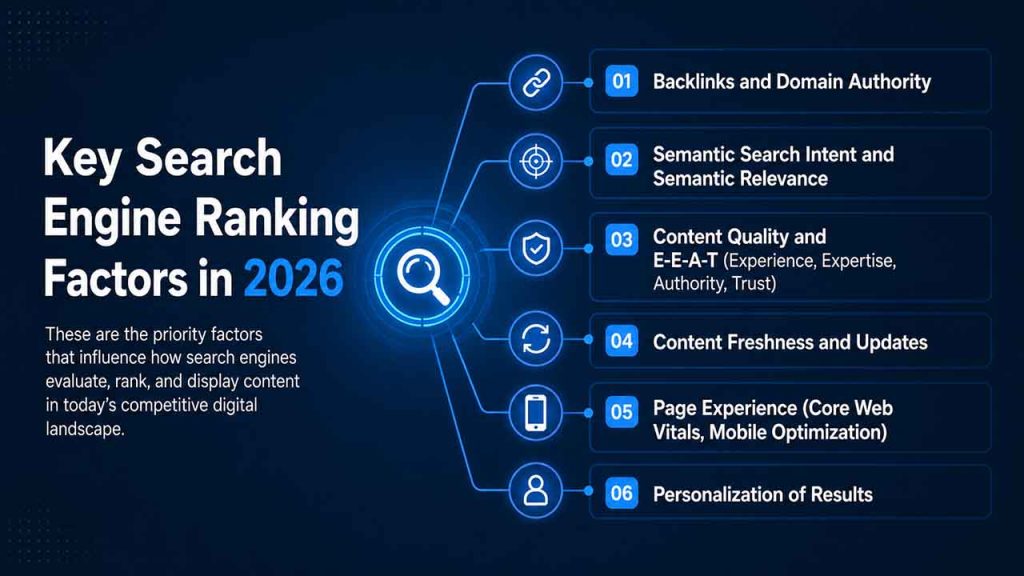
It is necessary to understand the mechanics of search; however, not sufficient. Modern search engines have evolved to go beyond just matching keywords to pages. Today, they evaluate content through a far more sophisticated lens, and businesses that are unaware of this shift are losing ground to competitors who have adapted.
Backlinks and Domain Authority
Backlinks remain among the strongest authority signals Google uses. But chasing random, low-quality links no longer works; it can actively damage rankings. You must focus on earning quality links from reputable, niche-relevant sources; working with trusted link-building companies can help you build that authority systematically.
Semantic Search Intent and Semantic Relevance
Google has moved beyond just matching exact keywords alone. Now, it understands context, synonyms, as well as the intent behind a query. For instance, a search for “affordable social media marketing services” can surface those pages that discuss “budget-friendly online marketing” because Google reads meaning, not just words. Your content must address the full intent behind a query to rank consistently.
Content Quality and E-E-A-T (Experience, Expertise, Authority, Trust)
Google rewards content that is written for people, not algorithms. The E-E-A-T framework (Experience, Expertise, Authoritativeness, and Trustworthiness) defines quality in the eyes of Google. Generic and recycled content is filtered out. Content built on real knowledge, genuine insight, and credible sourcing consistently wins.
Content Freshness and Updates
There is no need to update every page daily. However, news articles, trend-based content, and seasonal topics need regular and consistent updates. A website that keeps its information current signals reliability. Outdated content on time-sensitive topics quietly loses ground when fresher alternatives appear.
Page Experience (Core Web Vitals, Mobile Optimization)
Google’s Core Web Vitals measure load speed, visual stability, and interactivity. A slow, clunky, or mobile-unfriendly site loses rankings regardless of content quality. In 2026, mobile-first design, fast pages, and clean navigation are baseline requirements; not optional upgrades. The right website optimization tools can help you meet them efficiently.
Personalization of Results
Search results are not the same for everyone. They shift based on location, device type, past search behavior, language, and cultural context. Local intent searches surface nearby businesses. Smartphone users see results optimized for quick actions. Ignoring personalization means ignoring a significant portion of how rankings actually work.
Future of Search Engines: Trends You Must Know
Search engines have evolved well beyond directories of links. They are now AI-powered systems that interpret intent, context, and nuance. Several major shifts are shaping search right now, and businesses that are unaware of them are already falling behind.
AI-Driven Search: It has moved to the center of the experience. Google Gemini processes text, images, video, and code to deliver contextual answers. ChatGPT and Perplexity turn search into a conversation, while Search Engine Marketing Intelligence helps businesses understand evolving user behavior and optimize visibility across AI-driven search platforms. Users increasingly expect direct answers instead of links to browse. AI search marketing agencies can support this process by developing strategies that improve how brands are discovered, referenced, and represented within AI-generated results. Users increasingly expect direct answers instead of links to browse.
Rise of Zero-Click Searches: They are rising sharply. Featured snippets, knowledge panels, and AI-generated answer overviews now resolve many queries without the user having to clicking a website.
Personalized Results: It means results adapt to location, device, behavior, and language in real time. Two people typing the same query from different cities can see entirely different results. That’s why generic, one-size-fits-all content simply fails in this environment.
Voice and Visual Search Growth: Smart devices have made conversational queries the standard. Users search using images, they speak naturally, and expect accurate answers. Content that is structured around natural language questions performs significantly better here.
Challenges and Opportunities in Modern Search
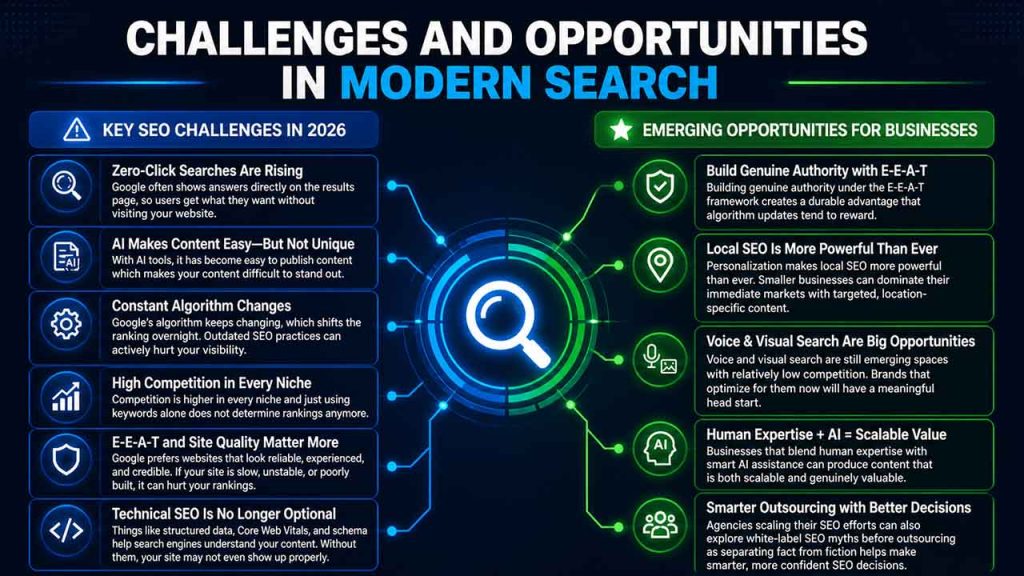
As search continues to evolve, businesses must navigate new challenges while also leveraging emerging opportunities to stay visible and competitive.
Key SEO Challenges in 2026
- Search is getting difficult, and traditional ways are not working anymore. Often, Google directly displays answers on the result page, so users get what they want without even visiting your website.
- With AI tools, it has become easy to publish content, which makes your content difficult to stand out.
- Google’s algorithm keeps changing, which shifts the ranking overnight. Many businesses are still relying on outdated SEO practices that actively hurt their visibility.
- Competition is higher in every niche, and just using keywords alone does not determine rankings anymore.
- Google prefers websites that look reliable, experienced, and credible. If your site is slow, unstable, or poorly built, it can hurt your rankings.
- Things like structured data. Core Web Vitals and schema help search engines understand your content. Without them, your site may not even show up properly.
Emerging Opportunities for Businesses
- The same forces creating challenges are also opening doors. Building genuine authority under the E-E-A-T framework creates a durable advantage that algorithm updates tend to reward.
- Personalization makes local SEO more powerful than ever. Smaller businesses can dominate their immediate markets with targeted, location-specific content.
- Voice and visual search are still emerging spaces with relatively low competition. Brands that optimize for them now will have a meaningful head start.
- And businesses that blend human expertise with smart AI assistance can produce content that is both scalable and genuinely valuable.
- Agencies scaling their SEO efforts can also explore white-label SEO myths before outsourcing as separating fact from fiction helps make smarter, more confident SEO decisions.”
Conclusion
A search engine in 2026 has become more than just a simple link directory. It is an AI-powered discovery system that personalizes results, understands user intent, and increasingly answers questions before a user ever clicks anywhere. From traditional web searches to specialized platforms like usenet search, users now expect faster, more accurate, and more relevant information discovery experiences. For businesses, that means both real challenges and real opportunities.
Understanding search engine basics like how crawling, indexing, and ranking work, what modern algorithms actually evaluate, and where search is heading forms the foundation of every effective digital strategy, which is built on trust, authority, and genuine helpfulness. Those businesses that keep up with the changing search dynamics will remain visible, credible, and competitive long after the next algorithm update lands.
FAQs About Search Engine Basics
Q. What are search engine basics?
Search engine basics refer to how search engines work, including crawling, indexing, and ranking web pages to deliver relevant results.
Q. How do search engines work in simple terms?
Search engines scan websites, store information in an index, and rank pages based on relevance, quality, and user experience.
Q. Why are search engine basics important for SEO?
Understanding search engine basics helps you optimize your website so it can rank higher and attract more organic traffic.
Q. What are the main ranking factors in 2026?
Key factors include content quality, backlinks, page speed, mobile experience, user intent, and website authority.
Q. What is crawling, indexing, and ranking?
Crawling is discovering pages, indexing is storing them, and ranking is deciding their position in search results.