

What Is Search Engine Marketing Intelligence? Strategy, Tools & Benefits
Learn how search engine marketing intelligence helps businesses improve PPC performance, optimize ad spend, analyze competitors, and increase conversions in 2026.
Most businesses that are struggling with paid search are struggling because they are spending without a strategy and understanding. They bid on keywords that sound right, write an ad copy that feels persuasive, and wait for results that never quite match the investment. The problem is not the campaign; rather, it is the absence of intelligence behind it. Before you can master paid search, a solid grasp of search engine basics helps you understand the ecosystem you are operating in.
That’s where search engine marketing intelligence comes into the picture. It shifts the foundation of every campaign decision from intuition to evidence, and in a landscape where every click carries a cost, that shift is everything.
What Is Search Engine Marketing Intelligence?
Search engine marketing can be defined as the practice of using paid advertisements to acquire a top position on search engine results pages (SERPs) on platforms like Google and Bing. These are the sponsored listings that appear before organic results, and they operate on a pay-per-click (PPC) model, meaning businesses pay only when someone clicks on their ad.
Search engine marketing intelligence, however, goes one layer deeper. It refers to the process of systematically collecting, analyzing, and applying data from campaigns, competitors, and user behavior to make informed decisions across every element of a paid search strategy. This includes understanding which keywords drive conversions rather than just clicks, how competitors are bidding and what ad copy they are running, what users mean when they type in a query, and which campaigns are delivering genuine return on investment.
In simple terms, SEM tells you how to run paid ads. SEM intelligence tells you how to run them well.
How Does Search Engine Marketing (SEM) Work?
Ad Auction Takes Place
When a user types in their query into search engines like Google or Bing, it instantly scans all active advertisers that are relevant for ads. Then, you have to state keywords that you want to bid on and the money that you are willing to spend per click. Next, Google checks if your keyword is included in the user’s search queries. If yes, then you automatically enter an ad auction.
Winning an Ad Auction
Even if your keywords are an excellent fit, and your SEO strategy is strong, your SEM ad might still not appear in search engines. Why, you ask? Because it is likely possible for other brands to bid higher for particular keywords. This confirms that money plays a big role in ensuring a good position on search engine results.
Quality Score
Google rewards each advertiser depending on ad relevance, expected click-through rate, and landing page quality. A strong Quality Score can outweigh a larger budget.
When your bid is combined with your Quality Score, it produces your Ad Rank. Ad Rank is determined by your bid, Quality Score, and additional contextual signals, including device, location, time of search, and the expected impact of ad extensions. You only pay when someone clicks, not when the ad appears. This pay-per-click model makes SEM one of the most budget-efficient paid channels available.
Top Benefits of Search Engine Marketing Intelligence

If you are running a paid search campaign without a strategy, you are navigating without a map. When intelligence drives the process, the outcomes look noticeably different.
Smarter Budget Allocation in SEM Campaigns
Smarter budget allocation is one of the most immediate benefits of SEM intelligence. Rather than distributing spend evenly, it reveals which terms are most likely to generate conversions. Pairing this intelligence with the right performance marketing approach ensures that every dollar in your paid search budget is tied to a measurable outcome, not just activity.
Competitive Analysis and Market Awareness
Using SEM intelligence, businesses can monitor competitor ad copy, track their keyword strategies, and bidding patterns. When you know what is working for others in your field and what is not, it helps you recognize gaps in your strategies, tweak your messaging, and avoid expensive bidding wars on terms that rarely convert.
SEM Intelligence Improves Ad Copy Performance
The quality of your ad and copy improves with continuous performance data. Click-through rates, conversion rates, and engagement patterns all reveal how users are responding to your messaging. This feedback loop allows for continuous refinement rather than one-time guesswork.
Better Audience Targeting with SEM Intelligence
It follows naturally from deeper data. Understanding what users are searching and why helps you align your ads more accurately with user intent. For instance, a user who is searching for “best CRM software for business” has a very different need than the one searching for “CRM software”. This distinction is visible through search engine marketing intelligence, and acting on it is the foundation of any audience-building strategy designed to maximize ROI.
7 Steps to Build an Effective Search Engine Marketing Intelligence Strategy
If you want to build a strategy that is grounded in intelligence rather than assumption, you must follow a sequence. Below are the steps to create a search engine marketing intelligence strategy:
- Define Clear Goals for Your SEM Campaign: Before you select a single keyword, define what your campaign is meant to achieve. It can be lead generation, product sales, brand awareness, or website traffic. Whatever decision you make, it should align with your predefined objectives or goals.
- Conduct Thorough Keyword Research for SEM: Use tools like Ahrefs, SEMrush, or Google Search Console to identify keywords that your target audience is searching online. Conduct thorough research to assess search volume. Competition level, commercial intent, and cost-per-click estimates. You should also include negative keywords from early on to prevent irrelevant traffic from consuming your budget.
- Analyze Competitor SEM Strategies: Your next job is to review ad copy, landing pages, and track keyword selections of your competitors in your space. When you look through these carefully, you’ll be able to identify their strong points, the gaps in their strategy, and ways to position your brand differently.
- Write SEM Ad Copy That Matches User Intent: Draft your ad carefully and each ad should address the direct need of the user. Keep headlines strong, value propositions clear, and calls to action specific as they consistently outperform generic copy, regardless of how high the bid is. If you want to go deeper on this, there are proven tactics specifically built to improve paid ad conversion rates without increasing spend.
- Optimize Landing Pages for Better SEM Conversions: The page a user lands on after clicking your ad must deliver on the promise of the ad itself. When there is a disconnection between the two, campaigns fail to convert despite generating clicks. Users will lose trust in your brand and won’t come back. Using the right website optimization tools can help you identify exactly where that disconnect is happening, whether it is load speed, layout, or message mismatch, and fix it before it costs you more clicks.
- Choose the Right SEM Bidding Strategy: Choose between manual bidding, enhanced CPC, or automated strategies like Target CPA or Target ROAS based on your campaign maturity and available conversion data. Avoid automated strategies before you have enough historical data to support them.
- Monitor and Optimize SEM Campaign Performance: SEM is not a one-time channel. You must review performance regularly, run A/B tests on ad copy and landing pages, and make incremental improvements based on what the data shows. For teams managing large-scale Google Ads accounts, automating Google Ads hygiene is a practical way to maintain campaign health consistently without manual oversight at every level.
Real-World Examples of SEM Intelligence
Related walkthrough
Free SEO Tool: DA/PA Checker Chrome Extension

Sometimes the best way to understand a concept is to see it in action.
- Example 1: A retail brand selling sports shoes was spending its budget on the broad keyword “sports shoes” with very little to show for it. Once they looked into the data, they found that specific terms like “lightweight sports shoes for women” had lower competition and converted far better. A simple shift in budget made an immediate difference.
- Example 2: An online education platform noticed that competitors were using urgency-driven copy, such as “Enroll Before Seats Fill” type of messaging. Instead of following the same approach, they used that intelligence to explore a different direction, leading with outcome-focused copy like “Become Certified in 8 Weeks.” Their click-through rates improved simply because they stood out from the noise.
- Example 3: A B2B software company discovered through campaign data that search activity for their primary keyword peaked on Tuesday and Wednesday mornings. They concentrated their budget in those windows and pulled back during quieter periods. The outcome is that their cost per lead dropped without spending a single extra dollar.
Three different businesses, three different problems; however, all solved not by increasing budget but by paying closer attention to what the data was already telling them.
Common Search Engine Marketing Mistakes to Avoid
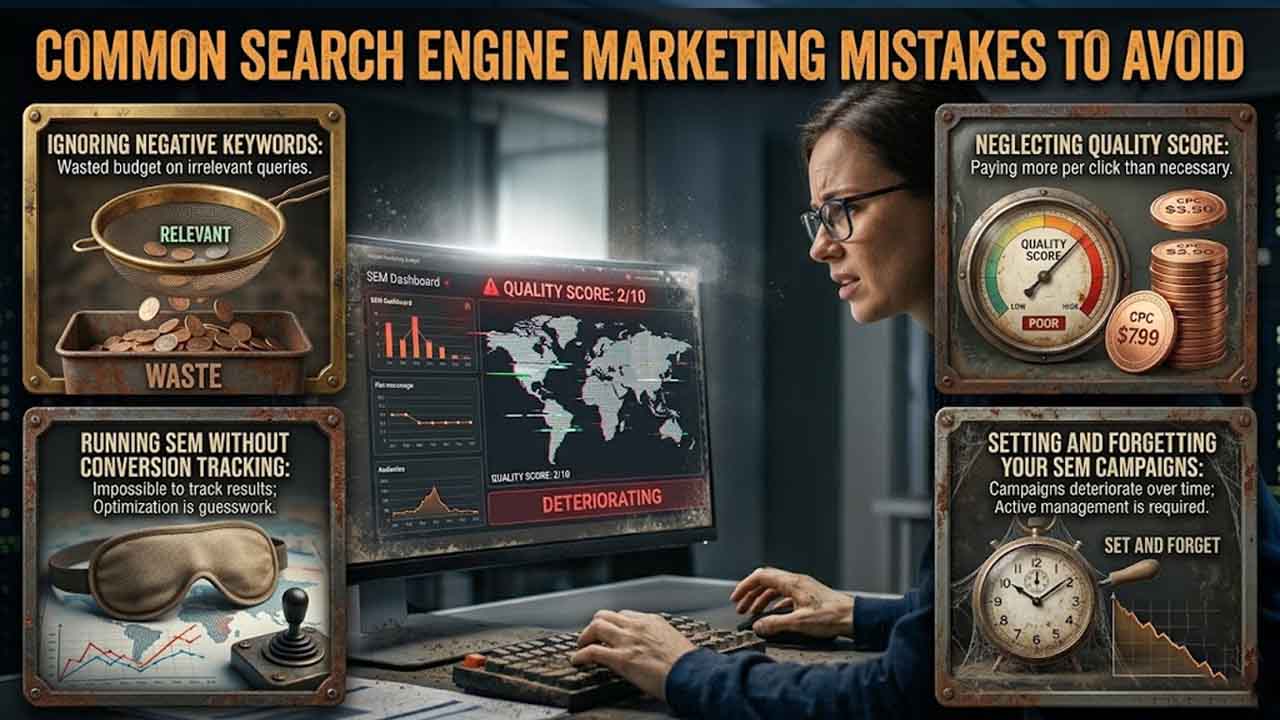
Even well-resourced campaigns fall short when you apply intelligence selectively or not at all. These are the mistakes that most consistently undermine SEM performance:
- Ignoring Negative Keywords: It can have costly consequences in paid search. If you overlook negative keywords, ads appear for irrelevant queries and consume budget without any chance of converting.
- Neglecting Google Ads Quality Score: It leads to paying more per click than necessary. Marketers who focus exclusively on bids without improving ad relevance and landing page quality are wasting their money.
- Running SEM Campaigns Without Conversion Tracking: If you don’t track your keywords or ads, it would be impossible to know which one of them is actually generating results. Lack of this data makes optimization a mere guesswork.
- Setting and Forgetting Your SEM Campaigns: It is perhaps the most common mistake of all. Search behavior changes, bidding landscapes shift, and algorithms evolve constantly. Campaigns that are not actively managed deteriorate over time, regardless of how well they were built initially. They evolve constantly. Campaigns that are not actively managed deteriorate over time, regardless of how well they were built initially.
Best Search Engine Marketing Intelligence Tools
The following are among the most widely trusted search engine marketing intelligence tools in the industry:
| Tool | Primary Use | Best For |
|---|---|---|
| Google Ads | Campaign creation, bidding, and performance tracking | All business sizes running search campaigns |
| SEMrush | Keyword research, competitor analysis, and ad intelligence | SEM and SEO strategy |
| Ahrefs | Keyword difficulty, search volume, and competitive data | Deep keyword and content research |
| Google Keyword Planner | Keyword discovery and bid estimation | Beginners and budget planning |
| WordStream | Campaign optimization and performance grading | Small-to-mid size businesses |
| Similar Web | Traffic source analysis and audience intelligence | Market research and benchmarking |
Each tool serves a different purpose, and the most effective SEM programs typically combine two or three rather than relying on a single platform for everything.
Conclusion
Paid search is one of the most measurable channels in digital marketing, and that measurability is exactly what makes search engine marketing intelligence so valuable. Every click, impression, and conversion leaves a data trail. The difference between campaigns that compound their results over time and those that decline is almost always how well that trail is read and acted upon.
In a digital environment, every search is a signal, and every click is a choice. Businesses that treat SEM intelligence as one component of a broader, well-structured set of digital marketing strategies are the ones that compound their results, turning paid search data into insights that improve performance across every channel.
FAQs About Search Engine Marketing Intelligence
Q. What is the difference between SEM and SEO?
SEM uses paid advertising to appear in search results, while SEO focuses on earning organic rankings through content and optimization.
Q. How much should a business spend on SEM?
There is no fixed amount. Budgets should be guided by campaign goals, keyword competition, and the cost per conversion your business can sustain profitably.
Q. Can small businesses benefit from SEM intelligence?
Yes, SEM intelligence is especially valuable for small businesses because it prevents wasted spend and helps them compete strategically without requiring large budgets.
Q. How long does it take to see results from an SEM campaign?
Paid search can generate traffic immediately, but meaningful performance data typically requires at least two to four weeks of active running before optimization decisions should be made.
Q. Is SEM intelligence only relevant for Google Ads?
No, SEM intelligence applies across all paid search platforms, including Bing Ads and any platform where keyword-based paid advertising is available.