

What is the Software Development Life Cycle? Full SDLC Guide for Beginners
Understand the software development life cycle with this complete guide covering SDLC phases, methodologies, security integration, and best practices.
Software projects fail more often than most people realize. It is not because the developers were unskilled, or because the idea was wrong, but because the process was missing. Teams quickly jump into writing code even before they fully understand the problem; they skip testing and then end up with a product that works poorly, costs more to fix than it did to build, and frustrates everyone who is involved.
This is exactly the problem the software development life cycle was built to solve. It brings structure to a process that tends to collapse under its own budget without it. Whether you are building a mobile app, an enterprise platform, or an internal tool, the SDLC gives your team a shared map to prevent teams from getting lost.
What Is the Software Development Life Cycle (SDLC)?
The Software Development Life Cycle is commonly known as SDLC. It is a structured process that guides how software is planned, built, tested, and delivered. It defines a series of phases that a development team must follow to produce high-quality software in a way that is organized, repeatable, and measurable.
It is used across industries, team sizes, and project types. A two-person startup and a thousand-person enterprise can both apply SDLC principles effectively, as long as they choose the right model for their context.
7 Key Phases of the Software Development Life Cycle (SDLC)

The SDLC is typically broken down into seven core phases. Each phase has a clear purpose, and the output of one phase directly benefits the next.
- Planning: The team identifies the scope of the project, estimates costs and timelines, assesses risks, and determines whether the project is feasible. Good planning does not eliminate surprises, but it significantly reduces how damaging those surprises are when they arrive.
- Requirements Analysis: Once the project is approved, the team works to understand exactly what the software needs to do. This involves gathering input from stakeholders, end users, and business owners to define both functional requirements (what the system should do) and non-functional requirements (how well it should do it). If the requirements are vague, it will lead to expensive misunderstandings later.
- System Design: With requirements in hand, architects and senior developers design the system. This includes decisions about the overall architecture, the database structure, the technology stack, security protocols, and how different components will communicate. This phase turns the requirements of the business into a technical blueprint.
- Implementation (Coding): This is the phase most people associate with software development, which involves the actual writing of code. Developers work according to the design specifications given to them, following coding standards and best practices. Teams that are newer to this phase often benefit from revisiting basic coding concepts before diving into complex builds. The quality of the previous phases directly determines how smoothly this phase goes.
- Testing: Software needs to be tested thoroughly before it reaches a user. The testing phase involves identifying bugs, verifying that the software meets its requirements, and validating performance under different conditions. Testing is not just a formality. It is the phase that determines whether the software is actually ready or not.
- Deployment: Once testing is complete and the software is approved, it is deployed to the production environment. The goal is to ensure a smooth transition from development to live use with minimal disruption.
- Maintenance: Software does not stop needing attention after launch. The maintenance covers bug fixes, performance improvements, security patches, and feature updates based on real user feedback.
Most Common Software Development Life Cycle Models
Different projects need different approaches. Here is a clear overview of the most widely used SDLC models.
| SDLC Models | Description |
|---|---|
| Waterfall | A linear, sequential model where each phase must be completed before the next begins. Best suited for projects with well-defined, stable requirements that are unlikely to change. |
| Agile | An iterative model that delivers software in small, functional increments called sprints. Highly flexible and built for projects where requirements evolve frequently. |
| Scrum | A subset of Agile that organizes work into fixed-length sprints with defined roles such as Scrum Master and Product Owner. Promotes transparency and fast delivery. |
| Kanban | A visual workflow model that manages tasks using boards and cards. Focuses on continuous delivery and limiting work in progress to improve efficiency |
| Spiral | Combines iterative development with risk analysis at each cycle. Ideal for large, complex, high-risk projects that require careful evaluation at every stage. |
| V-Model | An extension of Waterfall where each development phase is paired with a corresponding testing phase. Emphasizes validation and verification throughout the process. |
| Dev Ops | Bridges development and operations teams to enable continuous integration, delivery, and monitoring. Focused on speed, collaboration, and reducing time between releases. Businesses that are serious about this model often work with a DevOps consulting partner to implement it without disrupting existing roadmaps. |
Benefits of the Software Development Life Cycle

If you follow SDLC consistently, it will deliver real and measurable advantages for development teams and the businesses they support:
- It provides a clear roadmap that keeps all stakeholders aligned on goals, timelines, and expectations throughout the project.
- It reduces development costs by catching errors early, when they are still cheaper to fix, rather than after deployment, when fixes become costly.
- It improves software quality by making testing and reviewing a built-in part of the process rather than an afterthought.
- It increases visibility for project managers, giving them checkpoints to track progress and take appropriate measures before the problem escalates.
- It supports scalability by creating documentation and architecture decisions that make it easier to expand the software in the future.
- It reduces risk across the entire project by making planning, security, and validation standard steps rather than options.
Security in the Software Development Life Cycle (SDLC)
Related walkthrough
How to Use Google Apps Script: A Beginner’s Guide

Security is one of the most commonly underestimated aspects of software development. Many teams treat it as something to review before the launch rather than something that must be considered through every phase of the process.
The more effective approach is something increasingly referred to as DevSecOps. It integrates security practices directly into the development workflow. When security is built into the SDLC from the beginning, it dramatically lowers the cost of addressing it later. This results in far more resilient software. A vulnerability that is identified during the design phase costs a fraction of what it costs to patch after a breach has already occurred. Every team that is building software in 2026 should be treating security as a foundation beneath every phase.
Common Software Development Life Cycle (SDLC) Mistakes
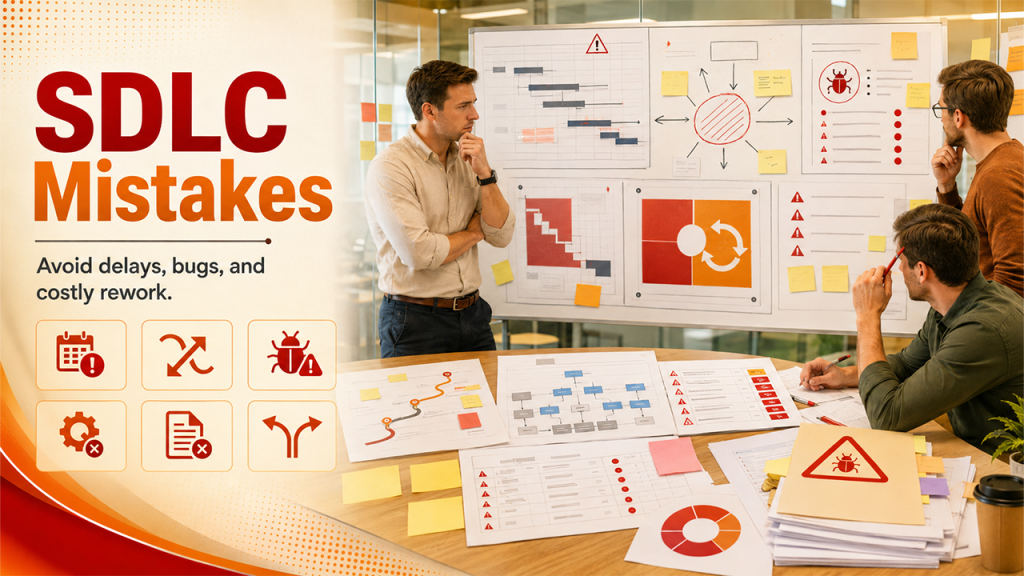
- Skipping the SDLC Planning Phase: The team is eager to start building software, which almost always leads to missed scope and deadlines.
- Treating SDLC Requirements as Fixed: Requirements keep evolving. Teams that do not build to manage changes end up building the wrong thing.
- Leaving SDLC Testing Until the End: Testing should be integrated throughout the development process because late-stage testing produces a long list of bugs and errors, along with expensive delays.
- Underestimating SDLC Maintenance Requirements: Software needs continuous attention to remain secure, permanent, and useful. Don’t assume that after deployment, your work is done.
- Ignoring Software Development Documentation: Do not avoid documenting just because it feels slow. Poor or no documentation creates huge problems when team members make changes or the system needs to be updated months later.
- Choosing the Wrong SDLC Model for Your Project: Applying a rigid Waterfall model to a project that has shifting requirements, or using Agile without the team discipline it requires, leads to poor outcomes.
Common Use Cases of the Software Development Life Cycle
The software development life cycle is not limited to one type of industry or project.
Enterprise Software Development: Large organizations that build internal platforms for HR, finance, or operations. They rely on the SDLC to manage complexity across multiple teams and departments that are working simultaneously.
Healthcare Applications: In an industry where software errors can directly affect patient safety, the structured validation and testing phases of the SDLC are not optional. They are regulatory requirements. Choosing the right healthcare software development vendor is equally critical, as they must understand both the technical and compliance demands that each SDLC phase carries in this sector.
E-commerce Platform Development: Online retail platforms that handle sensitive payment data and high transaction volumes use the SDLC to ensure security, reliability, and scalability during peak demand periods.
Mobile App Development: Consumer-facing apps that go through multiple iterations based on user feedback benefit from Agile-based SDLC models that allow rapid, incremental improvement.
Government and Defense Systems: Projects in these sectors demand extensive documentation, security review, and compliance validation at every phase; all of which the SDLC is designed to support.
Conclusion
The software development lifecycle is not a process that was invented to slow teams down. It is a discipline that the best development teams in the world rely on. As AI continues to reshape how software is built, the fundamentals of the SDLC become more important. The phases may be supported by smarter tools, but the logic behind them is to plan carefully, build intentionally, test thoroughly, and maintain consistently.
If your team is building software without a structured process, the SDLC is the most practical investment you can make in the quality of everything you ship.
FAQs About Software Development Life Cycle
Q. What is the main purpose of the software development life cycle?
The SDLC provides a structured framework that guides teams through every stage of building software, from planning to maintenance, ensuring quality and reducing risk.
Q. Which SDLC model is best for beginners?
Waterfall is the easiest to understand for beginners because of its straightforward, linear progression through clearly defined phases.
Q. How is Agile different from traditional SDLC models?
Agile delivers software in small iterative cycles rather than one large sequential process, making it more adaptable to changing requirements.
Q. Is security a separate phase in the SDLC?
No, security should be integrated throughout every phase of the SDLC rather than treated as a standalone step at the end of development.
Q. How does AI improve the SDLC?
AI accelerates coding, automates testing, improves requirement analysis, and enables predictive maintenance, making each phase of the SDLC faster and more accurate.