



The internet has made business faster, wider, and more connected than ever before. However, that same connectivity has also made every organization a potential target for cyberattacks. A small retailer
The internet has made business faster, wider, and more connected than ever before. However, that same connectivity has also made every organization a potential target for cyberattacks. A small retailer storing customer payment data, a bank managing millions of transactions daily, or a startup running its entire operation on cloud software- all of them face the same fundamental question: how do you protect what you’ve built?
That's where cybersecurity solutions come in. And the conversation around them has shifted. It's no longer just about blocking attacks; it's about building the kind of digital infrastructure that lets a business operate with confidence.
What Are Cyber Security Solutions?
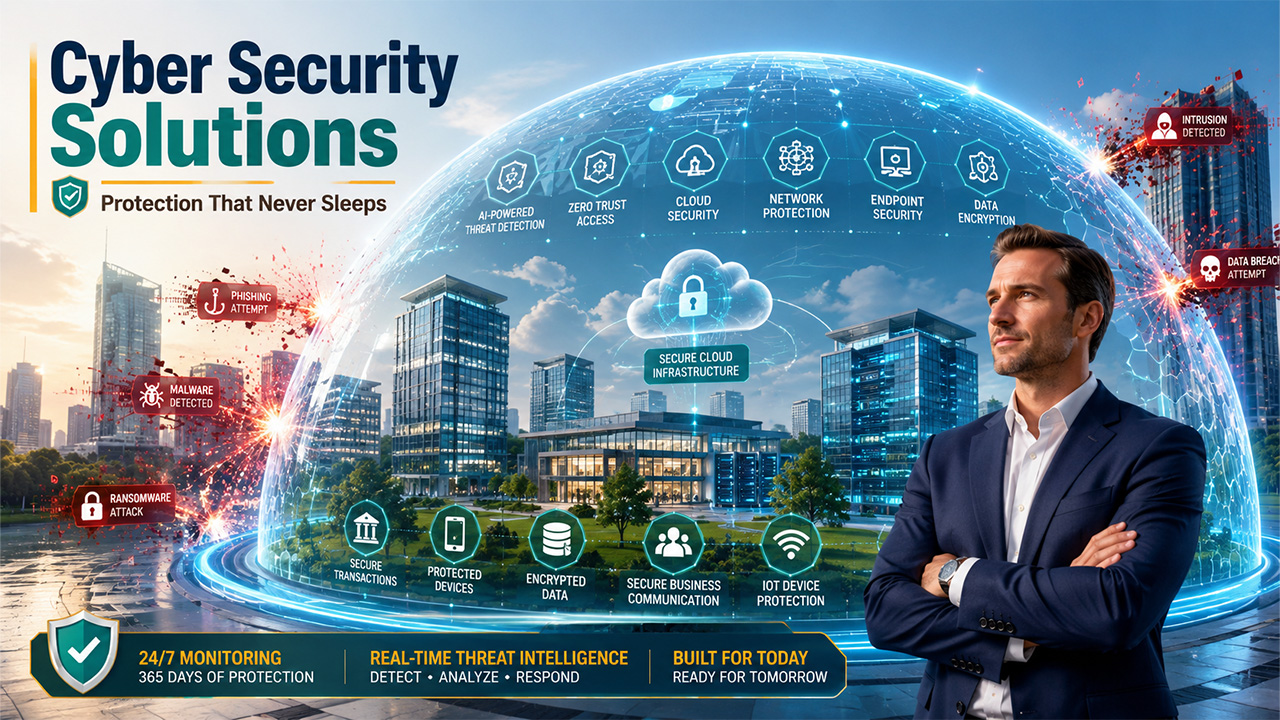
Every business today runs on data, and where there's data, there's risk. Cybersecurity solutions refer to the tools, technologies, and practices that sit between your organization and anyone who is trying to disrupt, steal from, or compromise it. They're not just about reacting when something goes wrong. The better ones are built to catch vulnerabilities before they're exploited and respond fast when a threat does slip through.
Whether you're a small business or a large enterprise, the goal is always the same: keep your operations running, your data protected, and your customers' trust intact.
What Are Enterprise Security Solutions?
With the growing business, security needs grow too. Enterprise security solutions are comprehensive frameworks that are built to protect large organizations, manage risk across complex networks, multiple locations, and significant volumes of sensitive data. This breaks down into two connected areas: Enterprise Security Management and Enterprise Security Governance.
Let's study them in detail:
Enterprise Security Management
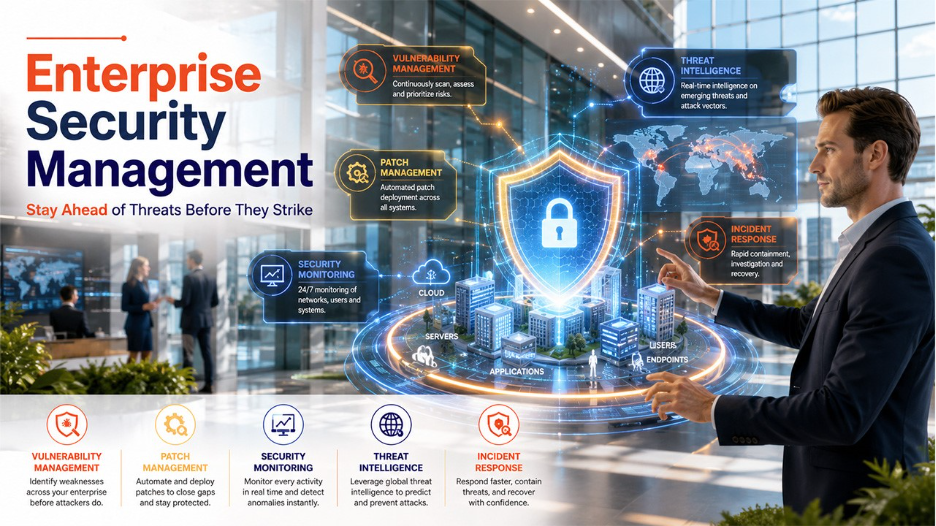
It refers to where day-to-day work happens. It is about deploying and operating tools that help keep systems secure, such as firewalls, monitoring platforms, patch management, and incident response. At its core, it covers:
- Vulnerability Management: It continuously scans systems to find and fix weaknesses before attackers do.
- Patch Management: It keeps software and systems up to date, so known vulnerabilities don't become open doors
- Security Monitoring: It watches network traffic, system behavior, and user activity for anything that looks out of place.
- Threat Intelligence: It gathers and analyzes information about emerging threats, so security teams can act before a breach happens.
- Incident Response: Having a clear, practiced plan for containing and recovering from a security event when one occurs
This layer is owned by the security and IT teams. They are the ones who keep an eye on dashboards, respond to alerts, and make sure that the infrastructure is actually doing what it’s supposed to do.
Enterprise Security Governance
It is, on the other hand, a strategic aspect. It's about setting policies, frameworks, and risk decisions that guide how an organization approaches security at a leadership level. Several established frameworks guide this work:
- NIST Cybersecurity Framework (CSF): Organizes security activities into five functions: Identify, Protect, Detect, Respond, and Recover. It's one of the most widely adopted governance references across industries globally.
- ISO/IEC 27001: An internationally recognized standard for information security management, built around risk assessment, documented controls, and continuous improvement.
- GDPR: Beyond data privacy, it requires organizations to implement appropriate security measures and demonstrate clear accountability for how data is handled.
- PCI DSS: Mandatory for organizations handling payment card data, covering access control, encryption, monitoring, and regular compliance audits.
- HIPAA: sets the baseline for protecting patient data in healthcare, requiring documented administrative, physical, and technical safeguards.
This side is driven by CISOs, boards, and senior management. They make sure that security priorities align with business objectives and that the organization meets its compliance and regulatory obligations.
Both need to work together. Governance without management is just a policy on paper. Management without governance is reactive, a work with no direction.
This side is driven by CISOs, boards, and senior management. They make sure that security priorities align with business objectives and that the organization meets its compliance and regulatory obligations.
Both need to work together. Governance without management is just a policy on paper. Management without governance is reactive, a work with no direction.
Here’s a quick comparison for more clarity:
| Enterprise Security Management | Enterprise Security Governance | |
| Focus | Day-to-day operations | Strategic oversight |
| Who drives it | IT and security teams | CISOs, boards, senior leadership |
| Key activities | Monitoring, incident response, tool deployment | Policy setting, risk management, compliance |
| Goal | Keep systems running securely | Align security with business and regulatory needs |
This structure is a regulatory necessity for sectors like banking and healthcare. It’s also why cybersecurity banking staffing solutions have grown into a specialized field because organizations need professionals who can operate confidently on both sides of this equation.
Main Types of Cyber Security Solutions
Cybersecurity solutions come in many forms, each designed to protect a specific part of your digital environment, from applications and data to networks, cloud infrastructure, and connected devices.
Application Security
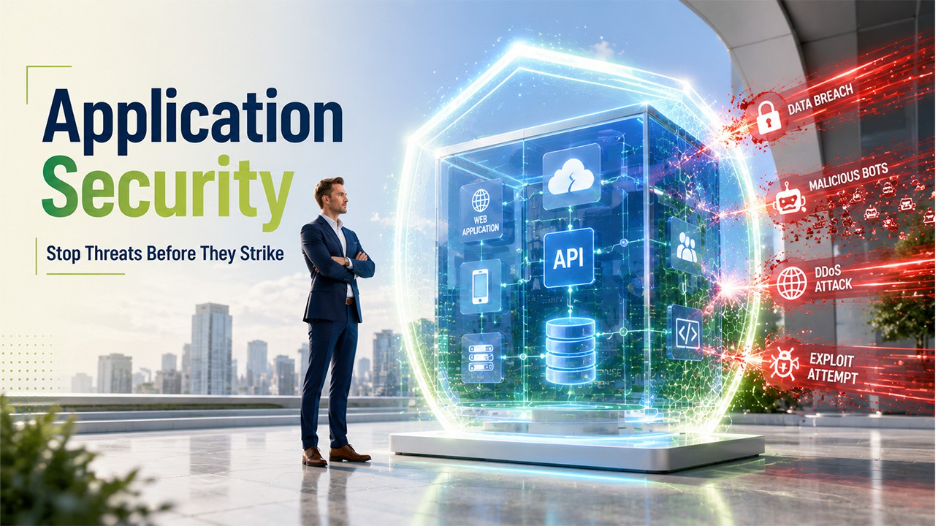
Every app that your business, team, or customers use is a potential door for attackers. Application security makes sure that the door stays locked. It finds vulnerabilities in software and fixes them before attackers can exploit them. It covers:
- Web Application Firewall (WAF): It sits between your web application and incoming traffic, filtering out malicious requests like SQL injection and cross-site scripting before they reach your app.
- DDoS Protection: It defends against distributed denial-of-service attacks that try to overwhelm your application with traffic until it goes offline.
- Bot Management: It identifies and blocks automated bot traffic that can scrape data, abuse login pages, or carry out fraud while still letting legitimate bots through.
- API Security: It protects the APIs that connect your applications and services, making sure they're not leaking data or being exploited as a backdoor into your systems.
- Runtime Application Self-Protection (RASP): It works from inside the application itself, detecting and blocking attacks in real time as the app is running.
Data Security
Data is usually the first thing that attackers target and what they are after. Data security solutions protect your sensitive information at every stage, whether it’s stored, being used, or moving across a network. The key components here are:
- Data Encryption: It scrambles data so that even if it's intercepted or stolen, it remains unreadable without the right decryption key.
- Data Loss Prevention (DLP): It monitors and controls how sensitive data moves within and outside your organization, stopping it from ending up where it shouldn't
- Database Security: It protects the databases where your most critical information lives through access controls, activity monitoring, and vulnerability assessments
- Data Masking: It replaces sensitive data with realistic but fictitious values, so development and testing teams can work with data without ever touching the real thing.
Endpoint Security
Think about every single device connected to your network right now, like laptops, smartphones, tablets, and even printers. Each one of them is a potential entry point. So, endpoint security solutions lock these devices down so that when a single device is compromised, it doesn’t become a breach across your entire network. This includes:
- Endpoint Protection Platforms (EPP): It constitutes the foundational layer of endpoint security, combining next-gen antivirus, anti-malware, and firewall capabilities into a single solution deployed across devices
- Endpoint Detection and Response (EDR): It goes beyond prevention by continuously monitoring endpoint activity, detecting suspicious behavior, and giving security teams the visibility to investigate and respond to threats quickly
- Extended Detection and Response (XDR): It takes EDR further by pulling in data from across the entire environment such as endpoints, networks, cloud, and applications giving a unified view of threats and a more coordinated response
Cloud Infrastructure Security
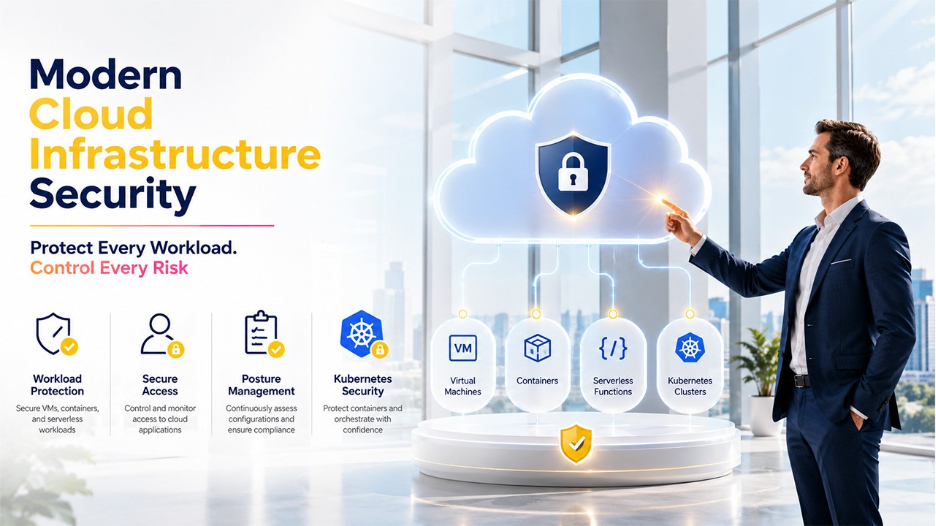
In this digital-first world, many businesses today run on the cloud in one way or another. However, that inconvenience isn’t without its challenges. Cloud infrastructure security solutions make sure that along with your business, your security scales too. Choosing the right cloud security tools is often the first step organizations take when building out this layer. The core solutions here include:
- Cloud Workload Protection (CWP): It secures the workloads running in the cloud, whether those are virtual machines, containers, or serverless functions, protecting them from threats at the infrastructure level.
- Cloud Access Security Broker (CASB): It acts as a checkpoint between your users and the cloud services they use, enforcing security policies, monitoring activity, and giving visibility into what's actually happening across your cloud environment.
- Cloud Security Posture Management (CSPM): It continuously monitors your cloud environment for misconfiguration and compliance gaps, the kind of small oversights that can quietly become serious vulnerabilities.
- Kubernetes Security: As more organizations adopt container orchestration, Kubernetes security ensures that containerized workloads are properly isolated, configured, and protected from attack.
Network Security
Your network is a highway everything travels on, and attackers are well aware of this. Network security solutions monitor that traffic, identify suspicious activity, and block unauthorized access before it reaches your critical systems. Regular network security auditing helps organizations identify gaps in this layer before attackers do. The key layers here are:
- Firewall: It is the first line of defense, controlling what traffic is allowed into and out of your network based on defined security rules
- Network Access Control (NAC): It manages and enforces policies around which devices and users are allowed to connect to the network, keeping unauthorized access out
- Network Detection and Response (NDR): It monitors network traffic in real time, using behavioral analysis to detect threats that traditional tools might miss
- Network Traffic Analysis (NTA): It digs into the patterns and behavior of network traffic to surface anomalies, insider threats, and lateral movement by attackers who've already gotten in
- VPN: It creates an encrypted tunnel for remote users and branch offices connecting to the network, keeping that traffic secure even over public internet connections
Internet of Things (IoT) Security
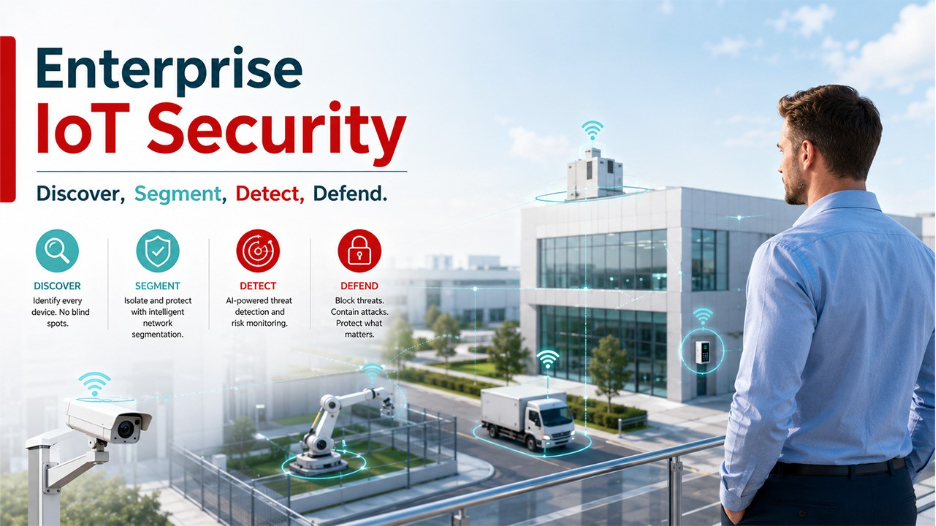
The IoT devices such as industrial sensors, smart devices, and connected equipment have quietly expanded the attack surface for most organizations. The problem is that many of these devices ship with minimal built-in security and are deployed at scale, making them attractive targets. IoT security solutions address this through:
- Device Discovery and Visibility: You can't protect what you can't see. This maps every connected device on your network, so nothing is flying under the radar
- IoT Network Segmentation: It separates IoT devices from the rest of your network so that if one device is compromised, the damage stays contained and doesn't spread to critical systems
- IoT Vulnerability Management: It identifies security weaknesses in connected devices and helps prioritize which ones need attention first, especially when patching isn't always straightforward on IoT hardware
- IoT Threat Detection: It monitors device behavior continuously, flagging anything unusual that could indicate a device has been compromised or is being used as a launchpad for a broader attack
Emerging Cybersecurity Threats and Trends in 2026
To stay protected, businesses must understand the latest cybersecurity threats and trends, shaping how organizations approach security, risk management, and digital resilience.
AI-Powered Cyber Security Solutions Are Becoming Mainstream
Artificial intelligence is now being used to detect threats faster than any human analyst could. AI systems process enormous volumes of data, identify unusual patterns, and flag potential attacks in real time. They also automate responses, isolating a compromised endpoint or blocking a suspicious IP before a human even reviews the alert. The flip side is that attackers are using AI too, which means the pace of the arms race has accelerated significantly.
Zero Trust Architecture Is Replacing Traditional Security Models
The idea used to be: keep threats outside the network and trust everything inside. That model doesn't hold anymore; not when employees work remotely, third-party vendors have system access, and cloud environments blur what "inside" even means. Zero Trust Security operates on a simple principle: trust nothing, verify everything, always. Every access request is authenticated and authorized regardless of where it originates.
Cybersecurity Staffing and Skills Shortages Continue to Grow
There's a well-documented global shortage of qualified security professionals. This has pushed demand for managed security services, AI-assisted tools, and specialized staffing firms particularly in high-stakes sectors where the cost of a gap in coverage is simply too high.
Supply Chain Security Is Becoming a Top Priority
Major breaches in recent years have come not through direct attacks, but through vulnerabilities in third-party software and vendors. Organizations are now scrutinizing the security practices of every partner and supplier in their ecosystem.
Final Thoughts
Cyber security solutions aren’t a single product or a one-time project. They are an ongoing commitment to protect the systems, data, and people that keep the business running. Whether you’re a small business securing your first cloud setup or a large enterprise managing risk across a global operation, the principles are the same: understanding your exposure, layering your defenses, and staying ahead of how threats are evolving.
Businesses that treat cybersecurity as a strategic investment rather than a reactive cost are the ones that build operational resilience that lasts longer. And in a world where a single breach can cost far more than years of protection, that investment tends to pay for itself.
FAQs About Cybersecurity Solutions
Q. What are cybersecurity solutions?
They are tools, technologies, and practices used to protect systems, networks, and data from digital threats and unauthorized access.
Q. What is cyber security?
Cybersecurity is the practice of defending computers, networks, applications, and data from attack, damage, or unauthorized access.
Q. What are the main types of cyber security?
The main types include application security, data security, endpoint security, cloud infrastructure security, network security, and IoT security.
Q. Do cybersecurity solutions for small businesses differ from enterprise ones?
The core principles are the same, but small business solutions are typically simpler, more affordable, and focused on the most common threat vectors like endpoints and email.
Q. What is a cybersecurity firm?
A cybersecurity firm is a company that provides security products, consulting, managed services, or staffing to help organizations protect their digital environments.
Respond to this article with emojis