
Database Management System: Types, Features, and Why Your Business Needs One
A database management system simplifies your business data with integrity, security, and retrieval speed. Know what it is, why it is important, and what features to look for.
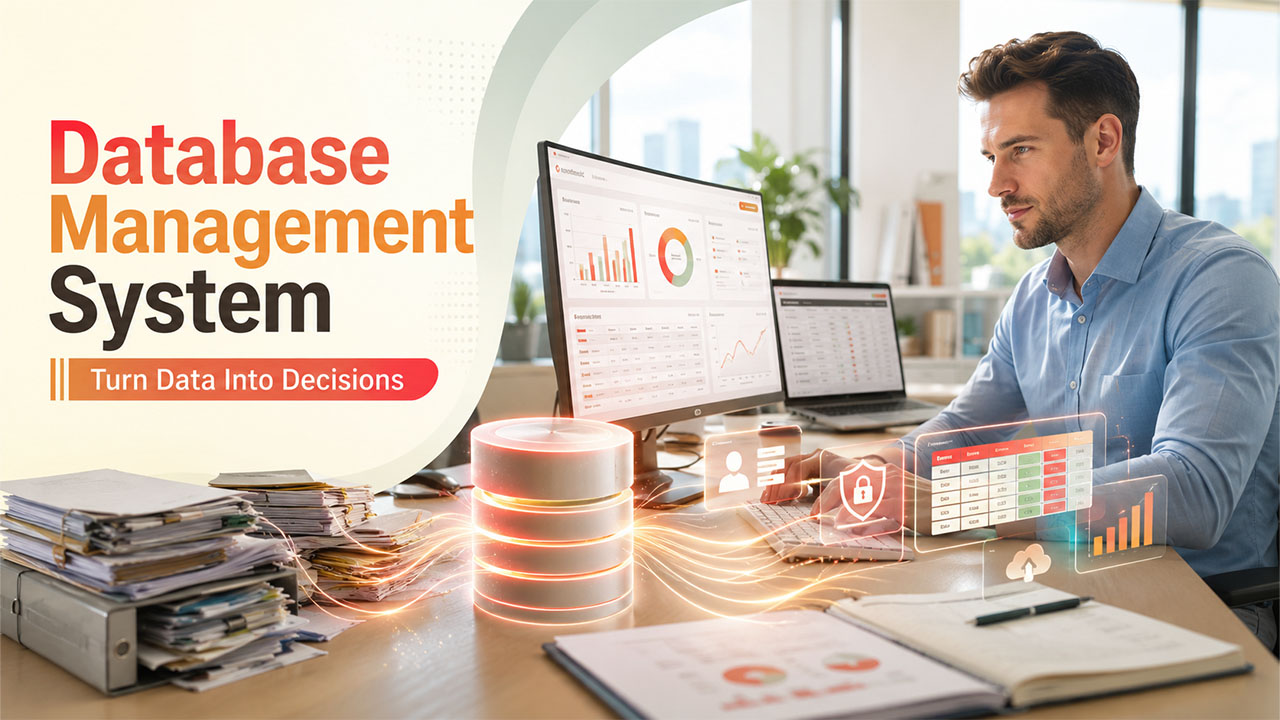
A dependable database management system (DBMS) works as the pillar of your business by unifying data to enhance security, efficiency, and strategic decision-making. While a DBMS makes sure that the data is secure and organized, the most successful systems go one step further by converting that data into visual and clear signals of growth. For sales-driven teams, utilizing a robust Insights and Reports feature in a CRM enables you to go beyond static storage and leverage real-time performance data to forecast what customers require next. In this comprehensive guide, you will understand what a database management system is, why it is important for managing business data, and the important features you must focus on while selecting a platform that aligns with the requirements of your company.
What Is a Database Management System?
A database management system refers to software that gives you an interface to interact with the data inside a database. In simple terms, you can refer to it as a highly efficient librarian that can manage your digital data. It catalogs your information, makes sure that it is safely stored, and enables you to find exactly what you are looking for and when you need it. A DBMS enables you to store, retrieve, and handle large amounts of organized data and works as a middle layer between your applications and data. The database engine enhances your data consistency and provides you with quick access to your stored data.
Why Do You Require a Database Management System?
A database management system sort of has a domino effect on the bottom line of your organization by centralizing its data. The advantages given below improve the financial performance of your business by minimizing costs, improving revenue, or both. The following table explains how they make it easy for you:
| Advantage | What It Means for You |
|---|---|
| Enhanced Productivity and Efficiency | Automates retrieval of data and analyses tasks to minimize manual work, allowing your team to emphasize high-impact strategies such as market expansion and innovation. |
| Effective Decision-making | Ensure consistent and accurate data across your business in real-time, allowing your team to make strategic decisions complementing business objectives. |
| Improved Data Security | Employs user authentication, encryption, and role-driven access controls to secure confidential data from breaches and enhance customer trust. |
| Cost Savings | Optimize storage and reduce duplicate data to minimize maintenance workloads and hardware expenses. |
5 Types of Database Management Systems
Every type of DBMS can manage distinct kinds of tasks and data. While some can manage huge volumes of data, others specialize in fast changes, and a few manage complex relationships between data.
Here is a breakdown of the 5 Common Types of DBMS:
1. Relational Database Management System:
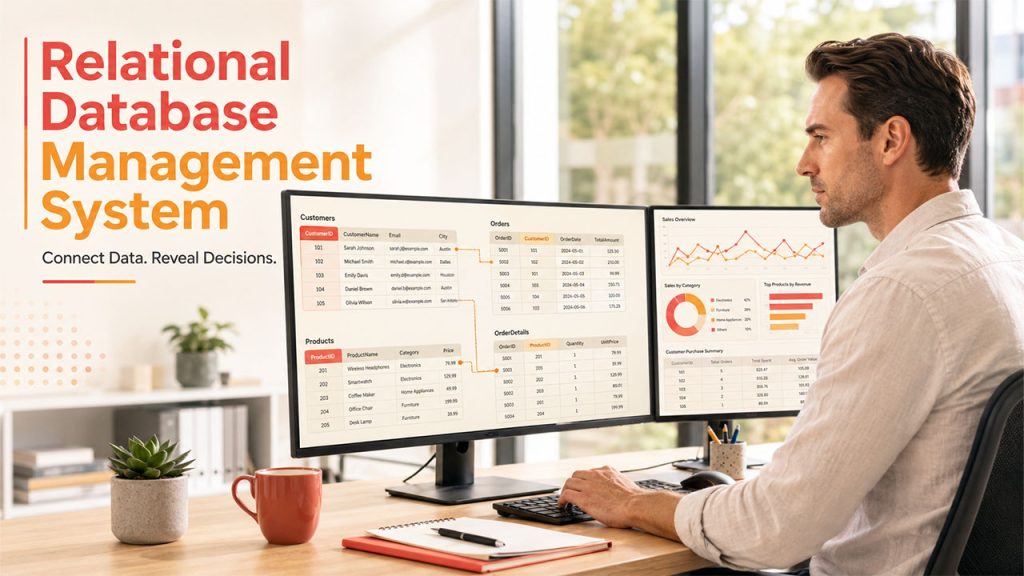
An RDBMS organizes data into tables with columns and rows that ensure relationships between different data sets. It leverages Structured Query Language (SQL) to query as well as manage data. The standardized query language and table structure allow complex queries for more effective retrieval and modification of data. The organized format makes RDBMS suitable for complex data interactions, specifically when you are dealing with interrelated data sets.
For instance, a sales data RDBMS might connect customer data to product details and order history. The two tables are related via the Shared Customer ID, so that you can easily fetch the data in both to create one report. This setup allows you to fetch comprehensive data quickly, such as purchase patterns of customer across product categories. The relational software is quite valuable for customer database software.
2. NoSQL Database Management System:
NoSQL platforms are more versatile as they handle distinct data types without requiring strict formats. They store information in numerous non-relational formats such as key-value pairs, graphs, documents, or columns. NoSQL DBMS can manage huge volumes of data and ensure that things run as seamlessly as possible as the data volume evolves. The NoSQL database is also a right option for handling big data applications and data warehouses.
NoSQL databases store related data in organized and flexible documents, which makes it quite simple to fetch all user activity without complex searches across distinct tables. For instance, a social media platform can utilize a NoSQL database to store as well as retrieve posts, user profiles, and interactions.
3. Hierarchical Database Management Systems:
These databases can sort data in a tree-like structure with child-parent relationships. They manage data that fits into hierarchy naturally, such as file systems and organizational charts. While its flexibility is less than the newer platforms, hierarchical DBMS still cater to specific fields. Take the employee directory of the company, for example. The CEO stays at the top, followed by department heads and team leaders.
A hierarchical format makes it simple to check out who reports to whom and to find anyone in a particular department. Similarly, a company might utilize a hierarchical database to store information with clear parent-child relationships. These include geographical data, file systems, bill of materials, and website navigation menus.
4. Network Database Management Platforms:
Network databases are quite similar to hierarchical databases, except they enable each record to have numerous parent and child records. They are more versatile in modeling complex relationships. Though it is comparatively less common, network DBMS can be valuable for particular setups.
Consider the database of a school as an example, where students can have numerous teachers, and numerous teachers educate different students. A network database can manage this web of connections smoothly. This makes it simple to see all the classes of a student and assigned teachers simultaneously. The network model aids in managing complex contact management scenarios.
5. Object-oriented Database Management Systems:
Such database store relationships as well as data in a single entity known as an object in the object-oriented model. They essentially handle complex types of data and relationships. OODBMS can be useful when working with engineering or multimedia data. Imagine a luxury car dealership and consider every vehicle to be an object with properties like specifications, available customization, and pricing.
The system provides customization options and vehicle specifications. It also incorporates target mailing lists for distinct marketing campaigns. OODBMS is a powerful solution for simple data storage requirements. A simpler database type might turn out to be a better option if you just want to keep track of basic customer details.
Key Characteristics You Need to Look for in a Database Management System
Related walkthrough
SuiteCRM Training Day 5 | SQL Queries and Database Management in SuiteCRM

When you are searching for a database management system, your wish list can change as per your requirements. Having said, the below-mentioned features become extremely significant:
Data Modeling:

Data modeling is how you structure and organize your database, such as creating a blueprint for your data. A DBMS enables you to map out data relationships easily. You can define tables, establish connections, and set rules for how data interacts. Look for characteristics that can help you visualize such relationships:
- ER (Entity Relationship) Diagram
- Schema designers with drag-and-drop interfaces
- Interactive data flow charts
- Visual query builders
The objective is to set up a logical structure that represents the requirements of your business. The logical foundation makes it quite easy to store, fetch, and assess your data later on. Furthermore, effective data modeling aids in avoiding issues such data inconsistencies or duplication.
If you are working with a relational system, comprehending schema structure becomes greatly significant. Refer to our guide on “How to Create a MySQL Database Schema: A Step-by-Step Guide” to begin with creating a profound relational foundation before setting up your DBMS.
Data Storage and Retrieval:
As far as data storage and retrieval is concerned, you require a DBMS that is both flexible and fast. Your system must be able to manage huge volumes of information without lagging. Whether you are extracting a single customer record or executing a complex query, you require fast results.
You also need options for how you are storing information. Some platforms are the right option for dealing with organized data (think neat columns and rows). Others specialize in managing unorganized data such as images or documents.
Look for characteristics such as indexing to expedite searches. Also, consider query language, such as is it easy to use? Can it manage the level of questions you will be asking about your data? The simpler it is to output or input the data, the more value you can extract from your system.
Concurrency Control:
Concurrency control enables end users to work with the same data at once. It is similar to traffic control of your database. Without any concurrency control, data inconsistencies can lead to errors, duplicate work, and lost updates, sacrificing efficiency and data accuracy. For instance, if one sales representative updates the address of the customer while the other edits the order details of another customer. Such changes can overlap and cause confusion or data loss.
A reliable DBMS tracks who is performing what tasks during concurrent access and makes sure that there are no clashes during changes. Your team members can work effectively without interfering with each other’s processes. Look for capabilities such as locking (which restricts access to data being changed temporarily) and versioning (which monitors distinct data versions).
Security and Data Integrity:
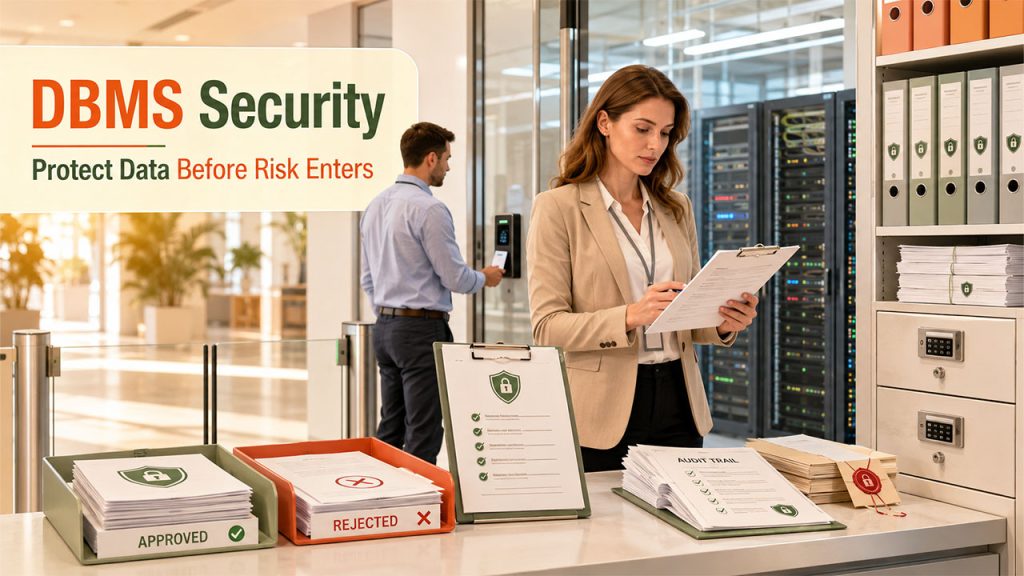
Security and data integrity make sure that information remains safe and reliable. They prevent your data from reaching wrong hands and causing major risks for your business. Integrity basically means that your data remains consistent and accurate. A quality DBMS establishes rules to avoid bad data from entering your system.
It works as a gatekeeper and blocks any input that does not match the pre-determined format. For instance, it might prevent a user from entering a contact number in the email field.
Security is important to ensure that the wrong eyes do not fall on your data. Look for specific characteristics such as the following:
- User authentication prevents unauthorized access by validating identities.
- Access control makes sure that only the right people have permission to modify or view confidential data.
- Encryption secures your data even if it is stolen, as only authorized users can decode it.
You also require audit trails to monitor who is performing what tasks in your database. Audit trails provide you with flexibility into specific actions within your database and enable you to quickly recognize possible misuse.
Read More: Cybersecurity is important in general for your business. Check out our guide on “Top Cybersecurity Solution Every Business Needs in 2026”
Recovery and Backup:
Data loss can happen at any moment, generally without any warning. Automatic backups make sure that your data remains safe even when human errors occur, such as forgetting to manually back up. Search for systems that allow you to schedule automatic backups, so data is always secure, even if team members forget.
You must also quickly restore the data when things go sideways. Look for recovery tools to find out how quickly you can get back online. Quick recovery tools reduce disruption during downtime, where each minute can mean losses in productivity. A few platforms can provide point-in-time features that allow you to roll back to any given moment, not just your previous backup.
This means that if you accidentally delete key records at 2PM, you can easily restore your system to 1:59 PM, right before deletion happens. It becomes useful if you want to undo a costly mistake.
What Is the Role of a DBMS in Data Governance?
A database management system plays an instrumental role in data governance that sets up key policies that control the creation of data, accessibility of data, and maintenance of data across your business. It makes sure that each data entry aligns with pre-determine standards, minimizing inconsistencies that can distort business reporting. Via role-driven access, validation rules, and audit trails, a DBMS creates accountability at each level of data management. The organized oversight enables businesses to remain compliant with data regulations while ascertaining the accuracy required for long-term and confident decision-making.
Conclusion
A database management system goes beyond than being a storage solution. It emerges as the operational pillar of data-based businesses. From enforcing integrity of data and allowing concurrent access to securing sensitive records and automating backups, a well-chosen DBMS minimizes risk while enhancing efficiency of the team. As the volume of your data increases and business complexity evolves, the right platform scales along with you, making sure that each decision that your team makes is powered by accessible, accurate, and well-governed data.
Irrespective of whether you are an evolving startup or an established enterprise, investment in the right DBMS is crucial across every department. It removes data silos, boosts compliance, and provides the team confidence to work on real-time insights instead of outdated assumptions. The best platform does not just store your information; it changes it into a strategic asset.
FAQs About Database Management Systems
Q1. What is the database management system?
A database management system (DBMS) is a specialized software that allows users to create, store, change, or fetch data from a database.
Q2. What are the types of DBMS?
A- The key types of DBMS include relational DBMS, network DBMS, hierarchical DBMS, and object-oriented DBMS.
Q3. What are 1NF, 2NF, and 3NF in DBMS?
A- 1NF, 2NF, and 3NF are progressive steps in database normalization. This is a technique utilized to organize tables in a DBMS to minimize data redundancy and avoid insert, update, and delete anomalies.
Q4. What are the four types of SQL?
A. The four main types of SQL commands (sub-languages) utilized to handle and modify relational databases are DML, DDL, DCL, and TCL.
Q5. What are the keys in DBMS?
A. The keys in a DBMS are attributes or sets of attributes utilized to identify rows in a table (tuples) and establish relationships between them.