
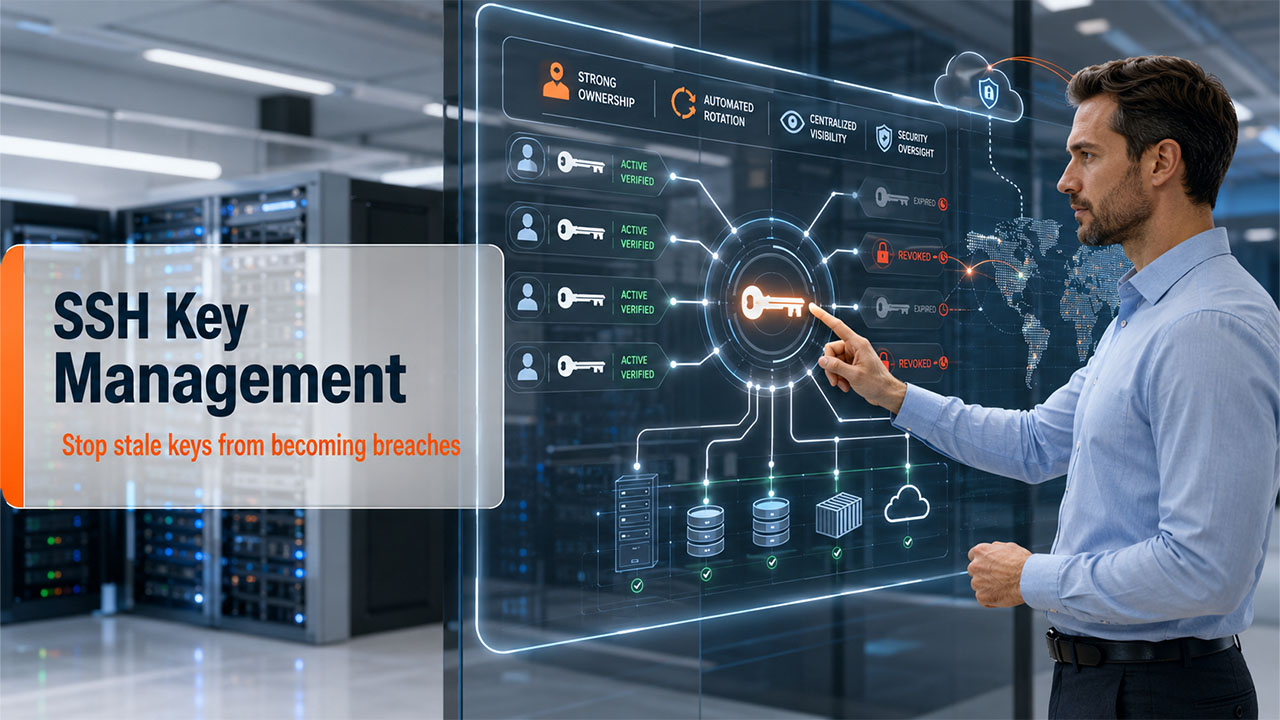
How Effective SSH Key Management Reduces Security Vulnerabilities
Learn how SSH key management improves security by controlling access, preventing key sprawl, automating key rotation, and reducing security vulnerabilities.
Remote administration depends on trust, and that trust fails quickly when private keys drift beyond clear control. Many organizations still maintain outdated credentials across servers, employee devices, and unattended tasks. Every dormant entry expands exposure, blurs accountability, and hinders containment after suspicious activity. Strong oversight reduces that risk by treating each key as a controlled access instrument, with ownership, recorded use, limited lifespan, and timely retirement before vulnerabilities lead to compromise. Effective SSH key management ensures these credentials remain secure, traceable, and properly governed throughout their lifecycle.
Key Sprawl
Unused credentials create entry points into sensitive systems. With sound SSH key management, security teams can see who holds access, which hosts accept each credential, and whether activity still matches a valid business need. That visibility matters because infrastructure changes often, while forgotten trust relationships may stay active for months. These gaps can be targeted after staff departures, device theft, or incomplete offboarding processes.
Hidden Risk
A copied private key can provide access to systems repeatedly without the friction of password prompts. Problems arise when public keys are stored on many machines, because every installed copy extends trust farther than administrators may realize. Lack of detail within records can leave responders to manually reconstruct timelines during an incident. Lost time raises damage. Confusion also allows unnecessary privileges to remain active long after a threat should have been contained.
Algorithm Choice
Inventory alone does little if the credentials themselves rely on outdated cryptography. Current practice favors modern options that provide strong protection with efficient performance. RSA is still widely used, but stronger configurations usually require a 3072-bit length for acceptable security. Ed25519 provides similar protection with a significantly smaller key size, which simplifies handling and improves speed. Older DSA credentials should be phased out, as current deployments no longer recommend their use.
Rotation Matters

Long-lived credentials age poorly, even inside disciplined environments. Responsibilities change, contracts end, and old automation continues after its original purpose has ended. Scheduled rotation reduces the value of any stolen key by shortening the time it remains useful. Shorter lifetimes also force teams to confirm whether access is still warranted. That review cycle clears outdated entries and reduces remnants from temporary assignments or emergency work.
Ownership Rules
Related walkthrough
How to Create AI UGC Ads Using Google Flow Agent | Complete Beginner Guide

Each key needs a named owner, a stated purpose, and a clear expiration point. Without that record, administrators cannot judge whether a credential still has a legitimate role. Shared access creates a deeper problem because accountability diminishes once several people operate under one identity. Individual assignment strengthens audit trails and narrows the scope of investigations. When suspicious behavior is detected, responders can isolate exposure without freezing access for unrelated staff or services.
Central Visibility
Strong security programs replace scattered authorized key files with a reliable source of record. That record should show the issuance date, approved owner, trusted systems, recent use, and pending expiration. With this evidence, teams can remove dormant entries, identify unusual patterns, and confirm that periodic checks happened on schedule. Memory and spreadsheets rarely survive pressure, especially during an active security event.
Automation Helps
Manual review can become untenable as the number of staff and hosts’ increases. An engineering team cannot inspect every credential by hand each week without risking oversight. Automated checks can flag outdated keys, expired owners, and policy exceptions before an attacker notices them. Effective tools also record issuance, renewal, and removal of events for later audits. Automating SSH key management enables organizations to enforce security policies consistently while reducing administrative effort. That combination reduces human error, speeds cleanup, and maintains control as environments change.
Incident Response
During a breach, speed matters more than perfect paperwork. Still, accurate records often decide whether containment takes minutes or consumes half a day. If responders know which systems trust a compromised credential, they can revoke access quickly and verify removal across affected hosts. Without that, teams may have to improvise under pressure. Effective oversight reduces the uncertainty that can turn a limited intrusion into a broader operational crisis.
Human Process
Technology cannot compensate for careless habits or weak administrative routines. Teams must implement onboarding, internal transfer, and departure procedures that promptly update access whenever responsibilities change. Reviews should be conducted on a fixed schedule, with clear approval rules and documented evidence. Training is also essential, as people who understand key handling are less likely to copy credentials into unsafe locations. Consistent habits make technical safeguards far more dependable over time.
Conclusion
Short key lifetimes, strong algorithms, named ownership, centralized records, and automated reviews all decrease the chances of forgotten access being used as entry points. Those controls also streamline investigations and make revocation more precise. By implementing effective SSH key management, organizations can strengthen access control through Zero Trust Security principles, reduce security vulnerabilities, and simplify compliance across growing infrastructure. When organizations treat credentials as monitored assets, they reduce exposure and maintain safer remote administration under routine operational changes.
Article rating
Was this article useful?
0.0 out of 5 from 0 ratings