
One AI Translation Isn’t Enough: Why Comparing Models Matters
Learn why relying on one AI translation model can lead to errors. Discover how comparing multiple AI translation models improves accuracy and translation quality.
You paste your text into an AI translator, hit enter, and stare at the result. It looks fine. It reads smoothly. But something nags at you: what if it’s wrong in a way you can’t catch?
That hesitation is not paranoia. It is pattern recognition.
You are not alone in this. Every person who has used AI translation tools beyond a text message has experienced this. And the risks increase depending on what type of content is, a legal contract, a product listing, or a medical prescription. The more sentences a content has, the less you can trust AI translator tools to get it right.
Here is the part most people miss. The fear is not really about AI translation failing. It is not about the AI translation being wrong. It is more about not being able to verify its work and relying on the AI model’s judgment.
Why a Single AI Model Can’t Earn Your Trust Alone
It is a fact that every language model translates the same sentence in a different way. Whether you use Claude, ChatGPT, or Gemini, they will give you three plausible answers to the same paragraph. Understanding the differences highlighted in Gemini vs ChatGPT comparisons makes it easier to see why these models often produce different translations and why those differences matter. Sometimes, those answers contradict each other. All of them sound so confident that you can’t flag them wrong.
This is the major issue you encounter when using single-model translation. Fluency and accuracy differ significantly. AI translation model uses such beautiful words to frame a sentence that it becomes difficult to guess which part you have to double-check. It also subtly changes numbers, inserts a half-baked clause, or uses the wrong regional term confidently making it hard to notice them.
The Data Behind the Discomfort
The discomfort has a measurable basis. Intento’s State of Translation Automation 2025 report tested 46 machine translation engines and large language models across 11 language pairs and found that baseline systems, off the shelf and unmonitored, averaged 10 to 15 errors per text. That is not a rounding error. That is a document with a genuine risk of miscommunication in nearly every paragraph.
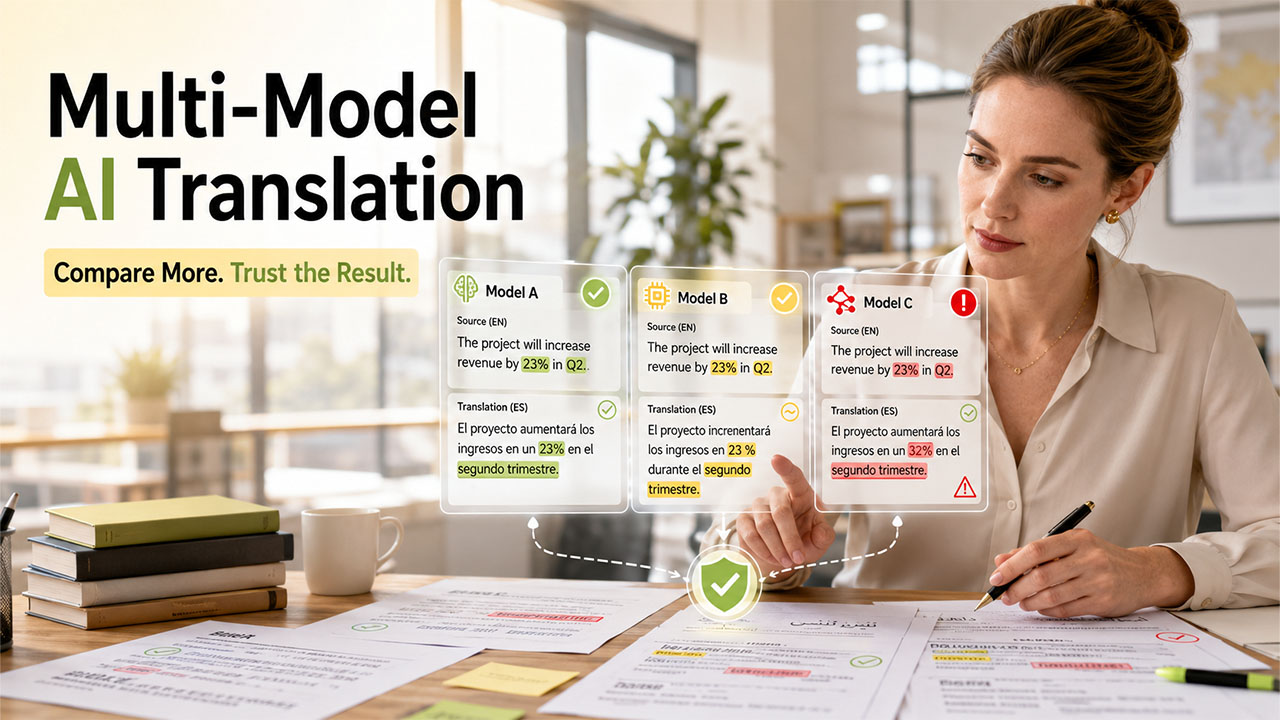
The report’s most interesting finding is not the error count. It is what fixed it. Intento found that a multi-agent approach, where several AI systems verify and test each other’s output, delivered the best average performance across the evaluation and earned top ratings in 9 of 11 language pairs. In other words, the fix for AI translation risk was never “pick a smarter model.” It was cross-checking.
That distinction is more important than you think. When you compare two different AI translations by making them translate the same text and receiving two different outcomes, this limitation becomes clearer to you.
The Three Blind Spots Single-Model Translation Creates
Related walkthrough
Step-by-Step Guide: Running Gemma in Action, Google's Latest Model

1. You Can’t See Where the Model Is Guessing
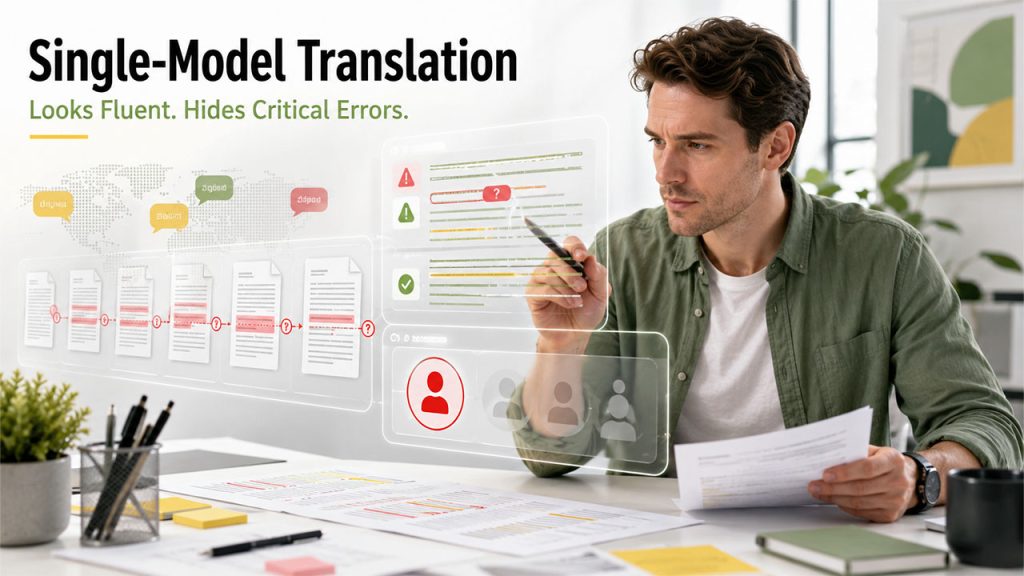
AI models don’t flag uncertainty. A model that is 95% confident and a model that is 55% confident produce output in the exact same tone. The real gap appears when they use idioms, regional terminology, honorifics, and context-dependent choice of words. And this is because here a model actually has to make a judgment call rather than just looking up the reference.
Take something as simple as saying “happy birthday” in another language. Translation tools can provide a quick answer, but they may not always explain why one phrase fits better than another. In German, there are several ways to express birthday wishes depending on the situation, relationship, and level of formality. A phrase like “Alles Gute zum Geburtstag” may work in many situations, while other variations can sound more personal, casual, or appropriate depending on who you’re speaking to. Tools like MachineTranslation.com help highlight these differences by comparing multiple AI translation outputs, making it easier to understand how different models interpret the same phrase. Its breakdown of the different ways to say “happy birthday” in German is a useful illustration of how much context-sensitive judgment sits behind even a short phrase, and why comparing translations can reveal nuances that a single AI model may miss.
2. Errors Compound Silently Across Longer Documents
A single mistranslated term early in a document does not stay isolated. If the AI model has translated the term incorrectly, it is going to use that same term consistently throughout the document by applying its own internal logic evenly across the text. Consistency is often considered a good thing; however, in this situation it becomes a liability if wrong terminology is used consistently in the document, changing its meaning.
3. You Have No Second Opinion Built into the Workflow
In any other high-stakes profession, a second reviewer is standard practice. Legal documents get a second set of eyes. Financial statements get audited. Medical charts get co-signed. AI translation is often the one workflow step where a single, unverified output goes straight to the reader with no built-in checkpoint.
What Actually Solves This: Comparison, Not a Better Model
The fix is not searching for the one AI model that never makes mistakes. That model does not exist, and it likely never will, because every model has different training data, different strengths by language pair, and different blind spots.
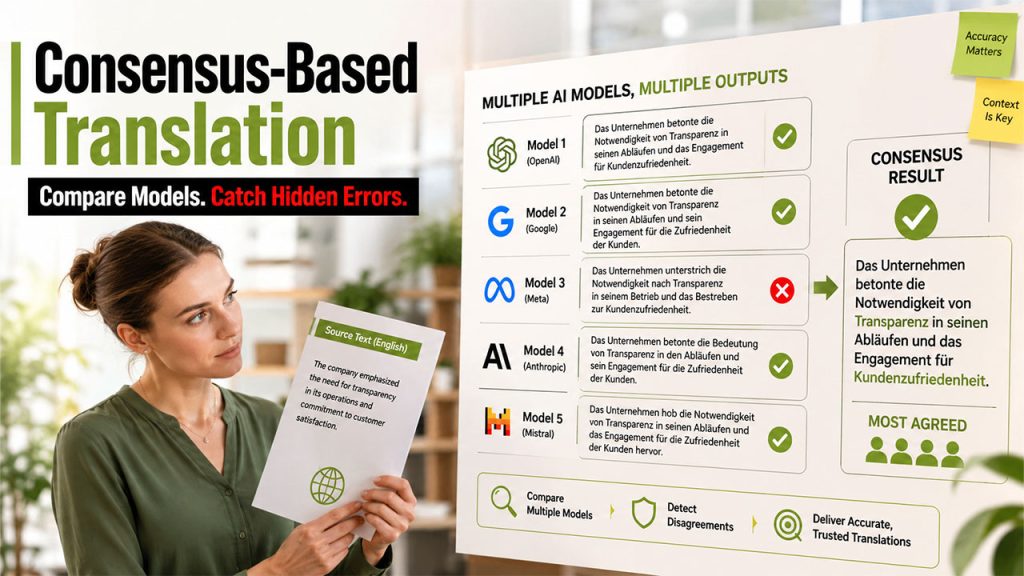
The fix is structural: run the same text through multiple models and see where they agree.
This is the logic behind consensus-based translation. Instead of trusting one model’s single guess, a consensus system compares the outputs of many models simultaneously, evaluates the surrounding context, and surfaces the translation that the majority actually agree on. Disagreement between models becomes visible information rather than an invisible risk. MachineTranslation.com’s SMART system applies exactly this approach, running text through 22 AI models and selecting the version with the strongest cross-model agreement, which internal benchmarking has tied to reductions in translation error risk of up to 90% compared with relying on a single model.
The logic maps directly onto something familiar outside of translation: when three independent doctors reach the same diagnosis, that agreement means more than any one opinion alone. The value isn’t in any single model being smarter. It’s in disagreement being caught before it reaches the reader.
Practical Takeaways You Can Use Today
If you are using AI translation model for anything that matters, a few habits close most of the gap:
- Fluency is not the same as accuracy: A sentence that feels smooth to read can still contain terminological or factual errors. Fluency tells you the grammar is fine, not that the meaning survived.
- Cross-check high-stakes phrases across more than one model or source before publishing, especially idioms, numbers, dates, and legal or medical terminology, where a single wrong word carries outsized consequences.
- Treat consistency in long documents as something to verify, not assume: Spot-check terminology in the middle and end of a document, not just the opening paragraph.
- Add a human review step for anything client-facing or regulated: Even the best consensus systems benefit from a qualified reviewer as a final checkpoint, particularly for contracts, compliance material, and anything with legal weight.
- Ask what a translation tool does when models disagree: If a platform can’t answer that question, it likely isn’t built to catch its own mistakes.
The Real Takeaway
The fear you feel staring at an AI translation is not irrational. It is your instinct correctly identifying that a single model’s confident output and a verified, accurate translation are two different things.
The solution was never to find a smarter AI. The goal is not to find a smarter AI. The only solution to this problem is you stop taking any model’s word for it. Do not blindly trust whatever the answers you get from AI translation models. Instead, build a process where you can check models against each other before it reaches a human for the final read. That shift, from single-model trust to cross-model verification, is what actually closes the gap between “this looks right” and “this is right.”