





Data has become an essential part of every business decision. It is used across different departments for different purposes, such as sales teams use it to track and qualify high-quality
Data has become an essential part of every business decision. It is used across different departments for different purposes, such as sales teams use it to track and qualify high-quality leads while marketing teams use it to analyze buyers' behaviors and preferences. Since this data is necessary to carry out these tasks, it must not be wrong. Incorrect or wrong data cannot support good decisions.
One field filled incorrectly in customer record doesn’t make a much difference. However, hundreds of small errors can significantly lower the quality of reports which in extension weakens campaigns, forecasts, and AI models. This is the reason why many organizations use a data quality platform to check, monitor, clean, and improve data before it causes bigger business problems.
What is a Data Quality Platform?
Data quality platforms refer to software that helps companies check the quality and reliability of their data. Additionally, it also cross-checks your data to find errors such as duplicate entries, missing numbers, incorrect formats, outdated information, and inconsistent records across systems. This keeps your data clean and useable.
If there’s a strong data quality check, you can also recognize the root cause of those problems and stop them from spreading further. Companies like Ataccama connect data quality with other measures like data cataloging, lineage, observability, and governance. Similar to modern Enterprise Data Platforms, this adds context to data so that teams can use it in a more meaningful way instead of treating every problem as a one-time cleanup task and being done with it.
On the other hand, if poor data quality isn’t affecting your business at the moment, you’re likely to overlook it until it does. Many people only notice the gaps in data when numbers differ or when someone spends whole day digging through incorrect data and fixing spreadsheets before going in a meeting.
If your data is bad, you are most likely to make wrong business decisions. This risk will only grow as companies adopt more automation and AI. Why? Because automated systems work with the data, they receive without caring about its quality. When you feed it with poor data, the output will be poor as well. This can lead to poor decisions that teams cannot fully trust.
Common Signs of Weak Data Quality
Companies may have weak data quality when teams notice signs such as:
- Reports that do not match: Different departments may use different numbers for the same metric because data comes from separate systems or follows different rules.
- Duplicate records: The same customer or company may appear more than once, leading to repeated outreach, unclear ownership, and inaccurate reporting.
- Missing or outdated details: Customer records may lack phone numbers, email addresses, addresses, job titles, or current account information.
- Inconsistent formats and spellings: Names, dates, phone numbers, addresses, currencies, or country names may appear in different formats across systems.
- Invalid entries: Fields may contain wrong values, placeholder text, broken formats, or data entered in the wrong place.
- Too much manual cleanup: Employees may spend time fixing spreadsheets, removing duplicates, or correcting records before they can use the data.
- Low trust in reports and AI outputs: Teams may question dashboards, automated workflows, or AI recommendations because the data behind them appears incomplete, duplicated, or inconsistent.
5 Key Features a Data Quality Platform Should Have
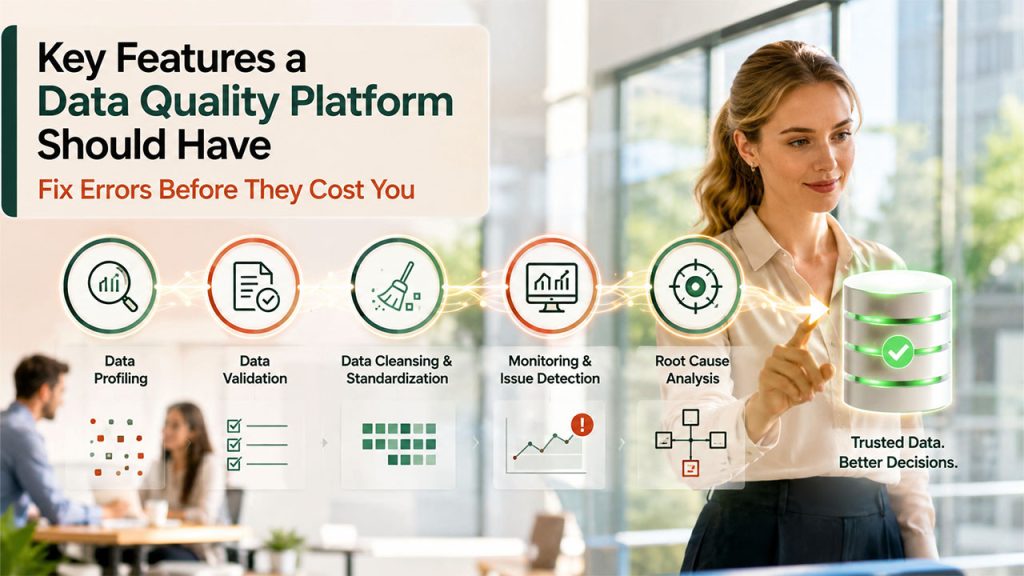
Good data quality tools should help teams understand what is wrong, why it happened, and how to fix it in a repeatable way.
1. Data Profiling
Data profiling is meant to assess the structure and condition of data. It is used to identify if data shows any inconsistencies, unusual patterns, duplicate records, or invalid formats. This saves time teams spend making sense of data or cleaning it before they can use it.
For instance, a profile shows that 20% of customer records are missing a country field, or phone numbers that have been filled with different formats across regions. With these details, teams can understand better the size and type of the problem before they start working on it.
2. Data Validation
Data validation checks whether data meets set rules. A company may require email addresses to follow a valid format. It may require product IDs to match a known list. It may require dates to follow one standard format.
With validation, teams can keep reports clean and prevent poor data from infiltrating your database, workflows, and downstream systems. Additionally, teams can now use a more stable and consistent way to apply business rules across the entire organization.
3. Data Cleansing and Standardization
Data cleansing fixes known issues in a dataset. This may include correcting typos, removing duplicate records, filling missing values where appropriate, and standardizing formats.
Standardization is especially useful when data comes from different sources. One system may write “United States,” another may use “USA,” and another may use “US.” These differences can break reports or create confusion. Data cleansing helps make records easier to compare and use.
4. Monitoring and Issue Detection
Data quality is not a one-time project. New data enters systems every day. New errors can also appear every day. Monitoring helps teams catch problems early before they affect dashboards, customer journeys, AI models, or business reports.
Monitoring can track quality metrics over time. It can also alert teams when data changes in a strange way. These continuous checks improve Data Analytics by ensuring reports and dashboards are built on accurate, up-to-date information. For example, a sudden drop in completed customer records may signal a broken form, system issue, or process change.
5. Root Cause Analysis
Fixing bad records is useful, but finding the root cause is better. If you analyze root causes, it helps you to understand where a data problem began. The issue may arise from different sources such as system, manual entry process, broken integration, or a rule that no longer applies to the business. A quick fix can keep your records clean temporarily. However, when your team knows the source of recurring problems, they can fix the process, so they don’t have to clean the same data again and again.
Why Data Quality Matters for AI Readiness
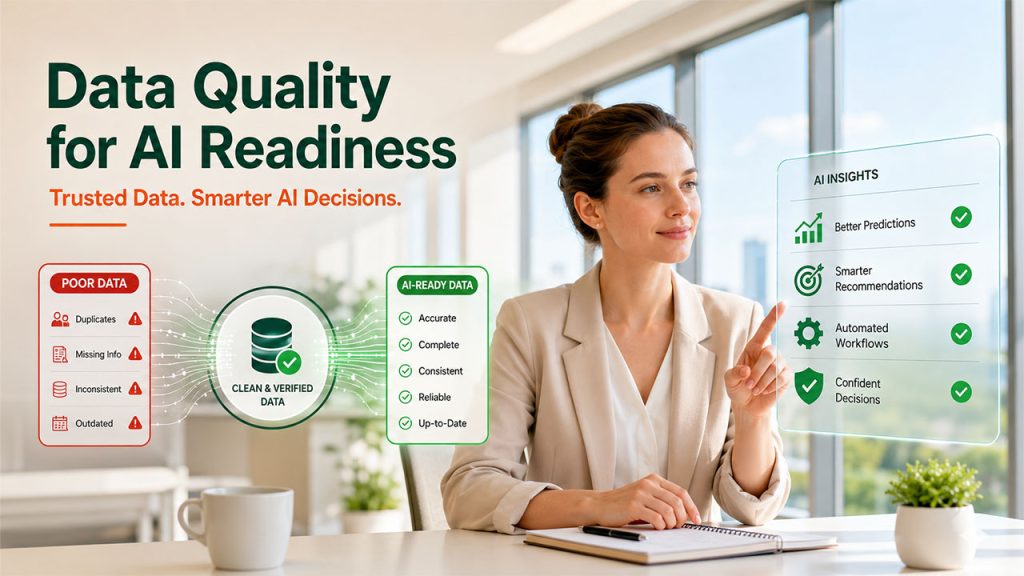
AI tools only work well when they get clean, accurate, complete, and updated data. You can only fully trust AI outputs when you have strong data quality. Good data reduces errors and trains systems to perform advanced automation and better decision-making.
- AI depends on reliable data: Machine learning models, AI assistants, automated workflows, and predictive systems need accurate input.
- Poor data leads to weak AI output: Missing, duplicated, outdated, or inconsistent records can make AI results unreliable.
- Clean data builds AI confidence: Trusted data helps teams use AI tools with more confidence and less manual checking.
- Data quality supports better recommendations: Accurate records help reduce weak suggestions, wrong predictions, and unclear outputs.
- Data quality does not make AI perfect: It gives AI systems a stronger foundation to work from.
- AI planning should include data quality early: Teams should prepare their data before testing, scaling, or improving AI use cases.
How Data Quality Supports Governance and Compliance
Data quality also supports better control over business information. When you keep your records clean, organized, and traceable, it becomes easier for teams to follow governance rules and prepare to meet compliance needs without getting lost or confused.
- Data governance needs clear rules: Governance defines how data is managed, used, protected, and understood.
- Data quality supports those rules: It helps keep information accurate, consistent, and reliable across systems.
- Clean records support compliance work: Accurate data can help teams prepare for audits and reviews.
- Clear ownership improves control: Teams need to know who is responsible for each dataset and process.
- Data lineage shows where data came from: Lineage helps teams trace data from its source to reports, systems, or AI models.
- Reusable rules reduce repeated errors: Standard rules help teams manage data in a consistent way.
- Stronger control lowers business risk: Teams can better understand what data they have, how trusted it is, and how it moves across systems.
Building Better Decisions Starts with Trusted Data
Reliable data is the foundation of every business. It is no longer optional, rather has become a necessity. Organizations gather data to assemble reports, provide better customer experience, run business operations effectively, meet compliance standards, and train AI. And a data quality platform assists businesses with these tasks. It helps them look for problems, fix them, and stops them from spreading further in the system. It offers a clearer way to manage data as a shared business asset. When you have strong data quality, you will make better, informed decisions that forges a stronger path forward for business.
Respond to this article with emojis