
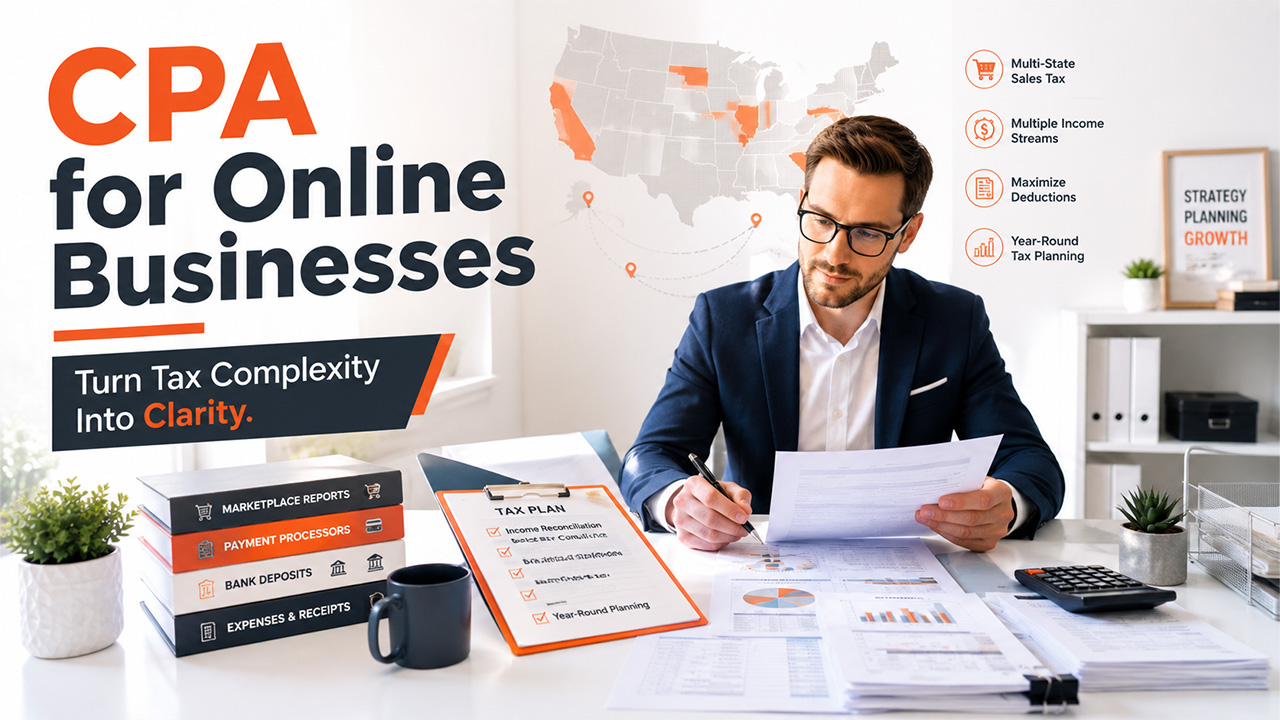
How a CPA Supports Online Businesses With Complex Tax Needs
Understand how an online business CPA helps with sales tax, multi-platform income, deductions, and year-round tax planning.
Running an online business generally comes with a specific set of financial complications, that the traditional brick-and-mortar businesses simply don’t face. For an online business CPA, understanding these challenges is essential to providing accurate tax planning and compliance support. Challenges like sales tax obligations, that shifts depending on where the customer nis located, income spread across multiple platforms and payment processes, and rapidly changing regulations that all can make bookkeeping and tax compliance far more complicated compared to that of a traditional seller.
The compliance burden this creates is well documented. Research conducted for the Small Business Administration’s Office of Advocacy found that small firms pay 67% more per employee to comply with the tax code than large firms do. For online business owners in Nashville juggling multiple revenue streams and shifting tax jurisdictions, that gap is exactly where professional guidance tends to make the biggest difference.
Why Online Businesses Face a Uniquely Complex Tax Picture
Unlike a traditional local business operating from a single physical location, an online business often sells to customers across multiple states, sometimes even multiple countries, each with its own tax rules and thresholds. What starts as a straightforward e-commerce operation can quickly become a tangle of overlapping tax obligations that most business owners never anticipated when they first started selling online.
This complexity is compounded by the fact that online businesses frequently operate across several platforms and payment processors simultaneously, each generating its own separate reporting documents that need to be reconciled accurately at tax time. Without a clear system for tracking this activity throughout the year, tax season can become a scramble to piece together scattered records from multiple sources.
Navigating Multi-State Sales Tax Obligations
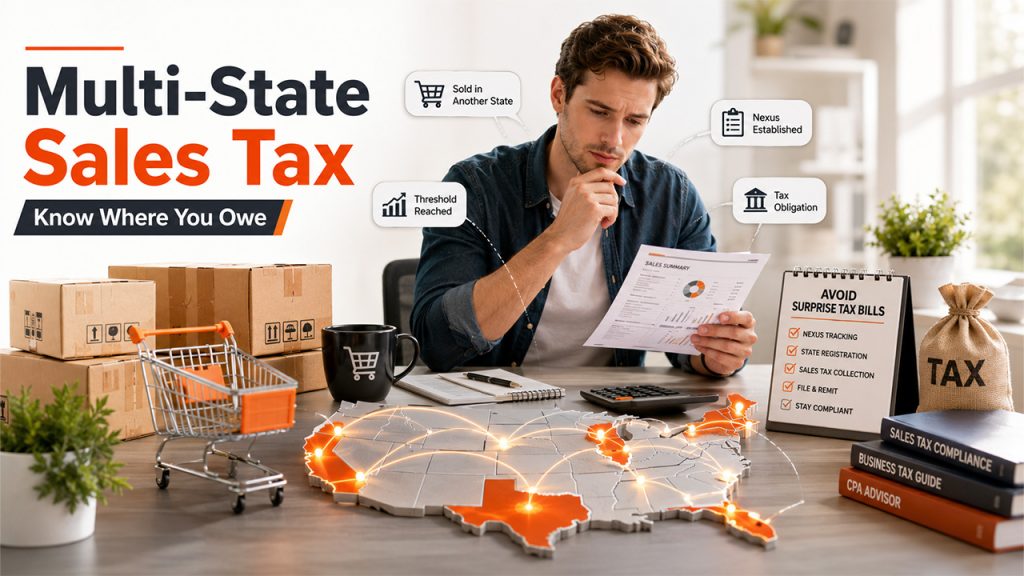
Among all the major challenges that the online sellers face, is determining where they owe sales tax is a question that depends on the complex rules around economic nexus and transaction thresholds, which are very significant from state to state. An online business might unknowingly cross a sales threshold in one state, where it has no physical presence, triggering a tax obligation that the owner wasn’t even aware existed before.
An online business CPA experienced in taxation of online businesses can efficiently track all such thresholds proactively, helping business owners understand where they’ve established their nexus and what registration or filing are needed to follow.
Reconciling Income Across Multiple Platforms and Processors
Online businesses often receive income through several different channels simultaneously: marketplace platforms, direct payment processors, and subscription services, each issuing separate 1099 forms or reporting documents that don’t always align cleanly. Fees, refunds, and processing delays can further complicate the picture, since the amount deposited into a bank account rarely matches the gross figure reported on a 1099 form. This reconciliation work matters because discrepancies between reported income and what’s actually filed can trigger IRS scrutiny, even when the underlying error is a simple reporting mismatch rather than any intentional misstatement.
A Nashville CPA experienced with online business structures can help reconcile these scattered income sources into a single, accurate picture for tax filing purposes. Sunil Kawatra CPA is one option equipped to help online business owners untangle exactly this kind of multi-platform income reporting, ensuring nothing gets missed or double-counted at tax time and that the final filed numbers hold up under scrutiny.
Online Business CPA Maximizing Deductions
Related walkthrough
What is CRM? CRM Explained in 1 Minutes | Boost Sales & Manage Customers Better

Online businesses often qualify for deductions that don’t apply to traditional retail operations: home office expenses, software subscriptions, platform fees, inventory storage costs, and even a portion of internet and phone bills used for business purposes. Many business owners simply aren’t aware of the full scope of deductions available to them, particularly as their operations grow more complex or expand across additional platforms, which can mean paying more in taxes than necessary year after year without realizing it.
A CPA familiar with the specific expense patterns of online businesses can identify these deductions accurately, drawing on experience with how similar businesses actually operate day to day rather than applying a generic checklist. This ensures a business claims everything it’s legitimately entitled to without overstepping into territory that could raise red flags during an audit, a balance that requires genuine expertise, not just a willingness to claim as much as possible.
Planning Ahead Rather Than Reacting at Tax Time
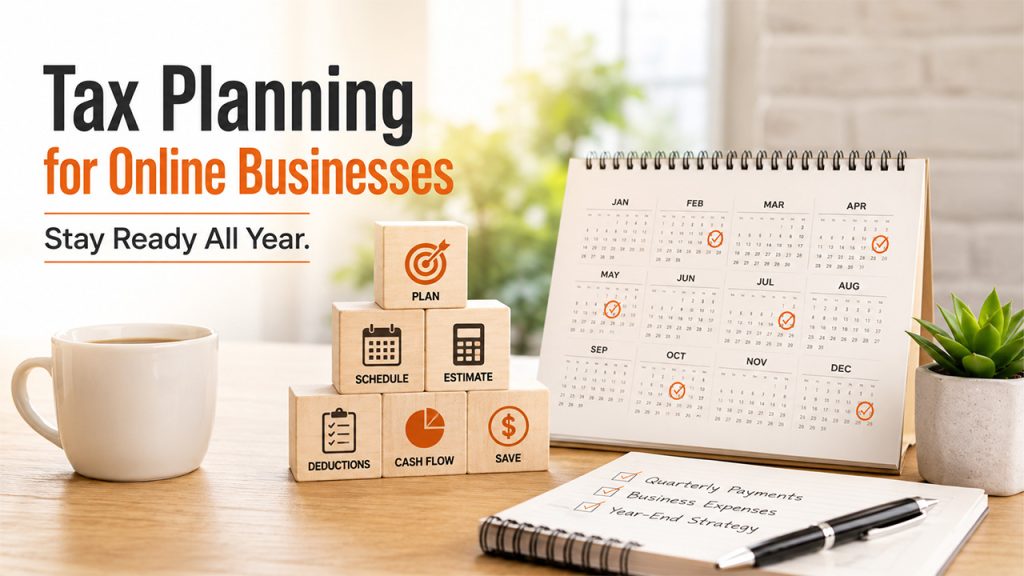
One of the most valuable things a CPA offers online business owners isn’t just accurate filing; it’s proactive planning throughout the year. The quarterly estimation of tax payments, strategic timing of major purchases, and entity structure decisions, all benefits from the ongoing guidance, rather than just a single conversation that happens every spring. By that time, most of the decisions of a year have already been made, and there’s little to no room left to adjust course.
This kind of continuous planning, supported by professional accounting support, generally tends to prevent the kind of last-minute scrambling that often leads to missed deductions, inaccurate estimates, or unnecessary penalties for underpayments.
A business owner who checks in periodically throughout the year rather than only at filing time is far better positioned to make informed decisions in the moment, whether that’s timing a large purchase to fall in the right tax year or adjusting quarterly payments before an underpayment penalty becomes unavoidable.
Questions to Ask When Choosing Online Business CPA
Choosing the right online business CPA is particularly important when an online business has customers across multiple states, uses several sales platforms, or needs ongoing tax planning. A few specific questions help business owners find a CPA genuinely equipped to handle online business complexity.
- Do you have direct experience with multi-state sales tax nexus for e-commerce businesses? A critical distinction, since general small business experience doesn’t always translate to online-specific challenges
- How do you handle reconciling income across multiple platforms and payment processors? A strong answer here signals real, hands-on experience rather than theoretical knowledge
- What ongoing, year-round support do you provide beyond annual tax filing? Revealing whether the relationship is built around proactive planning or a single annual conversation
Getting clear, specific answers to these questions helps online business owners find a CPA whose experience genuinely matches the particular challenges their business actually faces.
Conclusion
The complexity of online business taxation isn’t going away, and for many owners, it only grows as the business expands into new platforms, markets, or states. What starts as a single store selling through one channel can, within a few years, involve multiple marketplaces and sales tax obligations across several jurisdictions.
Working with a CPA who understands these specific challenges turns an ongoing source of stress into a manageable, well-organized part of running a successful online business, freeing owners to focus on growth, knowing the financial side is genuinely handled.