
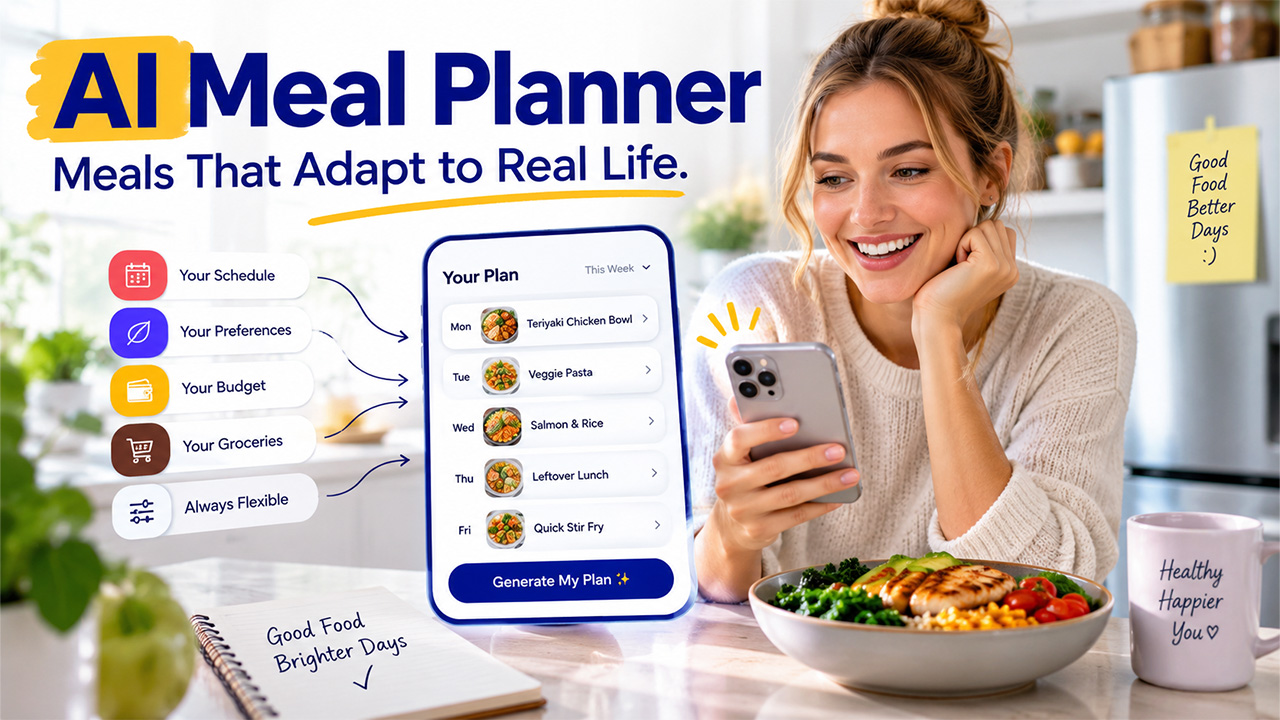
How AI-Powered Meal Planning Apps Are Changing Life
Discover how AI meal planner makes weekly meals easier by combining personal preferences, dietary needs, budgets, groceries, and changing routines.
Meal planning sounds simple until it has to survive an ordinary Tuesday.
The plan says salmon, roasted vegetables, and rice. Work runs late. The vegetables are still at the store, one person in the family no longer wants salmon, and there are half a container of mushrooms and some cooked chicken in the fridge that need to be used first.
A static weekly menu has no opinion about any of this. It was correct when it was written and increasingly inconvenient as real life moved away from it.
That gap is where AI is beginning to make meal planning more useful. The interesting change is not that software can produce seven dinner ideas in a few seconds. Recipe websites and basic planners have been able to supply menus for years. What is changing is the ability to build a plan around several personal constraints at once and then revise it when those constraints change.
A modern meal planning app can therefore be more useful when treated as an ongoing planning tool rather than a weekly recipe generator. Macaron takes this approach with its AI Meal Planner, which can work with preferences, dietary restrictions, budget, cooking time and weekly routines. It can also adjust meals after a plan has been created and carry previous feedback forward, so a meal someone enjoyed—or repeatedly skipped—can influence what is suggested later.
That moves meal planning closer to the way people actually make food decisions.
The Hard Part Has Never Been Finding Recipes
Anyone with internet access can find more recipes than they could cook in a lifetime.
The real difficulty is narrowing those possibilities into a week that makes sense.
A recipe can be healthy and still be a poor choice for Wednesday because it takes an hour to prepare. Another may fit a nutrition target but require six ingredients that will not be used anywhere else. A beautiful seven-day menu can become expensive if every dinner has a different shopping list.
Traditional meal planning often leaves the user to reconcile these conflicts manually.
AI can help because many of the constraints can be considered together.
Instead of asking for “healthy dinners,” someone can describe a more realistic week: two adults, dinners under thirty minutes Monday through Thursday, vegetarian on Tuesday, a larger meal on Saturday, lunches that can reuse leftovers, and a grocery budget that should not creep upward because every recipe requires a new specialty ingredient.
The quality of the plan depends heavily on those details.
This is one reason people often get disappointing results from AI meal planners on their first attempt. They describe an aspiration rather than their actual routine.
“Help me eat healthier” gives the system very little to work with.
“I cook four nights a week, get home after seven on Wednesdays, dislike very spicy food, and want lunches that can be packed the night before” is a planning problem with useful boundaries.
Personalization Becomes Valuable When It Changes the Plan
There is a weak version of personalization in which an app asks whether you are vegetarian, low-carb, or interested in high-protein meals and then assigns a corresponding menu.
That is useful filtering, but it is only the beginning.
Real preferences are messier.
Someone may eat almost anything but strongly dislike reheated fish. Another person may enjoy cooking at the weekend but refuse to make breakfast in the morning. A family may happily eat the same lunch twice but resist repeated dinners.
These details rarely fit neatly into dietary categories, yet they determine whether a plan will be followed.
AI systems are well suited to receiving this kind of information in ordinary language. Macaron, for example, allows users to describe preferences and routines conversationally rather than relying entirely on fixed categories, and its Deep Memory feature is designed to retain signals such as meals the user enjoyed or skipped.
The important measure of personalization is whether the next plan changes.
If someone keeps replacing elaborate breakfasts with yogurt and fruit, the planner should eventually stop proposing elaborate breakfasts. If lentil soup repeatedly becomes a successful Monday meal, there is little reason to insist on novelty simply because another recipe exists.
A useful food routine does not need to surprise the person eating it every day.
Good Planning Also Reduces Shopping Friction

Meal planning and Personal Shopping Appointments are often treated as separate tasks even though they are tightly connected.
A menu may look efficient until its ingredients are combined.
Five dinners that each require a different herb, protein, sauce, and vegetable can create a long bill and a refrigerator full of leftovers that have no obvious next use.
A better plan looks across meals.
Chicken bought for Tuesday can reappear in Thursday’s lunch. Spinach may work in one dinner and two breakfasts. A large batch of rice can support different meals without making every plate feel identical.
AI has an advantage here because it can reorganize a plan around ingredient reuse rather than simply selecting recipes one at a time.
Macaron’s current Meal Planner includes a consolidated grocery list with its weekly plans. The more interesting use, however, is to give the system shopping constraints before the plan is built.
Someone trying to spend less could ask for several meals that reuse the same core ingredients. A student with a small kitchen could rule out oven recipes. A household shopping only once a week can favor ingredients according to when they should be eaten.
The grocery list then becomes an output of the planning logic, not an administrative step added afterward.
The Plan Should Be Allowed to Break
Related walkthrough
Flint K12 Review | How AI Is Transforming Personalized Learning for Schools

One of the strangest features of traditional meal planning is that deviation often feels like failure.
Tuesday’s dinner gets skipped, so ingredients remain unused. Wednesday’s meal no longer fits. By Thursday, the original plan has become irrelevant and the household is improvising again.
A more flexible system can treat the skipped meal as new information.
Suppose Tuesday becomes a takeaway night. The chicken originally planned for Tuesday can move to Wednesday. Wednesday’s ingredients might shift later, or the planner may suggest a meal that uses both sets of perishables before they spoil.
This sounds like a small convenience, but it changes the relationship between the person and the plan.
Instead of asking, “Did I follow my meal plan?”, the more useful question becomes, “Does the plan still help me make the next decision?”
Macaron currently lets users swap meals or change a day after generating a plan, with the rest of the plan adjusting accordingly. That kind of flexibility is closer to how planning works in other parts of life: a calendar that cannot accommodate a changed meeting would not be considered very useful either.
Meal Planning Can Become a Way to Manage Decision Fatigue

For many households, dinner is not difficult because cooking itself is impossible.
The tiring part is making the same chain of decisions repeatedly.
What should we eat?
Do we have the ingredients?
How long will it take?
Will everyone eat it?
What needs to be used before it goes bad?
Should tonight’s meal produce lunch for tomorrow?
Individually, none of these decisions is particularly demanding. Repeating them late in the day is what creates friction.
A good planner using AI-powered tools can move some of that thinking to an earlier moment when the user has more time to make deliberate choices.
This does not mean outsourcing every food decision. People still change their minds, eat out, discover new foods, and decide that tonight is simply not the night to cook.
The benefit comes from having a sensible default.
When Wednesday arrives, the household is no longer beginning with an empty question. There is already a plausible meal, the ingredients are more likely to be available, and there is a fallback if circumstances have changed.
That is a subtler benefit than “saving time,” but it may explain why meal planning affects everyday life more than the number of minutes spent writing a menu suggests.
A Better AI Meal Plan Starts With Better Input
People using an AI meal planner for the first time can improve the result considerably by treating the initial setup like a short briefing.
The most useful information usually includes the things that genuinely constrain daily eating: foods that must be avoided, strong dislikes, realistic cooking time, number of people eating, rough budget, days when meals need to be especially easy, and whether leftovers are desirable.
It also helps to distinguish hard requirements from preferences.
A food allergy is a hard constraint. Preferring not to cook for more than thirty minutes is usually a preference that might change for a weekend dinner.
That distinction gives the system more room to make useful trade-offs without violating something important.
After the first week, the plan should be reviewed using actual behavior rather than intentions. Which meals were made? Which were skipped? What ingredients remained unused? Which dinner created useful leftovers? What looked good on Monday but felt unrealistic by Thursday?
Feeding this information back into the next plan is where AI planning starts becoming more personal rather than simply generating a fresh menu every week.
There Are Limits to What Meal Planning AI Should Decide

Personalization also creates an important boundary.
An AI system can help organize ordinary preferences, schedules, grocery constraints, and general nutrition goals. That does not make it a substitute for individualized medical nutrition care.
Someone managing food allergies should verify ingredients carefully rather than assuming generated recipes are automatically safe. Medical diets, pregnancy-related nutrition, eating disorders, and health conditions may require advice from a qualified professional. Macaron’s own guidance makes a similar distinction, recommending AI meal planning as organizational support rather than medical guidance in higher-risk situations.
There is also a more ordinary limitation: AI does not live in the kitchen.
It may not know that the supposedly available avocado became unusable overnight or that a child who liked a particular meal last month has suddenly decided against it.
The strongest use of these tools is therefore collaborative. The planner handles much of the organization; the user supplies reality.
The Most Useful Plan Is the One That Survives the Week
AI is unlikely to transform everyday eating because it can invent more recipes.
People already have plenty of recipes.
Its more useful contribution is helping turn a complicated set of small constraints into a workable next decision: what fits tonight, what should be bought, what can be reused, and what needs to change because the week did not go according to plan.
That makes the technology less about pursuing a perfect menu and more about maintaining a food routine that remains usable.
A successful meal plan may repeat favorite dishes. It may contain an intentionally easy dinner on a difficult day. It may change halfway through the week and look different from the version created on Sunday.
None of those things make the plan worse.
They are signs that the plan is responding to the life it was supposed to support.