
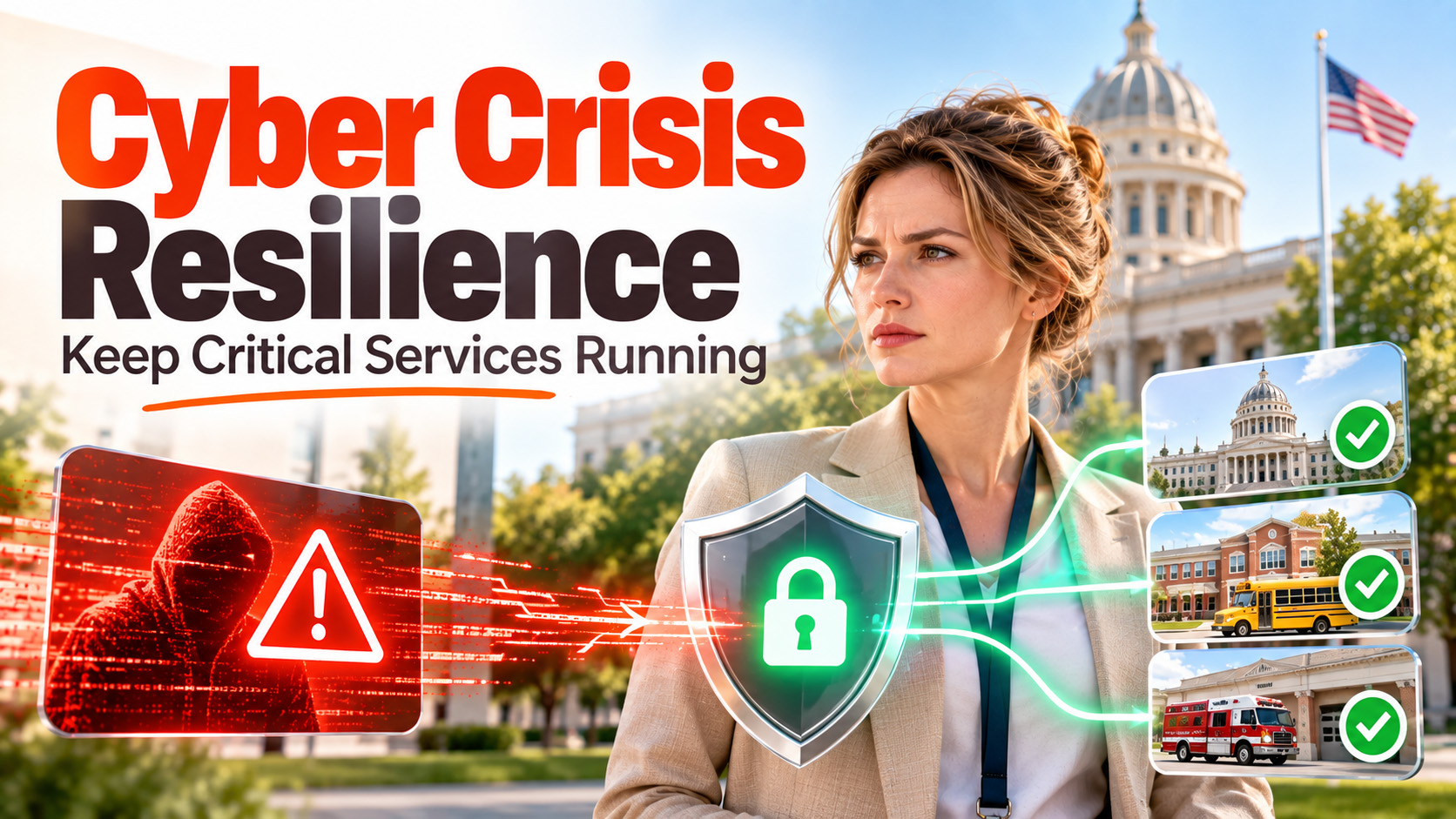
Strengthening Cyber Crisis Resilience for State, Local, and Education Organizations
Strengthen Cyber Crisis resilience in SLED organizations with identity protection, secure backups, tested recovery, and continuity planning.
State agencies, county governments, city halls, and school districts share a common set of constraints that rarely apply to private industry: tight budgets, legacy systems accumulated over decades, and services residents cannot simply do without. When a cyberattack hits one of these organizations, the fallout reaches far beyond a single office. Payroll stalls, student records become inaccessible, or a county clerk cannot process a marriage license. Building genuine resilience in this environment requires attention to three areas that tend to determine how badly an incident spreads: identity systems, backup integrity, and continuity planning. Preparing for a Cyber Crisis also requires organizations to understand how these areas work together during an active incident.
Why SLED Organizations Face a Distinct Risk Profile
State, local, and education organizations, often grouped under the shorthand SLED, operate under conditions that differ meaningfully from private sector enterprises. Budgets get approved annually and rarely include much room for unplanned security investment. IT teams are small in comparison to the systems they are tasked to support, and often those systems were designed or acquired several years ago without a comprehensive security plan in place. At the same time, these organizations’ data and services make them attractive targets. School districts house delicate information about students and their families. County governments oversee property documents, court records, and voter registration data. State agencies facilitate benefit payments and renew licensing that residents use to get through their day. This combination of limited resources and high-value data has made SLED organizations a consistent target for ransomware groups, who often calculate that under-resourced IT teams and public pressure to restore services quickly make these victims more likely to pay.
Identity Systems as the Foundation of Resilience
Almost all SLED agencies use a directory service for authentication, which is most often Active Directory, to authenticate users for email, file storage, and frequently the programs that power vital government or education services. When your identity infrastructure is breached, the effects are rarely isolated to just one system. An attacker who controls the directory service can spread outwards, elevate their own permissions, and silence your detection tools.
A plan for Cyber crisis management for SLED environments needs to address identity resilience explicitly, because restoring a public-facing application is not enough when staff and residents still depend on an unavailable or compromised identity system to access it. This means maintaining backups of identity infrastructure that are isolated from the production network, so that a compromised directory cannot corrupt its own recovery point. It also includes a tested process for detecting that the restored identity infrastructure truly is clean before re-joining it to production, as there is no point restoring a directory that still contains malicious backdoors under the hacker’s control.
Backup Integrity as a Cyber Crisis Recovery Baseline
Related walkthrough
Flint K12 Review | How AI Is Transforming Personalized Learning for Schools

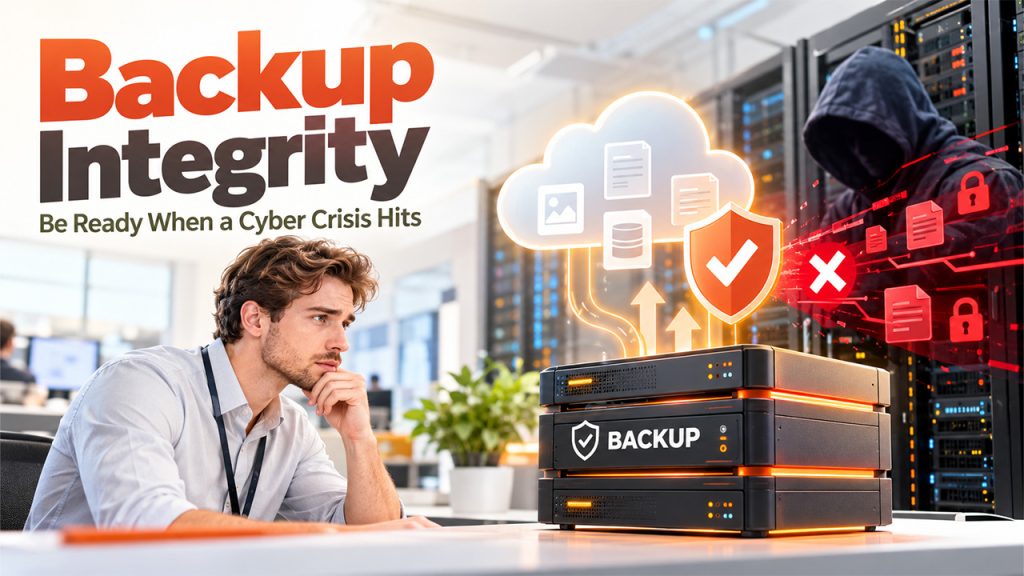
Backups often serve as the last line of defense during a ransomware incident, which makes them an increasingly common target themselves. Attackers who understand how organizations typically respond to ransomware will often attempt to locate and encrypt or delete backup data before triggering the main attack, removing the fallback option before the victim even knows an incident has begun.
For SLED organizations working with limited budgets, backup strategy often gets treated as a checkbox rather than a tested capability. A backup that has never been restored in practice offers false confidence, since the failure often only becomes apparent during an actual crisis, making backup recovery critical to maintaining a reliable recovery process. Organizations serious about cyber crisis management for SLED environments generally build their backup strategy around a few consistent practices:
- Storing backup data in a location genuinely isolated from the production network, not just logically separated
- Testing restoration regularly, not just verifying that a backup job completed successfully
- Maintaining multiple recovery points rather than relying on a single recent backup that could itself be compromised
- Prioritizing backup and recovery testing specifically for identity infrastructure, given how central it is to restoring everything else
Continuity Planning Built Around Public Obligations
Continuity planning for SLED organizations carries stakes that private businesses rarely face in the same way. A school district that cannot access its systems might need to cancel classes or delay meal programs that some students depend on for daily nutrition. A county agency unable to process benefits on schedule affects households with little financial cushion to absorb a delay.
During a Cyber Crisis, effective continuity planning starts with identifying which services carry the most direct impact on residents or students and working backward from there to determine acceptable downtime for each. Emergency communications and safety systems generally sit at the top of this hierarchy. Payroll, benefits processing, and other time-sensitive obligations follow closely, given the legal and financial consequences of missed deadlines. Administrative systems, while important, typically tolerate longer restoration windows without the same direct harm to the public.
This kind of planning works best when it accounts for the resource constraints SLED organizations actually face, rather than assuming access to the staffing and budget a large private enterprise might have. Realistic continuity plans build in manual workarounds for critical functions where possible, giving staff a way to maintain some level of service even while primary systems remain offline.
Making the Case for Investment Within Tight Budgets

One of the most ongoing issues for SLEDs is the need to communicate that stronger identity resilience, tested backups, and comprehensive continuity planning will be worth the investment when it comes to convincing an elected body, local school board, or other governing authority to approve the budget. Those stakeholders often don’t understand the technical aspects and risks that are at stake. Communicating the benefits of service continuity to these audiences instead of cybersecurity risk itself is more effective.
What you should know about grant assistance and state and federal cybersecurity initiatives: Funding for SLED agencies through state and federal cybersecurity initiatives has been growing over the last few years to help bridge these gaps, understanding that underfunded local school districts and local governments are an important vulnerability for national cybersecurity. So, if your organization is proactively seeking out these funds, it may be surprised by the amount of grant support it receives for these critical areas.
Key Takeaways
State, local, and education organizations face a genuine mismatch between the resources available to them and the value of the data and services they protect. Strengthening Cyber Crisis resilience in this environment does not require matching the security budget of a large private enterprise. It requires focused attention on the areas that matter most: identity infrastructure that can be trusted after an incident, backups that have actually been tested rather than assumed to work, and continuity plans built around the specific public obligations these organizations carry. Getting these three areas right gives SLED organizations a far stronger foundation for weathering an attack without the kind of prolonged service disruption that affects residents and students directly.