
Automating Google Ads Hygiene for Large-Scale SaaS Accounts
Learn how to automating Google Ads hygiene for SaaS accounts. Reduce wasted spend, improve efficiency, and scale paid search with smart automation.
Most SaaS growth teams don’t have a strategy problem around month three of scaling paid search; they have a time problem that could be solved by automating Google Ads workflows. Headcount is the same, but somehow 80% of the week is gone, search term reports, budget adjustments, broken URLs, chasing things that should have been caught automatically. The account got bigger. The processes didn’t.
At B2B SaaS CPCs of $15 to $50+, that’s not a minor inconvenience. Every hour spent on manual hygiene is an hour the algorithm is running unsupervised. And Google’s algorithm, left unsupervised, will spend your money with remarkable enthusiasm. The same problem shows up on LinkedIn, where a good LinkedIn advertising agency will tell you the first thing they fix is almost never the creative, it’s the account structure nobody has touched in eight months.
The Real Cost of Manual Account Management
Here’s the thing about reactive management: it’s always retrospective. You catch the CAC spike on Friday. Monday through Thursday already happened.
A single misconfigured broad match keyword can quietly drain a daily budget on irrelevant traffic for days before anyone notices. And that’s not a hypothetical, it’s a regular occurrence in accounts that have scaled faster than their governance model.
| Management Approach | Response Time | Cost Impact | Scales? |
| Manual review | 24 to 72 hours | High waste risk | Breaks above ~20 campaigns |
| Native automated rules | Near real-time | Moderate | Limited to simple logic |
| Automation layer | Real-time | Minimal waste | Fully customisable |
The governance problem isn’t unique to Google Ads. When we rebuilt the LinkedIn campaign structure for mdeg, a healthcare SaaS company, the first thing that became clear was that no optimisation was possible until the foundation was right. Tracking, audience structure, form alignment. Unglamorous work. That cleanup produced 730% ROAS. The automation didn’t create the result. It made the result repeatable. Same principle applies here.
Why Native Rules Fall Short
Google’s built-in automated rules are fine for simple accounts. For SaaS, they fall apart fast.
“Pause keyword if CPA exceeds $200.” Sounds reasonable. Except when you have a 30-day trial window and your attribution is set to last-click with a 30-day lookback. Or when that $300 CPA keyword is quietly producing your best LTV cohort. Native rules know what the platform reports. They have no idea how your business actually works.
A properly built automation layer lets you encode that context. Your sales cycle is 45 days, your attribution window is 30. That gap matters. A rule that doesn’t account for it isn’t protecting your budget, it’s just making decisions faster than a human would, with the same blind spots.
Four Hygiene Problems Worth Automating
Related walkthrough
Google Pics: Google's NEW AI Image Generator That Could Rival Canva!
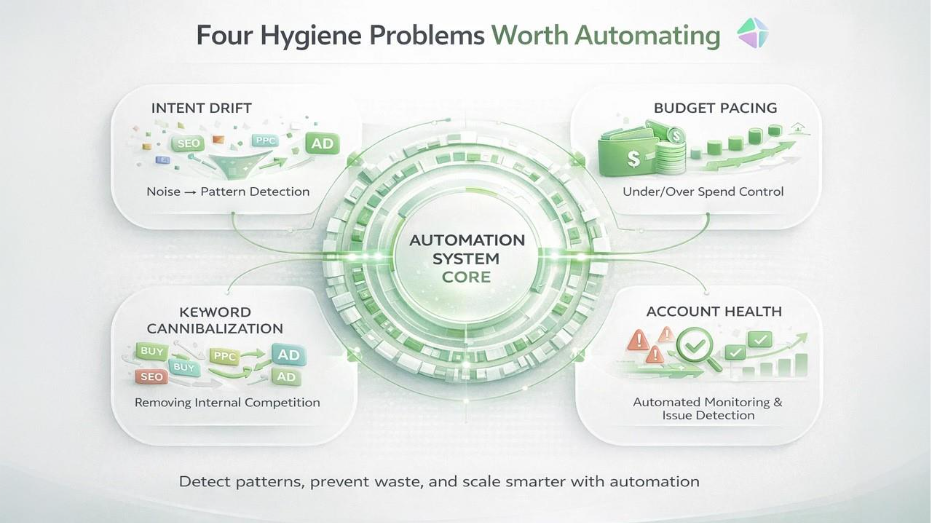
Intent drift in search terms is the quiet budget killer. The signal that “free trial how to tutorial” queries are converting at zero isn’t hard to find, it’s just spread across hundreds of individual rows in a search term report that no one has time to read end to end. Pattern-level monitoring finds it at the account level and flags it for exclusion. Still needs a human call. “Free” is a bad signal in some models and a core intent signal in PLG. The automation identifies the pattern. You decide what to do with it. This is exactly where automating Google Ads hygiene at scale becomes critical, as it allows teams to detect patterns, prevent waste, and act faster than manual reviews ever could.
Budget pacing is where most people focus on overspend and miss the underspend entirely. Running dry on your best campaign at 2pm on a Tuesday is just as expensive as burning budget on a bad keyword. It’s just harder to see.
With EverBee over Black Friday, an 82.63% ROAS improvement came in part from gradual budget increases in the weeks before the sale, not a spike on the day. The algorithm needs time to adjust. Pacing alerts that surface underspending campaigns early enough to reallocate made a direct difference.
And in SaaS, this gets messier because retargeting rarely lives on one platform. Budget decisions on Google affect what Meta and LinkedIn are doing with the same audience. If you haven’t thought through the cross-channel mechanics, this SaaS retargeting guide by platform is worth reading before you build any pacing rules.
Account health monitoring is the most automatable problem on this list and still gets done manually at most companies. Broken destination URLs, 404s after a product page rename, a CPC that jumped 40% because a competitor entered your branded terms, none of that needs a human watching a dashboard. High impressions, zero clicks means something is wrong with the destination. A CPC spike with no volume change means the auction shifted. Both are detectable automatically.
What automation doesn’t catch is what happens after the click. When we dug into Upper Hand’s demo request page, the platform data looked fine. A multi-step form was creating invisible drop-off. Cutting it to five fields produced a 4.6x increase in demo conversions. No script surfaces that. Someone has to actually look.
Keyword cannibalization in large accounts is mostly slow and invisible. Two campaigns bidding on the same terms, you’re essentially competing against yourself and pushing CPCs up for the privilege. A monthly audit mapping every keyword to its campaign and ad group catches it. Some overlap is intentional, so don’t automate the fix, just automate the visibility. Treat the output as a conversation starter, not a to-do list.
Build vs. Buy
The commercial tools, Optmyzr, Adalysis, SA360, cover the 80% case well. If your attribution is clean and your structure is simple, use them.
| Commercial Tools | Custom Automation | |
| Setup time | Low | Medium to high |
| Ongoing cost | $500 to $2,000/month | Near zero |
| Business-specific logic | Limited | Fully flexible |
| Best for | Standard hygiene at scale | Account-specific rules |
The 20% that commercial tools don’t cover is usually the part that matters most for SaaS: trial-to-paid attribution windows, LTV-adjusted CPA thresholds by segment, budget logic tied to pipeline stage rather than calendar month. That’s where custom scripts earn their place. At 10,000+ keywords across regions, commercial platforms also start to slow down. Custom automation runs against your account data directly.
What Actually Changes
When the routine hygiene is handled by systems, something shifts in how the team operates. Not because people are suddenly smarter, but because they’re working on different problems.
Creative testing, landing page iteration, competitive positioning, that work had always been on the list. It just kept getting pushed by search term reports. When the reports run themselves, the list changes.
That’s probably the most underrated argument for automation in paid search, especially when it comes to automating Google Ads to unlock efficiency and strategic growth.
Not the efficiency. The reallocation.