
How Technology Has Improved the Finance Industry
Discover how financial technology is transforming the finance industry with AI, automation, and blockchain to improve efficiency, security, and accessibility.
Technology has improved the finance industry in various ways, changing how individuals and businesses manage, invest, and move money. Financial services have become faster, widely accessible, and more secure, especially with the rise of digital banking and mobile payment platforms.
People can now complete tasks that used to require long queues and much paperwork with just a few clicks. Even on the advisory side, tools like Redtail CRM have made it easier for financial professionals to organize client data, track communications, and stay compliant, all while spending less time on manual admin work. As innovation improves, tech is also playing a huge role in making financial services accessible and empowering more people globally. Read on to discover how tech has improved this industry.
Why Does Financial Technology Matter Today?
Financial technology is no longer just about improving convenience for people. It plays a much bigger role in the global economy in several ways. As the finance industry grows at an exceptional pace, real-time payment systems have replaced traditional options that took much longer. That is because of the following:
- Faster transaction processing
- Improved efficiency
- Reduced reliance on cash
- Global financial connectivity
Due to improvements in this technology, capital can now move at a high speed. Financial technology also cuts the gap for people who do not have access to banking services. Through mobile wallets, people in emerging markets can access the benefits of the finance industry.
Financial technology is also important because it improves security. People lose billions of dollars to fraud, and innovations like agentic artificial intelligence offer real-time defenses that traditional banks may struggle to replicate.
Emerging Technologies Shaping the Finance Industry
Related walkthrough
GuestPostMailer Dashboard Overview | AI-Powered Guest Posting u0026 CRM Automation Tool

The finance industry is being reshaped by technologies that now go beyond simple digitization. It is now shifting toward autonomous systems. AI agents are one of the several core technologies at the forefront of the finance industry.
Several AI models are now executing complex workflows autonomously — a trend explored in depth in the rise of Generative AI in Finance, including real-time fraud mitigation. They also help process loans and automate compliance reports, significantly reducing operational costs.
In the same way, traditional institutions are also moving beyond crypto speculation. These institutions are tokenizing real-world assets, such as bonds and real estate, on blockchain rails to enable instant settlement and fractional ownership.
Quantum computing is also getting into the market. As a result, the finance industry is increasingly using this technology to protect sensitive data from hackers and other digital threats. The result is that finance becomes more proactive.
7 Ways Technology Has Improved the Finance Industry
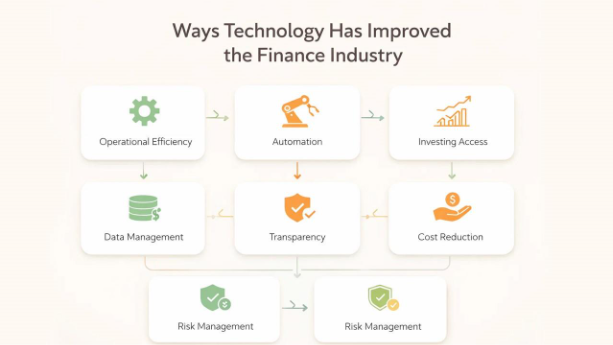
Technology has contributed to great improvements in the finance sector, especially in the management of financial data. It has also affected how transactions are conducted. Here are seven ways tech has changed finance for good:
Better Operational Efficiency
Technology has replaced manual processes with efficient strategies. Several digital tools now handle complex compliance and loan processing in seconds. On the other hand, cloud-based platforms enable smooth, real-time data integration, addressing the lengthy processes that previously delayed transactions. Finance is now faster and more accurate.
Automation
Automation has also improved the entire finance industry by implementing high-speed automation. AI agents can now handle complex data entry and ensure compliance, reducing operational costs. These technologies reduce human error and make finance simpler and leaner.
Broader Investing Opportunities
Tech has lowered barriers to entry for investing and wealth creation. With fractional investing, you can easily buy shares of expensive stocks or real estate. On the other hand, robo advisors provide automated, low-fee portfolio management, once reserved for the rich. When it comes to cryptocurrency, people can easily invest in Litecoin on Kraken or any other cryptocurrencies on other platforms.
Efficient Data Management
Technology has turned data management into a strategic asset through unified platforms. The advantage of cloud-based systems and data mesh is now the ability to process high-level information. AI-based analytics also automate cleaning and integration. All of these enable institutions to anticipate their customers’ needs and address risks quickly.
Financial Transparency
In the finance industry, tech is boosting transparency through blockchain’s immutable ledgers. This feature ensures that every transaction is traceable and tamper-proof. Technologies like AI-driven auditing also support real-time reporting, providing regulators and investors with instant insights that can be easily verified. By shifting from reactive to proactive oversight, the finance industry builds more trust and accountability.
Cost Reduction
Another way tech has improved the finance sector is by reducing overhead costs. This happens when expensive manual labor is replaced with automated processes and AI agents. Several middle-office tasks have been cut to reduce costs significantly. Cloud-based banking also reduces the need for maintenance fees, allowing institutions to help customers save money.
Advanced Risk Management
Due to technological improvements, risk management in the finance sector is no longer just reactive but also predictive. Since machine learning enables the analysis of billions of data points in real time, it becomes easier to identify fraud before it even occurs. Simulations that stress-test financial systems have helped reduce unexpected losses through automated risk assessment.
Endnote
Tech has driven significant improvements in the finance industry. Besides improving operational efficiency, automation, investment opportunities, and data management, it has contributed to financial transparency, cost reduction, and risk management.