
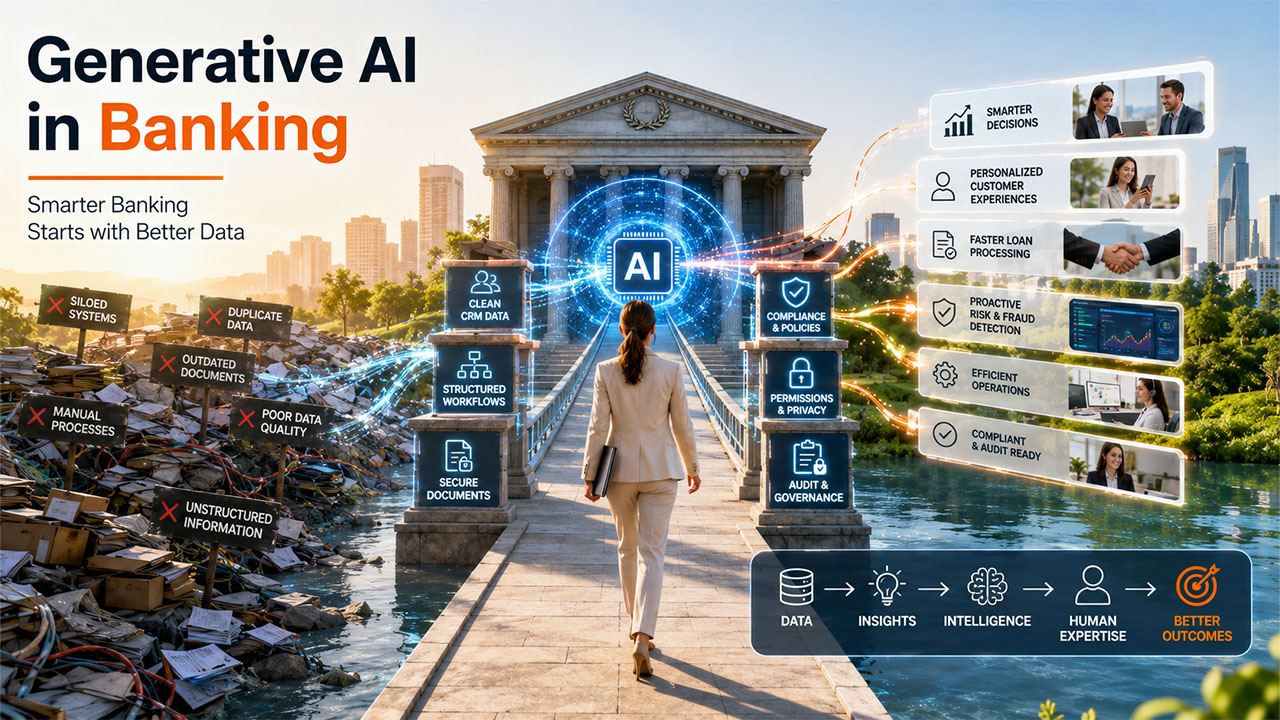
Generative AI in banking starts with cleaner CRM, data, and workflow systems
Explore how generative AI in Banking relies on clean CRM data, secure workflows, and governance to deliver accurate and scalable AI solution.
Banks rarely struggle because they lack technology. They struggle because customer records live in separate systems, service teams work around outdated workflows, compliance reviews depend on manual checks, and operations teams cannot always see the same version of a customer, case, or transaction history. Generative AI can improve parts of that picture, but only if the surrounding systems are ready for more intelligent automation.
For software teams, CRM consultants, and business system developers, generative ai in banking is not just a finance trend. It is a practical software architecture question: can the bank connect clean customer data, permissioned knowledge, audit-ready workflows, and secure AI tools without exposing sensitive information or creating unreliable outputs?
That question matters because banking AI is different from a generic chatbot project. A retail bank, credit union, digital lender, digital banking platform, or fintech platform handles identity data, payment records, loan documents, disputes, risk flags, consent logs, and regulated communications. Any AI layer placed on top of those systems must respect the way financial work is actually done.
Why banking AI depends on the systems beneath it
A generative AI assistant can answer customer questions, draft support replies, summarize call notes, prepare fraud-review narratives, and help staff search internal policy documents. Those use cases sound simple until the model needs accurate data from CRM, core banking, ticketing, document storage, and compliance systems at the same time.
If the CRM record is incomplete, the AI answer may miss recent activity. If policies are stored in old PDFs with no version control, the assistant may cite outdated rules. When support tickets lack a consistent structure, the reliability of summaries suffers. The model may be new, but the quality of the result still depends on ordinary software hygiene.
Banks that want useful AI should begin with the less glamorous work: cleaning customer records, mapping workflows, labeling documents, removing duplicate data, setting permissions, and deciding which systems can feed AI tools safely. Without that foundation, a pilot may look impressive in a demo and fail during daily operations.
CRM data becomes more valuable when AI in banking used safely

CRM systems are often treated as sales or service tools, yet in banking they contain much richer operational context. A single customer record may include onboarding history, product holdings, communication preferences, complaint records, branch interactions, digital support chats, consent choices, and follow-up tasks.
Generative AI can help relationship managers and support teams work faster with that information. It can summarize recent customer history before a call, draft a follow-up email, suggest missing documentation, or help a service agent understand the context of a complaint. The value is practical: less time searching across screens and more time resolving the issue.
The risk is also practical. AI should not expose one customer’s data to another customer, generate advice outside approved policy, or turn sensitive notes into casual text. CRM-based AI needs permission checks, source controls, and human review for actions that affect money, credit, complaints, or compliance.
Banking workflows where AI can help
| Banking workflow | How generative AI can support staff | System requirement |
| Customer support | Summarize case history and draft replies for agent review | Clean CRM records and approved response templates |
| Loan processing | Extract details from documents and prepare review notes | Secure document storage and validation rules |
| Fraud review | Turn transaction patterns into readable investigation summaries | Reliable risk data and audit logs |
| Compliance support | Search internal policies and draft explanations | Version-controlled knowledge base |
| Relationship management | Prepare account summaries before customer meetings | Permissioned customer data and activity history |
| Internal operations | Create task notes, handoff summaries, and process documentation | Structured workflows and role-based access |
Related insight: AI in Finance: Benefits, Uses & Industry Applications
RAG is often safer than open-ended AI
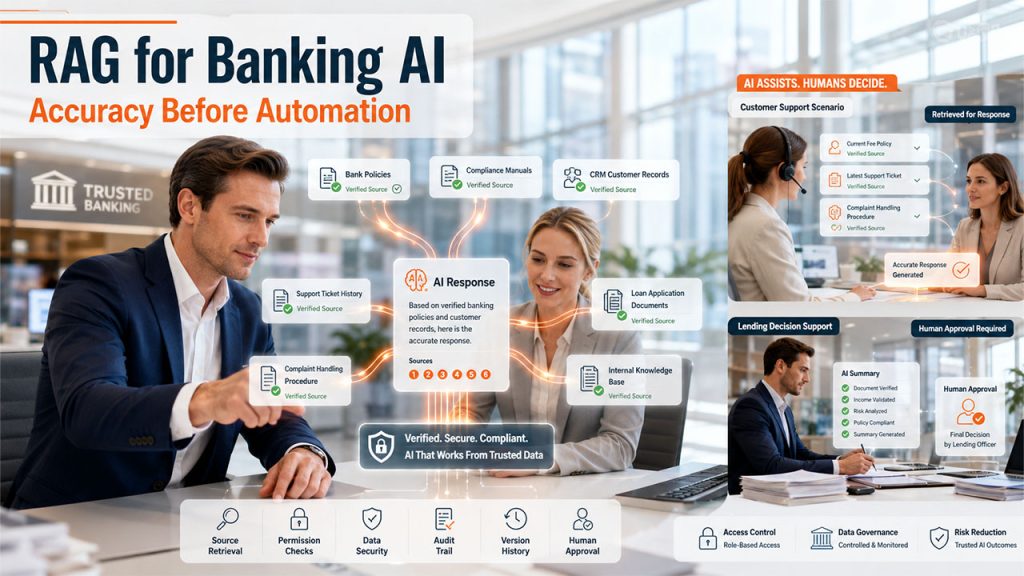
Banks do not need AI tools that invent answers. They need AI tools that can work from approved sources and show where the answer came from. Retrieval-augmented generation, often shortened to RAG, is useful here because it lets a model draw from selected documents, policies, CRM notes, and knowledge bases rather than relying only on its training.
For example, a support assistant can retrieve the current fee policy, the customer’s recent support ticket, and the correct complaint-handling procedure before drafting a response. A compliance user can ask a question about internal policy and receive an answer grounded in the bank’s own documents. A lending team can summarize application documents while keeping the final decision in human hands.
RAG does not remove every risk. Source documents still need owners, version history, access limits, and regular review. If the knowledge base is messy, AI will surface that mess faster. If permissions are wrong, the assistant may retrieve material the user should never see. The architecture has to be designed around banking controls from the start.
Custom software matters more than a generic AI plug-in
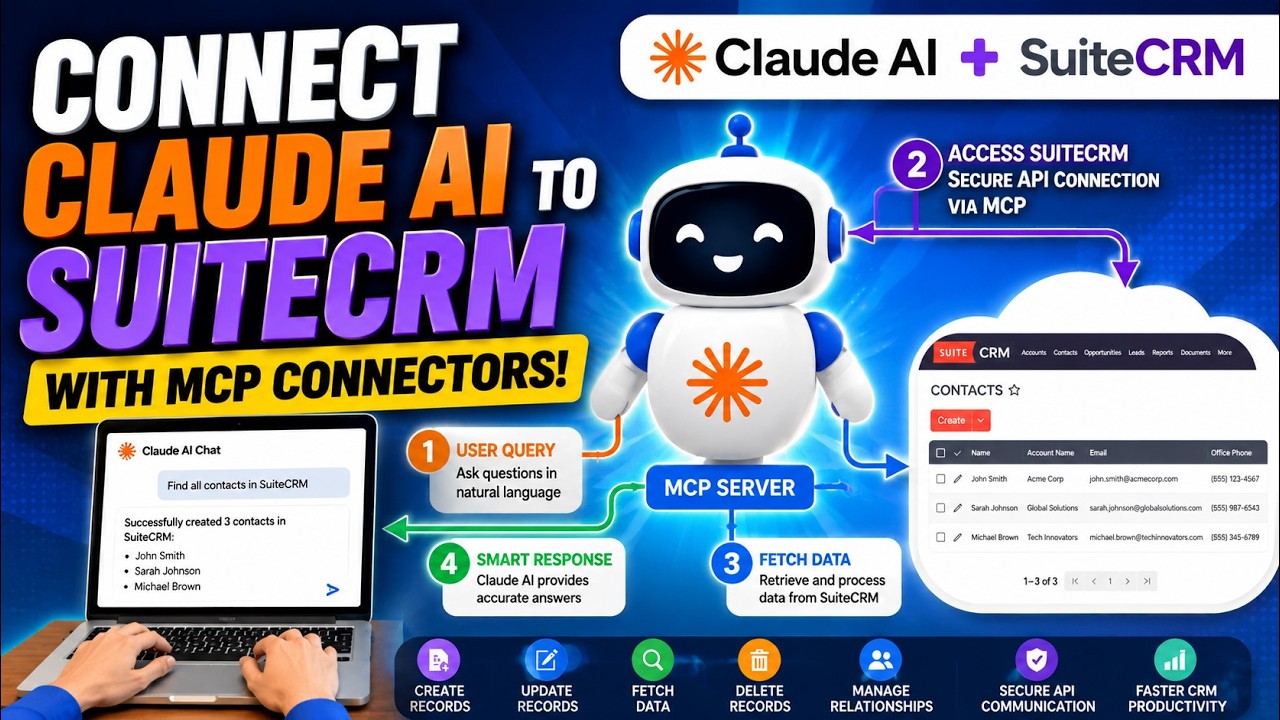
Related walkthrough
SuiteCRM MCP Server Tutorial | Connect Claude AI with SuiteCRM u0026 Automate CRM Workflows
Many banks already use several commercial platforms: CRM, document management, fraud systems, customer-service tools, marketing automation, analytics dashboards, and internal portals. Adding a generic AI widget to one system may help in a narrow area, but it rarely solves the larger workflow problem.
Custom software and integration work can connect AI to the places where banking teams actually spend time. That may mean a CRM extension that summarizes customer interactions, an internal portal that searches policy documents, a compliance dashboard that generates review notes, or an API layer that controls which data AI tools can access.
The strongest banking AI projects are often modest at first. They reduce repetitive work inside a defined workflow, keep humans in control, and create measurable time savings without touching every system at once. A focused tool for complaint summaries may deliver more real value than a broad assistant that tries to answer every banking question.
Governance should be built before rollout
Teams need clear rules before staff begin using AI in banking in production. Without rules, employees may paste customer data into unapproved tools, rely on AI wording without checking it, or use generated summaries in regulated communications without proper review.
A useful governance plan should answer several questions:
- Which banking workflows are approved for AI support?
- Which customer data can be used, and which data is restricted?
- Who reviews AI-generated responses before they reach customers?
- Which documents are approved sources for internal answers?
- How are prompts, outputs, edits, and user actions logged?
- What happens when the AI gives an uncertain or conflicting answer?
Data privacy decides the future of AI in banking
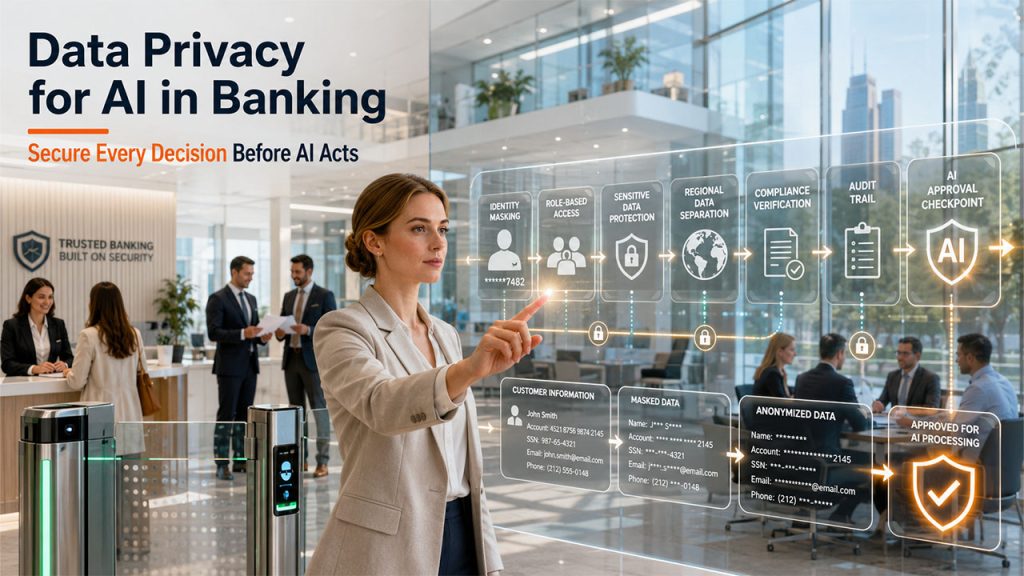
A small AI in banking pilot can run on carefully selected examples. Real banking operations cannot. Once AI touches live customer workflows, privacy becomes a design requirement rather than a legal review at the end.
Banks should separate customer data by role, product, region, and sensitivity. They should mask or remove personal data when the task does not require it. They should keep logs of AI-assisted actions and make sure customer-facing outputs can be traced back to approved sources. Vendor contracts also matter, especially around data retention, model training, subprocessors, and incident response.
The technical side and the legal side need to work together. Developers can build access controls, data filters, and audit trails, but business owners must decide what each user should be allowed to do. Privacy is strongest when it is built into the workflow instead of added after deployment.
A practical roadmap for banks
A bank does not need to automate everything at once. A steady roadmap works better:
- choose one workflow where staff already spend too much time reading, summarizing, or searching;
- clean the data and documents connected to that workflow;
- define what AI may draft, summarize, or suggest;
- keep approval with trained employees;
- log prompts, sources, outputs, and edits;
- measure time saved, error rates, customer impact, and staff feedback;
- expand only after the first workflow proves reliable.
The real value is operational discipline
Generative AI in banking will not succeed because a bank adds a chatbot to its website or lets employees experiment with prompts. It succeeds when the bank connects AI to clean CRM records, reliable workflows, approved documents, secure integrations, and human review.
For software teams and CRM specialists, that creates a clear opportunity. Banks need partners who understand business systems as much as models. They need people who can connect data, permissions, automation, reporting, and compliance systems as much as models. They need people who can connect data, permissions, and automation into tools that staff can use safely during everyday work.