

Why Grid Bots Are Becoming a Go-To Tool for Range-Bound Crypto Markets
Learn how grid bots automate crypto trading in range-bound markets, reduce manual effort, and maximize opportunities with Spot Grid and Futures Grid strategies.
Bitcoin has spent extended periods over the past twelve months inside defined horizontal channels – consolidation phases where price bounced between support and resistance without committing to a direction. Pull up any BTC/USD chart on TradingView and you’ll see it: weeks of choppy sideways grind broken by brief directional moves. For buy-and-hold traders, those flat stretches may provide limited short-term opportunities. For those running grid bots, every oscillation is a completed trade.
That gap in outcomes is pushing more traders toward automated grid strategies.
Buy-and-Hold Falls Flat When Prices Chop
A range-bound market means price bounces between a ceiling and floor without breaking either. Manual scalping works in theory but demands constant screen time, quick execution, and emotional discipline that erodes fast.
Grid bots fix this structurally — automating a “buy low, sell high” strategy within a predefined range by placing buy orders at lower grids and sell orders at higher grids. No sleep needed, no hesitation over a $30 ETH swing at 2 a.m.
How Grid Trading Actually Works
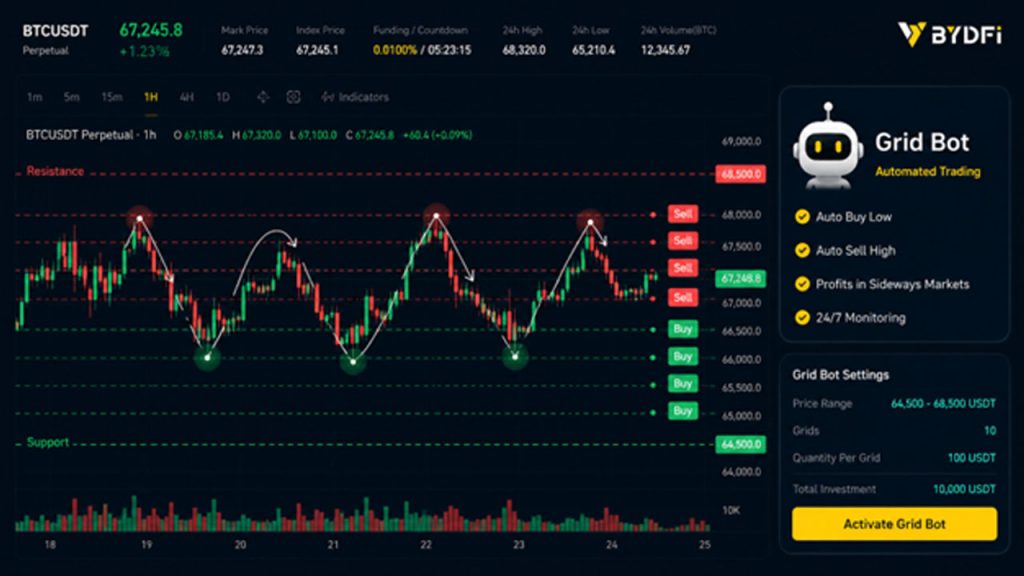
A trader sets two price boundaries — say $2,400 and $2,700 for ETH (hypothetical) — and the bot carves that range into evenly spaced grid levels. Below current price, buy orders wait. Above it, sell orders. As price ping-pongs, the bot runs a continuous cycle of small profitable trades.
BYDFi, a crypto exchange founded in 2020, offers a Spot Grid bot built around this mechanic. BYDFi supports more than 1,000,000 registered users across 190+ countries. In August 2025, BYDFi became the Official Crypto Exchange Partner of Premier League club Newcastle United through a multi-year deal – signaling institutional staying power.
A balanced setup matters: in a strong breakout, the bot may pause until price returns to the configured range. Each grid trade also incurs standard fees, so grid spacing should account for trading costs.
Configuring a Spot Grid: The Parameters That Matter
The Spot Grid supports between 2 and 99 grid subdivisions within a user-defined range. Fewer grids mean larger gaps — each trade earns more, but fewer fire. More grids mean tighter spacing, more frequent trades, smaller profits, and real fee drag. BYDFi’s spot trading fees sit at 0.1% buy / 0.1% sell with no bot surcharge — toward the lower end among major exchanges.
Users can run up to 10 Spot Grid bots simultaneously on the same pair, enabling A/B testing of different configurations. Spot Grid bots support Take Profit and Stop Loss settings for automatic exits if price breaks the expected range. All strategies operate on USDT spot pairs.
The interface loads fast even during high volatility. Crucially, Spot Grid bots operate entirely within the user’s spot balance — no forced liquidation, a meaningful distinction from leveraged alternatives.
Common Configuration Mistakes
Related walkthrough
This Bird-Inspired Robot Can Fly & Swim! The Future of Robotics is Here 🤯

A practical setup depends on balance. Too few grids may overlook smaller price swings, while too many can make trading costs more relevant to net results. A very narrow range can leave the bot idle if price moves beyond the selected boundaries. For traders who’d rather react to price moves directly instead of waiting on a fixed range, the right crypto day trading app can offer the speed and manual control that grid bots trade away for automation. The range itself reflects a view on near-term behavior. Investopedia’s overview of grid trading offers a solid primer for newcomers.
AI-Recommended Parameters: Lowering the Setup Barrier

For traders who’d rather not manually calibrate, the Spot Grid offers AI-recommended parameters based on historical backtesting. There’s also a demo account preloaded with 50,000 USDT for practice. Setting up a demo Spot Grid on the BYDFi app took under two minutes in testing — pair selection to bot activation on mobile.
Beyond Spot Grids: Matching Bot Types to Market Conditions
BYDFi offers automated trading bots including Spot Grid, Futures Grid, and Spot DCA, plus a Bot Marketplace where users browse and one-click copy community-created strategies. BYDFi copy trading extends this concept beyond bots, letting users replicate positions from traders whose track records are visible on the platform.
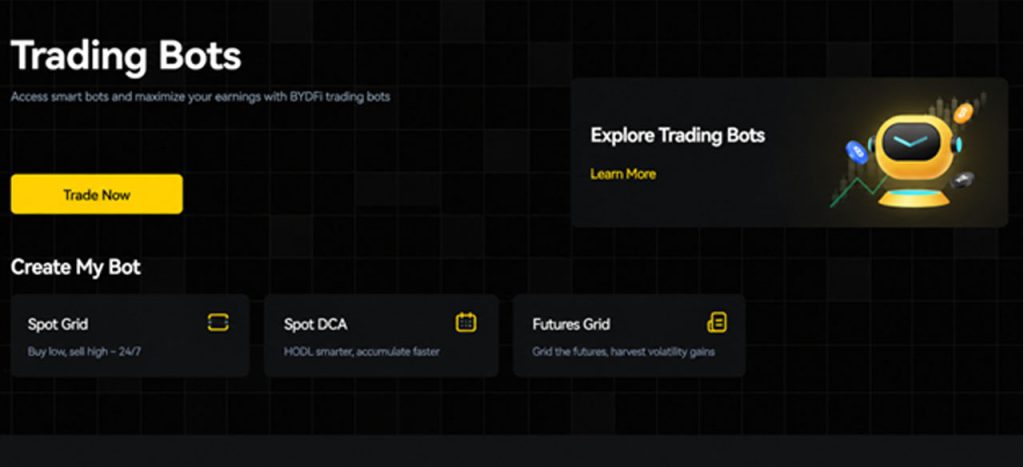
Futures Grid extends grid trading to leveraged perpetual contracts with Stop Loss, Take Profit, and Margin Ratio controls. A Futures Grid bot with an upward-biased range can capture volatility while staying directionally long, with margin monitoring built into the setup. Traders exploring BYDFi leverage options should align parameters with their preferred exposure.
Spot DCA accumulates crypto through periodic fixed-amount purchases at preset intervals, automatically lowering average cost during downtrends.
The Bot Marketplace, launched in 2026, lets users explore strategies across supported bot types, view historical performance, and deploy with one click.
| Market Condition | Suggested Bot Type | Key Consideration |
| Sideways / range-bound | Spot Grid | No liquidation risk |
| Uptrend | Futures Grid (directional bias) | Margin monitoring applies |
| Downtrend | Spot DCA | Scheduled accumulation |
| Any condition | Bot Marketplace | Copy community strategies |
There’s a new user welcome package worth up to 8,100 USDT. BYDFi holds multi-jurisdictional licenses and publishes Hacken-audited Proof of Reserves.
Closing the Range
Bitcoin has spent extended periods in horizontal channels. Those flat stretches aren’t dead zones – they’re structured opportunities for automated range-bound crypto strategies. A practical workflow: identify a pair trading within a defined range on TradingView, test parameters on a demo account, and start with a conservative grid count. Traders ready to move beyond demo can explore grid bot trading on BYDFi to deploy live Spot Grid or Futures Grid strategies. Grid bots are designed for specific market conditions, and for sideways markets they offer a structured, automated approach that passive holding can’t match.
Frequently Asked Questions
Q1. How do grid bots for range-bound markets differ from manual trading?
Grid bots automate the buy-low-sell-high cycle across preset price levels around the clock, capturing micro-swings that manual traders often miss due to timing or fatigue.
Q2. Can I run multiple grid bots on the same crypto pair?
Yes. The Spot Grid feature allows up to 10 bots simultaneously on a single pair for testing different configurations in parallel.
Q3. Is there a liquidation risk with Spot Grid bots?
No. Spot Grid bots operate within the user’s spot balance with no forced liquidation. Futures Grid bots use leveraged perpetual contracts, so margin settings and position monitoring are part of the setup.
Q4. What fees apply to grid bot trades?
Standard BYDFi spot trading fees of 0.1% buy / 0.1% sell apply per grid fill. No additional bot surcharge is added.
Q5. Do I need to design grid parameters myself?
Not necessarily. AI-recommended parameters based on historical backtesting are available. A demo account with 50,000 USDT is also available for practice.
Article rating
Was this article useful?
0.0 out of 5 from 0 ratings