

Why Enterprise Analytics Projects Fail? Exploring Top Reasons
Learn why enterprise analytics projects fail and how to ensure success with proper planning, data, and strategy.
A Fortune 500 company invests $10 million in cutting-edge analytics, assembles data science teams, and launches with fanfare—only to abandon the project 18 months later with minimal results. This scenario repeats across boardrooms worldwide, turning promising enterprise analytics initiatives into costly failures.
Enterprise analytics projects transform raw data into actionable insights that drive strategic decisions and create competitive advantages. Yet according to Gartner research, 85% of big data projects fail to deliver intended outcomes, while 87% of data science projects never reach production. These statistics reveal a troubling reality: despite massive investments, most enterprise data analytics initiatives fail to meet expectations.
When these projects fail, organizations face financial losses, missed opportunities, reduced market responsiveness, and diminished confidence in data-driven strategies. The stakes are too high to ignore these failure patterns.
Why Enterprise Analytics Projects Fail? Top Reasons
Reason 1: Poor Data Foundation and Architecture
The foundation of any successful enterprise data analytics initiative lies in robust data architecture and quality management. Many organizations rush into analytics projects without establishing proper data foundations, leading to inevitable failure when systems cannot deliver reliable insights from inconsistent, incomplete, or poorly structured data sources.
Data quality issues plague analytics projects from the start when organizations attempt to analyze information that contains errors, duplicates, missing values, or inconsistent formats across different systems. These problems compound quickly, as analytics models built on flawed data produce unreliable results that undermine confidence in the entire initiative.
Architecture challenges emerge when organizations lack proper data integration capabilities, scalable storage solutions, and efficient processing frameworks. Without adequate infrastructure to handle volume, velocity, and variety of enterprise data, analytics platforms struggle to perform effectively, resulting in slow queries, system crashes, and frustrated users who abandon the tools.
Professional data warehouse consulting services play a crucial role in addressing these foundational issues by designing scalable architectures, implementing data governance frameworks, and establishing quality management processes. These experts help organizations avoid common pitfalls by ensuring that data infrastructure can support current analytical needs while scaling for future requirements.
The integration complexity multiplies when organizations attempt to connect disparate systems, legacy databases, and cloud platforms without proper planning. Data silos remain isolated, preventing comprehensive analysis across business functions and limiting the insights that analytics teams can generate from their models and visualizations.
Reason 2: Insufficient Strategic Planning and Requirements Gathering

Many enterprise analytics projects fail because organizations jump into implementation without clearly defining objectives, success metrics, or business requirements. This lack of strategic foundation creates confusion about project goals, leads to scope creep, and results in solutions that don’t address actual business needs.
Requirements gathering challenges arise when stakeholders cannot articulate their analytical needs, express unrealistic expectations about what data can reveal, or fail to prioritize which insights matter most for business outcomes. Without clear requirements, development teams build generic solutions that satisfy no one and solve no specific problems.
Strategic misalignment occurs when analytics projects operate independently from business strategy, resulting in technically sound solutions that generate insights nobody uses. Organizations often focus on implementing impressive technology rather than solving specific business challenges, leading to analytics platforms that become expensive curiosities rather than essential business tools.
Change management planning gets overlooked during project initiation, leaving organizations unprepared for the cultural and operational shifts required to become data-driven. When users don’t understand how analytics fits into their workflows or why they should adopt new tools, even well-designed systems fail to achieve adoption goals.
The following strategic planning elements are essential for project success:
- Clear business objectives tied to measurable outcomes and financial impact
- Stakeholder alignment on priorities, timelines, and success criteria
- User adoption strategy including training, support, and change management
- Scalability roadmap for expanding analytics capabilities over time
- Governance framework defining data access, security, and compliance requirements
Reason 3: Technical Implementation Challenges
Technical implementation failures represent another major category of enterprise analytics project problems, particularly when organizations underestimate the complexity of integrating advanced analytics capabilities with existing systems and processes. These challenges often stem from poor technology choices, inadequate testing, and insufficient technical expertise during critical development phases.
Platform selection mistakes occur when organizations choose analytics tools based on vendor presentations rather than actual business requirements and technical constraints. Mismatched platforms create integration nightmares, performance bottlenecks, and user experience problems that prevent successful adoption and value realization.
Integration complexity increases exponentially when analytics platforms must connect with multiple source systems, each with different data formats, security protocols, and update schedules. Poor integration planning results in data delays, synchronization issues, and incomplete information that undermines analytical accuracy and timeliness.
Performance optimization gets neglected during development, leading to slow query responses, system timeouts, and frustrated users who abandon analytics tools. When systems cannot handle realistic data volumes or concurrent user loads, the entire investment becomes questionable regardless of analytical sophistication.
Security and compliance considerations often receive insufficient attention during implementation, creating vulnerabilities that expose sensitive data or violate regulatory requirements. These oversights can result in project shutdowns, legal issues, and damage to organizational reputation that extends far beyond the analytics initiative itself.
Reason 4: Organizational and Change Management Issues
Cultural resistance represents one of the most significant barriers to enterprise analytics success, as organizations struggle to shift from intuition-based decision-making to data-driven approaches. This resistance manifests through various behaviors, including skepticism about analytical insights, preference for traditional reporting methods, and reluctance to change established workflows.
Leadership support failures occur when executives champion analytics projects initially but fail to demonstrate ongoing commitment through resource allocation, policy changes, and personal adoption of data-driven decision-making. Without visible leadership engagement, middle management and front-line employees quickly revert to familiar practices.
Training and education gaps prevent users from effectively utilizing analytics platforms, leading to low adoption rates and poor return on investment. Organizations often underestimate the time and resources required to develop analytical literacy across different user groups with varying technical backgrounds and responsibilities.
Communication breakdown between technical teams and business users creates misunderstandings about system capabilities, realistic timelines, and expected outcomes. Poor communication leads to unrealistic expectations, frustration with system limitations, and eventual abandonment of analytics initiatives.
Workflow integration challenges arise when analytics tools don’t fit naturally into existing business processes, forcing users to adopt parallel systems that create additional work rather than streamlining operations. This integration failure makes analytics feel like a burden rather than a productivity enhancement.
Reason 5: Resource and Expertise Gaps
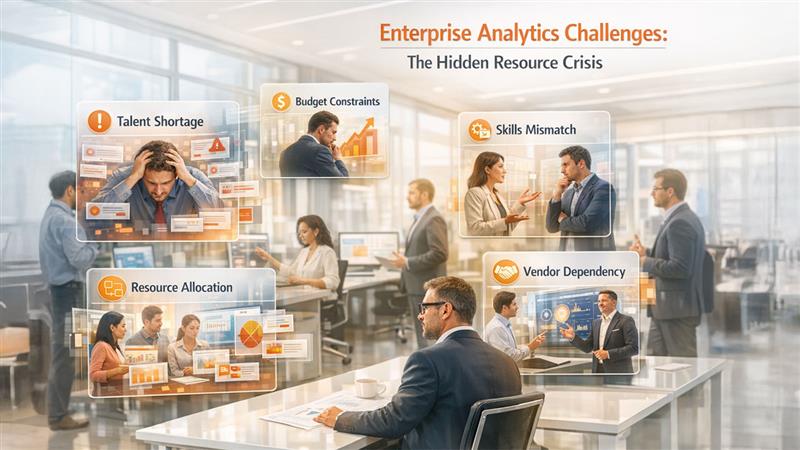
Talent shortages plague enterprise analytics projects as organizations struggle to find qualified data scientists, analysts, and engineers who can design, implement, and maintain sophisticated analytical systems. The competition for skilled professionals drives up costs and extends project timelines while creating knowledge gaps that undermine project success.
Budget constraints often emerge after projects begin, particularly when organizations underestimate the total cost of ownership for enterprise analytics initiatives. Hidden costs include data preparation, system integration, ongoing maintenance, training, and infrastructure scaling that weren’t included in initial project budgets.
Skills mismatch occurs when organizations hire technical talent without ensuring they understand the business context, or business analysts without adequate technical capabilities to work effectively with advanced analytics platforms. This mismatch creates communication barriers and limits the practical value of analytical insights.
Vendor dependency risks increase when organizations rely heavily on external consultants or software vendors without developing internal capabilities to maintain and evolve analytics systems. This dependency creates ongoing costs, limits customization options, and reduces organizational learning that should result from analytics investments.
Resource allocation problems arise when organizations spread analytics talent too thin across multiple initiatives, preventing teams from achieving depth in any particular area. This fragmentation reduces the likelihood of breakthrough insights and limits the cumulative learning that drives analytical maturity.
Read also: Risks and Challenges of Data Analytics Outsourcing and How to Overcome Them
How to Avoid These Failures
Related walkthrough
GPT-6 Can Build a 3D Rocket Using ONLY Your Voice

Expert Guidance and Proven Methodologies
Successful implementations require following proven methodologies that address both technical and organizational challenges. Expert guidance helps navigate complex decisions while risk mitigation strategies prevent common problems before they derail initiatives.
Quality assurance processes ensure analytics solutions meet performance and accuracy standards, while comprehensive testing prevents user frustration and project abandonment.
Benefits of Professional Partnerships
Professional partnerships provide specialized skills that most organizations cannot develop internally within reasonable timeframes. This enables faster implementation, higher quality results, and reduced risk through proven approaches rather than trial-and-error development.
Ongoing support relationships help organizations evolve analytics capabilities after implementation, ensuring systems remain current with changing business needs and technological advances.
Key Success Factors
Essential Implementation Elements:
- Executive sponsorship with visible commitment
- Cross-functional collaboration between technical and business teams
- Phased implementation with clear milestones
- Continuous improvement based on user feedback
- Investment in training and organizational change management
Learning from Failure to Build Success
The five main failure reasons—poor data foundation, insufficient planning, technical challenges, organizational resistance, and expertise gaps—represent predictable and preventable problems. Understanding these patterns enables organizations to approach enterprise analytics with realistic expectations and proper preparation.
While enterprise analytics projects are inherently complex, failure isn’t inevitable. Success depends on organizational readiness, strategic alignment, and systematic change management alongside technical implementation. Organizations that invest in comprehensive approaches, expert guidance, and proven methodologies can achieve the transformative benefits that enterprise data analytics promises.
Rather than becoming another failure statistic, organizations can join the minority that successfully harnesses data for a competitive advantage through proper preparation and systematic execution.