



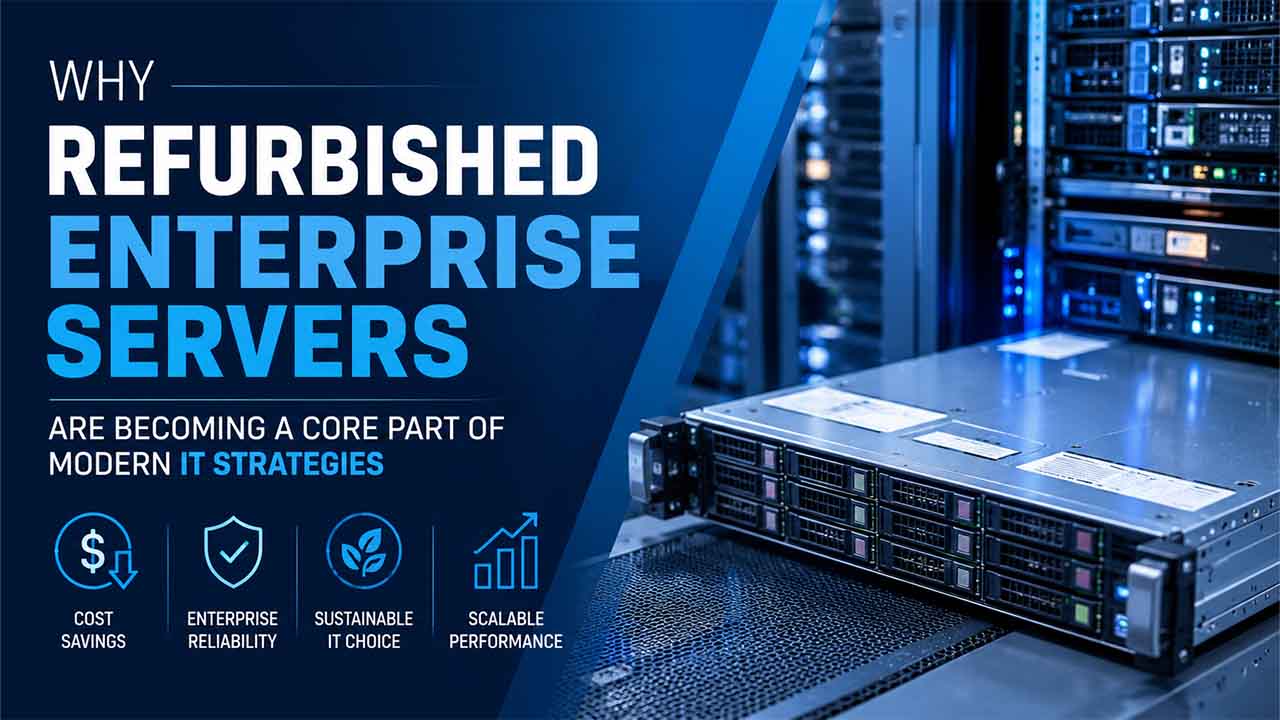

Nobody retires their car the moment the warranty expires. So why are we doing that with Refurbished Enterprise Servers? Seriously. A server built in 2019, running an HPE or Dell
Nobody retires their car the moment the warranty expires. So why are we doing that with Refurbished Enterprise Servers?
Seriously. A server built in 2019, running an HPE or Dell architecture, wasn't designed to be shelved in 2024. It was built to handle enterprise workloads for well over a decade.
Yet IT refresh cycles keep treating five years as a hard expiration date, and many organizations are quietly wasting serious money because of it.
That's starting to change, though. And the organizations leading that change aren't the ones who can't afford new hardware. That's the part worth paying attention to.
IT Strategy Doesn't Look the Same Anymore
Cloud adoption shifted everything, but not quite in the direction the original pitch promised. Full migration was supposed to be the end state.
For most organizations, IT now operates in a hybrid cloud infrastructure model where some workloads move to the cloud while others remain on-premises.
Data residency requirements, latency-sensitive applications, compliance controls that are cleaner on-prem than in shared cloud environments, these aren't edge cases.
They're common. And they mean on-premises infrastructure isn't a legacy problem waiting to be eliminated. It's a permanent fixture that needs to be managed well.
That's where enterprise hardware lifecycle management became an actual discipline rather than just a line item someone reviewed once a year. Organizations started asking harder questions about what they were buying, when, and why.
Refurbished Enterprise Servers started getting real consideration, not because budgets were tight but because the answers to those questions kept pointing in their direction.
The Numbers Behind IT Cost Optimization
Refurbished Enterprise Servers and related enterprise hardware typically run 40 to 70 percent cheaper than equivalent new units. If that sounds like a rough estimate, it is, because it varies by generation and vendor. But even at the conservative end of that range, it's a meaningful difference.
Think about what that frees up. Cloud service fees aren't dropping. Software licensing costs one direction. Security spend is genuinely non-negotiable in 2026.
When capital expenditure on hardware competes with all of that for the budget, buying refurbished for the right workloads isn't compromising. It's just allocating intelligently.
And the enterprise server ROI picture gets more interesting when you look at workload type specifically. Virtualization environments, backup and recovery systems, and internal databases, none of these need the latest silicon generation.
They need a solid, reliable computer running without interruption for a long period. For those use cases, proven refurbished hardware beats new hardware on total cost of ownership. Full stop.
Scaling Compute Without Constant Capital Spikes
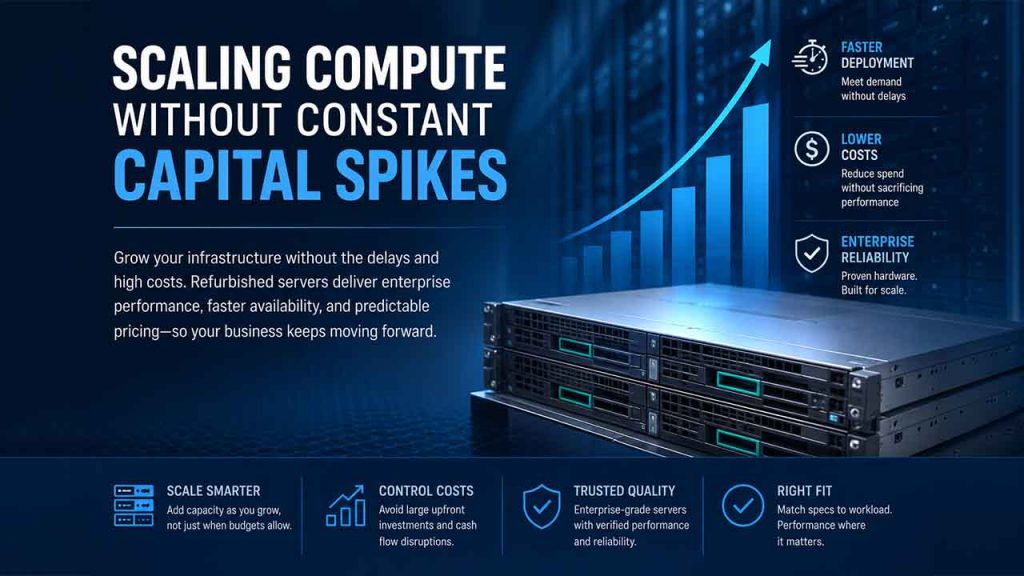
Growing organizations hit a specific frustration repeatedly. Infrastructure needs expand faster than procurement timelines move.
You need more capacity; the operational need is real and present, but the approval cycle for new hardware doesn't operate on the same schedule as the problem you're trying to solve.
Refurbished servers help here because availability is faster, and per-unit cost is lower. Organizations building out scalable infrastructure while managing growth efficiently regularly choose HPE refurbished servers for exactly this reason.
The performance history is documented, the hardware is proven at enterprise scale, and the cost structure makes rapid expansion realistic without blowing the annual budget in one quarter.
That said, workload matching still matters. Buying refurbished without evaluating spec requirements against actual demand is just buying cheap. Different thing entirely.
Sustainable IT Is Real Now, Not Just Messaging
A few years ago, green IT language lived in sustainability reports and almost nowhere else in actual procurement conversations. That's genuinely shifted. Hardware disposal is visible, it's quantifiable, and stakeholders are asking about it in ways they weren't before.
Refurbished servers keep functional equipment running longer and out of the waste stream. For organizations with real ESG commitments, hardware reuse is one of the more direct and measurable ways to back those commitments with actual purchasing behavior.
What makes this interesting is that the environmental argument and the financial argument point in the same direction. That doesn't happen often enough to ignore.
Hybrid Infrastructure and Where Refurbished Fits?
Modern enterprises aren't choosing between cloud and on-prem anymore. They're running both and figuring out which workloads belong where.
Local processing requirements, compliance controls, and latency constraints; these keep on-premises hardware relevant even inside aggressively cloud-forward organizations and highlight the need for an intelligent network architecture that can efficiently connect cloud and on-prem environments.
The Dell PowerEdge R760 is a capable example of a platform that holds up well in that hybrid picture.
High-performance computing tasks, dense virtualization workloads, and edge processing scenarios it handles these without demanding the budget that new hardware procurement requires. Refurbished hardware complements cloud-first strategies. It doesn't contradict them.
Managing the Hardware Lifecycle Properly
Unplanned hardware refreshes are expensive. Emergency procurement is expensive. Defaulting to new hardware for workloads that have been refurbished would serve just as well, but it is expensive in a quieter, less visible way.
Planning refresh cycles deliberately, mixing new and refurbished systems based on workload criticality rather than habit, consistently produces better outcomes.
For storage-heavy and data-intensive environments specifically, the Dell PowerEdge R740XD continues to perform against enterprise virtualization and high-performance computing demands at pricing that makes thoughtful deployment genuinely practical.
Vendor quality is the variable that makes or breaks this. Refurbished hardware from vendors with serious testing protocols and actual warranty support is a completely different purchase than refurbished hardware from someone offloading old stock. That due diligence isn't optional.
Where does this all land?
Refurbished Enterprise Servers have become a core part of modern IT strategies because the underlying logic earned their place.
Cost efficiency, scalable infrastructure, sustainability, performance for appropriate workloads, these factors converge in a way that makes the decision straightforward for organizations willing to evaluate hardware on fit rather than habit.
This stopped being a budget story a while ago. It's just smart data center optimization now.
Respond to this article with emojis