
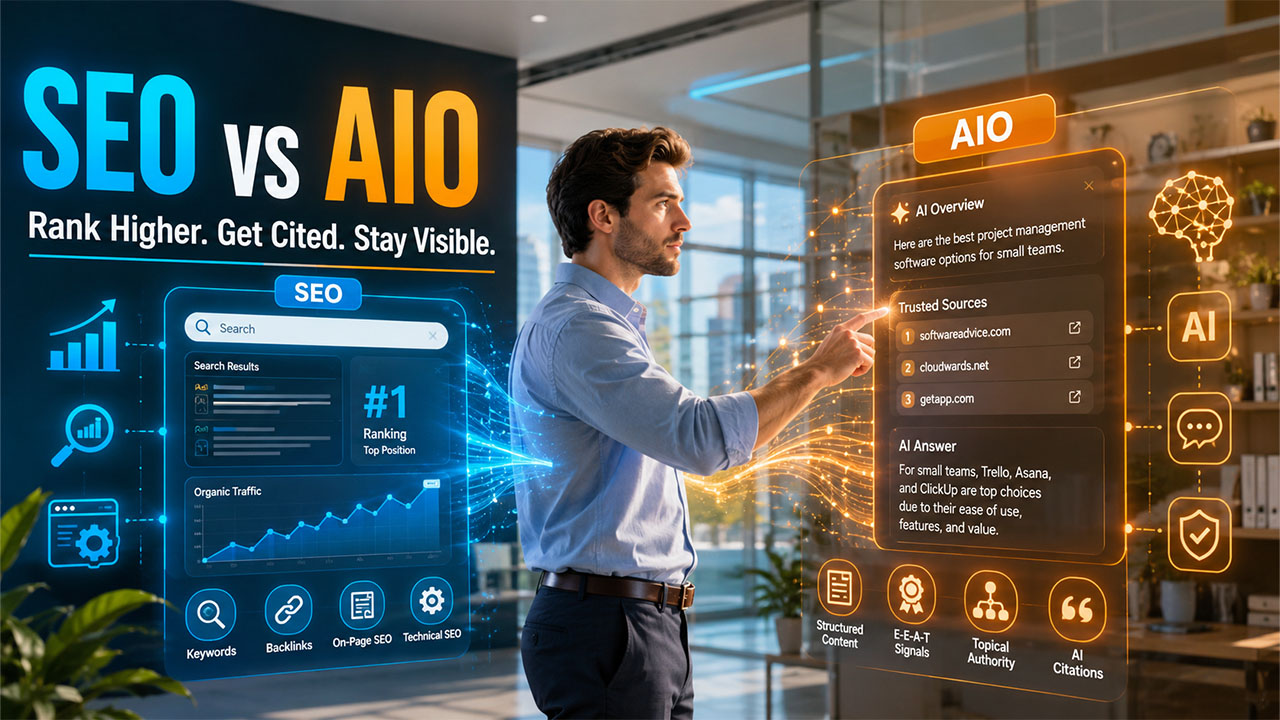
SEO vs AIO: Key Differences, Benefits & Strategies for 2026
Learn the key differences between SEO vs AIO, how AI-powered search is changing digital marketing, and how to optimize content for both search engines and AI systems.
Earlier, ranking on Google meant finding the right keywords, building backlinks, optimizing your meta tags, and consistently publishing content. For years, it worked really well. Then, AI entered the search experience, and everything changed. Google started showing answers directly at the top of the page. ChatGPT began redirecting people to sources that it trusted. Perplexity started synthesizing answers without sending users anywhere at all. Suddenly, the old ways felt incomplete.
That’s the tension sitting at the heart of the SEO vs AIO conversation. And it is worth understanding thoroughly if you’re a marketer, a business owner, or a content strategist.
What Is SEO (Search Engine Optimization)?
SEO (Search Engine Optimization) refers to the practice of improving the ranking of your website and optimizing your content. This is done to make search engines like Google rank your content higher in organic search results. SEO strategies involve keyword research, link building, on-page optimization, technical improvements to websites, and content strategy. Businesses, SEO professionals, marketers, or content strategists do all this to make content easy, so that search engines can find, crawl, and rank it better.
The ultimate goal is visibility. It means your content must show up when someone searches for something relevant to your business. In return, you earn traffic, user, and search engine trust, and eventually, conversions.
What Is AIO (AI Search Optimization)
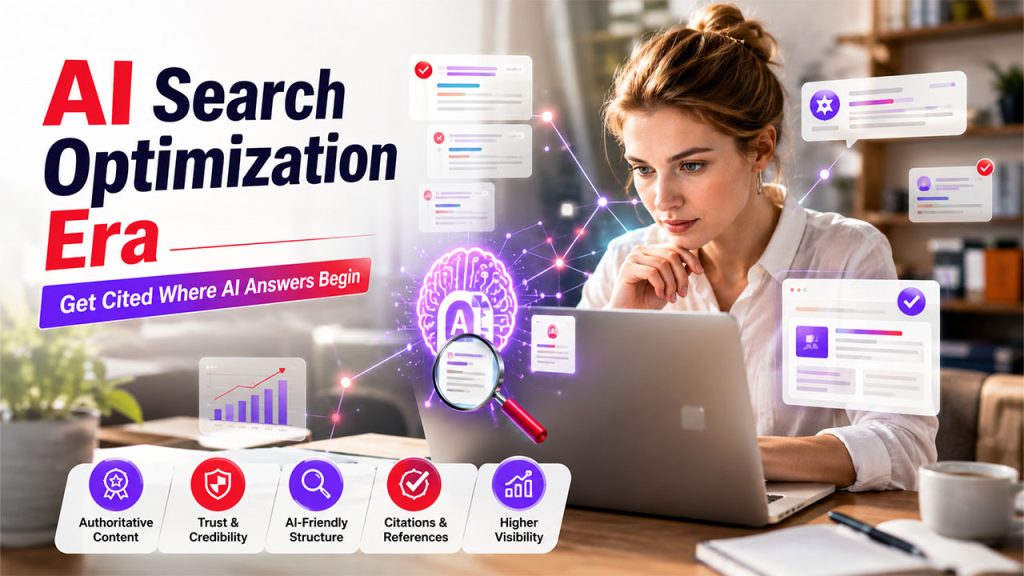
AIO stands for AI Search Optimization. It’s the practice of optimizing your content specifically to be discovered, understood, and cited by AI-powered search systems such as Google’s AI Overviews, ChatGPT, Perplexity, and other large language model-based tools that generate direct answers rather than just listing links.
AIO speaks to AI systems that read content from a reader’s perspective who’s looking for content that is clear, authoritative, and trustworthy. The goal is more than just to rank. It is to become a reliable source that AI systems actively surface when someone asks something.
SEO vs AIO: Key Differences Explained
They both share the common ground, but they differ in focus, methods, and success metrics. Let’s discuss:
| Factor | SEO | AIO |
|---|---|---|
| Primary Audience | Search engine crawlers and algorithms | AI systems and language models |
| Main Goal | Rank higher in search results pages | Get cited or referenced by AI-generated answers |
| Content Focus | Keyword relevance and search intent | Clarity, authority, and contextual depth |
| Key Metrics | Rankings, organic traffic, click-through rate | AI citation frequency, brand mentions, visibility in AI answers |
| Optimization Tools | Keyword tools, backlink analysis, technical audits | Structured data, E-E-A-T signals, conversational content |
| Search Format | Traditional SERP with blue links | AI Overviews, zero-click answers, generative responses |
| Content Style | Optimized for keywords and structure | Optimized for natural language and topical authority |
To understand more clearly: SEO helps people find you with the help of search engines, whereas AIO helps AI systems to understand and recommend you to people.
SEO vs AIO: A Real-World Example
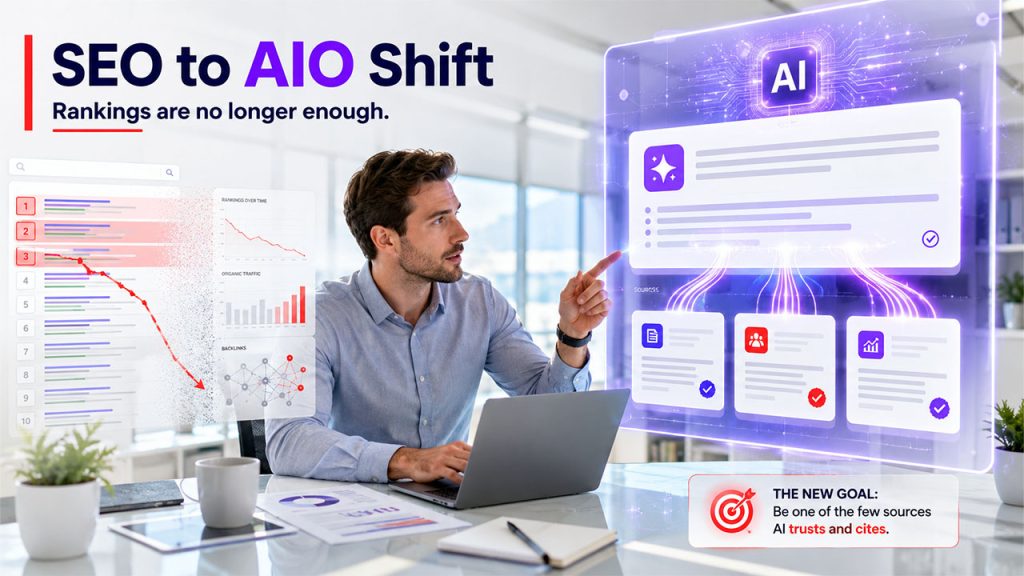
Suppose someone is searching for “best project management software for small teams”.
Using traditional SEO strategies, your aim is to make your website rank on page one of Google for that particular query. To do that, you’d research primary and LSI keywords, optimize a comparison article around it, build internal links, earn a few backlinks, and finally, leave everything to Google to place you in the top five results. If your page ranks higher and earns a few clicks, you’d consider that a success.
However, the dynamic is different with AIO. When a user types that same question in ChatGPT or Google’s AI Overview, he gets a synthesized answer without having to scroll down the page or click through ten links. That answer references two or three credible and authoritative sources. Your goal has shifted. It is now one of those sources. And you can achieve this by avoiding outdated SEO practices like keyword stuffing and making your content genuinely informative, well-structured, and useful enough that AI trusts it and considers it a reliable reference.
Same topic, same question, but completely different strategy for how you show up in search results.
SEO vs AIO: Where Do They Overlap?
Related walkthrough
15 SEO Mistakes Killing Your Google Rankings in 2026

SEO and AIO are not as different as they seem. In fact, the foundation of good SEO is also the foundation of good AIO. They may be different in execution, but they both function on one central principle, which is that the content should serve the reader and perform well everywhere.
A few key areas where they meet are discussed below:
High-Quality, Well-Structured Content: It matters for both. Search engines and AI systems both reward depth and clarity. If your content is thin, vague, or stuffed with keywords, neither will favor it as it won’t serve any purpose to readers.
E-E-A-T: Experience, Expertise, Authoritativeness, and Trustworthiness is a ranking signal for Google SEO and a trust signal for AI systems. It is considered a good practice to demonstrate your real expertise through content that is well-sourced and accurate.
Search Intent: Whether a human is clicking a link or an AI is synthesizing an answer, the underlying question is the same. Both SEO and AIO aim to understand what someone is actually looking for and answer it completely in the best possible way.
Technical SEO & AI Discoverability: Technical SEO matters too. If your page loads fast, site structure is clean, schema markup is thorough, and is optimized for mobile responsiveness, then it will be easier for search engines to crawl your site and AI systems to parse your content accurately.
How to Implement SEO Strategies for Better Search Rankings

Even when they share the same content, they have different priorities in practice.
For SEO Implementation:
- To understand what your audience is looking for, conduct thorough keyword research using keyword research tools such as Ahrefs or SEMrush. Then, optimize your page titles, headers, and meta descriptions around those terms.
- Next, build topical authority by covering related subjects or topics comprehensively rather than publishing isolated articles.
- To increase your DR, earn quality backlinks from credible and reputable websites through guest posting and link exchange.
- Work on technical SEO by fixing issues such as slow load times, broken links, or crawl errors, as they prevent search engines from indexing your site properly.
- Use tools such as Google Search Console or Sitechecker to constantly monitor your rankings and organic traffic. Use those insights to adjust your strategies.
For AIO Implementation:
In this, the focus is on how AI systems evaluate and trust content.
- Write in a clear, simple, and easy-to-understand language that directly answers questions without beating around the bush. Remove unnecessary words that increase cognitive load.
- Structure your content in short descriptive paragraphs, headers, and logical flow that makes sense. You can use schema markup and structured data to give additional context to AI systems about what your content is about.
- Build credibility of your brand through consistent publishing, author bylines, citations, and external link building. Make sure your content represents your expertise so that AI systems can recognize you in that niche.
- Focus more on conversational queries such as long-tail, question-based searches that reflect how people actually think and talk to AI tools. AI systems can accurately detect content that lacks genuine depth and only scratches the surface.
SEO vs AIO: Which Strategy Is Best for Your Business?
This is a good question; however, the better question is, where is your audience finding answers right now, and where will they be finding them a year from now?
SEO remains important for your business if your audience is still using traditional search to look for answers to their questions and discover content. It drives organic traffic that can be measured, tracked and has a proven return over time.
But if your audience is increasingly using AI tools like ChatGPT, Perplexity, and Google’s AI Overviews to get answers without wanting to dig through multiple websites, then ignoring AIO could make your website become invisible to a growing segment of your market.
For most businesses today, the answer is both. However, the proportions depend on your industry, audience behavior, and how quickly AI search adoption is moving in your space. A B2B technology company whose buyers are early AI adopters needs to invest in AIO now. A local services business whose customers search on Google Maps and traditional SERP still needs solid SEO fundamentals first.
The point is not to pick any one of them. It is important to understand what is changing and adapt to those changes by adjusting your strategies accordingly. Additionally, make sure that your content is built to perform in both environments.
Conclusion
The SEO vs AIO debate isn’t about one replacing the other. SEO isn’t dead. However, it is evolving, and AI-powered search has just added an extra layer that marketers, SEO professionals, or content creators can’t afford to ignore. AIO is not a replacement for SEO; rather, it is an extension of it. The same elements, such as quality, accuracy, clarity, and genuine usefulness, that make content rank well in traditional search are also what make it trustworthy enough for AI systems to reference. The fundamentals remain the same; only the landscape has changed.
Build content that’s clear, credible, and genuinely helpful. Optimize it for both search engines and AI systems. And keep adapting to changes because the way people find information is still mid-shift, and the marketers who understand both sides of that shift will have a meaningful edge.
FAQs About SEO vs AIO
Q. What does AIO stand for in digital marketing?
A. AIO stands for AI search optimization. It is the practice of optimizing content so that AI-powered search tools can find, understand, and cite it.
Q. Is SEO still relevant in the age of AI search?
A. Yes. SEO fundamentals remain important, but they must now work alongside AIO strategies to maintain full digital visibility.
Q. How do AI systems like ChatGPT decide which sources to reference?
They prioritize content that is clear, accurate, authoritative, well-structured, and backed by strong trust signals like E-E-A-T.
Q. What is the biggest difference between SEO and AIO?
A. SEO targets search engine ranking algorithms; AIO targets AI systems that generate direct answers and cite trusted sources.
Q. Can small businesses implement AIO without a large budget?
Yes. Focusing on clear writing, structured content, accurate information, and consistent publishing goes a long way toward AIO readiness without high cost.