
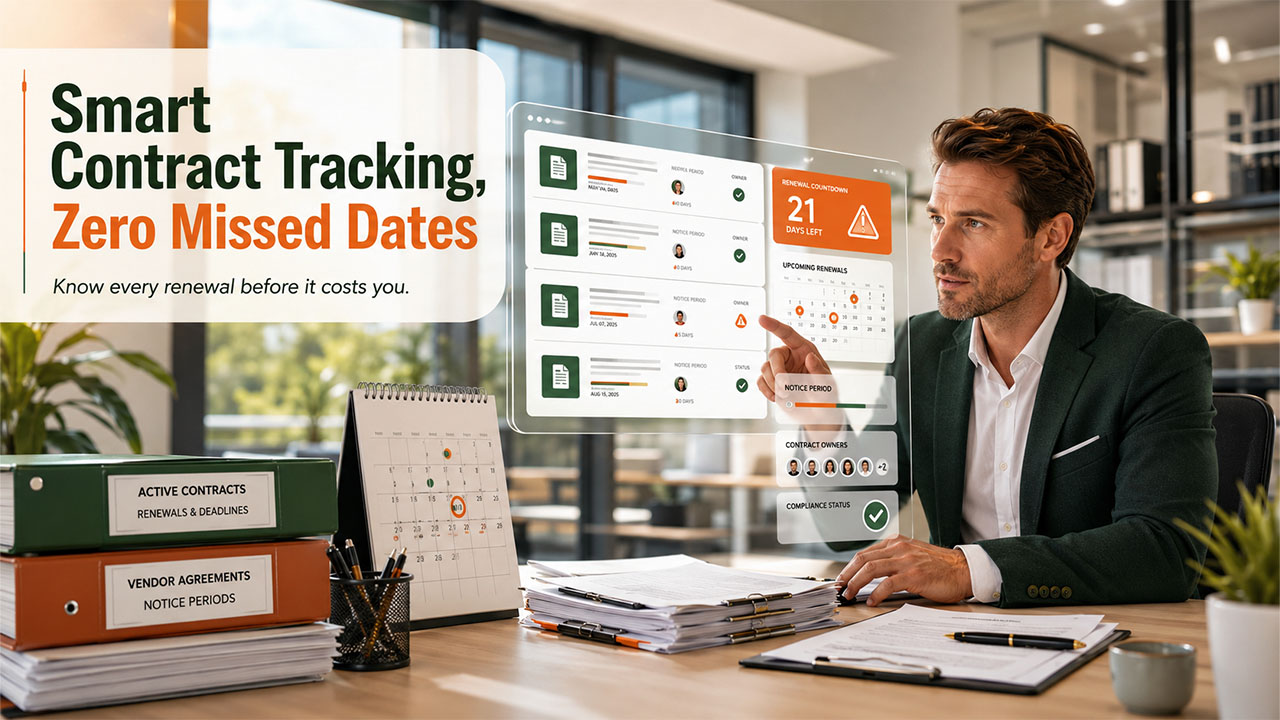
How to Track Contract Renewals and Deadlines Without Missing a Thing
Missed renewals and forgotten deadlines cost businesses real money. This guide covers how the contract tracking system works so that nothing slips through the cracks.
Most businesses across the globe do not lose revenue because they signed bad contacts but lose it because they forget about a good one. The agreement of a vendor is silently renewed automatically at the last-year’s pricing, whereas a client contract which expired without noticing, remained unnoticed, unltil the invoice was already sent. A compliance deadline that passed because the person responsible changed roles three months ago and nobody picked up the thread.
These are not rare events. They happen constantly in businesses that manage more than a handful of active agreements. The contracts themselves may be perfectly drafted, but if nobody is actively tracking what comes due and when, the value negotiated at signing quietly erodes over time.
How Contract Tracking System Works
A contract tracking software mainly works by converting contracts into structured data, along with continuously checking deadlines using rules and automatically triggering reminders. The system behaves like a rule-driven engine for contact lifecycles, instead of relying on manual intervention for reminders.
The working of contact tracking systems is explained as follows:
1. Contacts are Captured as Structured Records
The system not just add contacts as PDFs, but also extracts key metadata as structured fields, such as contract name, counterparty, start date, end date, renewal type, and notice period, among others.
2. Key Dates are Normalized
The system builds a timeline for each contract. This timeline allows the system to calculate which contract needs attention.
3. A Scheduler Evaluates Contracts
The system runs a background process at regular intervals, which performs key checks like:
- Which contracts are expiring in 90 days?
- Which contracts are inside the cancellation window?
- Which contracts have already expired?
4. Rules Determine Next Action
The system applies predefined logic rules. These rules ensure consistent decision-making across all contracts.
5. Alerts and Notifications are Automatically Triggered
If any rule condition is met, the system automatically generates notifications. This includes email alerts, Slack or Teams messages, in-app notifications, and project tools.
6. Ownership Accountability
Each contact has an assigned owner. If ownership changes, the system updates all future tracking automatically.
7. Dashboard Offers Real-Time Visibility
The dashboard of the contract tracking system shows key details, like:
- Contracts expiring soon
- Contracts needing immediate action
- Auto-renewals at risk
- Overdue compliance tasks
Why Companies Lose Contracts After Signing?
There are two main reasons for contacts getting lost after signing up, which are: they either get stored in places nobody checks, or the people responsible for tracking them change over time.
Contracts Are Stored in the Wrong Place
In the majority of small and mid-size businesses, signed contracts exist in email attachments, shared drives, desk drawers, or a mix of all three. There is no one place where someone can see every active agreement, when do they expire, and the kind of obligations it carries. This often starts upstream, when the original proposal was sent through email with no system to carry that information forward. That’s why professional service firms increasingly look at Karbon alternatives to keep the proposal-to-contract handoff connected from the start. When a renewal date comes close, the only alert system you end up with is someone’s memory.
Ownership Gets Changed and No One Else Picks Up the Thread
The person who approved and signed the vendor contract two years ago may no longer be with the company anymore. The account manager who monitored client renewals may have switched to a different team. When there is a change in ownership and there is no longer a system in place to transfer monitoring responsibilities, no one is watching the deadlines anymore.
How to Create a Contract Tracking System That Is Successful?
Related walkthrough
Create Automatic Backups and Restore in just one-click using SuiteCRM Backup-Restore Extension

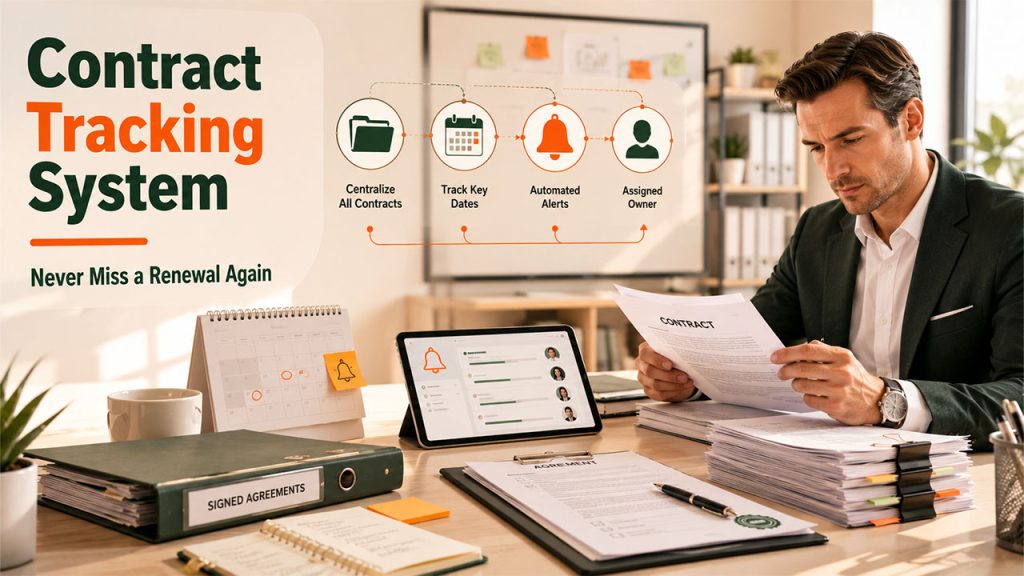
An effective system of tracking encompasses four main things: a central hub where all contracts exist, an organized way to collect important dates, automated alerts that get triggered before deadlines come up, and a clear owner for each agreement. For an in-depth walkthrough of best practices of contract tracking, including sophisticated tooling options and compliance workflows, HyperStart has published a complete guide that is worth bookmarking.
Centralize Each Contract in One Place
The first step is collecting each active agreement into a single and searchable location. This does not mean that you have to purchase over-the-budget software on the first day itself. A folder that is well-organized with a consistent naming convention is a crucial enhancement over disorganized files scattered everywhere. The objective is that anyone on the team can find the contract within the first minute.
As the business evolves, a dedicated repository of contract with metadata, tagging, and search becomes important. However, the overall centralization habit is more significant than the tool you utilize to achieve that.
Capture Important Dates for Each Agreement
Every contract contains important dates: the expiration date, the effective date, the auto-renewal trigger date, reporting deadlines, payment milestones, and notice periods. They must be captured in an organized format when the contract is signed, not extracted from the six months-old documents when someone realizes that a deadline is approaching.
A spreadsheet that looks simple with columns for start data, contract name, counterparty, end date, auto-renewal date, notice period, and owner will cover most requirements. The significant thing is that these dates are consistently recorded and kept updated.
Configure Alerts That Get Triggered Before Deadlines Arrive
Having the knowledge that a contract will expire on 30th September is only meaningful as long as the concerned party is reminded in July, not on 1st October. Alerts must be triggered at configurable lead times, generally 90 days for high-value contracts and 30 days for standard ones, providing the responsible person with enough time to renegotiate, review, or terminate before the deadline has passed.
Calendar reminders work for a few contracts. Once you are handling dozens of contracts, you require automated alerts associated with the tracking system so that reminders are routed to the right person irrespective of who originally set them up.
For Every Contract, Assign a Clear Owner
Every contract must have one named person who is responsible for monitoring its obligations and important dates. Not a team. Not a department. The assignee must have a name attached to that agreement and receive the alerts when deadlines come close.
When that person changes roles or leaves the company, ownership must be transferred formally. This is quite obvious. However, most missed deadlines go back to the contracts that had no clear owner or whose owner changed without updating the tracking system.
How Renewal Alerts Work
Renewal Alerts Systems is part of the contract tracking system, which automatically notifies the right people before a contract deadline is reached. The system uses rules, time-based checks, and notifications to trigger renewal alerts instead of manually remembering dates.
The Renewal Alert System features three crucial aspects, which are trigger conditions, scheduling logic, and recurrence jobs. These are a type of engine mechanics which describes “when alerts happen”, “why they happen”, and “how often the system checks for them”.
- Trigger Conditions: The trigger condition defines the exact rule that helps the system decide whether an alert should be generated or not. They are based on contact data like dates, status, and ownership.
- Scheduling Logic: The scheduling logic defines when the system needs to evaluate contracts and how it should prioritize each contract. It optimizes the performance of the system and ensures important contracts are checked frequently.
- Recurrence Jobs: It is an automated background processes, which run repeatedly on a schedule to execute logic of the system. This makes the system continuous, instead of just one-time execution.
The Costly Mistakes You Need to Keep an Eye On
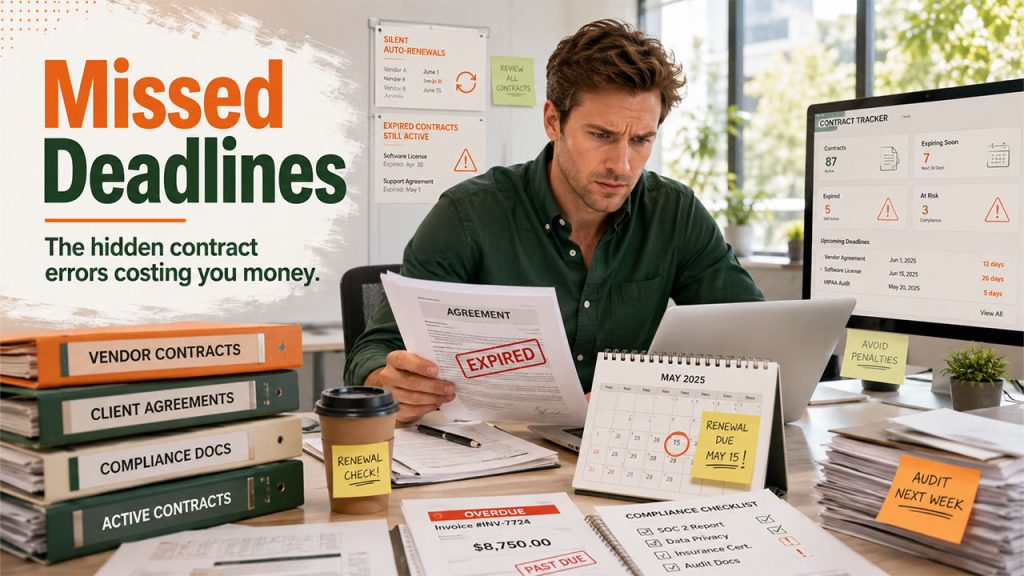
Three main types of missed deadlines cost businesses dearly: expired agreements that remain active, silent autorenewals, and expired agreements that remain active, and compliance deadlines that cause penalties. These deadlines incur heavy losses for businesses.
Silent Autorenewals
The majority of vendor contracts involve auto-renewal clauses that go beyond the agreement for another if the business does not send a cancellation notice within a particular time window. If nobody monitors that window, the contract automatically renews whatever terms that were negotiated prior, even if pricing has modified; the service is not needed anymore, or the business could get much better terms somewhere else.
Expired Contracts That Remain Active
When a client contract gets expired and nobody notices anything, the business may deliver services continuously without a valid agreement in place. This implies that there are no enforceable payment terms, no legal recourse, and no liability protections if something goes astray. The work continues as usual, but the security disappears.
Compliance Deadlines That Cause Penalties
A few contracts carry out a few obligations in terms of reporting, audit requirements, or regulatory compliance deadlines. Missing these can trigger financial penalties, termination of contract, or reputational damage. For businesses that exist in regulated industries, compliance tracking is not an optional step.
Read More: How Businesses Automate EHS Regulatory Compliance
Conclusion: Start in a Simple Way and Scale
To track contracts efficiently, businesses do not require costly software, but a unified folder, organized spreadsheets with important dates, calendar alerts, and a named owner per contract. In contract tracking, discipline is more important than tools.
As the contract volumes scale up, the manual approach will break apart. This is when dedicated monitoring platforms and automated workflows become worth the investment. However, foundation remains the same: centralized place for each contract, organized dates, proactive alerts, and clear ownership.
The businesses that effectively monitor their contracts do not just avoid missed deadlines. Renegotiation happens from a position of strength because they predict a renewal months in advance. They remain compliant since obligations are tracked and not forgotten. And they secure the value that they agreed upon during signing because no one lets it slip away quietly.